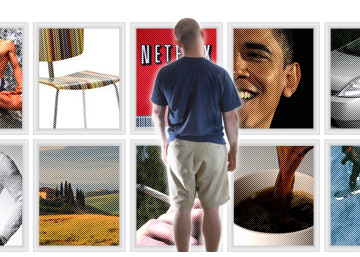

The author of "Stuff White People Like" skewers the sacred cows of lefty Caucasian culture, from the Prius to David Sedaris.

To listen to a podcast of the interview with Christian Lander, click here.
To subscribe: Click here to add Conversations to iTunes or cut and paste the URL into your podcasting software:

Stuff White People Like is a satirical blog about a particular segment of Caucasian culture. It’s like an extended “you might be a redneck if” joke recast for a more upscale set. It gently mocks the habits and pretensions of urbane, educated, left-leaning whites, skewering their passion for Barack Obama and public transportation (as long as it’s not a bus), their idle threats to move to Canada, and joy in playing children’s games as adults. Kickball, anyone? (A list of the white stuff is here.)
It’s likely I don’t have to tell you about the Stuff White People Like site, because the odds are someone — someone white — has already forwarded it to you. Christian Lander, 29, who grew up in Toronto and now lives in Culver City, Calif., created the site to amuse his friends when he was working as the associate manager of corporate communications for an Internet agency last January. He doesn’t do that job anymore, because 32 million hits and a book deal later — “Stuff White People Like: The Definitive Guide to the Unique Taste of Millions” was published July 1 — Lander’s become a professional mocker of whitey and himself.
Lander is firmly in the demographic he’s ribbing. By his own definition, he screams white. A grad school dropout, he studied film and literature in a master’s program at the University of Arizona before bailing on a Ph.D. program at Indiana University. In his author’s photo, Lander illustrates a number of things he spoofs in the book: He wears a beard, chunky glasses, shorts, a performance athletic vest, New Balance shoes and an iPod, while riding a bike and carrying a reusable water bottle, a Macintosh laptop, organic vegetables and a copy of the New Yorker.
Not surprisingly, Lander’s site has been embraced by the white culture that he lampoons, complete with an appearance on public radio’s “Talk of the Nation.” The site’s success supports Lander’s theory that, as he writes in his book, self-deprecating humor is all a part of whiteness. Lander’s site has also inspired copycat sites, such as Stuff Asian People Like, as well as hate mail accusing him of racist stereotyping and critiques that he’s pretending to poke fun at white people while actually giving them new ways to feel superior.
Salon spoke with Lander by phone from his home office, where his fixed-gear bicycle hangs on the wall, near the shelves of books, proudly displayed.
What led you to launch your site Stuff White People Like?
My friend Myles Valentin and I were both at work, and we were just having an IM [instant messenger] conversation. We were talking about “The Wire.” We’re both huge fans of the TV show “The Wire.” And then my friend Myles, who is Filipino, said he didn’t trust any white people who don’t watch “The Wire.”
From there we ended up talking about what are white people doing instead of watching “The Wire”? And we threw back a few responses, like doing yoga, getting divorced, going to therapy. And I thought it was funny.
So I went to Word Press, and I just started writing, never expecting it to be popular, just expecting Myles to read it, and maybe a few more friends back home. And that was it. It wasn’t any more of a grand scheme than that.
Obviously you’re not talking about all white people. Which white people are you talking about?
I think it doesn’t take long reading the site to figure out which white people I’m talking about. It’s mostly left-wing, upper-middle-class.
In the book, you also occasionally mention “the wrong kind” of white people. Who are the wrong kind of white people?
There are a lot of the wrong kind of white people. You have, obviously, poor, right-wing white people, and rich, right-wing white people.
Yet a lot of the stuff you write that white people like, obviously many other people like, too.
When you create a site called Stuff White People Like, it’s easy for people to make an assumption that it’s actually about stuff only white people like. It’s not meant to be exclusionary but rather a focus on the things that, well, white people like.
Let’s talk about some of them. What is the significance of bottles of water?
It’s all about ranking. It’s essentially a contest. It used to be that bottled water was a status symbol. You drink Evian, or you drink Fiji, or what is the most expensive water.
But advanced-level white people, the higher-ranking white people, realized that they were creating a lot of waste, and so they switched over to the Nalgene bottle. That also reminded them of going camping. So then they could take a stance of superiority over the people who were drinking bottled water. And then, that whole story came out about Nalgenes leaching I don’t know what the exact toxin is [Bisphenol A]. So then super-advanced white people went even further and got those metal Sigg bottles, and now you have this really solid hierarchy and ranking of white people of commercial bottled water, Nalgene bottle and either the glass or metal, twist-top bottles.
What’s the significance of an eco product, like the Toyota Prius, the carbon offset or the reusable shopping bag?
That again is another way to claim superiority over regular-level, or subpar, white people. You’re saving the environment, you’re making a difference. It helps remind you and others that your lifestyle is making things better.
Why is it important to hate evil corporations, except for Apple, Ikea and Target?
That’s one of the great contradictions of white people. For the most part, all the world’s ills are based on large, evil corporations — government corruption, American expansion through the use of corporate contracts, pollution, globalization, every bad thing that’s happened. But if it happens with nice design, it’s acceptable.
What happens if you point out these exceptions?
You’re going to really annoy white people. They do not need to be reminded. It’s like with the Prius. It’s not a good idea to remind Prius owners that the car still burns gasoline. That really pisses them off.
You are a graduate school dropout. What is the significance of graduate school?
Graduate school — it’s very important, because you sort of get this impression in the rest of the world that getting advanced degrees helps you get a higher-paying job. But interestingly, within white culture it actually gets you lower-paying jobs.
Why is that?
A Ph.D. in English isn’t going to get you a higher-paying job than, say, a Ph.D. in chemistry or law, but it does give you one important thing, which is academic credibility at cocktail parties.
But obviously, there are a lot of white lawyers.
Oh, yeah. Some of the white people, who are not quite advanced enough white people, have sold out.
What does going to law school represent?
It’s what you do when you finish with your liberal arts degree, and you start to panic about realizing that the careers available for someone who knows a lot about Proust are very limited, and you realize that you still want money. So you end up going to law school. There are people who enjoy law school, because then you can work for a nonprofit organization, and you can be very helpful.
Why is working for a nonprofit important?
White people have the constant and unabiding need to feel as though they’re helping, and because this gives them the ability to hold it over other people.
Who are the whitest celebrities?
Alec Baldwin, Susan Sarandon, Leonardo DiCaprio, Rosie O’Donnell.
Is the whitest TV show “The Wire?”
It’s not the whitest TV show. It’s just a TV show beloved by white people, because it was really well done, and it got low ratings. These are two very important characteristics for white people to like a TV show. In order to be known as an ultimate white TV show, you have to make sure that you don’t last more than five seasons.
But isn’t it kind of a contradiction, because isn’t bragging about not having a TV also a sign of status?
Yes, because do you know how white people consume “The Wire”? Netflix subscription watched on their MacBook.
What do you think is the whitest TV show ever?
“Twin Peaks” is a contender. “Mr. Show” is definitely on that list. “The Simpsons” is on there, although in recent years it’s also declined a little bit.
A very important concept when you’re dealing with white people is this idea of “jumping the shark.” And “The Simpsons” is one of the best examples of that. You have to make sure that when you talk about “The Simpsons” you know exactly the appropriate moment to say when you stopped liking it.
If you say you stopped liking it too early, you look too snobby. If you say you stopped liking it too late, you kind of look like an idiot. So, the best answer is you say the “Who Shot Mr. Burns?” episodes.
What’s the whitest movie ever?
This one is a challenge. “The Royal Tenenbaums” is up there. “Garden State.” “Donnie Darko” is on there. “Fight Club.”
The problem is that whatever is liked by white people, advanced-level white people have to hate it, because it was popular. The advanced levels have to have some sort of French film in there from Godard. Some people need a Japanese film that hasn’t been translated yet. You’ll get some white people who are like, “I only watch silent film.” It’s difficult.
What about the whitest band?
Right now? I have to say Vampire Weekend all the way. They’re pushing it to levels unseen.
Let’s talk about food.
Food is another important area of competition, and being able to show up other white people. Some white people get their status based on how much they know about food, like expensive ingredients or foreign cuisine. Whereas other white people gain their status based on how many things they’ve cut out of what they eat, like gluten and sugar and refined things and dairy and meat, trying to reduce as much as possible.
But universally, throughout, shopping at Whole Foods is considered the best way to go.
But what about farmers’ markets?
Unless you’re in California, where you have year-round farmers’ markets, you need consistency throughout the year, and Whole Foods provides that.
Definitely organic, when you’re talking about fruits and vegetables?
This isn’t even a question.
What meals are important?
Breakfast on the weekend, I guess you’d call it brunch, too, is one of the most important white meals, because it allows white couples to get together. Some people even bring their dogs, if they have outdoor patios. During the week for working white people, the expensive sandwich lunch is essential.
What do you mean by the expensive sandwich?
Anywhere you will find a predominance of white businesses, such as advertising agencies, nonprofit organizations, hedge funds, there will undoubtedly be a store nearby that sells sandwiches that cost between $8 and $12.
You’ve already mentioned eating outside. Can you talk a little bit about the importance of the outdoors?
It’s just where white people want to be. From the time white people are raised, they’re taught that being indoors is a bad thing, and that it’s always better to be outside. So they’re always on this constant quest to be camping or bicycling or eating outside, whatever it takes to get outside. The more time you spend outside the more credibility you have to dump on other people for not going outside.
And even if you’re not outside, you might be wearing what you call outdoor performance clothes. Why is that?
White people need to know that if someone calls them up, and says: “You want to go camping?” they’re ready at the drop of a hat. Bam, out they go. You could be in the Ikea, just leave the cart in one of the aisles, head up to some campsite.
Can you talk about the deep love of David Sedaris?
It’s hard to talk about it. It’s like talking about a love of oxygen. It’s just there.
Why David Sedaris?
They love him, because he’s funny, and he lives in France, and he’s gay. He’s like everything you could possibly want in the ideal friend. Oh, he also writes for the New Yorker. He hits so many things on the list it’s unbelievable.
On the site, I’ve been getting all these e-mails from people who have gone to his signings, and they said that it’s just like this sea of white people and huge lineups usually reserved for rock stars.
You have this quiz in your book to calculate how white you are. So, how white are you?
It’s tough for me to say this, because there is the answer based on my quiz, and then the fact that I wrote the book gives me like a bonus score. So, I’m going to say 91 percent.
So, are you like the ultimate, advanced, elite white person, because you are categorizing all the rest of them?
I think, but I know that people are gunning for me, and I don’t think that it’s going to last much longer.
Do you see yourself as critiquing this white culture, or are you kind of celebrating it?
I think I’m critiquing it, as well. I make fun of myself a lot on the site. That’s why I put my photo on there to let people know that I’m making fun of myself. It’s been a great chance for me to call out so many of my pretentious leanings.
There is such a strong belief among this type of people that you’re right, of being unwilling to listen to anything else, and I think that’s one of the things I’m trying to point out. There is a critique in there, but the top priority is to be funny.
But don’t you say that even self-deprecating humor is a marker of the white culture?
Yeah. I was trying so hard to sound smart there, and you totally called me out on it.
White people figured out an awesome way to use self-deprecating humor to compliment themselves. Like, when you talk about being “broke,” what you’re really saying is that the people with money are sellouts.
Haven’t you gotten a lot of hate mail about the site?
Yeah. I used to read all the comments on the site, when it was getting like 30,000 hits a day, and I was getting comments every couple of minutes. I was reading them all, because it was fascinating to me, and there are so many funny people out there. But as it got bigger, people left a lot of mean comments about me, about the site, so I stopped reading them entirely, because I was trying to write the book, and I just wanted to stay positive. Reading the comments broke my spirit. I’d just feel so down. But I still read every e-mail that comes in.
Are the angry commenters mad about the idea of the site, or do they feel like you’re making fun of them?
A lot of them just hate me for the fact that the site got popular. A lot of people just hate it because they think I’m being racist, but they don’t really think it through. The people who write in think that I’m perpetuating hate, and that all stereotypes are evil, and I think that they’re kind of missing the point.
The white people who like your site — are you just giving them another way to feel self-congratulatory?
Possibly. That might be part of it. It’s a funny concept that is open-ended. A lot of people can add their things that I’m missing.
To some extent I’m sure there is some self-congratulation in there, and that’s fine. I’m not a performance artist here. I’m really trying to make people laugh more than anything. If it leads to questioning, that’s great, but I think a lot of people are quite proud with how white they are, which is certainly an unintended consequence.
CPAC welcomes white nationalists
Three noted white supremacy enthusiasts to host anti-diversity panel at conservative conference
Sen. Marco Rubio addresses the annual Conservative Political Action Conference in Washington, Feb. 9, 2012. (Credit: Jonathan Ernst / Reuters)
CPAC is here, so it’s time for everyone’s annual look at the psychos invited to the premier conservative event of the year, and those unfortunate enough to have been excluded.
GOProud, the gay Republican group that was founded because the Log Cabin Republicans were considered too concerned about gay civil rights and not sufficiently focused on “fiscal issues,” is not invited this year, because they are too “aggressive” about being gay, which made Jim DeMint uncomfortable.
CPAC also uninvited the John Birch Society, which had made a triumphant return to mainstream conservative acceptance in 2010, when they co-sponsored the conference.
But! While the Birchers and the open homosexualists are no longer welcome, there is still room for multiple outspoken white nationalists!
The National Review’s John Derbyshire, a stock “pervert Tory” character from a Martin Amis novel sprung to life and given a sinecure at the National Review, is hosting a panel on “multiculturalism” (boo hiss) featuring two of America’s most detestable sacks of shit: Peter Brimelow, founder of white supremacist site VDARE, and Robert Vandervoort, the director of some sort of “don’t make me press one for English” nativist group and a white nationalist from way back.
CPAC organizers are like, we didn’t specifically organize this panel ourselves so whatever, but they are not canceling the panel, because the conservative movement has always quietly set a place at the table for their white supremacist allies when they get together for Thanksgiving. And after everyone says grace (and sings “God Bless America” and the national anthem and does the Pledge of Allegiance) comes the ceremonial declaration that liberals are the real racists, for inventing welfare.
The Derbyshire, Brimelow, and Vandervoort (these names!) panel is called “The Failure of Multiculturalism: How the Pursuit of Diversity Is Weakening the American Identity,” and the fact that these panelists are all well-compensated members in good standing of the conservative movement instead of shrieking their “defense of Western Civilization” nonsense for free from a bench outside a subway station does suggest that something has gone wrong with the American experiment. (I think we let too many racist British people enter the country and steal our right-wing think tank and magazine contributor jobs, personally.)
I am guessing the panel will feature at least one “why is there no white history month” joke.
CPAC’s biggest draw today was the speech by Marco Rubio, who many expect to be Mitt Romney’s eventual running mate, because Republicans think he’ll appeal to the voters they accuse of poisoning American identity with their insufficiently Western European heritages.
Charles Murray does it again
Big government has created a new lower class of lazy, shifty, low-IQ folks, argues Charles Murray
People wait in line at the 2011 Maximum Connections Job and Career Fair Thursday, Sept. 15, 2011, in Portland, Ore. (Credit: AP/Rick Bowmer)
Hey, white people – they’re talking about you again!
I argued a few weeks ago that Newt Gingrich and Rick Santorum might be able to believe they’re not singling out black people, or “blah” people, when they rail against food stamps and government “dependency” on the campaign trail. Yes, Republicans have long used not just dog whistles but foghorns to tell white working- and middle-class voters that welfare programs only support lazy, undeserving African-Americans. Ronald Reagan gave us those iconic Cadillac-driving “welfare queens” and “young bucks” using food stamps to buy T-bone steaks. Gingrich is certainly playing on that long history with his remarks. (It’s funny how our first “food stamp president” also happens to be black.)
But increasingly the right wing argues that government programs have created a dangerously expanding lower class that includes white people, too. This new white lower class, like the black lower class before it (in the telling of conservatives), is struggling not because of the decline in median wages, the rise of unemployment or the disappearance of middle-class jobs, but because it prefers casual coupling over marriage, and government-subsidized slacking over work.
A little over a year ago, the conservatives behind “When Marriage Disappears: The Retreat From Marriage in Middle America” tied the decline of the American middle and working class to the drop in marriage and the rise in the number of children living in single-parent homes – trends that are most stark, over the last few decades, among white people. Now comes Charles Murray to make the issue of race even more pronounced. In “Coming Apart: The State of White America, 1960-2010,” Murray identifies a new “white lower class” consisting of men who choose not to work hard, women who choose not to marry, and children who are deprived of the values-generating support of the two-parent family, and are thus doomed to repeat the cycle all over again.
Murray, of course, has said all of these things about black people before. In his 1984 tome “Losing Ground,” he provided the intellectual justification for Reagan’s bromide, “We fought a war on poverty, and poverty won.” The book argued that the explosion of welfare programs didn’t help their intended targets, especially poor African-Americans; in fact it hurt them, encouraging men to forgo supporting their children by substituting government in the role of provider. In “The Bell Curve,” Murray went on to argue that racial and class divisions in society were largely due to genetic intelligence differences that caused whites and Asians to excel and consigned blacks and Latinos to lower status, and there was nothing government could do to fight that natural order. In fact, government made the problems worse, as Murray believed he’d “proven” in “Losing Ground.”
In “Coming Apart,” Murray seems to have learned a little bit from the racial controversies that greeted his earlier work. Now he sets out to show how similar forces are at work among white people. But his premise and arguments in this book are no less skewed or more persuasive.
….
For a book that purports to be dispassionate and data driven, Murray makes the odd decision to create two fictional towns, “Fishtown” and “Belmont,” to represent the two poles of the white lower and upper classes he’s trying to describe (you can guess where the lower class lives). He only includes statistics for people from 30 to 49, to best get at the marriage and work habits of adults who are most likely to be parents and married (or should be married) couples. It gets even weirder when he includes interviews from a genuine case study of the real-life “Fishtown,” an actual white working-class Philadelphia neighborhood, which happens to be home to Irish Catholics, my people, who have so often been scapegoated in similar class terms. (The lower IQ of Irish Catholics once was used to defend discrimination against them, from Northern Ireland to New England.)
Murray’s odd foray into fiction doesn’t invalidate the actual statistics he assembles on white lower- and upper-class family life, but it makes his conclusions seem less data-driven and objective than anecdotal and subjective.
And that’s because they are.
But let me take a moment to note what I found interesting in the book: Murray’s description of a new white super-elite, whose wealth and education get more concentrated with every generation, as does its isolation from the rest of us. Unfortunately his portrait of this new uber-class draws heavily from David Brooks’ “Bobos in Paradise” for color, making many of its observations about the NPR-supporting, New York Times-reading, helicopter-parenting residents of “latte towns” seem tired. But the data Murray marshals are fascinating, showing the ways the uber-rich have walled themselves off geographically (as well as culturally and economically) in real-live “SuperZips” much like the fictional Belmont: ZIP codes where everyone is wealthy for miles around. Devoted to the ferocious accumulation of more, the new uber-rich are building ever-wider moats and higher walls.
Murray also takes time to show how admission to the most elite universities — Ivy League schools plus the highly selective “Public Ivies” — has become vastly more exclusive than even a generation ago, in terms of student test scores and family income. Roughly 80 percent of the students admitted to these top-tier schools come from the top quartile of American families in terms of income; only 2 percent come from the bottom quartile. Then, because young people tend to find their mates in these hothouses of privilege, that wealth concentrates, as they marry and breed and pass their advantages on to a next generation, which repeats the process. One way that wealth used to redistribute itself – by a high-income, well-educated man marrying someone from another class, maybe a girl he met in high school back when even most privileged folks went to public schools and almost no one lived in exclusive SuperZips – just doesn’t happen much anymore. Elite education facilitates wealth, wealth facilitates elite education, and the rich get richer, like the old song says, in ever more staggering ways.
But the other thing going on at the very top of white America, Murray argues, is that elites are far more likely to get married and to stay married than other people – particularly the new white lower class. Some 90 percent of kids in the SuperZips live with both parents. And where the authors of “When Marriage Disappears” talked mainly about a “marriage gap” — they noted a decline in “bourgeois values” among the unmarried lower class, but didn’t dwell on it — Murray’s book is intended to highlight a values gap. He identifies what he calls the “founding virtues” of America – industriousness, religious practice, honesty and marriage – and finds the new white lower class lacking in all four. Meanwhile, at the very top of society, he says, adherence to those virtues persists, and it’s working very well. Divorce and single parenthood did rise among the rich for a while in the ’60s and ’70s, but then it leveled off.
In Murray’s telling, the ’60s seem like a hoax designed to trick the poor into hedonism while the wealthy stayed abstemious. It’s as if Puritans dressed up and played swingers for a while, then took off the costumes and went back to work. In fact, Murray argues that the white upper class, particularly but not exclusively the liberals within it, has betrayed the lower class, by refusing to “preach what they practice” – that hard work and marital fidelity are the reliable time-tested path to success.
….
There are so many problems with Murray’s cause-and-effect arguments it’s hard to know where to begin. The marriage and family trends he identifies continued to worsen even after Congress and President Clinton accepted some of the questionable conclusions about the relationship between “dependency” and poverty Murray drew in “Losing Ground,” and abolished with the program he found most disastrous: Aid to Families With Dependent Children. AFDC became TANF, Temporary Aid to Needy Families, 15 years ago, forcing welfare recipients to get work and limiting the amount of time they could spend on the program, and dropping many millions of people from the rolls. Yet the rate of single parenthood among poor and working-class people continued to rise.
I also had an enormous amount of trouble with the premise that the rich are more virtuous than other people. I’m blessed to know a lot of rich people as well as a lot of working-class people (my extended family), and I’ve never noticed that, at all. I found myself wanting to introduce Charles Murray to Charles Ferguson, whose “Inside Job” chronicled not only the greed and corruption of the Wall Street hotshots who brought us the 2008 banking crash, but their depravity: the hookers, the cocaine, the conspicuous consumption of decadence. I thought Ferguson overdid it in his attempt to prove the complete and utter evil of the Wall Street elite, but it’s a welcome correction to Murray’s pale picture of upright, honest businessmen reaping the just reward of their hard work and self-discipline.
To be fair, Murray occasionally nods to bad behavior at the top. He rather comically looks at the 2008 banking crash for evidence that maybe today’s rich lack some moral fiber, too, but finds nothing he believes is reliable. He also acknowledges that the Founders didn’t always practice what they preached, when it came to either marital fidelity or religious observance. The important thing is that they tried to embrace and advance those values. And it’s true that even skeptics like Jefferson thought religion was a good thing — for other people, anyway.
Murray also pretends to consider the possibility that the decline in wages and opportunities for working-class men might be behind the drop in marriage rates within the same group. But he shows that married men work harder and earn more than unmarried men, even within the same social class, and makes the case that the absence of marriage discourages work, rather than that the absence or scarcity of work discourages marriage (or some more subtle interplay between the two). A rise in the number of working-class people declaring bankruptcy proves to Murray that they’re dishonest, not increasingly shackled to debt by a decline in wages. An increase in the number of white working-class Americans who tell pollsters that they value job security over the rewards of a job well done provides Murray with evidence that they’re lazy, rather than rightly insecure about employment in a changing economy.
Of course, Murray never mentions the fact that the country’s so-called red states have the least government and the highest levels of religious practice, yet they have the highest poverty and divorce rates in the country. Conversely, the godless liberal blue states have the lowest rates of divorce and single parenthood. He also ignores the possibility that changes in our tax code have given the wealthy ever more powerful incentives to practice the “moral” behavior that wealth rewards, while a shrinking public sector makes it feel more imperative to secede from the commons into their SuperZips and private schools. And he ignores the way wealth can also save marriages, allowing unhappily married husbands and wives to console themselves with separate vacations, homes, even separate lives.
But hypocrisy on the part of the wealthy or the Founders doesn’t bother Murray at all. The fact is, rich people can mostly be trusted to do the right thing — even if, when it comes to marriage, they sometimes try and fail and fake it, or in the case of religion and our skeptical Founders, they don’t personally practice what they preach. It’s among the lower classes that the loss of “virtue” matters most. Because the non-wealthy have to be forced to do the right thing, whether by strict religious mores or the threat of going hungry. Ideally, in Murray’s view, it’s both.
The fact that these family trends have accelerated even as the U.S. has cut back much of its welfare state would seem to undercut Murray’s argument. Unless, that is, you believe that any government support at all encourages indolence. And Murray does. The only major increase in government social spending has come in the category of Social Security and Medicare, which take care of old people after they work. But maybe those programs let the working and middle classes work less hard, since they don’t have to fully support their parents in old age.
And maybe if we all had to rely exclusively on our kids to take care of us, we’d try harder to make sure they’re thrifty, honest and industrious; that they either don’t have kids before they’re married (or if they slip, they get married ASAP). In fact, maybe we’d do away with child labor laws entirely, and have them help support the household, the way Newt Gingrich thinks they should. Maybe we’d all stay on a hamster wheel of nonstop work, until we dropped dead in our pre-assigned places.
That’s always been the formula the rich use to scapegoat and exploit the poor, of course. Shame, stigma and deprivation are every bit as crucial as honesty, industry, religious belief and marriage in creating the world Murray envisions.
….
At bottom, Murray’s old genetic fatalism undoes him in “Coming Apart.” Clearly the new lower class can’t be helped by government programs, but Murray doesn’t seem to think they can climb into the upper class by hard work and self-discipline either. Ultimately, he believes the sorting and separation of the classes is inevitable, given the cognitive intelligence differences between them. And here we’re back to IQ again.
Modern society is vastly more unequal, Murray believes, because we’ve created a new sorting mechanism – college, but particularly the elite colleges – that identifies the best and brightest and lets them find one another. Kids of the upper class marry kids of the upper class at least partly because they wouldn’t find partners who would understand them in the new lower class. But even when some benighted lower-class kids manage to climb into Harvard or Yale, they’re not going back either, Murray says. Isolated in their old world of cognitive intelligence losers, they’ve finally found a place where they can be themselves.
Thus the only real way to address the growing gap between the wealthy and the rest of us, Murray argues, is to implore the white uber-class to take more of an interest in the growing underclass. But taking more of an interest, in Murray’s view, basically involves latte-town liberals realizing the only thing that will save the lower class is more self-discipline, and therefore abandoning their traditional support for government programs that try to help them, but only make things worse. Murray takes pains to show that the four most Super of the SuperZips – New York, Washington, D.C., Los Angeles and the San Francisco Bay Area – are also the home of our liberal media and government elite, seeking to prove that the country is being governed by the people who are most isolated from the rest of America.
These liberal elites bear special blame for the problems of the new lower class, because they refuse to face the truth as Murray tells it:
There are genetic reasons, rooted in the mechanisms of human evolution, why little boys who grow up in neighborhoods without married fathers tend to reach adolescence not socialized to the norms of behavior that they will need to stay out of prison and hold jobs….[Liberals] will have to acknowledge that the traditional family plays a special, indispensable role in human flourishing and that social policy must be based on that truth.
Murray tries to correct some of his past mistakes by professing to believe that the lessening of prejudice and discrimination against African-Americans and women was a long overdue victory for justice. Meanwhile he derides “big government,” without which those goals wouldn’t have been achieved, and demands that we return to the traditional family, which makes real equality for women impossible. Murray promises that this will be his “valedictory,” his last book trying to win us over to his libertarian politics and traditionalist values. That’s probably good for everyone, since this new effort simply dresses up his old arguments in a different color, white rather than black.
But maybe one more piece of evidence that the right regards them with the same contempt that they once reserved for poor African-Americans will wake up the white working class to the way the GOP’s politics of scapegoating minorities in fact helped one tiny minority: the top 1 percent.
GOP race-baiting masks class warfare
By demonizing some, the Republicans seek to discredit the safety net for the 99 percent
Occupy DC protesters hold signs during a march (Credit: Jonathan Ernst / Reuters)
It’s commonplace to note that Newt Gingrich’s dog-whistle appellation that Barack Obama is the “food stamp president” is both racist and politically cynical. But the stereotyping of black government dependency also serves the strategic end of discrediting the entire social safety net, which most Americans of all races depend on. Black people are subtly demonized, but whites and blacks alike will suffer.
Gingrich persists because it’s a dependable applause line, and because his political fortunes keep rising. Compare that to September, when Mitt Romney attacked then-candidate Rick Perry for calling Social Security a “Ponzi scheme.” Perry backtracked, insisting that he only wanted to bolster the program and ensure its solvency. But in his 2010 book “Fed Up,” Perry made his opposition to Social Security clear, calling it “a crumbling monument to the failure of the New Deal.” Scrapping entitlements is a core tenet of contemporary fiscal conservatism, but most of the time politicians only get away with attacking the most vulnerable ones: Medicaid, food stamps and welfare cash assistance, which are means-tested and thus associated with the black (read: undeserving) poor, although whites make up a far greater share of food stamp recipients. Government welfare programs with Teflon political defenses — Medicare and Social Security — are nearly universal entitlements and thus associated with “regular” (read: white) Americans.
“Ending welfare as we know it,” as Bill Clinton and congressional Republicans did in 1996, is one thing. “Ending Medicare,” Republicans were last year reminded, is something else altogether. “Keep your government hands off my Medicare,” declared a 2009 Tea Party town hall attendee who today might very well be an ardent supporter of Gingrich’s assault on food stamps. It is a political lesson that free-market fundamentalists have to relearn with some frequency. It was only 2005, after all, when President George W. Bush launched his ill-fated proposal to privatize Social Security — a setback he later called his greatest failure.
Yet as more government programs of any sort are framed as pernicious, laissez-faire ideologues are again emboldened to get rid of everything.
As recently as November 2009, the New York Times reported that stigma around food stamps had faded; the program received strong bipartisan support as millions of newly impoverished Americans reached out for food assistance. But temporarily cautious politicians had only stashed the old playbook on the top shelf, and the revival of welfare queen demagoguery made for quick political results. Nationwide, state legislatures are moving to impose drug testing of welfare, and even unemployment insurance, recipients.
“If you go apply for a job today, you are generally going to be drug-tested,” Florida Gov. Rick Scott said in October 2010. “The people that are working are paying the taxes for people on welfare. Shouldn’t the welfare people be held to the same standard?”
And and then came the push for cuts. Few noticed in April 2011 when House Budget Committee Chairman Paul Ryan, R-Wis., proposed cutting $127 billion from the food stamp program. The same went for the proposed dismantling of Medicaid, the healthcare entitlement for the nation’s poorest, which would be transformed into a block grant to the states with no coverage requirements. Everyone was focused on Ryan’s audacious proposal to privatize Medicare, and conservative pundits were eager to sink the popular entitlement under the banner of pragmatic fiscal seriousness. “The Ryan budget,” David Brooks wrote at the time, “will put all future arguments in the proper context: The current welfare state is simply unsustainable and anybody who is serious, on left or right, has to have a new vision of the social contract.”
Republicans quickly backtracked. But the effort to dismantle the “poor black people” entitlements continues unabated. In Pennsylvania, Gov. Tom Corbett this month announced that people under 60 with more than $2,000 in savings or other assets — cars and homes generally excluded, savings very much included — will be barred from receiving food stamps. The move elicited widespread criticism from anti-hunger advocates but little concerted political resistance. Corbett’s administration also cut 88,000 Pennsylvania children from Medicaid.
But politicians have more trouble getting away with criticism of less stigmatized benefits. Corbett suggested on the campaign trail that “The jobs are there. But if we keep extending unemployment, people are just going to sit there.” Democrats pounced and he rushed to issue a clarification, though a conservative think tank eagerly backed up his original position.
Unemployment benefits, however, are on the political cusp: Once somewhat invincible like Social Security and Medicare, some states have made cuts amid the campaign of stigmatization. In South Carolina, state-funded jobless benefits were reduced from 26 to 20 weeks. Republican state Sen. Kevin Bryant blogged, “I’m disappointed that we have a significant segment of our society leeching [off] the system.” Arkansas, Missouri, Michigan and Florida have also reduced benefits. Yet it was just two months ago that Republicans suffered their greatest embarrassment of 2011 after nearly blocking the extension of unemployment benefits.
Welfare was “reformed” in 1996 because politicians, and many white Americans, were convinced the program’s beneficiaries weren’t meritorious. Indeed, the entire history of the American safety net is one of programs losing popularity as they are associated with poor black people. Initially blacks were largely excluded from New Deal welfare. It was when the War on Poverty broke down racial barriers that white public opinion turned against it. “Increasingly associated with Black mothers already stereotyped as lazy, irresponsible, and overly fertile,” writes Northwestern School of Law’s Dorothy Roberts, “it became increasingly burdened with behavior modification, work requirements, and reduced effective benefit levels.”
The same was true for public housing, which once received broad-based support. But in the 1950s, whites moved to segregated suburbs and blacks were left behind, and the projects became unpopular and underfunded. Housing benefits for upper-income Americans, like the mortgage interest rate deduction, are not, to be sure, subject to such negative stereotypes, and neither are the billions in federal and state dollars that have been spent on highways and federally subsidized mortgages for disproportionately white homeowners.
Or take public schools. If all of our children, black and white, rich and poor, were in one big system, that system would get ample support. But since many poorer students of color are segregated into separate, unequal and low-performing districts, policy solutions like charters and an obsession over standardized testing that would never pass muster in a wealthy district are advocated as pragmatic solutions.
Count yourself lucky that rich people still (for the meantime) breathe the same air as everyone else.
Rick Santorum has declared, “I don’t want to make black people’s lives better by giving them somebody else’s money.” (He now says that he said “blah” people.) On Social Security, Santorum is making what appears to be a safe argument for reform: cutting rich people out of the program. Right now, Social Security belongs to everyone. Cutting rich people out is the first step to making it a program for the poor. Making something a program for the poor — see food stamps, Medicaid and welfare — is the first step toward eliminating it. While crazy Newt Gingrich talks about black people and food stamps, Mitt Romney (whom Brooks, of course, calls “serious”) resurrects a big idea: privatize Medicare. That, of course, is why conservatives so fear single-payer universal healthcare: They know that once we got it, we would never let them take it away.
If some whites reap some cold comfort from Gingrich’s performance, the racial hostility on display comes at a much higher cost to the American people as a whole. We have long since traded the possibility of a decent society for fear and resentment. So watch out for the next attack on “the food stamp president.” The entitlement they end might be your own.
Our selective stance on bigotry
Some of Paul's stances are odious. But our racist drug war and Islamophobic invasions are equally offensive
Rep. Ron Paul, R-Texas, speaks during a campaign stop Wednesday in West Columbia, S.C. (AP Photo/David Goldman) (Credit: AP)
If they have any value at all anymore, presidential election campaigns at least remain larger-than-life mirrors reflecting back painful truths about our society. As evidence, ponder the two-sided debate over Republican candidate Ron Paul and bigotry.
One camp cites Paul’s hate-filled newsletters and his libertarian opposition to civil rights regulations as evidence that he aligns with racists. As the esteemed scholar Tim Wise puts it: This part of Paul’s record proves that he represents “the reactionary, white supremacist, Social Darwinists of this culture, who believe … the police who dragged sit-in protesters off soda fountain stools for trespassing on a white man’s property were justified in doing so, and that the freedom of department store owners to refuse to let black people try on clothes in their dressing rooms was more sacrosanct than the right of black people to be treated like human beings.”
The other camp tends to acknowledge those ugly truths about Paul, but then points out that the Texas congressman has been one of the only politicians 1) fighting surveillance, indefinite detention and due-process-free assassination policies almost exclusively aimed at minorities; 2) opposing wars that often seem motivated by rank Islamophobia; and 3) railing against the bigotry of a drug war that disproportionately targets people of color. Summarizing this part of Paul’s record, the Atlantic Monthly’s Conor Friedersdorf has written: “When it comes to America’s most racist or racially fraught policies” affecting the world today, “Paul is arguably on the right side of all of them (while) his opponents are often on the wrong side.”
So which side is right? Both of them, and thanks to that powerful oxymoron, Paul has become a mirror reflecting back our own problematic biases. Specifically, his candidacy is showing that the conventional definition of intolerable bigotry is disturbingly narrow — and embarrassingly selective.
This reality is best demonstrated by those voters who say they detest Paul not because of his extreme economic ideas, but because they feel his record represents an unacceptable form of racism. These folks will likely tell you that their alleged commitment to policies promoting racial equality has moved them to support Mitt Romney or Barack Obama, politicians who, of course, support bigoted civil liberties atrocities, Islamophobic foreign invasions and a racist drug war.
In making such a choice, then, these voters are tacitly embracing the definition of unacceptable bigotry as only hate speech (Paul’s newsletters) and opposition to civil rights laws (Paul’s odious position), but not also various forms of institutional bigotry that their favored candidates support and that Paul has fought to end. Incredibly, this selective definition asks us to ignore many of the most destructive tenets of what legal scholar Michelle Alexander’s celebrated book calls “The New Jim Crow.” And yet, as the reaction to Paul proves, it is precisely this definition that pervades so much of American society.
To be clear: Noting this hypocrisy is not meant to urge a vote for Paul (I’m not a Paul supporter), nor does it absolve those Paul fans who wholly ignore the objectionable parts of their candidate’s record on race. Instead, it is simply meant to argue that if we’re going to have a long overdue discussion about bigotry, then let’s have an honest conversation about all forms of bigotry — not our current talking-points-driven screamfest that rightly criticizes one kind of prejudice but wrongly tolerates other forms of prejudice that are often just as destructive.
Perpetuating that kind of naked bait-and-switchery may help one set of candidates and hurt another in a given presidential campaign, but it does nothing to advance the cause of equality in America.
TV’s eerie new race-less world
In an Obama age, shows like "Parenthood" flatter us into believing race no longer matters -- and avoid hard truth
Joy Bryant and Dax Shephard in "Parenthood"
NBC’s “Parenthood” is a trick show that people tuckered out by life are eager to believe in. I am one of these tired people. Its bustling mornings, carefully disheveled interiors, and impromptu kitchen dance-parties create the illusion of safe chaos. “Parenthood” knows that for the modern television viewer, controlled disorder is better than none, for safe chaos tricks you into believing that what you’re watching isn’t totally sanitized. Strategically placed ad-libbing, background chatter and overlapping dialogue combine to slyly convince you of its authenticity — that not only does “Parenthood” belong to an age of realism and daring and diversity, but it’s helping create it.
It reminds me very much of my eighth-grade teacher who so desperately hoped to be the mythic sage who made a difference, but failed to realize his well-meaning musings about why “black families can’t stay together these days” did little to raise our awareness of anything other than his own desire to seem good. And this is what “Parenthood” does in its broad-stroke coverage of everything that could happen in the life of a modern American family. Since we’re all terrified of being different, there is some point in airing things we might still regard with shame: infidelity, moving back with your parents, not going to college, raising an autistic child, and, finally, interracial dating. As the end product of an interracial date, I find this last theme most interesting. On the show, it’s explored in two story lines.
In one, Crosby Braverman (Dax Shephard), the youngest son in the Braverman clan, is reunited with Jasmine (Joy Bryant), an old one-night stand who surprises Crosby with his half-black 5-year-old son, Jabbar. Crosby and Jasmine rekindle their old romance but eventually split apart.
And in the second story line, teenager Haddie Braverman (Sarah Ramos) falls in love with Alex (Michael B. Jordan), a boy so beyond her in sexual energy that a more forced union could hardly be imagined by anyone who spent two seconds in high school. But in “Parenthood,” love is blind — as is a white middle-class family, who, save for one or two lines by characters denying their ability to ever be racist, makes no real reference to the black paramour’s blackness. And here is the point that many of us still have difficulty understanding: Pretending to not see race ignores the experiences of people of color and the racism they do sometimes experience. Race-blindness is a well-meaning assertion of a white worldview, one where race is never an issue.
Comedian Franchesca Ramsey’s recent parody video “Shit White Girls Say to Black Girls” is an excellent example of how segregated these realities are. Many black female friends and family members posted a link to the video on Facebook pointing to its hilarious accuracy and mentioning additional comments commonly received — for example “You’re so smart for a black girl.” Many whites, however, found the video offensive, and Ramsey even appeared on Anderson Cooper’s show, “Anderson,” in defense of it.
With its black characters’ curiously race-less existence, “Parenthood” believes it’s nurturing a helpful attitude. Instead, it supports the kind of backlash that Ramsey faced — and this is where things get tricky. How does a television show address race in a real way without alienating those who need to hear the discussion the most? (The people enraged by Ramsey’s video, for example.) Those who point out the continuing existence of inequalities, especially about race, will be attacked. In the age of Obama, where few whites witness blatant discrimination, accusations of racism feel like a betrayal. We’re all supposed to be on the same team now, and a prime-time show, naturally, would rather play it safe and flatter viewers rather than risk ostracizing them. Especially this show, built entirely around stroking its audience to sleep.
The best recent example of a show that handled race well is the first season of Louis C.K.’s “Louie.” It directly addressed white entitlement, smartly cushioning it within self-deprecating comedy. Every serious observation on race was followed by the most absurd and unsophisticated (and funny) joke. Because Louie was the one who made the mistakes, he could tell you about white male privilege. We would listen because we didn’t feel threatened … and then he would make a joke about having sex with a fat woman. In this strategic way, “Louie” escaped preachiness.
“All I want to do with these scenes is talk about these things. Air them out,” Louis C.K. told me. “I very much doubt if the show will please enough people consistently enough to be a great success. It occurs to me that you yourself may see things in upcoming episodes that you won’t like, because I’m playing on every side of the line …
“I think that what’s on TV today has left people too divided, inebriated and expecting only to see shows that agree with them and soothe them. The vast majority will find it too hard to watch something that takes no clear position and satisfies nothing, only opens sores and stirs curiosity.”
The complexity of race in America can even be addressed in two lines from the second season of “Treme.” Harley, a white street musician in a post-Katrina New Orleans, is robbed at gunpoint by a black teenager. As the teen flees, Harley says, “You’re making a bad choice, son.” The boy stops, turns around, replies, “I ain’t your … son” — and shoots Harley in the face. In under a minute we’re confronted with the history of white American paternalism and its many consequences.
“Parenthood’s” silence about its black characters’ blackness reflects our genuine desire for things to be different, but also our willingness to ignore the reality of the experiences of people of color in an eagerness to move ahead to post-racialism. This underlines two things: Things have changed, in that there’s a collective desire for equality. But the main problem remains: It is still a white playing field, with white main characters who want to enjoy a world without racism. They’re the ones who have decided to move on.
In a clumsy effort to avoid racist portrayals, many TV shows and films have decided to make all black characters superhumanly virtuous or placed them in positions of authority. David Estes, as director of the CIA’s counter-terrorism center and Claire Danes’ boss in “Homeland,” is one of the latest. In “Parenthood,” Alex is a high school dropout, in AA and a volunteer at a homeless shelter. He is a positive influence on Haddie’s life to the point of corniness. Meanwhile, career-minded Jasmine, nicely embodying the “strong, independent black woman” role and dancing for Alvin Ailey, no less, is cheated on by Crosby.
This virtue, they think, will distract us from the fact that all the main characters, the ones allowed to be truly human with successes and faults and a range of emotion, are still white. TV is still a white world, one where racism exists, but in small amounts that allow us all to sleep easily.
And in this day and age, even some of the gains black people have made on TV are at risk. As “30 Rock’s” black male characters Toofer, Tracy, Grizz and Dot Com pointed out in Season 4:
Toofer: You will not believe what just happened to me. A guy on the subway just called me a ”biggledeeboo.”
Grizz: What’s a ”biggledeeboo”?
Tracy: It’s an 18th-century word for dark-skinned Moor. I’ve learned the word ”black” in every language, just so I know when to be offended.
Dot Com: Well, I’m sure it was just an isolated incident.
Tracy: I’m telling you, Dot Com, old-school racism is back.
Toofer: How can racism be back when we elected a black president?
Tracy: Barry Obama is the one who brought it back!
Toofer: So you’re saying that racism is back because white people no longer feel sorry for us?
Tracy: Hey, something’s going on. You know what I saw last night? A Slomin’s Shield commercial with a black burglar!
Dot Com: That’s not good.
Grizz: Come to think of it, I saw a white judge on “Law and Order” last night.
Page 1 of 72 in Race
Female soldiers fight the brass ceiling
Catholic tribalism and the contraceptive flap
Salman Rushdie fears nothing
The two Americas clash at CPAC
Making the perfect cover girl
A birth-control compromise could divide the right
Unions in a “death spiral”? Not on my job site
The answer that’s been staring them in the face
And the Oscar goes to … “Twilight”!
Adele: Too fat for fashion designer 

