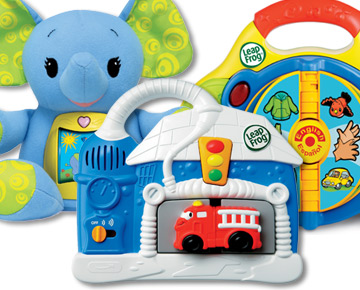

Will these LeapFrog gizmos teach your kid something, or just irritate you?
Toys for toddlers don’t just roll or bounce anymore. These newfangled, battery-powered electronic gizmos shout the letters of the alphabet, count out numbers and make animal sounds, in between blasting music and flashing lights, all in the name of good-time learning fun. But do they really teach anything?
Over the past several weeks, my 16-month-old daughter and I tested three of the many educational toys made by LeapFrog, a 13-year-old company based in the San Francisco Bay Area that uses technology to try to school even the pre-preschool set.
I wanted to see not only if she enjoyed the toys — easy to tell — and learned anything from them — much harder to ascertain — but also if the toys passed this parent’s irritation test: Is the value that this toy has for my child really worth the annoyance of its intermittent squealing, squawking, bleeping and blipping? Her reactions — and mine — were all over the map, but one toy was a big hit with both of us.
The first toy we tried, Shapes With Ella, advertised for children ages 6 months and up, is essentially a glorified stuffed animal. The soft blue elephant has a wheel implanted in her chest, which plays a few seconds of soothing music when the child spins it. Above her chest there’s a pink heart-shaped button, which illuminates the wheel when a child presses it.
Photo courtesy LeapFrog
Shapes With Ella
Spinning the wheel reveals daytime and nighttime scenes of a cartoon version of Ella. The daytime scene shows a happy Ella frolicking on some grass, with a half-eaten apple precariously balanced on the tip of her trunk, underneath a smiling sun and two flying bluebirds. Ella scores parental points for nutritious food propaganda, since she seems to be dancing in joy about this tasty red apple she’s apparently half-munched.
Spinning the wheel again shows a scene of Ella sleeping on the grass under a slumbering half-moon. Above her are some stars, linked by dotted lines, like constellations, which form a square, a circle and a triangle. That’s the “shapes” part of the toy, I gather.
The cardboard box that Ella comes in claims that she introduces children to shapes, facial features, daytime and nighttime routines. I’m not sure if any of that came across to our daughter. But she does enjoy spinning the wheel to watch the scene change and make the music play, as well as pressing the button to see the light go on and off. The music Ella plays is soft and calming, so it’s thankfully palatable to adult ears.
I wouldn’t predict that Ella is destined to be a beloved favorite in our home, but she’s also not likely to be banished to a dusty box in the garage by a parent who can’t stand the noise she makes.
The Learn and Groove First Words Radio, which goes on sale in September and is aimed at kids 12 months or older, promises to teach tots vocabulary, word categories and fine motor skills. The toy presents hard plastic pages for the child to turn; when each page is flipped, the radio makes a satisfying page-turning sound. At least, it appears to satisfy my daughter, because just turning the pages back and forth to make this sound is the primary way she plays with this toy.
Photo courtesy LeapFrog
Learn and Groove First Words Radio
On each page, there are six images, depicting things like a cat, a plate of spaghetti and meatballs, a faucet spewing water and a pair of stomping feet. Pushing the button next to an image causes a child’s voice to sing a little exclamatory ditty. For instance, pressing the button next to a pair of shoes plays, “Shoes! I love my shoes! They are red. They are new. I love my shoes! Shoes!”
To make matters more cacophonous, there’s a big button in the middle of the radio that allows the child to switch the language of the toy from English to Spanish and back again. That would be fine, if there was an easy way for an adult to ensure the toy stays on one language setting, at least temporarily. There’s not.
Our daughter prefers to push the language button over and over again, causing the toy to switch wildly from English to Spanish and back again, the radio exclaiming over and over, “English! Español! English! Español!” As you can imagine this greatly amuses her, but quickly irritates me.
When I push some of the buttons next to the images on the radio for her, she tends to repeat the words she already knows, like “cat,” “dog” and “water.” She doesn’t seem to have much reaction to words that she has not said before. My suspicion is that this is one learning toy that will wear out its welcome among the adult members of our household before the toddler gets much out of it that’s new.
Finally, we tried the Fridge Wash and Go Magnetic Vehicle Set for ages 12 months and up. Of the three toys we tested, this one was the clear favorite among both the toddler and the adults around here. The toy consists of five different vehicles — a car, a train, a fire engine, an airplane and a boat — each of which is cut in half. All 10 pieces of the vehicles are magnets. A child can then fit the pieces into a station — also a large magnet — that fits on your refrigerator door.
Photo courtesy LeapFrog
Fridge Wash and Go
If the kid puts the right pieces together in the correct sequence to form, say, a green train, the toy (in a man’s voice — rare for these types of toys) exclaims: “Green train! You made a match!” The guy then sings a song about the train, toots its horn, and gives some vehicular facts: “A train has a conductor. All aboard!”
But the great thing is that if the child puts the wrong two pieces together — say half a fire engine and half a car — the toy sings a silly little song about that too: “A fire engine car? You can wash that fire engine until it’s clean. Wash that car. Make it gleam. But I’ll tell you something that you should know. A fire engine car, it won’t go.”
These songs drive our daughter into paroxysms of spontaneous dance, and they’re catchy enough that my husband and I find ourselves singing the little ditties to her, too.
She doesn’t quite yet have the fine motor skills to fit the pieces into the station by herself, but she can with a little help. On her own, she likes to move the magnets around on the refrigerator, which is a good diversion from all the other regular magnets that live there (they’re too small for her to safely play with, and have to be kept out of reach). It’s also great to have a toy that lives in the kitchen — it can keep her attention while we adults are getting meals together — but doesn’t end up scattered around underfoot.
What exactly is she learning from these vehicle fridge magnets? OK, she’s definitely working on motor skills, both in terms of physical dexterity and things that go vroom. But is she learning that there is no such thing as a fire engine car? Maybe. In the end, with this toy, I don’t care that much about the educational claims, since she enjoys it so much, and its soundtrack doesn’t drive Mom and Dad up a wall.
Interview With My Bully: When I confronted my bully about racism
In seventh grade, Mary's "ching-a-ling" routine scarred me. But years later, she was the one who cried victim
(Credit: Salon)
Judy Blume, my mentor and friend, told me not to engage with my bully. “Forget her, she isn’t worth it,” she told me. But I had a strange curiosity over what happened to the woman — I’ll call her Mary — who had once been my tormentor. Over the years I’d developed a secret theory of bullies, that they were the ultimate softies, the ones who have to build a fearsome spiked carapace over some sad, sad hurt. It’s that kind of empathy, perhaps, that made me a novelist. And Mary certainly gave me a story to tell.
Bullying, unfortunately, was a part of the warp and weave of my childhood. I grew up in northern Minnesota in the ’70s, where my Asian family was the only color in a sea of Scandinavians. When I was in second grade, a crew-cutted boy shoved me against some metal monkey bars, cracking the back of my head open.
But the most difficult time came when I entered junior high. I was underweight, bookish, bespectacled. Gym class was a convergence of all my anxieties. The other girls were tall with pretty hair that feathered and training bras, while I had no breasts and not even an undershirt for camouflage underneath the one-piece uniforms that looked like a baby’s onesie.
Mary was the instigator. She was not particularly popular or athletic. She had that kind of genericism that I would have killed for — she was just like everybody else.
One day in the locker room, Mary leapt out in front of me and started to sing, “ching-ching-a-ling” while doing some kind of interpretive dance that involved pulling the lids of her eyes into slits. Her friend Terry (also not her real name) echoed her taunts. I had a feeling this was not the end of it — and it wasn’t.
My Asian parents valued nonconfrontation over everything. When I vaguely hinted at this assault that waited for me daily (or, at least as it seemed at the time), they suggested I stay quiet and concentrate on my schoolwork. Some people didn’t know how to deal with minorities, they said. One day, this would pass, and I would leave Hibbing behind for an Ivy League school, and everything would be all right. That might have been good advice for the long term, but in the meantime, the ching-ching-a-ling routine continued, my only solace being that it often fell flat.
And then one day, two “tough” girls brought the whole thing to an end. They spoke quietly to Mary and Terry, who then approached me, ashy-faced, and each muttered, “I’m sorry, I won’t ever do it again.”
Now in my 40s, enter the brave new world of Facebook. Like many, I receive requests from classmates I barely knew — including this: Mary the Bully wants to be friends! I deleted the request and didn’t think about it. But after a few months, another request would appear. Then another.
It occurred to me that maybe Mary had read one of my novels, including one, in which a Korean American girl growing up in Minnesota — surprise, surprise — suffers through a “ching-ching-a-ling” song (and in the novel, at least, the protagonist manages to fight back). There was a mention of my novel in People, and classmates were definitely reading it. But while people like my piano teacher wrote tearful letters (“I had no idea this was going on”), the apologies I thought I might receive never arrived. The closest thing to an apology: “I didn’t know why you let it bother you so much, people were just kidding.”
With Mary’s enthusiastic friending — she also went to the trouble to find and join my Facebook author page — I thought, maybe the novel had made her more reflective, and now as adults it would be possible to talk about what happened. I accepted her friend request, only to discover she just liked to write things about Sarah Palin on my wall. But after more time passed, I thought this was a unique opportunity to do something I never had the courage to do when I was younger. I wanted to try one last time to understand my bully.
Mary lives in Oregon now and is married with an assortment of children, stepchildren and grandchildren. She agreed to talk with me, and we had an hour-long conversation on Skype.
When I asked her why she had tormented me for so long in junior high, she said she didn’t remember the specific incident nor its duration. In a rush, she told me she had “blacked out” most memories of junior high because her parents had gotten divorced and she was having a hard time; therefore, she didn’t have any memories of me, specifically. In fact, she went on, she was bullied: Right before entering junior high, she’d moved among the town’s three elementary schools where “people were mean” to her, particularly at her last elementary school, where “the bitches” made her life miserable. She added that she had older brothers who beat her up all the time. At one point, I almost wanted to say plaintively, “But what about my being bullied?”
The more I tried to pin her down about the “ching-ching-a-ling” routine, though, the more she sought cover.
“I’m a good person, I’m compassionate,” she said. She never came out and said, “I didn’t do it,” or “You’re crazy.” Instead, she said, “I’m not a racist.” And, “I don’t see color.” She went on to postulate that if she did do that routine, it wasn’t an expression of racism, it was more out of a desperate need to get laughs. “And it was at your expense,” she admitted. “I tried to be nice to all these other girls and they weren’t nice back to me. All I wanted to do was fit in.” She started crying. She apologized. I suggested she didn’t need to apologize for something she can’t remember doing. We said goodbye. Cordially, I thought.
There is a quote attributed to Plato and/or Philo of Alexandria — “Be kind, for everyone you meet is fighting a hard battle” — that is probably anachronistic to both, but still useful. Hearing about what was going on in Mary’s life at the time made me open to the possibility that she wasn’t motivated by racism, or, at least, that wasn’t the primary motivation. I believed her: She was desperate to get laughs from our peers, and my being Asian conveniently sat right in front of her, and my 85-pound weakling demeanor made it all the more attractive.
But that’s certainly not how the seventh-grade me perceived it. It has been disturbing to read that a government study found that Asian Americans endure the most bullying in school of all ethnic groups: 54 percent of Asian American teens compared with 38 percent of blacks, 34 percent of Latinos, 31 percent of whites. This study was released last October, the same month U.S. Army Pvt. Danny Chen was dragged from his bed on a base in Afghanistan and forced to crawl on the ground while his fellow soldiers threw rocks at him while yelling ethnic slurs.
Hours later, Danny Chen shot himself. His journal read, “Everyone here jokingly makes fun of me for being Asian.”
One lingering effect of this bullying was that for years afterward, I disavowed all things Asian that could in any way be connected to me; I even turned away from the Seoul Olympics, refusing to watch any non-event footage, puzzling my college boyfriend who thought I might at least want to watch a cultural spectacle with him. Living in New York and meeting other Korean and Asian American friends who did not deny or avoid their ethnicity helped me get over my self-loathing, as did a year I spent living in Asia.
But even now, as a fairly composed adult, when I read about bullying, particularly racial bullying, I am back in seventh grade with Mary, while she pleads amnesia, telling me: “Honestly, my first memories of you aren’t until high school.”
The day after we spoke, Mary further muddied the water by sending me a long email that was at once apologetic, evasive, ambiguous, contradictory, ashamed, conciliatory:
Again, I can only say that if I did do those things you say I did, I am truly sorry. I was a dumb, insecure preteen who was trying to fit in and in doing so I hurt you, and I am very sorry. I cannot change the past, or your memory of what may or may not have happened.
Followed by,
What I am equally ashamed about is that during the course of that call, my 26 year old daughter was in the other room listening to the entire conversation. Imagine the shame of having your child hear these terrible accusations, of which, she does not believe. Thank goodness.
Then she closed with this:
Its’ [sic] not always about you being Asian. You need to understand that the world is not against you because your [sic] Asian…I will continue to be the woman I am, I am kind, considerate, caring, compassionate & loving. I am a good mother and grandmother. I raised my children to be compassionate, caring and good stewards of our environment.
It occurred to me that she could indeed be a good steward of the environment and still be the girl who made my life a living hell in junior high. Don’t we all recast our memories to bolster the stories we tell ourselves, about who we are? My friend who also grew up Asian in the Midwest had an unforgettable experience of having her face slammed into a brick wall, breaking a bunch of her teeth, but the perpetrator now tells people, oh, no, she was trying to help by putting a hand on her back to stop her face from hitting the wall. Perhaps she honestly believes it. Mary told me many times she is not a racist but that Terry, well, she never liked minorities too much; what was her point revealing that? I could whine that what I hoped would be a spiritual exercise ended up an unproductive mobius-loop meditation on the fungibility of memory.
Another possibility, however, is that while that experience colored my life, it wasn’t a big deal to her, maybe it even fell in the category of affectionate “teasing” and was thus unworthy of remembering; it has been 30 years. Another friend says she receives Facebook friend requests all the time from mean girls who singled her out; clearly, to them, their behavior was not a big deal. That’s the insidious underside to this: What may be unremarkable, forgettable, deniable (“I was just joking!”) for one person can cause wounds that never fully heal in another.
There was a girl, let’s call her Heather, who came to our high school senior year. She, like me, was bookish and the subject of unkind remarks about her looks, and, as we were all graduating in a few months, no one bothered to befriend her. At least she was brilliant in physics class, and I presumed in a few short months she’d be out and on to some great career as a rocket scientist.
She came to a book signing I had in Minneapolis, and at first I didn’t recognize her. She was disheveled, with at least three equally disheveled children in tow. We had a short, uncomfortable chat where she informed me she was a single mother on welfare (and possibly drugs?). Right before she left, she asked, in a voice full of pain: “How did you do it? How did you get past it?”
I didn’t know what to say. I was lucky? The most damaging part of being bullied is the awful feeling of being alone. Maybe what saved me was that I wasn’t alone. In seventh grade I had the tough girls who stood up for me. By high school, I had teachers, friends and writing to carry me through. Writing nonfiction helped me figure out the world, fiction allowed me to revisit these memories, examine them as an outside observer, and to alchemize them into art, something I was proud to own. My earliest novels were young adult and middle grade novels, set in junior high and high school, and perhaps they were a message-in-a-bottle to the next generation of kids: You are not alone.
Ironically, while I was reading Mary’s long, conflicted, seemingly heartfelt note to me, she was composing a different kind of screed on Facebook — one that I was blocked from, but calling out an “Asian” from school, prompting a few helpful classmates to forward it to me. Her blacked-out memories of me apparently had been miraculously revived:
I’m tired and weary of people making everything about their race. Guess what, if you perceive people as mean to you solely due to your race, maybe they just don’t like you as a person? Perhaps they don’t give a rats [sic] ass what your race is…maybe your [sic] just a bitch, with a giant chip on your shoulder!!
At least, I don’t have to worry about defriending her on Facebook again. Maybe Judy was right. This was a can of worms I might have been better to leave alone.
Stop diagnosing my son
When we adopted Jake at 7, we waited years before letting a psychologist label him. Others haven't been so kind
(Credit: Shutterstock)
“Sounds like your son has Asperger’s syndrome,” she said. “Have you ever thought of that?”
I looked back at my son, hanging upside down on the monkey bars. “Sounds like you have Asshole syndrome,” I said. “Have you ever thought of that?”
In my head, I said that. What I said out loud was something like, “We think he’s just Jake, and that’s good enough for us.”
“Well, he might have Asperger’s,” she pursued. “And you should have him tested.”
“Well, you might be a bitch,” I said, in my head. “Is there a test for that?”
My actual words were, “We’re not interested in labeling him at this point.”
I was standing under a tree with a woman from our home-school play group when this dreaded “developmental milestones conversation” occurred. Her son had all his multiplication facts memorized; mine still hadn’t memorized addition facts. Her son was complimented for being polite; mine often ignored other children’s personal space. Her son was reading three grade levels ahead; mine was reading three below.
Well-meaning folks, I discovered, were happy to share their unsolicited pop psychology diagnosis of my son, certain I’d be grateful for the 15 seconds of thought they put into it. In modern American culture, we are quick to participate in the labeling melee. Someone’s “ADD is kicking in,” and another is “so OCD,” and their boss is “obviously bipolar.” It’s common lingo. So why not label a kid who seems a bit different?
But it was this labeling issue that smacked me in the face when I became a parent.
In 2002, my husband, John, and I traveled to Ukraine to adopt our son. Jake was 7 ½, weighing 35 pounds and speaking rapid Russian, he raced into our lives like a little tornado. The adoption process prepared us for disabilities. We were told Jake had “psycho-motor delay,” a common catch-all meaning “he might be slightly behind.” He couldn’t read or write, not even his own name.
The typical route for most parents adopting older children from a foreign country is to have their kids evaluated as soon as they return to the States. We hesitated. “Of course he’s going to have delays,” John said. “He’s lived in an orphanage his whole life and he’s the size of a 4-year-old.” Before a professional informed us what was wrong with Jake, we wanted to let Jake show us who he was on his own.
The first weeks at home were thrilling and exhausting. Jake explored everything. He played with our two German shepherds, he flipped light switches off and on and off and on. He opened the front door and ran into the street with the dogs. He touched everything and sniffed everything else. He hugged anyone who showed him kindness, including the baggers at the grocery store.
He was curious, joyful and supremely energetic. He pounded trees with sticks, broke branches off the bushes to use as play swords, did flips off his bed, tried to do pull-ups off the bathroom towel bar. He enchanted and amazed us.
But he was also fidgety. As I began working with him on numbers or letters in brief sessions, our son demonstrated the attention span of a flea.
“He might have ADHD,” I told John. “He just can’t focus on anything — unless it’s something he really wants to do, like build with Legos.”
John could relate. As an adult he self-diagnosed his ADHD and understood what it was to grow up unfocused. With Jake’s 12-word English vocabulary and overabundance of energy, we decided to home-school him, at least until he caught up.
That first year was glorious. We went to the zoo every two weeks as part of animal study. We caught bugs in the backyard and took nature hikes. We cooked. We sang. We danced. We worked on letters, numbers and sounds. Jake thrived, and we kept going.
But after two and a half years, we hit a plateau. Jake was stuck. And I couldn’t figure out how to unstick him. John and I began to believe a diagnosis might help now, if only because it would help us figure out how to help him.
His assessment was no surprise. It included ADHD, dyslexia, dyscalculia and auditory processing disorder. Overwhelmed but determined, I hoarded books from the library, talked to specialists and surfed the Web for techniques and curricula that would match his multiple diagnoses — and the boy I knew.
And a new question arose: What do we tell Jake?
I’ve talked to many parents, of both adopted and biological children, who’ve struggled with the same dilemma. Our kids usually know they’re different, but they often don’t understand it.
Some parents bust out the clinical terms and explain each: ADD, OCD, SID, ADHD, Asperger’s, autism. The alphabet soup of the multi-diagnosis becomes part of the family’s regular dialogue. Others take a less scientific approach, focusing on their child’s gifts and differences rather than deficits. We wanted to celebrate those differences, but also understand and work around his deficits, making certain he sees there’s a place for him in the world. Where was that line between cold analysis and sugarcoated truth?
John and I tried to find a middle road that explained his diagnoses but focused on his uniqueness. So ADHD became: “You have a turbo-charged jet engine that likes to move fast.” Dyslexia was: “Your eyes sometimes flip words around like a carnival ride, which makes it hard for you to see what’s actually on the page.” And auditory processing disorder was: “Sometimes things float in the shallow end of your mind for a while before they go in deep so your brain can make sense of them.”
I think these gave Jake a sense of peace. But that didn’t mean we didn’t have problems. A few months later, mid-morning of an early fall day, the kitchen table was stacked with school books and laptops, mugs of hot tea, and plates scattered with pumpkin muffin crumbs— and Jake was in the throes of a full-scale math meltdown.
“There’s something missing in my brain,” Jake wailed. “I’m missing a wire somewhere that ruins my thinking. I think God made a mistake on my brain.”
“Jake,” I said his name clearly and firmly, and as lovingly as possible, “there is nothing wrong with you, and God does not make mistakes.”
We pushed math aside for the day and took the dogs for a walk. Outside, I told Jake a piece of his story, our story. A story he’d heard before.
“On the day we met you,” I said, “your dad and I were amazed by your joyfulness. Here you were, abused and practically starving, yet you decided you would find joy in life. Now your dad and I are here to help you remember the Jakeness deep inside you — and to help you work on everything else. You don’t have to survive on your own anymore. You have a mom and dad — and five dogs who love you. And you know how much those dogs love you!”
The smile returned to Jake’s face, and we talked about happier things. In the weeks following, I consulted with experts, researched new curriculum, and tried to focus on what was right about Jake rather than what was wrong about Jake.
Friends helped in ways they couldn’t possibly understand. Every few weeks, someone shared a story about Jake’s happy spirit — how he’d walked all the way across the room to say hello to them or told another kid not to make fun of someone, and I stored these nuggets as precious jewels, never knowing when we’d need affirmation that other people saw the specialness in our son, too.
About a year later I turned a corner in our home-school co-op just in time to see Jake scamper down the hallway, peek into a classroom, pound on the door and run away. “Jake!” I whisper-shouted.
“Oh, that’s your son,” a voice said from behind me.
One of the co-op board members gazed at me down the hallway. “Yes,” I said, “that’s Jake.”
“He’s completely out of control,” she declared.
My skin prickled. “He has boundary issues,” I said, “but he’s not completely out of control.”
“No, he’s completely out of control,” she said. “I know exactly what he needs.”
“I bet I can tell you exactly what you need,” I declared, in my head. Instead, she rattled on while I entertained thoughts of stuffing her into a supply closet.
Aloud, I mumbled, “Thanks so much.”
I retracted my claws and headed toward the multi-purpose room to reprimand my son. I found him helping a harried mom of seven with her unruly toddler. There would be ample time to scold, but just at that moment, it was time to appreciate what my son was doing right.
The science of getting along
Research shows that our first years of life shape our ability to play well with others. Here's how
(Credit: hxdbzxy via Shutterstock)
I’m sure every parent could tell a distinctive story about how their children grew. You might well observe, whatever your own views about children, that learning to cooperate is not easy. That very difficulty is, in a way, positive; cooperation becomes an earned experience rather than just thoughtless sharing. As in any other realm of life, we prize what we have struggled to achieve.
The child psychologist Alison Gopnik observes that the human infant lives in a very fluid state of becoming; astonishingly rapid changes in perception and sensation occur in the early years of human development, and these shape our capacity to cooperate. Buried in all of us is the infantile experience of relating and connecting to the adults who took care of us; as babies we had to learn how to work with them in order to survive. These infant experiments with cooperation are akin to a rehearsal, as infants try out various possibilities about getting along with parents and peers. Genetic patterning provides a guide, but human infants (like all young primates) also investigate, experiment with and improve their own behaviour.
Cooperation becomes a conscious activity in the fourth and fifth months of life, as babies begin to work with their mothers in breast feeding; the infant starts to respond to verbal cues about how it should behave, even if it does not understand the words, for instance responding to certain tones of voice by snuggling into position to help. Thanks to verbal cueing, anticipation enters the repertoire of the infant’s behaviour. By the second year of life infants become responsive to each other in a kindred way, anticipating each other’s movements. We now know that such cued behaviour – the stimulations of anticipating and responding – helps the brain activate previously dormant neural pathways, so that collaboration enables the human infant’s mental development.
The cues non-primate social animals give are static in the sense of being instantly readable; when bees ‘dance’ to each other they send precise signals, for instance, that pollen can be found 400 metres to the north-west; other bees know instantly how to read these cues. In infant human experience, cueing becomes increasingly un-beelike. The human infant tries out hand gestures, facial expressions, grips or touches which prove puzzling to adults rather than being instantly read and understood.
The psychologist Jerome Bruner has emphasized the importance of such enigmatic messages as signs of cognitive development. The infant increasingly intends a meaning on his or her own terms, as in crying. An infant crying at two months is simply reporting pain; in time, crying takes more varied forms because the infant is trying to say something more complicated, something the parent has more trouble interpreting. This gap is established by the second year of life, and changes the meaning of ‘mutual’; infant and adult continue to bond through give and take, but are not quite sure what they are exchanging, since the cueing process has become more complex. The gap between transmission and reception, Bruner says, constitutes a ‘new chapter’ in the bond between infant and parent. But the new chapter is not a disaster. Both infants and parents learn to adjust to it, indeed are stimulated by it to pay more attention to one another; communication has become more complex rather than broken down.
Still, for parents it’s easy to imagine babies have left the Garden of Eden when entering what Benjamin Spock famously called ‘the terrible twos’. The common explanation for a surfeit of anger at this stage is that the infant becomes surly as it separates physically from its mother. The child psychologists D. W. Winnicott and John Bowlby were the first to draw a more refined picture. In his studies, Winnicott built on the common parental observation that an infant, in working with the mother during breastfeeding, comes to recognize that the mother’s nipple is not part of his or her own body; Winnicott showed that the more freedom an infant is given to touch, lick and suck the nipple, the more aware he or she is of it as an outside, separated thing, belonging only to the mother. Bowlby made the same observation about tactile freedom in the child’s play after the second year of life; the more freely children interact with toys, the more they become aware of physical things as having an existence all their own. This physical awareness of separateness also appears in dealings with other children, in freely punching, kicking and licking them. It’s a discovery that other kids do not respond as the child expected, that others are separate beings.
Toddler life thus provides an early grounding in the experience of complexity and of difference. Children hardly ‘hibernate’ from each other, to invoke Robert Putnam’s image, as a result. If anything, separated and at cross purposes as they may be, they are ever more interactive. In this regard we want to put parents into the picture. On one account, parents who talk constantly to their babies produce two-year-olds who are more sociable with other infants, less anger-triggered against care-givers, than silent parents whose infants are more likely to be social isolates; the difference parental stimulation makes is detectable in greater or lesser activation of the infant’s neural circuits in the brain. But even if parental stimulation is inhibited, the baby’s physical drive to exchange cannot be extinguished. By the second year of life, all infants begin noticing and imitating what others do; learning about physical objects also speeds up, particularly about the size and weight of things, as well as their physical dangers. The social capacity to cooperate together on a common project, like building a snowman, becomes well established in toddlers by the third year of life: young children will do it, even if parental behaviour does not encourage it.
One virtue of understanding early experiences of cooperation as a rehearsal is that this concept explains how infants deal with frustration. Inability to communicate produces the frustration evinced by wailing, and trying out different wails is something infants learn to do – with a surprising result. Bowlby found infants are inclined to wail more as their vocal repertoire expands, since they now focus on, and are more curious about, the vocalization itself; they are no longer simply sending a sheer report of pain.
Equally important is the matter of structure and discipline. In a rehearsal, repetition provides a disciplining structure; you go over things again and again, seeking to make them better. Sheer mechanical repetitiveness is, to be sure, an element of play in childhood, just as hearing the same story over and over exactly in the same form is a pleasure. But mechanical repetition is only one element. Round about the age of four, children become capable of practising in the sense we understand it, either in playing a sport or a musical instrument; through repetition they try to get better at what they are doing.
Social consequences follow. In the nursery, Bowlby found, repetition begins to bond infants to one another when they experiment together and repeatedly; in performing a gesture together, the frustration of singing in coordinated time, for instance, becomes what he called a ‘transitional affect’, that is, no absolute bar to trying to get the coordination right the next time. Much other research has found that rehearsing, in the sense of working over a routine to improve it, is harder when done alone. Put more formally, repetition in time makes cooperation both sustainable and improvable.
The developmental origins of cooperation advance a further step by the age of four. Of course, sign-posting by years is arbitrary; development is elastic, varying from child to child. Still, by this age, the psychologist Erik Erikson has shown, young children become capable of studying their own behaviour reflexively, self-consciously, the act detachable from the self. In practical terms, he means that children have become more capable of self-criticism without the need of cueing or correction from parents or peers; when a child can do this, he or she has become, in Erikson’s framework, ‘individuated’. Around the age of five, children become avid revisionists, editing behaviour which has served them before but which no longer suffices.
Reflexive, self-critical thinking doesn’t imply withdrawal from other kids; children can be reflexive together. One piece of evidence Erikson provides for this process is game-playing. At the age of five to six, children begin to negotiate the rules for games, rather than, as at the age of two to three, take the rules as givens; the more negotiation occurs, the more strongly do children become bonded to one another in game-playing.
A century ago, in his study of play, Homo Ludens, the historian Johann Huizinga noted the difference between observing the rules of a game and discussing what these rules should be. To Huizinga, these seemed just alternatives children could choose at any time; modern psychology instead sees them as a sequence in the process of human development. As a recent study put it, sheer obedience comes first in the developmental process, the powers of negotiation later. A profound consequence ensues: development makes us capable of choosing the kind of cooperation we want, what its terms of exchange are, how we will cooperate. Freedom enters the experience of cooperation as a consequence.
Erikson’s sweeping point about this passage is that cooperation precedes individuation: cooperation is the foundation of human development, in that we learn how to be together before we learn how to stand apart. Erikson may seem to declare the obvious: we could not develop as individuals in isolation. Which means, though, that the very misunderstandings, separations, transitional objects and self-criticism which appear in the course of development are tests of how to relate to other people rather than how to hibernate; if the social bond is primary, its terms change up to the time children enter formal schooling.
From the book “Together: The Rituals, Pleasures, and Politics of Cooperation,” by Richard Sennett. Published by Yale University Press. Copyright © 2012 by Richard Sennett. Reprinted by permission of Yale University Press. Available wherever books are sold.
How stress is really hurting our kids
New science shows that childhood trauma can cause cancer, heart disease and other problems. An expert explains
(Credit: Dainis via Shutterstock)
Fear is a part of everyday life, for all of us. We worry about the mortgage, about the way we look, whether we’ll be fired. We worry whether we’ll be able to take the kids on vacation, or how we’ll afford to pay the bills. The fact is, the more stressed we are, the less healthy we are. Doctors and scientists point out parallels between our growing rates of trauma and questionable decision making, and the fact that they’re leading to greater rates of obesity, diabetes, heart disease and high cholesterol. But when it comes to children, the effects of trauma can be much, much worse.
“Scared Sick: The Role of Childhood Trauma in Adult Disease,” the new book by Robin Karr-Morse and Meredith S. Wiley (respectively, a family therapist and a nonprofit worker with a background in family policy), explains just how profoundly babies and young children are affected by traumatic experiences. In the remarkably researched work, the two women show that early life malnutrition and abuse can affect a kid’s nervous system well into adulthood. Children raised in traumatic environments are more prone to cancer, chronic pain and even diabetes. The duo’s previous book, “Ghosts From the Nursery,” looked at the childhood roots of violence, but this new work is no less significant in its conclusions about American culture.
Salon spoke to Karr-Morse over the phone from Oregon about, among other things, trauma during pregnancy, its effect on later life — and what her findings mean for the future of America.
The subtitle of your book is “The Role of Childhood Trauma in Adult Disease.” What do you consider trauma?
A lot of people think of trauma as a physical occurrence, as big events: earthquakes or disasters, car accidents and so on. In the book, we are talking about emotional trauma very early in life — in the prenatal months and the first three years. We talk about what happens to a fetus and an early developing brain when there is chronic emotional trauma. In the case of the fetus, this trauma happens to the mother.
Central to this is something called the HPA axis, which is composed of the hypothalamus, the pituitary gland and the adrenal gland. What is it, and why does it matter?
There are two pieces of information that really provide the bridge to understand the connection between emotional trauma and adult disease, and the HPA axis is one of those pieces. The other is epigenetics. It starts with the hypothalamus in the brain, so that when we perceive any kind of threat to ourselves through the senses, through eyes or ears or nose or touch or whatever, that message comes into the brain and hits the hypothalamus. Then hypothalamus sends the message to the pituitary gland, which sits just below it, which in turn sends the message to the adrenal glands, which sit on top of each of the kidneys. This generates the flow of adrenaline and cortisol in the body. Adrenaline and cortisol are the hormones of stress. So there’s a connection between the hypothalamus, the pituitary, which is part of the endocrine system, and the adrenal gland, which is part of the immune system. That means that what happens to us emotionally affects our immune and endocrine functions.
When that happens early in life and chronically, it disregulates that whole system. “Trauma” means that stress is occurring over and over again chronically, so the HPA gets revved up and stays in the red zone. It upsets literally all of our physiology, activating the genetic proclivity we might have for whatever disease, setting the stage for it in the beginning, and oftentimes those systems don’t appear later in our lives until after our reproductive years. There is often a total disconnect between those diseases and its root in early chronic emotional trauma.
One of the ways children deal with trauma is that they simply freeze and become unresponsive. What is happening when that occurs?
Freeze is the signature of trauma. When we are upset, we go into fight/flight; the system is designed to enable our whole body to fight or flee. So our hearts pump, our breathing goes rapid and often shallow, our hands perspire, our stomachs tighten. Basically, our digestive systems stop and adrenaline shoots blood and enables oxygen to all of the limbs in the body to fight or flee, but if that happens over and over and over again, and you’re a baby and you can’t fight or flee, fight/flight becomes trauma or freeze state. It’s sort of like an electrical current, an outlet that is overwhelmed. The baby goes into freeze state, no longer crying, screaming, but rather sort of frozen and dissociated and removed from reality. It’s nature’s anesthesia to numb the brain and numb in preparation for death. But in a brand-new little nervous system, it doesn’t take a lot to put a baby into trauma or freeze state. With a brain that has developed normally and in a protected fashion, and then hits trauma later in life, we have one set of outcomes; but with a tiny baby, when this happens routinely, they can spend a great deal of time in frozen or dissociative trauma state.
So why is this trauma so much more significant when it happens to babies or young children than for adults?
That’s a really good question. The answer is that it’s in this prenatal period and in the first two to three years that the brain is developing structurally and chemically, so the whole rhythm of the brain, the chemical regulation of the brain, is set up then. If that little brain is set up with a great deal of trauma or chronic stress, the HPA axis is going to be activated chronically, and it truly disregulates everything. One of the things that they found out, for example, about post-traumatic stress was [in] soldiers returning from Afghanistan and Iraq: There’s a real difference in how people have experienced these violent scenes of blood and warfare. It appears as though there is a correlation between people who have come back with PTSD and early childhood trauma versus those who come back, obviously with terrible difficulties from having seen this, but not with post-traumatic stress.
And you use the metaphor of kindling to describe how this plays itself out.
It’s really not my term, that’s really Dr. Rob Scaer’s term, and I think he could explain it much more clearly than I can, but basically it’s the concept that the brain, once alerted or once becoming hypervigilant, tends to go into that trauma state much more quickly or tends to go into a reactivity or hypervigilance much more quickly. What early chronic exposure does is set the stage for the kindling process. It’s a way of describing the fact that a person who has had early chronic trauma is much more susceptible to later reactivity to stressful events.
What kind of traumas are we talking about when it comes to pregnancy?
There are two categories. One of them is hunger. If the mother is not getting adequate nutrition, the fetus may grow and form normally, but it will be compromised in terms of the number of cells in the various organs, so that the baby may be born at a low birth weight, fully formed and looking normal, but in reality the kidneys can have fewer nephrons, the heart can have fewer cells, and so on. So that it’s sort of like planned obsolescence when that individual reaches their reproductive years; their organs literally begin to fall apart, begin to wear much more quickly than organs that have been formed more fully. A second form is maternal stress, and that surprised us. We know that it’s common for women in pregnancy to be stressed, but to be extremely stressed chronically, where the mother’s HPA axis is already chronically on fight/flight, means that the baby is growing in an environment that is bathing in far too much cortisol. And that can have a tremendous influence on the nervous system of the fetus, so that baby, from birth, might be susceptible or hypervigilant or vulnerable to any form of stimulation, because their nervous system is set on high.
So what kind of things would trigger this in the mother? You mention poverty and war in the book.
Well ,you know, even in poverty and war, if she is part of a support system that anchors her or grounds her or protects her… but the studies have been done on women who have lived through concentration camps, have lived through violent histories with their partners, the children who have survived the Holocaust. Even the following generation can be still affected.
What kinds of traumas affect young children once they are born?
The research on this is prolific. A traumatic birth can certainly set off a series of problems: being born too soon, prematurity, and a stint in the NICU [neonatal intensive care unit]. Maternal depression is very profound, has a huge impact: as profound an impact as child abuse on that little brain. It can be caused by ongoing maternal neglect or family neglect. The attachment process early in life is really the hub, the core of that baby learning how to self-regulate its own nervous system. When it’s interrupted over and over again, as it is for infants who are left in various forms of childcare with neighbors, friends, catch as catch can, that’s a huge problem. So those are just a few examples from early in our lives that can set that little nervous system on high. One of them alone does not do this, and it’s terribly important that people realize that even when the mother is stressed, if things settle down, and the baby goes home with mom who moves into a more relaxed state and develops a strong stable environment for the baby and herself, that’s fine.
Prematurity, similarly, all by itself is a problem and it’s certainly associated with emotional and learning disabilities later, but that’s because so often prematurity accompanies or occurs in conjunction with issues like poverty and all kinds of stressors on the mom: drug abuse, mental illness, separation, single parenthood, teen parenthood and so on.
So what kinds of disease does this early trauma cause in people once they are grown?
Some of the really obvious ones are fibromyalgia and IBS, irritable bowel syndrome. Gut problems, chronic back pain, many forms of arthritis, cardiovascular issues, are probably the ones that occur to me first. Often times in chronic pain. Many of the subtler problems like fibromyalgia and many forms of chronic pain are diseases that doctors are flummoxed by. They don’t understand where the source of the problem is. It doesn’t appear to be genetic. The bridge to really understanding that is the adverse-childhood-experience study, the Felitti and Anda study that I mentioned in “Scared Sick,” that mentioned the histories of 58,000 Kaiser Permanente patients and correlated their middle-age health issues with the number of what they called adverse childhood experiences. It asked people specific questions like, “Was anyone in your family incarcerated in this period of time in your life?” It asks about child abuse, it asks about neglect, it asks about addiction, it asks about very specific issues early in life. And the correlations between the number of early childhood experiences and certain diseases is shocking. Cardiovascular being the glowing one, but some forms of cancer, some forms of arthritis, and as I say, gut and intestinal problems.
In the last few years, there’s been a big pushback against helicopter parenting. Is this an argument for or against that?
I kind of agree with the pushback against helicopter parenting. I spend my daytimes as a family therapist, working with people every day, with kids who are being thrown out of preschool for biting, kicking, hitting other kids, or who are having trouble learning for all kinds of reasons. That’s what I do for a living, and I work with families with children. We have many families in this country where the inmates are running the asylum: The children are running the family. And if children grow up thinking that they are the absolute center of the universe, and adults are abdicating their role of providing cortical-brain-based decent decision making and boundaries for kids, I do think that’s very troubling. But this is not what we are talking about here. We are talking about recognition of the fact that early in life, in pregnancy and early life for a child, we need a calm and balanced nervous system to guide and shape and build a calm and balanced nervous system in a baby. So I don’t see a conflict.
We also live in a modern society with a lot of advantages that humans in previous centuries and thousands of years did not. Children in the Stone Age were exposed to a tremendous amount of trauma on a daily basis. Doesn’t that suggest we should have evolved to deal with this by now?
They experienced stress for certain. Potentially trauma, yes. But the reality was that in place was a family, in place was a tribe, in place was a village that provided the stability and the regular protection of that little nervous system. A child might be traumatized by a saber-tooth tiger or whatever your fantasy is, but the familial system and the extended family were in place to pull that kid in. There was no, “Oh, that’s that person’s kid, I won’t touch them because I might get sued.” That provides some of the pieces of attachment that are so critical to building that little nervous system competently.
Given the sort of correlation between poverty and a higher incidence of potential trauma, this has real implications for the class system in the U.S. It shows how hard poverty works to keep itself alive.
That’s entirely correct. The reality is that we are a nation of idiots about infancy. We are the only postindustrial First World nation that hasn’t signed the U.N. rights of the child. We have a huge black eye in our nation regarding our rate of child abuse and neglect. Our rate of incarceration is the greatest in the history of the world, and our childcare system in this country is deplorable still. It is simply not keeping up with the need. We have this wonderful catchphrase about leaving no child behind. Well, we’re leaving a lot of children behind.
It’s so much cheaper to build healthy kids than to fix broken adults. It’s so much cheaper in financial terms and more humane to attend to the front end, but we absolutely have huge pieces in place to keep that from happening. We have huge lobbies for the existing incarceration system, huge lobbies for the existing late-stage medical system, drug system, drug companies and so on. What can we do, really, that makes a difference? Certainly for ourselves there are some things to be done if we realize that trauma is at the root. There are some very different implications for adult health than we are currently practicing in Western medicine. If we recognize that that’s true for the babies we know about in this crazy world, there are some things that we can do that can set up our children and grandchildren for a very different future.
Two fundamental American ideals are that you can pull yourself out of any hardship no matter your background, and that whatever doesn’t kill us makes us stronger. Your findings go against this.
You are exactly right. What you need to understand first of all is that the human nervous system runs the world for better or for worse. Genes do not explain the realities of the rates of disease we are seeing. The new information out of epigenetics, out of the Human Genome Project, is that DNA is only a part of a gene. Circulating around DNA are these proteins whose whole job is to sense the environment and then work with the DNA to express or repress pieces of DNA to enable that organism to survive the environment. So if the environment is stressful, or a mother is hungry, the epigenetic influences are profound from the very beginning of life. We are talking about issues like preserving the environment, and war, and health, but if our kids’ brains are disregulated from the beginning, we aren’t going to have that critical mass of people to think about and shape our future.
The dilemma of taking care of elderly parents
Aging boomers are agonizing over how to help Mom and Dad. I should know -- my daughter is one of them
(Credit: Kuzma via Shutterstock)
It has become the baby boom generation’s latest and, in some ways, most agonizing life crisis: what to do when the parents who once took care of you can no longer take care of themselves. Raise your hand if you’re one of the 60-year-olds reading this who has one or more living 80-year-old parents.
Listen in on a group of middle-aged children of the elderly, and you’ll hear that even the most casual mention of aging parents is likely to open up a Pandora’s box of anxieties. These are stories told with tears, with exasperation, and sometimes, when they can take a step back, with laughter. Not funny ha-ha mirth, but more like the hysterical laughter we all experience at those moments when we’re forced to come to grips with the absurdity of life and our own helplessness.
Even if their parents are still doing fine, middle-aged children need only look around at friends and neighbors to be reminded that these anxieties will become theirs one day. Indeed, most of the children I spoke with in the research for my book, “60 On Up: The Truth About Aging in America,” actively worry about their aging parents, often well before their parents need any help.
I see it with my own 63-year-old daughter, who wants me — her 87-year-old mother — to be in touch when I leave town, even if only for a few days or a week, who calls when she’s traveling though she never did before, whose anxiety announces itself over the phone lines when we haven’t talked for a while: “Are you OK?” I tell her I’m fine, ask her to stop worrying. “It’s my turn to worry,” she replies.
She and her husband have regularly spent some weeks each year in adventurous travel abroad. Now, she’s reluctant to go away for so long and resists going anyplace where she’ll be out of reach for more than a day or two. When I tell her that her anxieties are overblown, that her fears are unfounded, that I want her to go and enjoy herself, she looks at me and says, “It has nothing to do with what you want. It’s what I need.”
It’s a response that moves me to tears, while a little corner of my brain thinks, “Yes, I know, but that’s your problem. It has nothing to do with what I need right now.”
When she read these words in an earlier draft of this article, she called. “I think you left something out here, Mom.” I’m quiet, puzzled, waiting for the rest, until she goes on to remind me that when she phoned to say they were back after their last overseas trip, my immediate response was one of great relief — “as if,” she says, “you were holding your breath the whole time we were gone. You actually told me that you were relieved and that you didn’t really like it anymore when I’m so far away for so long.”
I resist at first, wanting to tell her she’s making more of it than I meant. Then I remember the rush of unshed tears when I heard her cheery, “We’re home!” at the other end of the phone line, remember, too, how comforted I felt to know she was nearby again, relieved of an anxiety I hadn’t even fully known was there.
“But I also meant it when I said I don’t want my feelings about this to determine how you live your life,” I say.
“I know,” she says, “but that’s only because you think you always have to be the mom. I love you for it, but it can be a pain when I feel like I’m getting mixed signals and when you try to protect me when I don’t need your protection.”
Another reader — the adult child of another mother — to whom I sent an earlier version of this article, sends an email pointing to this passage and says, “It would be nice if you’d expand on what you do need. Parents tend not to say what they need, and we children are left to try to figure it out, which leads to problems when we make mistakes.”
These issues between parents and children, the mixed messages on both sides — children who say they want to help but who already have too many demands on their time and energy, parents who say they don’t need anything but clearly do — are an old story. It’s not news either that adult children have always worried about their parents, that they’ve always cared for them in their old age, and that the role reversal is inevitably a wrenching emotional experience for all concerned.
But the demographic and cultural context in which this takes place is vastly different now than it was a century ago. Then, few women worked outside the home, so someone was available to care for an ailing parent. Today, a changed culture combined with economic need has put most women in the labor force alongside their men, which means that there’s no one at home to take care of Mom or Dad when they need it. Then, life expectancy at birth was just over 48 years; today, it’s close to 80. Then, so few lived to 65 that there is no record of life expectancy at that age. Today, if we make it to 65, we can expect to live another 20 years. And one-third of those over 65 need some help in managing their daily lives; by the time they reach 85 (the fastest-growing segment of our population today), that number jumps to well over one-half.
The result: Middle-aged adults may well spend more years caring for a parent than they did for their children.
Those in their 60s and 70s, who looked forward to these years with their promise of freedom from the responsibilities that bound them before, are now asking: “When do I get to live my life for myself?” The younger ones, who at middle age are already stretched thin by their own financial problems — worried about how they’ll provide for their children’s education, whether they’ll ever have enough for their own retirement, how they’ll live the rest of their lives — are asking: “How can I do it all?”
No one wants to ignore parental needs, but unless there are financial resources well beyond what most families can dream about, how to meet those needs is a problem with no easy solution. For the children, it can mean bringing their parents into their homes and, among other things, dealing with a spouse’s grumblings about the intrusion in their lives, teenagers’ complaints about giving up the privacy of their rooms and coming home to Grandma or Grandpa after school – a tempest that sometimes strains marriages to the breaking point.
If there’s one word to describe the dominant feeling on both sides of the bridge that connects the generations at this stage of life, it’s “ambivalence.” “I love my parents, but…” That’s a line I hear spoken repeatedly as women and men struggle with the duality of their feelings — their love for their parents; their sense of obligation; their guilt that, no matter how much they do, it never seems to be enough; their difficulty in coping with their own needs, with their jobs, their families, their fears about their future and, not least, the inability to see an end in sight. The parents’ stories are the mirror image of their children’s. “I love my children, I know they want to help, but…” The words say they appreciate their children’s concern while they feel it as an infringement on their autonomy.
Children grumble about how hard it is to reason with their parents, about how they resist any change even when it seems clearly necessary. Parents complain about unwelcome intrusions, about being talked to as if they were incompetent children. “It’s what happens when you’re old. You lose all credibility, and people treat you as if you’re half brain-dead,” observes an 86-year-old father heatedly. “It’s damn insulting, and I don’t like it any better when my children do it. Worst part of it is, they don’t get it. They just write you off as being difficult.”
His 79-year-old wife agrees but speaks with more understanding of the difficult situation in which they all find themselves, welcoming her daughter’s caring while also resenting her interference. “I know she doesn’t agree with our decision to stay in our house, but that’s only because she wants us someplace she thinks is safe, so she doesn’t have to worry.” She hesitates a moment as if considering whether to go on or not, then adds, “I don’t know exactly how to say this, but sometimes I think the kids are selfish, too. I mean, I know they love us and want the best for us, but is it an accident that what they think is best is what will relieve them, whether it’s really good for us or not?”
An accusation that’s not without some merit, but one also that doesn’t take account of the complex and conflicting feelings both generations juggle. Looked at from the parents’ side, there may, in fact, be something self-serving in the way children push parents to give up their home, their cars, their lives, so that they can stop worrying about them. Some even acknowledge it. But step into the children’s shoes, and you wonder: Who’s selfish? Is it selfish of parents to insist on maintaining their lives and the home of a past they can no longer live easily without considering the price children pay?
True, parents didn’t count the cost, whether financial or emotional, when they gave themselves over to caring for their children. But parents chose that life. It wasn’t forced on them by circumstances outside their control, and the legitimacy of their authority to do so was unquestioned. But taking care of Mom and Dad profoundly interrupts the lives of adult children who have no authority to control or manage the situation unless their parents willingly hand it over. “I feel like I’m being torn to pieces,” cries a 48-year-old woman as she struggles to balance her care and concern for her 70-something parents who need help and don’t have the financial resources to pay for it.
Her parents’ response: “We just want her to stop nagging us and let us live our lives the way we want to.” I remind them that their daughter says they can’t afford to continue to live their lives as they have.
“That’s our problem,” her mother replies, hotly. “We’ve managed until now. We’ll manage again.”
It’s a no-win situation. Parents commonly resist their children’s attempts to intervene, but they are often in denial about the depth of their decline and can’t or won’t see what’s plain to others: They need help. If children back off from the conflict, their parents can fall through the cracks. If they don’t, parents are often resentful and difficult. “They think because their father died, I need them to tell me how to run my life — where to live, how to spend my money. It’s ridiculous. I love them and I don’t want to get upset and argue with them, so I finally just stopped listening when they talk. Sometimes when I know it’s one of them calling, I don’t answer the phone.”
It’s an upside-down version of the familiar passive-aggressive drama between parent and adolescent child: “Where are you going?” “Out.” “Who are you going with?” “Nobody.” “What are you going to do?” “Nothing.” Just as parents must decide when to intervene and demand answers, so adult children sometimes have no choice but to take control.
“My mother is furious with me because I insisted on moving her into an assisted-living place,” says a 70-year-old man mournfully. Then, his sadness turning to anger, “For God’s sake, she’s 89 years old and has arthritis so bad she can hardly move. I don’t think she’ll ever forgive me, but when I found her on the floor because she fell and couldn’t get up, there was nothing else to do.”
There is no right and wrong here, no black and white; there are only shades of gray in situations so murky that it’s nearly impossible for either parents or children to know just when it’s the right time to take a step, make a move. Children, who think they see the line more clearly, push their parents to a decision, mostly out of loving concern but also because they need some relief from the worry and the burden. Parents fight more tenaciously to hold on to what’s left, as each step of their decline poses another threat to their sense of self. They tell themselves they’ll know when the time has come; then one day they slip, fall and can’t get up. Or at some unseen, unfelt moment, they slide past the time when they were mentally capable of making a reasoned choice. For a disease of the mind doesn’t arrive with the drama of a broken hip; it travels stealthily, taking little bits and pieces as it moves through the brain, each one seeming inconsequential in itself until one day the person has slipped over the edge.
What to do? I have no easy answers. What I do know is that one of the great challenges facing both the nation and its families is how to take care of our parents and grandparents — a problem that is increasing exponentially as 78 million baby boomers have begun to move into the ranks of the elderly. In an article last month in the New York Times about the failures of Medicare — what it does that it shouldn’t do, what it doesn’t do that it should — Jane Gross tallies some of the social cost: “Right now, there are 47 million Medicare beneficiaries, costing a half trillion dollars a year, or one-fifth of the nation’s health spending. In 2050, the population on Medicare will number 89 million. How scary is that?”
Scary enough to push us to lift our voices for some radical change in the way healthcare is delivered in our nation. I know, I know. We’re living in a moment when the rise of the political right, and the consequent gridlock in Washington, has even made it socially and politically acceptable to propose the abolition of Medicare and Social Security as we’ve known them. But that doesn’t mean we must suffer in silence. Rather, we — both parents and children — have to make ourselves heard on behalf of the kinds of changes that will lift some of the strain from the backs of both generations. At minimum, a change in Medicare policy that would allow for long-term care, whether outside or inside the home, without requiring that the recipient be impoverished — a policy shift that would ease the financial anxieties of both generations and surely assuage some of their psychological anxieties as well. At best, a national universal healthcare system that, like those in every other Western democracy, would ensure healthcare for all Americans and wouldn’t break the bank, as our present for-profit system threatens to do.
Meanwhile, take a deep breath and come to terms with the reality that our new longevity is both a blessing and a curse — a blessing because we live longer, healthier lives than we ever dreamed possible, a curse because old age sucks. It always has, and it always will, because it is, by definition, a period of decline that takes a toll on those who are old and those who love them. The only difference now is that, because we live so long, our children suffer it right alongside us.
“This was supposed to be my time,” says a 75-year-old retired widower whose 94-year-old mother has been living with him for 13 years. “It’s hard not to think, What about me? I’ve had some heart problems, and I think about that and know that, well, you know, I could die anytime and I’ll never have had the chance to live these years like I wanted to.”
Page 1 of 66 in Children
The things I carry
When I lost the ability to type
Pop art, the beaded edition
The beautiful banality of high school
The unemployed meet MacArthur’s tanks
Demi’s last night out
One day you’re in
Pitch and catch
Whip-it 

