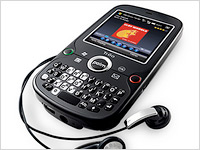

It's crunch time for the fledgling Treo maker.
Palm
Yesterday, Palm (remember them?) released its latest iteration of its “smartphone” series: the Treo Pro.
The New York Times describes the new model this way: “Slimmer and more elegant than current models, the new Treo will not solve Palm’s troubles, but its larger keyboard and screen that is flush with the phone’s chassis make it more user-friendly than Palm’s old calculator-like design.”
The $550 phone will be released in the U.S. in the fall as an unlocked phone, meaning it will run on either of the two American GSM carriers, AT&T or T-Mobile. It also includes an improved battery, HSDPA, Wi-Fi, a standard headphone jack, and a host of other specs that I won’t bother listing here.
Before I had an iPhone, I had a Treo 650. And it sort of fell into my lap by accident — I didn’t go seeking it out. At the time (this was summer 2005), I was working at a magazine in San Francisco, and I had been on the job maybe a week or two at most. The publisher of the magazine was walking around and mentioning to everyone that he was tossing his Treo in favor of a BlackBerry: “Who wants it?” My hand shot up. And without a moment’s hesitation, it was suddenly mine.
This was the first time that I had used a smartphone for any extended period of time. Suddenly I had e-mail, Web access, and, omg, movies! Using a snazzy piece of open-source software, TCPMP, I could watch whole episodes of “Star Trek” on my way to work with no problem. Sure, it didn’t quite fill up the whole screen and was letterboxed pretty bad, but whatever, I got an awesome phone for free. I also had an iPod, largely because syncing with my Mac was just so much easier than having to take the SD card out, put in a card reader, drag the music files over and put them on the card. Calendar syncing via Bluetooth or USB worked, but took for-freaking-ever (I used it maybe once), even though theoretically I had set it up to sync my iCal on my Mac to the Treo properly.
When the iPhone came out, I didn’t get one right away. Once the price dropped on the cheapest model (hello refurb store!), I snagged one and sold the Treo and didn’t look back. I’m sure that I’m one of many thousands that did the same thing. Since the BlackBerry and now the iPhone have been released, Palm and its iconic and revolutionary Treo have fallen by the wayside. But gadget heads will remember that back in 2004, the Treo 600 was freakin’ sweet.
As Business 2.0 reported at the time:
Flash forward to a recent morning. Sitting in his Silicon Valley office in jeans and sneakers, [Palm Pilot inventor Jeff Hawkins] holds the payoff on that death-defying maneuver in the palm of his hand: a sleek Treo 600, the hottest cell phone on the market and by acclamation the first smartphone to actually deserve the name. And in a twist rich with irony, it may also be the gizmo that saves PalmOne, the successor to Palm Inc., which at various times has been both the beloved company Hawkins founded and his sworn enemy.Packing more processing power than early home computers had into a frame about the size of a deck of cards, the Treo 600 went on sale last fall and, despite an initial price tag of $600, became a runaway smash. About 100,000 units were sold in the first month. More than 250,000 have been sold to date, and another 800,000 are expected to move as production ramps up during the next year.
Since then, Palm has been on a pretty quick downward spiral and really didn’t release anything of note to counter the onslaught from the BlackBerry and the iPhone. So much so, in fact, that exactly one year ago today, Engadget released a lengthy (and thoughtful) memo titled: “Dear Palm: It’s time for an intervention.”
And I quote:
Frankly, you’ve taken a turn from being the respected underdog and innovator to repeat offender in stale gear. Every press release you issue or “leaked” photo we see these days is another dent in your already banged up armor, and really, we’re not sure how much more we can take — our loyalty has practically become an embarrassment among peers. The New York Times totally nailed it when they said “Palm is about to release a new model in its Treo line and photos leak out to silence.” That said, we humbly submit a few (mainly practical) suggestions for how you can turn things around, organized by hardware, software, and other.This is make it or break it for Palm, like, for realzies this time. Ed Colligan, you listening?
Fake text messages give false voting information
Obama prevailed, but there were still troubling problems with the voting process. Isn't it time to standardize federal elections?
This election has been full of superlatives and firsts. I’ve never been prouder to be an American abroad than right now. The historic rise of this unlikely candidate, in the unlikely story that is America, fueled by this unlikely swelling of the online masses donating in unprecedented numbers, is nothing short of historic and astonishing.
But there were also a few troubling episodes on the technological front, with text messages and e-mails being used as a way to perpetuate false information.
Wired reported late last night that voters in Florida and New Mexico received a fake text message from 505-507-6041 that says things like: “Due to long lines if you are voting for Barack Obama you can vote tomorrow,” or “Due to the long lines today, all Obama voters are asked to vote on Wednesday.”
The AP adds that there have been reports of similar “robo-calls” and fake texts in Missouri and that the Missouri secretary of state and U.S. Attorney’s Office have been notified. I’m glad that this wasn’t widespread enough to have made a difference, but it’s still a troubling development.
But that’s not all. Thousands of students at George Mason University received an e-mail spoofed to look like it was from Provost Peter N. Stearns saying that “election day has been moved to November 5th. We apologize for any inconvenience this may cause you.” Apparently the FBI is on the case.
And finally, while the outcome of the election was by a pretty overwhelming margin, there were still problems with electronic voting in numerous states, although not enough to have any sort of real impact.
Still, we as a country really need to have a single standard for federal elections, get rid of these awful e-voting machines, and streamline this whole process so we don’t have to deal with this kind of crap anymore.
On a more personal and professional note, I share with you the news that this is my last post in Machinist, which is going on hiatus beginning tomorrow.
I thank all of you for reading and for your thoughtful and critical comments. If you’d like to follow me and/or any of my other work on public radio or elsewhere, you can do so on my blog: cyrusfarivar.com (where I’ll be announcing the result of our little trial voter-verified election), and/or you can email me at cfarivar [at] cfarivar [dot] org.
Cheers!
CNN debuts hologram technology to beam people in 3-D
Yellin to Blitzer: "[I feel] a bit like Princess Leia right now."
Among the wackiest technologies that I’ve seen during this election night is CNN’s hologram technology — something that was predicted back in the Star Wars era.
There’s not much info as to exactly how this stuff works, other than what USA Today has reported:
CNN will have 44 cameras and 20 computers in each remote location to capture 360-degree imaging data of the person being interviewed. Images are processed and projected by computers and cameras in New York. There’ll also be plasma TVs in Chicago and Phoenix that will let the people being interviewed see Blitzer and other CNN correspondents. Bohrman says the network can project two different views from each city so Blitzer can appear to be in the studio with two holograms.
Jessica Yellin was the first CNN reporter to be “beamed” to the New York newsroom, where Wolf Blitzer interviewed her — and she reported that there were only 35 cameras pointed at her, and that “talk to the cameras in New York.” Apparently representatives in the Obama campaign in Chicago and the McCain campaign in Phoenix will be interviewed as holograms later in the evening.
It’s still unclear who makes this hologram technology, nor how much it costs, nor how exactly it works — nor when I’m going to get it in my house. Man, and I was just getting used to Skype video chat. Still, scope out the video below.
Top 10 songs to rock your Obama victory party
From reggaeton to techno, he's everywhere.
At the risk of being a bit premature, I decided to poke around the Internet to find what tunes I could spin to spice up my Obama victory party tonight. After consulting Wired, About.com and this massive list on YouTube, I’ve come up with my Top 10 Obama songs:
1) Mariachi Aguilas de Mexico – Viva Obama
This is without a doubt the best Obama song that I’ve seen so far. It’s got catchy lyrics — Viva Obama! — snappy outfits, a line about healthcare, and that female violin player? Muy caliente!
This half Kenyan band (just like Obama!) rock out on this chillaxed benga track. Great guitar riffs.
Jamaican reggae star Coco Tea recorded this tune earlier this year, earning a small writeup in the Jamaica Observer at the time.
As he told the newspaper:
“If you notice, Obama is getting a lot of support from the young people, and when the younger generation begin to call for change, it usually comes, as they and the future, and Obama’s future is in their hands. Support for Obama is also coming from other quarters including the Kennedy family, as he is seen as the man with a plan, therefore I was guided by Jah on this one.”
How can you argue with Jah?
4) Docta Musica WashiWara – Barack Obama
This tune comes to us from Cameroon, and if you believe what the Docta says on his Web site: “The video has quickly becomed a big hit on Youtube.” Indeed.
5) crbballgal – BARACK THE VOTE!
How can I deny two fly girls, an ’80s-style synth, and rapping in front of a bathroom mirror? Well done, ladies.
6) Mighty Sparrow – Barack the Magnificent
Mighty Sparrow is the world’s leading calypso singer, hailing from the island of Grenada. Cop a read on the lyrics over here — I’m sure this is the first time that the phrase “Foreign Relations Committee” has worked its way into a calypso song.
7) Obama Song Spanish Reggaeton
I’m not sure who wrote this song, but nothing makes me want to sing “Si se puede!” louder than this reggaeton tune.
Bruce Springsteen – Working on a Dream
This song debuted just two days ago at a rally in Cleveland, so if you drop this joint at your fiesta, you’ll definitely be about 75 percent as cool as the Boss himself.
Although college a capella may get mocked on Stuff White People Like, this cover of the famed will.i.am song is perfectly pulled off by Barackapella, a group from Lewis and Clark College in Oregon. (Also, don’t forget the parody, by john.he.is!)
I really, really hope that this is the first song that the Obamas dance to at the inagural ball. Or at least at the party in Chicago tonight.
Where to watch election results live online
And people, please go vote.

CBS screen shot
If you’re like me, you’re going to spend Election Night pretty much glued to the Internet, waiting for news to pop up wherever it might — on Twitter, blogs, YouTube and, yes, that good ol’ stalwart, the mainstream media. Usually I don’t watch television, but there are a few instances — like today — when I actually do want to watch something like CNN with the graphics, the analysis, the whole shebang. Further, I’m abroad, so it’s not like I can simply hop over to my local bar to watch election results (here’s a handy map showing when the polls close). So where can I go to watch live coverage online?
CNN is offering live coverage here and here. I’ve also found CBS‘s coverage to be working well so far — as of this writing, CBS has a camera trained (sans commentary) on a gym in Chicago where Obama is voting. (See photo at top.)
Oh yeah, and don’t forget about the ever-reliable C-SPAN.
Apparently ABC and MSNBC will be offering live coverage online as well, but I haven’t been able to find the respective sites yet.
There’s also this gray-market online streaming site, Channel Chooser, which offers both American channels and foreign ones, including BBC, France 24, Al Jazeera English and Sky News Australia.
Alley Insider has a bunch of live feeds from the McCain and Obama camps and some conservative Christian groups as well.
For live radio coverage, there’s NPR and CBC.
The New York Times has built a neat little election dashboard that updates every two minutes, and Google has gotten in on the action with its own map-based results page.
And finally, of course, there’s Salon’s own coverage.
Happy voting!
France flexes its tech muscle with pending bill, new policies
If Digital France 2012 passes, l'Hexagone could see a slew of new tech-related laws.
The French seem to be all over all kinds of new, far-reaching digital policy.
First, the French Senate “voted overwhelmingly” (297-15) late last week to create a sort of digital three strikes law, which after the third strike, would cut people off from the Internet. It’s not entirely clear how a law like this would be enforced, especially considering the fact that people can access the Internet from home, from their workplace, and also from free, public Wi-Fi hot spots, not to mention at other locations such as a public library.
The bill now heads to the French National Assembly for final approval.
But, as the BBC reported this morning:
If enacted, the law will put France on a collision course with Brussels, which rejected a call to impose such “three strikes” laws across Europe in April 2008.
Throwing people offline, it said, conflicted with “civil liberties and human rights”.
Second, late last month Eric Besson, a Sarkozy cabinet minister in charge of the “development of the digital economy,” presented a new 81-page Digital Plan 2012 for France, which apparently was one of Sarkozy’s presidential campaign promises.
If enacted, this would be one of the most ambitious technological policy plans in Western Europe in recent years. (And while I don’t mean to harp on Estonia, the Baltic powerhouse has had a few of these items, like digital ID cards and health records, for some time now.)
Among other things, the report says that “high-speed Internet,” like water and electricity , is “essential.” And as such, 2 million to 4 million French citizens are without it — and the government needs to work such that by 2010, every single citizen has 512 kbps that costs no more than 35 euros per month. Further, every French citizen should have access to high-speed mobile Internet as well, which only covers 85 percent of the citizenry as of today.
Other proposals include:
- allowing the old analog television signals to be opened up to wireless and mobile Internet access.
- an electronic national identity card for each citizen starting in 2009 (Estonia already has this).
- a doubling of cyber-crime law enforcement agents by 2012
- the promotion of telecommuting in the public sector
- a digital medical file for each citizen by 2012
- a Green IT and Cleantech prize
- a migration away from the American-dominated ICANN toward a more multilateral and international organization to run the infrastructure of the Internet.
As of yet, this remains but a proposal — but an interesting and ambitious one — and if Sarkozy is serious about keeping his campaign promise, especially while France holds the the Presidency of the Council of the European Union until the end of the year, it could be a boon to France.
Page 1 of 16 in Cyrus Farivar
The GOP’s emerging Bob Dole problem
The Senate and Grammys condone domestic abuse
Interview: Gary Oldman talks about his first Oscar nomination
A match made on Craigslist adult services
Can’t see the forest for the wood
The things I carry
When I lost the ability to type
Pop art, the beaded edition
The beautiful banality of high school
The unemployed meet MacArthur’s tanks 

