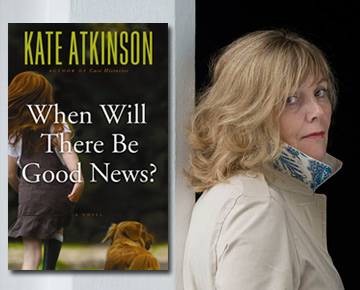
“When Will There Be Good News?”
Kidnapping, romance, comedy -- Kate Atkinson's delightfully inventive "When Will There Be Good News?" is much more than just another crime novel.
In real life, violent crime is a horror; in popular fiction it’s the occasion for light entertainment. English novelist Kate Atkinson has been fruitfully exploring the chasm between the two for several years now, inventing new ways to write about murder and its aftermath in three books featuring the same protagonist, Jackson Brodie. The latest is “When Will There Be Good News?” and it is, like its two predecessors, a work of fancy, genre-bending footwork in which a rueful, cranky, modern comedy-of-manners dances an intricate minuet with an unlikely partner: a kidnapping plot. You don’t need to have read the earlier two books to appreciate this one, but I can’t think of any reason to deny yourself the delights of all three.
“When Will There Be Good News?” begins with an eruption of bloody and unfathomable brutality in the Devonshire countryside, then jumps forward 30 years, to contemporary Edinburgh. The perpetrator of the old crime has just been released from prison, the only surviving victim goes missing, and the night train from London derails on the outskirts of a scruffy working-class suburb. Brodie somehow becomes hopelessly tangled up in all of these catastrophes. A soldier turned policeman turned detective turned man of leisure, he is hangdog and lovelorn but nevertheless stalwart, and his talent for blundering into trouble is matched only by his handiness in getting out of it again.
Because his vexations are inevitably both personal and professional, Brodie couldn’t find himself in Edinburgh (even by accident) without somehow getting embroiled in matters of keen interest to Louise Monroe. A hard-boiled, even surly police detective suffering from empty-nest syndrome, Louise was a minor character in Atkinson’s last novel, “One Good Turn,” and in the intervening years, we learn, she and Brodie have secretly pined for each other, even though they’ve recently managed to marry other people.
Atkinson’s books aren’t proper mysteries. She’s forever taking her villains down a peg, portraying them as crude, shabby and stupid instead of as ingenious fiends or architects of vast conspiracies. Her detectives are dogged rather than brilliant. In this, she’s more realistic than most crime writers; in her reliance on an outrageous amount of coincidence, she’s less so. “When Will There Be Good News?” is full of red herrings and wild goose chases, too many by the conventional standards of mystery fiction, yet that would appear to be the point. A great, looping web of chance and intention connects all of the novel’s characters, but as with any intricate piece of crochetwork, all of it is woven from a single strand.
The civilians in the story include the Hunters, a woman doctor and her louche entrepreneur husband, as well as their intrepid, sharp-eyed au pair, 16-year-old Reggie Chase, whom all the other characters persist in underestimating. Reggie is a less battle-scarred version of Louise, one of those people who struggle mightily to make the world run as it ought to, and who harbor a jaundiced view of all but a select few of their fellow human beings. Lonely Reggie worships Dr. Hunter, and having recently lost her own mother in a freak accident, longs to be invited all the way into the family. As for Mr. Hunter, Louise puts it best when she concludes, “Twenty years ago she too would have found his moodiness attractive. Now she just wanted to punch him.”
Stinging unspoken retorts are a trademark of Atkinson’s heroines, who, as a rule, see everything around them as going to hell in a handbasket. “A woman had told her that she was too young to wear make-up. Reggie would have liked to say, ‘And you’re too old to wear it,’ but unlike, apparently, everyone else in the world, she kept her opinions to herself.” Louise, making an atypical visit to a therapist — “a hippy-ish well-intentioned woman called Jenny who looked as if she’d knitted herself” — is instructed to visualize a pirate’s chest into which she can stash all her “unhelpful” thoughts. “The problem was that when she had safely locked up all the negative thoughts at the bottom of the sea, there was nothing else left, no positive thoughts at all.”
With their waspish dispositions and misanthropic attitudes, these women ought to be disagreeable, yet somehow they’re not. They’re too dependable, too witty and, more often than not, too right to quarrel with. And, fortunately for them, they have Jackson Brodie, who single-handedly redeems the male gender in their eyes. “If someone he loved was lost he would stalk the world forever looking for them,” Brodie morosely observes of himself at one point. This is a key difference between Atkinson’s novels and the usual run of crime fiction: her ability to wrench our attention away from the fascinating glamour of evil and redirect it toward that even rarer phenomenon, goodness, and the conditions that allow it to survive in a hostile world.
It’s the victims and those who love them who shine in “When Will There Be Good News?” and in doing this the novel satisfies the question in its own title. The answer is: Right here and right now.
Laura Miller is a senior writer for Salon. She is the author of "The Magician's Book: A Skeptic's Adventures in Narnia" and has a Web site, magiciansbook.com. More Laura Miller.
“Flawless: Inside the Largest Diamond Heist in History”
The real-life "Ocean's Eleven"-style caper that plundered a supposedly impenetrable vault
Winter, too, has its dog days, when “crisp” feels more like just plain cold, the streets are lined with grimy crusts of snow, and all the interesting holidays are shrinking in the rearview mirror. It’s a time of year that calls out for the occasional binge of frivolous reading every bit as much as summer does. “Flawless: Inside the Largest Diamond Heist in History” by Scott Andrew Selby and Greg Campbell, a caper movie in print, complete with European locations and a dash of journalistic scuttlebutt, offers exactly the right blend of diversion and pith. It’s a ripping yarn, yes, but a meticulously reported one.
Continue Reading Close
Laura Miller is a senior writer for Salon. She is the author of "The Magician's Book: A Skeptic's Adventures in Narnia" and has a Web site, magiciansbook.com. More Laura Miller.
Christmas insanity unwrapped
"Tinsel" investigates the allure -- and demented poignancy -- of America's holiday obsession
Every year, Christmas is directly responsible for some of the worst books to cross a reviewer’s desk: stale, overfrosted sugar cookies loaded with the literary equivalent of artificial coloring and high-fructose corn syrup. But now all is forgiven because the season has inspired Hank Stuever to write “Tinsel: A Search for America’s Christmas Present,” a portrait of the holiday as it’s celebrated in the booming Dallas exurb of Frisco, Texas. A delicately calibrated combination of rigorous reporting, observational humor and old-fashioned empathy, “Tinsel” is the book that saved Christmas for this curmudgeon. The first two sentences alone, with their vivid evocation of big-box America and the promise of more crackerjack prose to come, did the trick:
Continue Reading Close
Laura Miller is a senior writer for Salon. She is the author of "The Magician's Book: A Skeptic's Adventures in Narnia" and has a Web site, magiciansbook.com. More Laura Miller.
How memoirs took over the literary world
A new book says: Fiction is dead, long live the age of autobiography
Has the memoir become the “central form” of our culture, as Ben Yagoda insists in his breezy new consideration of the form, “Memoir: A History”? Do I detect hackles rising from coast to coast at the mere suggestion? Today, autobiography is both very popular and widely reviled, for reasons that aren’t always clear. People complain that the modern memoir is narcissistic, formulaic, pretentious and often falsified — all true on occasion, though when pressed the accusers can usually list a few contemporary memoirs that they do admire. What is it about the memoir in its current form that makes it simultaneously so irresistible and so annoying?
Continue Reading Close
Laura Miller is a senior writer for Salon. She is the author of "The Magician's Book: A Skeptic's Adventures in Narnia" and has a Web site, magiciansbook.com. More Laura Miller.
Investigating his father’s murder
A memoirist searches for the truth about a fatal shooting in 1960s Phoenix
In 1975, Ed Lazar was shot in a Phoenix parking garage stairwell by two men he’d never met. Thirty years later, Lazar’s son, Zachary, an acclaimed novelist (“Sway”), began to investigate the murder in preparation for writing “Evening’s Empire,” a book he had been contemplating for as long as he could remember. No “solution” was called for in any conventional sense of that word: Authorities have known who killed Ed Lazar (two hit men affiliated with the Chicago mafia) and why (they were paid to do it by Ed’s former business partner, Ned Warren) for years. But for Zachary, his father’s death remained a mystery. How did a quiet, respectable suburban CPA like Ed Lazar, a man whose friends could make no sense of his violent end, wind up dying in what Walter Cronkite described on the CBS Evening News as “a gangland-style murder”?
Continue Reading Close
Laura Miller is a senior writer for Salon. She is the author of "The Magician's Book: A Skeptic's Adventures in Narnia" and has a Web site, magiciansbook.com. More Laura Miller.
Archaeologists behaving badly
Mystery and conspiracy plague a dig at the site of ancient Sparta in "The Hidden"
During the early fall, publishers release the highest concentration of books by established writers — many of which, incidentally, turn out to be disappointing, like this year’s offerings from John Irving and Philip Roth. As a result, it’s easy to miss fine novels by relative newcomers (who are also less tempted than the big names to phone it in). Tobias Hill’s impressive “The Hidden,” published last month as a paperback original, is a case in point. Hill, a British poet, novelist and short story writer, likes to take subjects conventionally associated with airport thrillers — murder mysteries, quests for ancient treasure, conspiracies — and crack them open to probe for more succulent literary meat. “The Hidden,” set on an archaeological dig at the site of ancient Sparta, circles around the suspicious activities of some of the dig’s team while dissecting the broken inner life of a young man who wants nothing more than to be let in on their secret.
Continue Reading Close
Laura Miller is a senior writer for Salon. She is the author of "The Magician's Book: A Skeptic's Adventures in Narnia" and has a Web site, magiciansbook.com. More Laura Miller.
Page 1 of 5 in Must Read