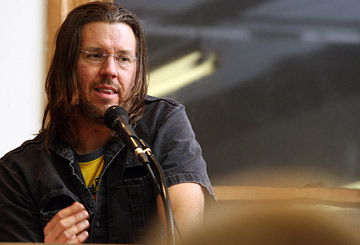

David Foster Wallace

The last days of David Foster Wallace

The people who knew the brilliant writer best talk about the crippling anxiety and spiraling depression of his torturous final weeks.

  • more
    • All Share Services

The last days of David Foster Wallace

Following David Foster Wallace’s suicide on Sept. 12, stunned fans, colleagues and friends paid tribute to the writer in countless articles and blog posts. They wrote of his imagination and breadth of knowledge, of the ways in which his books and essays inspired a generation of writers and forever altered the literary landscape. They used words like “virtuoso” and “genius.” Many, like Jocelyn Zuckerman, the Gourmet editor who went to bat for Wallace’s infamous and groundbreaking essay “Consider the Lobster,” a masterwork that morphed from a scene piece about a festival in Maine into an essay about whether it’s ethical to boil lobsters alive (short answer: no), now mourn the enormous talent the world has lost. “A lot of people,” she says, “are really sad for all the books we’re not going to get to read.”

Those who knew him personally speak of his kindness: Longtime agent Bonnie Nadell recalls how he stood on line at FedEx the week before Christmas to mail an autographed book to a fan. “He would just do things like that because he was a really sweet person,” she says. His students at Pomona College in Claremont, Calif., remember the committed, engaged teacher: Amanda Shapiro had taken writing classes with him the past three years, and recalls the copious comments she got back from him about her assignments. “He would write five pages of notes on a six-page story,” she says, “and put so much care and thought into helping us as writers. He would type out the letters, and then annotate them, in pen, with little smiley faces and notes and corrections.”

A common thread running through the many magazine and newspaper tributes, the online eulogies and recalled anecdotes, was shock. Wallace may have been a hugely influential and critically celebrated figure, the winner, in 1997, of a MacArthur Foundation “genius” grant, but he was also a very quiet one. He had given few interviews in recent years, and he found much of the fame that came with literary success, the adoration and spotlight that countless other writers would have killed for a taste of, embarrassing and uncomfortable. He taught creative writing at Pomona, wrote short stories and essays and attended the occasional book reading and conference. When news of his suicide began to spread, fans were left wondering: Why? Why had this gifted, funny, often disarmingly humble writer — a man with seemingly so much to live for — taken his own life?

Unbeknown to most, Wallace had suffered from clinical depression for the past two decades. Family and close friends knew of it, but few others did. Over those years, Wallace had taken powerful anti-depression medication that had allowed him to work and write, according to his father, James Donald Wallace. But recently the drugs had been having very serious side effects. In June of 2007, Wallace and his doctor decided that they would have to try another course of treatment.

“Going off the medication was just catastrophic,” his father remembers. “Severe depression came back. They tried all kinds of things. He was hospitalized twice. Over the summer, he had a series of electro-convulsive therapy treatments, which just really left him very shaky and very fragile and unable to sleep.”

Suffering from near-crippling anxiety, Wallace found himself unable to write. “I don’t think he’d been able to write for more than a year,” says his father. Wallace told the human resources department at Pomona College that he would be unable to teach there in the fall, and he was granted a medical leave for the fall semester.

“I knew this summer had been particularly bad,” says Nadell. “My job was just to keep everyone and everything away from him.”

On Aug. 18, Wallace’s parents came to Claremont to stay with their son. Wallace’s wife of four years, Karen Green, had been called away on an urgent family matter, and Wallace did not want to be left alone. He had canceled previous visits with his parents over the past year, telling them that he couldn’t bear to have people in the house, even those he loved, so the invitation came as a welcome surprise to them.

When Mr. and Mrs. Wallace arrived, they found their son exhausted and gaunt. “He was very, very thin,” says his mother. “He weighed about 140 pounds, so I immediately started to try to put 40 or 50 pounds on him, the way mothers will.” She cooked and cleaned. Wallace couldn’t eat, he told his sister later, but he liked the way the house smelled, and how clean everything was.

Mornings were spent walking Wallace’s two dogs, Werner and Bella. Wallace and his parents strolled the streets of Claremont, talking of small things. In the afternoons, they spoke some more, and helped their son deal with the paperwork and insurance issues that had been piling up. “He was very glad we were there,” says his mother. “And he was very emotional. He was just terrified of so much. We would just try to hold him.” The memories bring tears. “He did tell me that he was glad I was his mom.”

The time together, she says, was a gift. “We hadn’t spent that much time with David since he was a small boy. Once they grow up and leave home you see them, of course, and you visit, but you don’t spend hours and hours with them.”

Toward the end of their visit, Wallace and his parents called his sister Amy. “I’m a public defender,” she says, “and I had just lost a trial that I was really upset about. He was really in a lot of pain, but he said all the right big brother things, you know, like how lucky my client was to have me.” She pauses. “That was the last time I spoke with him, and it was his last chance to be a big brother. I think it really made him feel better, at least for a few minutes. I know it made me feel better.”

The respite, though, was brief. “He told me that he wasn’t OK,” she says. “He was trying really hard to be OK, but he wasn’t.”

His wife returned home shortly after, and, on Aug. 30, James and Sally flew back to their home in Urbana, Ill. It was the last time they would see their son. Two weeks later, Wallace hanged himself. He was 46.

News of Wallace’s death shocked fans and colleagues worldwide, even those who knew firsthand of his struggles with depression. Longtime friends busied themselves with preparations for a memorial service in October, even though the very thought of speaking publicly of their friend filled them with dread. Jonathan Franzen, author of “The Corrections,” who knew Wallace for two decades, found it nearly impossible to speak about him, noting that if the words barely came now, how, in a month, would he know what to say?

His sister Amy described emotions ranging from disbelief to sadness to acceptance, of a sort. “Inevitably our thought was, if only he could have held on a little bit longer,” says sister Amy. “And then we realized, he did. How many extra weeks had he hung in there when he just couldn’t bear it? So we’re not angry at him. Not at all. We just miss him.”

While friends and family recalled the anguish of Wallace’s final weeks and days, they also wanted to talk about his sweetness, his unfailing politeness, his generosity of spirit. Amy spoke of the “magical uncle” who wasn’t so big on kids, but adored his two nieces. “He took them to Disneyland a few years ago,” she remembers, “and God, he hated stuff like that! Just all the people and the parking and the driving in L.A. But he absolutely delighted in being with them.” His mother talked about him as a husband who had, in Karen, found his best friend and soul mate. A painter and mixed media artist with her own art gallery, Beautiful Crap, in Claremont, Karen had met Wallace through a mutual friend and married him on Dec. 27, 2004, in the Champaign County Courthouse in Urbana. “The happiest he had ever been in his life was being married to Karen,” his mother says. “She was the one ideal person on the planet for him, and thank God he found her.”

When David was 5, his mother recalls, he decided that he had two careers to look forward to. He would be a professional football player, for one. In the off-season, while the other players were recuperating or doing whatever it is that pro football players do when they’re not running or passing or slamming their bodies into each other, he would be a neurosurgeon. His mother has no idea how, at 5, her son might have heard about neurosurgeons or what they were or did, but he had. The first day of his medical career, he promised his mom, he would take out all of her frayed nerves and fix them. “Somehow he knew about neurosurgeons,” she says, “and he knew that my nerves needed fixing.”

After Wallace’s death, readers began revisiting his books and essays, searching for clues to his death, hints of suicide notes planted between the lines. There were, of course, plenty to be found. There were references to depression, death, paranoia and, yes, suicide — more and more clues, the more one chose to look. But those who knew him hope that what we now know of the demons he struggled against won’t forever color the way his books are read, or the way he is remembered.

“I understand that he was apparently depressed, but that wasn’t the only important part of his life,” says former student Amanda Shapiro. “And I don’t think that’s where his genius came from. I think his genius came more out of his passion, and the things that he thought were worth living for and writing about in the world.”

“I hope he’ll be remembered in the way that every writer hopes to be remembered,” says Little, Brown publisher Michael Pietsch, who acquired and edited “Infinite Jest” in 1992 and had worked with Wallace ever since. “That people will continue to read his books. His mind is there on every page. ‘Infinite Jest,’ in particular, is one of the great works of a mind in our time.”

Robert Ito has written for the Village Voice, The Believer and the New York Times. He lives in Los Angeles with his wife, Hyunu, and his son, Ezekiel.

Consider David Foster Wallace, journalist

There's more to DFW than "Infinite Jest." On what would've been his 50th birthday, it's time to honor his reporting

  • more
    • All Share Services

Consider David Foster Wallace, journalist

On Tuesday, David Foster Wallace would have turned 50 years old, an occasion that has even inspired conferences. After his death and canonization into what looks like an entire field of academic study, there remains a popular critical notion that Wallace is to be solely known as a writer of fiction. These are typically readers who swear by “Infinite Jest,” a work that is indeed Wallace’s crowning achievement, but by no means his only. They acknowledge his other fiction, but refuse to credit him as having also been a skilled nonfiction reporter. Or, they happily acknowledge that there are many readers that go right to Wallace’s essays and skip the fiction altogether, but simply consider this a mistake.

There even seems to be a now common agreement in academia that readers who champion Wallace’s essays as their favorite work of his are simply missing something and must be less advanced readers, because his nonfiction couldn’t possibly hold up to his one towering opus. It’s a facile assumption that accessibility signals lack of seriousness.

It doesn’t help matters that Wallace himself said, on occasion, that he is no journalist. “I think of myself as a fiction writer,” he told Charlie Rose in 1997, just after the publication of “A Supposedly Fun Thing I’ll Never Do Again,” a terrific collection of essays. “And I’m not even a particularly experienced fiction writer,” he added, in trademark self-deprecation.

A year ago, on Slate, Tom Scocca stoked the “not a journalist” theme further (those words even composed the article’s headline). Scocca posted the transcript of an interview he did with Wallace in 1998, in which Wallace said, “The weird thing about the nonfiction is, I don’t really think, I mean, I’m not a journalist, and I don’t pretend to be one … The thing that was fun about a lot of the nonfiction is … it was just mostly like, yeah, I’ll try this.”

It would be weak to take Wallace’s tongue-in-cheek humility as definitive evidence of what he was or wasn’t as a writer. Wallace was likely aware, even in his more self-doubting moments, that he was a skilled reporter (he certainly enjoyed it, at least). Yet even if he didn’t realize the rich tradition into which his style of nonfiction fit perfectly — even if, as he let on, he bought into the idea that he was merely pretending — it should not preclude the literary establishment from considering his talents in this second, less showy role to be equal to the studied brilliance of “Infinite Jest” and his other fiction. “I’ll try this” can certainly be the mantra of someone who nonetheless succeeds immensely in a new form, whether they’re fully aware of the success or not.

In his nonfiction, Wallace most closely resembled another writer before him, a man who was also considered something other than a journalist: Hunter S. Thompson. Both writers took reportage a step further than the literary techniques of Gay Talese, Joan Didion and the New Journalism. Yes, both Thompson and Wallace shirked objectivity, happily injecting their own commentary and asides into factual reportage, but today scores of journalists reject objectivity (Rolling Stone’s Matt Taibbi, Esquire’s Tom Junod or, to a lesser extent, Jon Krakauer, who certainly makes his own views clear by the end of “Where Men Win Glory”).

What Thompson did differently that Wallace emulated (consciously or not) is more about a slippery definition of honesty and truth. An essay Wallace wrote about attending the Adult Video News (AVN) Awards opened the collection “Consider the Lobster.” It’s a rollicking tour in which the author plays representative for the reader’s disgust and fascination (when a girl meets Wallace and brags about small valves in her new breast implants that allow her to adjust the size of the breasts by adding or draining fluid, she raises her arms to show him and Wallace can only write, “There really are what appear to be valves”).

But the essay, it seems, stretched the truth of what happened to Wallace at the AVN Awards. Evan Wright, author of “Generation Kill,” was also at the 1998 event and spent some time guiding Wallace around. He appears in the essay as “Harold Hecuba” and as many people have noted, his own account of the events differs from Wallace’s. Notably, he tells Wallace a brief anecdote about meeting a cop who professed to be a porn fan. Wallace expanded the story into a much larger chunk and seems to have added to the quotes relayed to him by Wright, embellishing them a bit. Blogger Annlee Ellingson has a more detailed side-by-side comparison of the story as relayed by Wallace in “Consider the Lobster” and then by Wright in an L.A. Weekly piece, but aptly concludes that Wallace, “writing about somebody else’s anecdote, in a footnote, no less … gives a much more complete picture of the entire scenario” and uses it “to expound on the entire adult-entertainment industry.” Nevertheless, this may be the reason Wallace called his nonfiction stories “essays” and not “journalism,” but from a perception point of view, it almost shouldn’t matter.

The same goes for his massaging of the facts in other essays. In October, during a New Yorker Festival event, Jonathan Franzen stirred up some drama when he told David Remnick that “David and I disagreed on,” as Remnick raised it, a “view of fact and fiction” and the “dividing line” between the two. Remnick, aghast, asked if Wallace “said it was OK to make up dialogue on a cruise ship” and Franzen confirmed that, indeed, he did. Pushing aside for a moment the question of why Franzen even felt the need to randomly interject about Wallace (and the jealous, complicated feelings Franzen has demonstrated publicly for his friend), the idea that Wallace’s occasional use of invented dialogue makes him, by definition, not a journalist is a laughable one.

As Michelle Dean aptly noted in a piece for the Awl, “It’s very hard to say whether Franzen’s charge is (a) true … or (b) new information.” It certainly wasn’t new information for most Wallace devotees, and as for whether it’s true to contend that Wallace made up dialogue, the evidence says otherwise. This is a person who, as the Awl piece points out, felt extremely bad about his portrayal, in the cruise-ship piece “Shipping Out,” of two of the people he met on the cruise. And yet even as he described his shame over insulting this couple who had befriended him, he reaffirmed the accuracy of the meaner parts of his portrayal, describing the wife as “a terrific, really nice, and not unattractive lady who did happen to look just like Jackie Gleason in drag.”

If he did on occasion tweak direct quotes, it didn’t affect the truth of the situations, and if anything likely got closer to a representation of truth, at least the personal, first-person narrator sort of truth that the cruise-ship piece and others like it aimed to convey. The cruise piece, among many others, delivers an extremely satisfying, complete representation of Wallace’s own personal experience (a very bad one) on the cruise, and if altering dialogue served to better crystalize and define that experience, then it’s still truthful, no matter what David Remnick or his fact-checkers would say. (For more on this ever-raging debate, read John D’Agata’s new book “The Lifespan of a Fact,” though D’Agata strays much further off the rails of allegiance to fact than Wallace ever did.)

As for Hunter S. Thompson, the man is certainly revered today — movies are made of his books, like “The Rum Diary”; documentaries present him to wider audiences — but his career is continually diminished by the term “gonzo journalism.” Those who use it, to this day, do so to point out his craziness, lies and unreliability. Yet “gonzo,” with its negative connotations, fails to reflect Thompson’s passion for truth and devotion to accuracy. What makes his writing so engaging is that no matter how far off the rails he allows himself to stray (he titled his eulogy of Richard Nixon “He Was a Crook”), he maintains investigative honesty. In most of his work, Thompson plays a sort of intimate, dunderheaded guide, walking the reader through whatever event he may be chronicling. The same goes for Wallace, a Virgil guiding us as he traverses hell, whether that’s a porn convention or an old woman’s house as she watched 9/11 unfold on television. Wallace said as much to David Lipsky in “Although of Course You End Up Becoming Yourself: A Road Trip With David Foster Wallace”: “In those essays … there’s a certain persona created, that’s a little stupider and schmuckier than I am.” This confession also stands as a sort of mantra for Wallace’s journalism.

In his article “Seething Static: Notes on Wallace and Journalism,” Christoph Ribbat of the University of Liverpool writes that “there is nothing particularly ‘bold’ about Wallace’s nonfiction, at least not the kind of boldness that Tom Wolfe, Hunter S. Thompson and Mailer developed to establish themselves as maverick heroes.” But that’s the point: Wallace didn’t want to establish himself as a maverick hero; instead, he echoed Thompson’s techniques in order to create something more accessible.

Some of the same tricks Wallace used in “Big Red Son,” Thompson enacted before him, particularly in “Fear and Loathing on the Campaign Trail ’72″ and in “The Kentucky Derby Is Decadent and Depraved,” an assignment for the now-defunct sports rag Scanlan’s Monthly. Thompson was asked to write a story on the famed race, but instead wrote about the drunk, drugged-out crowd that attends it, Thompson and his illustrator Ralph Steadman included.

“Big Red Son” has one scene that, whether by coincidence (possible) or intentional tribute (more likely), directly mirrors a scene from “Campaign Trail.” Wallace writes: “A strange and traumatic experience … consists of standing at a men’s room urinal between [porn stars] Alex Sanders and Dave Hardman … The urge to look over/down at their penises is powerful and the motives behind this urge so complex … Be informed that male porn stars create around themselves the exact same opaque affective privacy-bubble that all men at urinals everywhere create.” Yes, he’s going for shock factor, but he’s also telling you something, and above all else, he’s playing the wide-eyed Average Joe.

The similar moment in “Campaign Trail” happens when Thompson cleverly (if inappropriately) takes advantage of a vulnerable moment to speak to George McGovern, whose campaign he is covering: “By chance, I found George downstairs in the Men’s Room, hovering into a urinal and staring straight ahead at the grey marble tiles.” Thompson proceeds to interrogate McGovern on a touchy subject — McGovern’s reaction after his good friend Harold Hughes endorsed a different candidate — and carefully observes his body language at this moment of weakness: “He flinched and quickly zipped his pants up… I could see that he didn’t want to talk about it.” This is what Thompson and Wallace do; they take every potential opportunity, no matter how unusual or taboo, and mine it for information and storytelling value. And the same blend of intrigue, humor and discomfort that Thompson achieves with the urinal scene is present throughout “Big Red Son,” like when Wallace brazenly notes that a porn director forced a starlet to stick a pen “up her asshole.” He then, in his essay, doesn’t just include the actual phrase she scribbled down, but copies the phrase into his text in the same jagged handwriting with which she originally wrote it in the director’s notebook. The result: that messy, unsettling feeling in the reader, the same Thompson often embraced, a feeling that signals fearless journalism.

“Consider the Lobster,” the title essay of Wallace’s collection, is itself another piece of evidence linking Wallace to Thompson. When the food and travel magazine Gourmet assigned Wallace to write an article on the annual Maine Lobster Festival, he ended up musing about the ethical dilemma that cooking a lobster alive presents to eaters. Implementing facts and figures along with his own judgments, Wallace reaches no final conclusion but rather poses the question directly to Gourmet readers, asking them, “Do you think much about the (possible) moral status and (probable) suffering of the animals [that you eat]? If you do, what ethical convictions have you worked out that permit you not just to eat but to savor and enjoy flesh-based viands?” This essay in particular makes it a shock that he’s rarely remembered as a journalist; just look at what he was doing with the form. Thompson took a similar avenue with “Fear and Loathing in Las Vegas”: “Cover the story. Never lose sight of the primary responsibility. But what was the story? Nobody had bothered to say. So we would have to drum it up on our own.”

When the Atlantic’s Matthew Hahn asked in 1997 if he thought any younger writer was approaching nonfiction in the same style as he did, Thompson answered: “I don’t think that my kind of journalism has ever been universally popular. It’s lonely out here.” But Wallace, in myriad ways, was that heir. (He also burst onto the nonfiction scene right around the time of Thompson’s interview with Hahn.) Like Thompson, he killed himself (though at a far younger age) and dealt with depression. Of course, it’s the writing that counts, and the writing irrefutably reflects Thompson’s influence.

In 1997, Wallace told Charlie Rose, regarding his nonfiction essays: “If there’s a shtick, the shtick is, Oh gosh, look at me, not a journalist, who’s been sent to do all these journalistic things.” Whether or not Wallace fully believed in the shtick he created, the evidence — his outstanding reportage — speaks for itself.

Continue Reading Close

Daniel B. Roberts is a magazine reporter and book critic in Manhattan. You can find him on Twitter.

Would David Foster Wallace like this video?

A biographer thinks he'd be wowed by the Decemberists' "Infinite Jest" tribute

  • more
    • All Share Services

Would David Foster Wallace like this video?A still from the Decemberists' new music video.

Combine the Decemberists and David Foster Wallace — as “Parks and Recreation” co-creator Michael Schur did in a new video for the band’s “Calamity Song” — and it’s catnip for the McSweeney’s set. Schur and the band brought to life a game from the book called Eschaton — which is part tennis and part “War Games” — in a brightly colored and crisply shot video.

What would David Foster Wallace think? We asked David Lipsky, who spent five days on the road with the late author during his book tour for “Infinite Jest” for a Rolling Stone profile. After Wallace’s death, the article became the basis for his book “Although Of Course You End Up Becoming Your Self: A Road Trip With David Foster Wallace.” And judging by Wallace’s fondness for R.E.M., it’s easy to imagine that he would have liked the jangly “Calamity Song” even before the Decemberists tribute to Eschaton. 

Had you imagined what Eschaton would look like, and how close did the vision in the video come to your sense of the game? What caught your imagination most about the video? 

It’s impossible to read the Eschaton scene and not shoot some mental footage yourself. The video is pretty much exactly what you imagine, best-case; the crisp colors, the propellor beanie, the youth of the kids on court, which somehow never comes through when you’re reading about high schoolers. You read them as if they’re you with a tighter curfew; you forget they’re walking around in tiny adolescent form. What made me smile most — aside from the sight of Otis P. Lord at his terminal — was seeing Colin Meloy really sportily wearing Pemulis’ yachting cap. And the Enfield Academy gear, I have to say, excited my consumer response. Note to Michael Schur: Please sell T-shirts. The red and gray, as Wallace anticipated, look really splendid together.

You spent days in the car with David Foster Wallace — what did you listen to? Any sense of what he might have made of either the Decemberists or this video?

We talked in the car, and when we weren’t it was R.E.M.’s album “Monster,” a lot of replays of the song “Strange Currencies” — guitar-heavy, and not so different from the Decemberists. At his house, he played me a Brian Eno song, “The Big Ship,” to show how close it was to the Bush song “Glycerine,” which he’d taped off the radio. (This was an analog time.) He said he’d grown up listening to “an enormous amount of Pink Floyd.” He really loved Alanis Morisette’s “You Oughta Know” — he laughed and said, “I have the musical tastes of a 13-year old girl.” Then he said a typically lovely thing: that Alanis was unlike lots of other celebrities, in that she was realistically sloppy; with the others, “You can’t imagine them putting a quarter in a parking meter or eating a bologna sandwich.” I don’t really know how he might have felt about the Decemberists, but they are bologna-imagination friendly. And I had the impression he loved movies, well-shot ones, and so my sense is it might have been a treat to see his complicated game treated so well, so gorgeously worked out: That flattery filmed versions pay to a written work. Catering trucks, lights, wardrobe, sound people, actors, musicians, directors, all marshalled because you imagined something so compellingly. A kind of stunning compliment, a movie: You imagined something so well we are going to make it temporarily real.

And lastly, it was directed by Michael Schur, the co-creator of “Parks and Recreation,” who also holds the film rights to “Infinite Jest.” Does the video give you any insight into what a possible movie adaptation would look like?

Schur did a very lovely job — beautifully framed, high gloss and intelligent, and with that feeling of the youth of the kids, the energy that gets directed in very specific places until it pools and builds and spills over, which is just how high school feels. It gave me a very strong sense of the novel, with something I’d forgotten — youth, seasons, weather, asphalt, all the side stuff that your brain approximates while reading a book, even one as completely rendered as Wallace’s. It reminded me that movies have that advantage: of time, of things actually moving, of all the footage shot. As a reader, it made Wallace’s world feel very real, and made me think Schur would do extraordinary work with a filmed version — though, as he told the New York Times about show-running Adam Scott and Amy Poehler, “I like my current job a lot.”

What David said about any movie version was that it would be a hard book to film, “Unless it’s like one of these 48-hour Warholian, bring-a-catheter-to-the-theater experimental things.” The impression the video left this reader with is that it wouldn’t: it’s filled with an incredible amount of life.

[Video via NPR]

Continue Reading Close

David Daley is the senior culture editor of Salon.

How a podiatrist sign became a literary icon

Happy Foot/Sad Foot has captured the imagination of David Foster Wallace, Jonathan Lethem and others

  • more
    • All Share Services

How a podiatrist sign became a literary icon

F. Scott Fitzgerald’s generation had its green light at the end of the dock in “The Great Gatsby,” that symbol of unattainable dreams, and today’s young literati have — a podiatrist’s sign?

The sign for the Sunset Foot Clinic on West Sunset Boulevard in Los Angeles is known to some locals as a kind of fortuneteller. On one side is depicted a foot with a woeful face, a bandaged big toe and crutches, while the other side shows an ecstatic foot in gloves and sneakers giving the thumbs-up sign. (Yes, these feet have both arms and legs.) When the sign is working, it rotates, and several residents of the nearby Silver Lake and Echo Park neighborhoods believe that whichever side they see first indicates what sort of day awaits them. Others use the sign as a guide: If they see the Happy Foot, they get to do something fun, while the Sad Foot condemns them to an afternoon of chores.

The Happy Foot/Sad Foot sign became better known to readers outside the Los Angeles area when it appeared in Jonathan Lethem’s 2007 novel, “You Don’t Love Me Yet.” In that book, the main character, a musician named Lucinda, can see the sign from the window of her apartment: “The two images presented not so much a one-or-the-other choice as an eternal marriage of opposites, the emblem of some ancient foot-based philosophical system. This was Lucinda’s oracle: one glance to pick out the sad or happy foot, and a coin was flipped, to legislate any decision she’d delegated to the foot god.”

The sign also appears to have inspired a passage in “The Pale King,” the final, unfinished novel by the late David Foster Wallace, published last month. Wallace relocates the sign to Chicago and changes its appearance somewhat, so that one side depicts the name and telephone number of the podiatry clinic while the other features “a huge colored outline of a human foot.” As in “You Don’t Love Me Yet,” aimless young people — in this case, college students who can see the sign from their dorm room — use the rotation as a “wheel-of-fortune” to determine the evening ahead, depending on which side is facing them when the sign is turned off at the end of the day. “If it stopped with the foot facing our windows,” the narrator explains, “we would take it as a ‘sign’ (with the incredibly obvious double-entendre) and immediately blow off any homework or supposed responsibility we had.”

In an eerie coincidence, Lethem, formerly of Brooklyn, N.Y, is now the Roy E. Disney Professor of Creative Writing and Professor of English at Pomona College in Claremont, Calif. — the same position Wallace held when he died in 2008. He doubts that Wallace ever read “You Don’t Love Me Yet,” given the major depression his predecessor was wrestling with when it was published. Instead, he believes that they were both inspired by local legend.

“When I was researching my novel,” he said, “I visited L.A., and at one point I was driving down Sunset Boulevard with someone who’d agreed to be a source on the area. I laid eyes on the sign, and asked about it, and that’s when the Happy Foot/Sad Foot lore was unfolded for me. I was aware when I used it that I was keying into a Silver Lake meme — a non-Internet meme, that is. Later, a friend met a guy who had a Happy Foot tattoo, and got a photo of that for me.”

The sign has also been immortalized in a song by the Eels, “Sad Foot Sign” (bemoaning one of the increasingly frequent occasions when the sign is broken and therefore no longer rotating), and in a short animated video, “Happy Foot vs. Sad Foot.” The musician Beck is also rumored to believe in its divinatory powers, and locals have been known to dress up in foot costumes for Halloween.

The sign’s literary legacy would appear to be rather more exalted, however, and — who knows? — it could even achieve the cult, in-joke status of the “Wilhelm scream,” a sound effect that has been inserted into hundreds of movies by puckish sound editors since it was first recorded in 1951. Of course, it’s a lot easier to slip a brief yell into a cacophonous soundtrack without calling undue attention to the thing; casually introducing a rotating podiatry sign into any novel set in L.A. is a taller order. Lethem, when asked if he would like to see other Angeleno writers rise to the challenge and find a way to work the bipolar anthropomorphized feet into their fiction, said, “It would be nice to see it become universal.”

Further reading

An article about the Happy Foot/Sad Foot sign in Boing Boing

“Happy Foot vs. Sad Foot” animated video

“Sad Foot Sign” by the Eels

A (highly recommended) transcript and audio recording of a segment on the Wilhelm scream from the radio program “On the Media”

Continue Reading Close
Laura Miller

Laura Miller is a senior writer for Salon. She is the author of "The Magician's Book: A Skeptic's Adventures in Narnia" and has a Web site, magiciansbook.com.

“The Pale King”: David Foster Wallace’s last battle

In his final novel, the great writer tackles humanity's most dreaded foe: Boredom

  • more
    • All Share Services

David Foster Wallace

Only after his death could David Foster Wallace be properly misunderstood. While he lived, the rap against him was that his work was all brains and pomo tricksiness with no heart, but in the years since his suicide in 2008, he’s been recast as paradoxical fusion of Kurt Cobain and Khalil Gibran, a dispenser of inspirational life lessons who was nonetheless too much the sensitive artist to go on living.

Maybe Wallace was a little of all of these things, though surely he’d have been the first to inform us he was no saint. On the other hand, one of his persistent themes was the self-deluding vanity of cleverness, which sneers at the truths encased in nostrums and mottos simply because they’re banal. What he left as the sole counterpoint to the various posthumous Cults of Dave was the unfinished manuscript of “The Pale King,” his third novel. His editor, Michael Pietsch (who, full disclosure, edited my own book), has assembled the completed portions and included some of Wallace’s notes on the narrative’s conclusion into a volume that has just been published.

Since Wallace never envisioned this novel as observing a conventional plot, “The Pale King” doesn’t seem especially incomplete. It was always hard to find the figure in the carpet of his fiction and very easy to enjoy the individual sections, so in a way the reader is let off the hook. You don’t feel obliged to get a handle on what it all means and are free to let the sum of the parts amount to more than their total.

This also turns out to be a fitting form for the novel’s subject, which is the lives of several men and women working at a regional Internal Revenue Service office in Peoria, Ill., in the mid-1980s. As a summary, this could not sound more tedious, but as a book it could hardly be more engaging. “The Pale King” is by turns funny, shrewd, suspenseful, piercing, smart, terrifying and rousing. It feels less intently worked than Wallace’s 1996 novel “Infinite Jest,” and is much better ventilated than his last short story collection, “Oblivion.” (When talking to a friend, I once inadvertently referred to that collection as “Obsidian,” an understandable malaprop; it’s a stony book, if a darkly glossy one.)

One of the novel’s characters is a rookie named David Foster Wallace, who steps in with the occasional first-person chapter to explain that the book in the reader’s hands is “in point of fact, more like a memoir than any kind of made-up story,” although “more than this I am legally enjoined from telling you by the refusal of certain members of my family to sign the appropriate legal releases.” The veracity of such claims is made instantly suspect: Surely, the facade of the Peoria REC (regional examination center) is not covered with a gigantic mosaic resembling a 1040 form? The feckless “Wallace” gets mistaken for some far more exalted personage with the same name and as a result finds himself plunged into a “very high-level” presentation on “the Minimum Tax on Preferences, which evidently had its origin in the Democratic administration of Lyndon Johnson.”

The “David Foster Wallace” chapters come amply footnoted and resemble the quintessential David Foster Wallace text, right down to the hilariously exhaustive explication of the traffic problems at the entrance to the REC’s parking lot and tirades against the “me-firsters” who try to circumvent the jam by driving on the shoulder (hilarious because it describes exactly the sort of thing many of us obsess about). There are also third-person accounts of first-day orientations, barroom confessions, vignettes from the childhoods of the other tax-form examiners (or “wigglers”), lore about the office ghosts, conversations whose participants and settings must be deduced by the reader, the adventures of one Claude Sylvanshine, a “fact psychic” whose mind is perpetually invaded by trivial information, and some transcribed interviews for a documentary about IRS workers whose ultimate purpose is a bit mysterious.

As has often been repeated, “The Pale King” is “about boredom,” although that is only where it starts. It’s also about the transformation of America from a stakeholder society in which citizens view themselves as active, responsible participants into a consumer market in which people simply demand value for money. (“Big Q,” Wallace’s notes read, “is whether IRS is to be essentially a corporate entity or a moral one.”) And it’s also about existential dread and loneliness, which “David Foster Wallace” suspects of being at the root of the human aversion to boredom, because humanity seeks “enough stimulation to distract people from some other, deeper type of pain that is always there … Right here before us all, hidden by virtue of its size.”

The wigglers respond to the “unbelievable tedium” of their work in several ways. Some simply endure. Others, like “David Foster Wallace,” dive so deeply into the arcana of “the Service” (as it calls itself) that they find drama in its hierarchies and the rare savants who can master them. Another, Shane Drinion, even appears to have achieved a state of serene, zen-like detachment.

But I like to think that the moral center of the book is the long narrative of Chris Fogle, who describes his transformation from a “nihilistic child” (aka, average wastrel college student) to a sort of ninja of the recondite. He’s nudged toward this transition (which amounts to a reconciliation with the stoic virtues of his once-disdained, quintessentially Midwestern father) when he enters the wrong classroom and hears a lecture intended for CPA candidates. The rivetingly self-possessed speaker galvanizes him by explaining that all familiar forms of heroism are empty because they are “all designed to appear heroic, to excite and gratify an audience. An audience.”

“Gentlemen,” the nameless lecturer goes on, “welcome to the world of reality — there is no audience. No one to applaud, to admire. No one to see you. … Here is the truth — actual heroism receives no ovation, entertains no one. No one queues up to see it. No one is interested.” After receiving this revelation, Fogle embraces the motto of the Service — whose name takes on a quasi-religious quality as the book goes on — which translates to “He is the one doing a difficult, unpopular job.” (Need I add that this is not the real motto of the IRS?)

The work of the IRS is indeed all this: excruciatingly boring, absolutely necessary, completely uncelebrated and widely loathed. Wallace’s notes indicate that Chris Fogle supposedly possesses a magical number (shades of “Lost”!) that, once recited, gives the speaker the power to concentrate on anything, indefinitely. Attention is another of the novel’s themes. We struggle to make our minds do what they need and ought to do, and more often than not we fail. Surely Wallace — in his own long, doomed struggle with depression — knew this all too well. Yet, as Pietsch observes in an endnote, “nowhere in the chapters we have does Fogle display this power.”

Maybe Wallace thought better of the idea, or perhaps he meant for Fogle to renounce that magic number, to decide it’s better to do what needs to be done the hard way. If “Oblivion” described the struggle of human beings to find meaning in their suffering, the “The Pale King” seems intended to plumb the meaning of boredom, a phenomenon usually defined by its meaninglessness. In his notes, Wallace explains that Shane Drinion has found a way to “the other side of crushing, crushing boredom” where there awaits a state of “constant bliss in every atom.” But he doesn’t say how Drinion did it, and now he’s gone, leaving the world so much less meaningful. What is there left for the rest of us to do but follow the example of Chris Fogle and gut it out?

Continue Reading Close
Laura Miller

Laura Miller is a senior writer for Salon. She is the author of "The Magician's Book: A Skeptic's Adventures in Narnia" and has a Web site, magiciansbook.com.

Road trip with David Foster Wallace

A young writer spent five intense days with the author of "Infinite Jest." Here's what they talked about

  • more
    • All Share Services

Road trip with David Foster WallaceDavid Foster Wallace

  ”What I would love to do is a profile of one of you guys who’s doing a profile of me,” David Foster Wallace said to David Lipsky in March 1996, when Lipsky was interviewing Wallace for Rolling Stone. It was the tail end of the book tour for Wallace’s magnum opus, “Infinite Jest,” and Lipsky, a novelist himself, was more than a little dazzled by the acclaim reaped by the 1,079-page novel. “It would be a way,” Wallace explained about his idea of profiling Lipsky, “for me to get some of the control back.”

The profile never ran (Rolling Stone sent Lipsky off to write about heroin addicts in the Pacific Northwest instead), and the interview went unused until last year, when Lipsky had the mournful task of writing about the last weeks of Wallace’s life; the author killed himself in September 2008. Still, that left five days’ worth of 1996 material largely untapped at a time when hunger for Wallace’s words and thoughts has never been keener. “Although Of Course You End Up Becoming Yourself: A Road Trip With David Foster Wallace” is a book-length transcript of those three days, an engaging and occasionally frustrating record of an extended conversation between two young men who had no idea that, 12 years later, the literary world they took for granted would melt away and one of them would be dead by his own hand.

The posthumous transformation of Wallace’s reputation has been a disconcerting thing to behold. In 2008, he hadn’t published a novel since “Infinite Jest,” and his final short story collection, “Oblivion,” was filled with riches, but bleak ones, and a strenuous harvest to boot. His nonfiction, always more popular and accessible than his fiction, was no longer sensationally fresh. The moment for fat, formally adventurous novels designed to capture the historical moment seemed past, if for no other reason than that the media institutions required to launch such books — the New York Times, Time and Newsweek, etc. — had lost much of their authority. The kind of fiction Wallace wrote had begun to drift toward the cultural margins, and in August 2008 anyone nominating him as the most significant American writer of his time was more likely to have encountered raised eyebrows and sneers about “pomo cleverness” than appreciative nods.

Wallace’s death was tragic, but the actual tragedy has been further wrapped in a mantle of hysterical pop tragedy, that process by which virtually any self-destroying celebrity is transubstantiated into the avatar of each fan’s personal misery. (Special bonus irony: Who would be perfect to write about this metamorphosis? David Foster Wallace!) He’s also been reincarnated in the public’s imagination as a dispenser of inspirational wisdom, largely thanks to the circulation of the commencement speech he made at Kenyon College in 2005 (published in gift book format as “This Is Water”).

The latter role would probably have made Wallace himself cringe, but it’s not a bad fit. He was always burrowing down to the moral roots of whatever he wrote about. The best passages in “Although Of Course You End Up Becoming Yourself” show him doing just that with Lipsky, whether the subject is film (David Lynch’s “Blue Velvet” was a turning point) or the likelihood that he’d behaved like a “prick” as experimentalist in the University of Arizona’s realism-dominated creative writing program. To read what Wallace has to say about fiction’s mission — that its task is to surmount “loneliness,” to illustrate the “toxicity” in the idea that “pleasure and comfort are … really the ultimate goal and meaning of life” — is as exhilarating as ever.

For the most part, Lipsky makes a worthy partner in these wide-ranging discussions, which took place in diners, pizza parlors, airport lounges and bookstores as well as during long drives across the icy Midwestern landscape around Bloomington, Ill., where Wallace lived at the time. They talk about books, movies, music and family.

And Wallace did get his wish in a way; the book winds up being an expression of Lipsky’s preoccupations almost as much as Wallace’s, an unwitting self-profile of the interlocutor at age 30. He was four years younger than Wallace, had published two novels to good reviews and had spent seven financially catastrophic years trying to live off of his fiction before turning to journalism. Lipsky is dogged in his efforts to get Wallace to talk about how great it feels to be so widely celebrated and well-reviewed, to make the bestseller list and read to packed houses on a multi-city book tour. Isn’t he “thrilled”? Isn’t it “exciting”? Wasn’t it “fun”? And Wallace keeps telling him, over and over, that it’s “nice” but he’s trying not to think about it too much because “I gotta be very careful about how much of this stuff I take inside.”

We now know Wallace wasn’t entirely honest with Lipsky. After suffering a suicidal breakdown in 1989, he began taking the antidepressant Nardil. (He led Lipsky to believe that he rejected such drugs and he also claimed not to be “biochemically depressed.”) In 2007, during a period of what Wallace’s friend Jonathan Franzen called “optimism, happiness and strength,” he decided to go off the drug. Unfortunately, Wallace’s depression returned in a form that resisted all treatment, including Nardil.

Wallace believed that his earlier despair was in part a hangover from the success of his first novel, “The Broom of the System,” and the relative failure of the short story collection that followed it, “Girl With Curious Hair.” He’d also reached the end of a creative arc with “Girl,” and concluded that “writing was empty and just all a game … You get all that affirmation from the exterior that, when you’re a young person, you think will make everything all right. … It fucked with my sort of ‘metaphysics of living’ in an incredibly deep way.”

“Infinite Jest” was Wallace’s resurrection. “I’ve finally discovered I really love to write this stuff. I really love to work hard.” In his conversations with Lipsky, he couldn’t have been more clear about perceiving the accolades and attention that the younger writer coveted as a threat: “I’m so terrified that this [i.e., being profiled by Rolling Stone] is going to somehow twist me. Or turn me into somebody whose hunger for approval keeps it from being fun.” Nevertheless, Lipsky kept prodding him to say “something positive” about his fame, and Wallace kept patiently deflecting him, finally announcing, “I’m serious, man — this would have been over a day ago if you hadn’t been somebody who writes novels.”

Wallace did lose his temper just once, when Lipsky accused him of pretending to be less “smart” than he actually was, like an adult holding back while playing in a kid’s softball game. It’s an utterly ambiguous moment — Wallace gives every sign of being hurt, which temporarily shuts down the conversation, but Lipsky’s suspicion that he’s been patronized and his courage in saying so can’t be summarily dismissed. I don’t think it’s a coincidence that after this turning point the interview feels more forthright and searching.

In his introduction to “Although Of Course You End Up Becoming Yourself,” Lipsky writes that when he pulled out these transcripts a year after Wallace’s death, “one thing kept touching me: We were both so young.” The text is studded with contemporary interjections noting that this independent bookstore has since shuttered, that literary publication has folded. The cultural apparatus that made the ascension of “Infinite Jest” possible no longer exists. All that’s left now are the words on the page — and on the pages of “Although Of Course You End Up Becoming Yourself,” too, with the voices they conjure of two writers talking, talking, talking as they drive through the night.

Continue Reading Close
Laura Miller

Laura Miller is a senior writer for Salon. She is the author of "The Magician's Book: A Skeptic's Adventures in Narnia" and has a Web site, magiciansbook.com.

Page 1 of 4 in David Foster Wallace