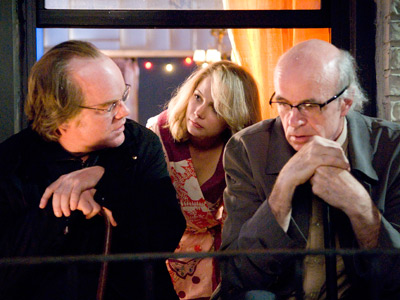
Andrew O'Hehir speaks with director Charlie Kaufman about his latest film, "Synecdoche, New York."
Andrew O’Hehir interviews director Charlie Kaufman about his latest film. Stephanie Zacharek reviews the film here.
A detail of the cover of"Anatomy of Injustice"
Make no mistake, Raymond Bonner’s new book, “Anatomy of Injustice: A Murder Case Gone Wrong,” is a movie idea begging to be greenlighted. It would make an ideal vehicle for Sandra Bullock (or maybe Julia Roberts), in a dirty blond wig, playing the tough but still idealistic defense attorney with a checkered past, alongside an unknown shoo-in for the supporting actor Oscar as the simple-minded handyman whose life she’s determined to save. Like a John Grisham novel, this story has an ass-covering posse of good ol’ boys running the rigged law-enforcement and judicial system in a small Southern town and a team of dedicated legal crusaders from outside who check into the local motel and sit cross-legged on the floor surrounded by boxes of files and takeout coffee cups. It’s a genuine whodunit, a page-turner and a tale of redemption. And it’s all true.
For all that, however, “Anatomy of Injustice” is also a blistering indictment of the death penalty. Assuming, dear reader, that you are yourself an opponent of capital punishment, it will only further cement your objections. It’s also a great book to hand to your less reflective or informed friends and relatives, the ones who may still support executions. Bonner, a Pulitzer-winning reporter who has long covered the issue for the New York Times and other publications, delivers a crackerjack feat of storytelling that steadily administers the truth about capital punishment like a slow, toxic IV drip.
The story begins with the discovery of a body in 1982: Handsome, well-off Dorothy Edwards, a 76-year-old widow and resident of rural Greenwood, S.C., who “could have passed for 56.” Her battered corpse was found in her closet by a neighbor. He helpfully pointed out to the police a beeping alarm clock, a full pot of automatically brewed coffee and an open copy of TV guide — all conspicuously pointing to a time of death — before suggesting that the 23-year-old man who’d recently washed Edwards’ windows seemed a likely culprit. Within days, the police had arrested Edward Lee Elmore, a soft-spoken, docile laborer of very limited intelligence, with the feeblest excuse for probable cause: Edwards had written Elmore a check and one of his fingerprints was found on the windows she’d paid him to clean. Do I even need to tell you that Edwards was white and Elmore black?
After that came a mockery of criminal investigation followed by a mockery of justice. The police failed to photograph the bed where they claimed Edwards had been brutally raped or to retain the bedsheets as evidence. Other evidence passed through an unusually large number of hands (some of them unaffiliated with the investigation), or disappeared and then eventually reappeared (or not). No one bothered to check out that so-helpful neighbor who discovered the body and recommended a suspect. The medical examiner delivered a convenient but highly improbable time of death in a report that an expert would later liken to the work of a “first-year intern.”
As for the public defenders initially assigned to Elmore’s case, one was a racist who referred to his client as “a red-headed nigger.” The other was, in the words of a detective convinced of Elmore’s guilt, “drunk through the whole trial.” The judge made no secret of wishing to wrap things up quickly. He allowed the father of a prosecutor’s best friend to sit on the jury and incorrectly informed the jurors that those who didn’t support the death penalty were obligated to recuse themselves. He also plainly indicated that he considered Elmore to be guilty. The locally powerful lead prosecutor engaged in a colorful array of misconduct. In a week, Elmore was sentenced to death.
Elmore’s advocates succeeded in overturning his conviction twice. He was awarded two additional trials. In the first he was assigned the same incompetent defense attorneys (Bonner describes it as a “video replay” of the original trial) and in the second (which was allowed to contest the sentencing only) a committed but inexperience defender was unable to outwit a wily, unscrupulous prosecutor to mitigate the penalty. Elmore’s case changed that young lawyer’s views on capital punishment by showing him a legal system plagued by outright finagling: “not human error,” he told Bonner, “but human manipulation … We don’t have the right as a civilized society to pass this judgment.”
Eventually, Elmore’s case came to the South Carolina Death Penalty Resource Center and Diana Holt, a freshly minted attorney at age 36. Holt had overcome a childhood and youth marred by sexual abuse, drugs and divorce. She was convinced of Elmore’s innocence and the further she and her colleagues pursued inquiries that should have been made by his original defense team, the more convinced they became.
Bonner is clear that most convicts on death row are guilty; at issue is not whether they committed the crime, but whether mitigating circumstances — in particular, mental deficiency — argue for life without parole. That death sentences will be appealed is taken for granted, but what Bonner underlines is the institutional defensiveness and inertia that makes those sentences so difficult to overturn. South Carolina judges were extremely reluctant to admit that South Carolina state attorneys and law enforcement could be negligent or deceitful, or their fellow judges remiss. A state attorney (like the one assigned to Elmore’s appeal) might one day expound on a prosecutor’s solemn duty to pursue justice not just victories, then battle fiercely to uphold a conviction even he can see is unjust.
Perhaps most appalling to the average citizen, the emergence of persuasive evidence of innocence after a conviction is often irrelevant to the appeals process. A condemned man’s defenders must instead rely on persuading judges that his constitutional rights were violated during his arrest or trial. “Innocence alone does not entitle a defendant to a new trial,” Bonner explains. While there are good reasons for this principle, it has led to such grotesqueries as a state lawyer arguing before the Missouri Supreme Court that an innocent man ought to be executed even if the court found “absolute” evidence exonerating him of the crime. (To their credit, the justices on that court ruled that “It is difficult to imagine a more manifestly unjust and unconstitutional result than permitting the execution of an innocent person.” Conservatives on the U.S. Supreme Court apparently disagree.)
In Bonner’s expert hands, the twists and turns of Elmore’s appeals, and the gradual discovery of the travesties in the original investigation and trial by Holt’s team, make for excruciatingly suspenseful reading. Perhaps some observers might object to the application of true-crime-style narrative devices to an issue so grave. But we love crime novels and courtroom dramas for the same reasons that we ought to care about the perversion that is capital punishment in America; all of us, deep down, want to see justice done. If it takes a Hollywood story line to get us to pay more attention to the contrast between our favorite fictions and the world we live in, then that seems fair enough.
Maggie Smith in "Downton Abbey"
I have a confession to make. “Downton Abbey” is getting on my nerves. This will be taken as heresy in some circles. More specifically, it will be almost treasonous in my own circles. But it’s become harder and harder to sit through the episodes of Season 2 (which concludes tonight) without feeling the need to constantly apologize — to my husband, in particular — for its excesses.
Let me be clear. I remain an avid fan. I loved “Downton Abbey” from the first moment I laid eyes on it. The lustrous sets. The gorgeous costumes. I could watch the upholstery on that show for an hour and be satisfied. Each month that passed between the end of Season 1 and the start of Season 2 brought a small heartache. I squealed just a little when the swelling violins took up again in January.
What’s changed is that “Downton” is now just another melodrama. What so many viewers fell in love with was not just the setting, or the clothes, or Lady Mary’s magnificent eyebrows (which, I’d like to note, deserve an entire plotline to themselves). It was the complexity of the whole. There was an attention to detail in Season 1 that drew the viewer into its world. So much of what made the show work could only happen in that house, during the years of 1913-1914. It gave the story an authenticity that made the experience akin to reading a novel instead of watching a television show. There was the housemaid who dreamed big and wanted to become a secretary. The Irish Socialist who somehow lived with the cognitive dissonance of serving as a chauffeur in an English estate. The middle-class lawyer thrust into the middle of the aristocracy. The closeted footman who couldn’t find any outlet for his passions.
It was all fantastic upstairs/downstairs stuff. Picking up where he had left off in “Gosford Park,” Julian Fellowes fleshed out the world of the manor house. Sure, there were the love affairs. Feckless, often cruel Mary played with Matthew’s emotions, but their relationship served a larger purpose. We saw the traps of upbringing and expectations in her conflicted feelings about marrying him. We experienced his confusion and wounded pride at being turned down when it seemed he wouldn’t actually inherit all the money.
Which is why, perhaps, “Downton Abbey” was appointment TV for my husband and me, two people whose tastes rarely coincide. He watches sports. I watch upholstery. But as the season has progressed, the groans from his end of the couch have gotten louder.
I knew we were in trouble during episode 4, when Matthew, feared captured or worse during the war, showed up unannounced in the middle of a concert for the recuperating officers and walked up the aisle, singing. There is no surer sign that a TV show has turned the corner into shameless soap opera than when a man walks up an aisle toward the woman he has jilted, leading the wounded in song.
Melodrama in and of itself is not a problem. The genre has a long and storied history, although it is not usually embraced by those with middle-brow pretentions as assiduously as “Downton Abbey” has been. “Uncle Tom’s Cabin” is nothing if not melodramatic, and it ignited the Civil War, at least according to Abraham Lincoln.
And let’s be honest, “Downton Abbey” has been a melodrama from the start. Set in a distant and unknown (but still familiar enough) culture whose customs and mores are foreign to us, Season 1 featured a family in peril, star-crossed lovers, evil machinations, the works. It’s an irresistible combination that writers have gone back to over and over again, from Gothic novels like “The Castle of Otranto” to vampire lit.
Season 2 does have some stalwart holdouts. The Dowager Countess’ tongue remains as tart as ever upstairs, and Mrs. Patmore still grounds the downstairs world with her earthy, observant candor. Beyond that, what’s left is the most basic, pedestrian soap opera. Sure, we’ve seen World War I and the Spanish flu, but as the season has evolved, everything and everyone has become merely contrivances to propel the sudsy plot. It’s gotten so that “Downton Abbey,” which used the conventions of the soap opera to such great and subtle purpose before, seems to check off each outlandish mark as it goes. Miraculous nonparalysis! Stolen kisses! Overheard conversations! Pretty young woman dead of a broken heart! Murder most foul!
More and more characters — especially the female ones — have become nothing more than useful plot points. We saw something of this in Season 1. Mary’s Turkish lover, for example, was ushered in and out quickly. The difference is that he had an immediate impact — the look of incredulity on Mary’s face when Pamuk suggests that his family would look down upon a match with her is still, to my mind, one of the series’ finest — and lasting importance. His visit, and his death in her bed, still haunt the show.
It’s hard to see how the presence of Jane, the housemaid conjured as if to fill Lord Grantham’s lonely, frustrated fantasies, will continue to resonate. And Lavinia, who finally acquired a scintilla of personality, had to be dispatched so that she’s not in the way of the real story anymore.
Other characters have gotten more one-dimensional, too. Where is Branson’s political fire? All he did for most of this season was stand around the garage mooning over Sybil. She’s proved herself worth it, but he has been reduced in the process. The new maid, Ethel, is a descendant of Tess of the D’Urbervilles and every disgraced relative in Jane Austen’s novels who give into physical passion and are punished for it. Whereas Gwen aspired upward to the heights of secretarydom, Ethel’s dreams are thwarted in the most conventional, and most sensational, way.
Most disappointing is how good everyone is turning out to be. The bitchy Mary, who would string a man along for money without a second thought, now spends most of every episode crying over her lost love. Taciturn Bates, who was so cut off — physically and emotionally — from everyone else, has been turned into a puppy dog in love. The bite is gone. The flawed characters we all loved, or loved to hate, have been flattened by niceness.
There is still a lot of drama to be mined from the characters and situations set up by “Downton Abbey.” England in the 1920s is still as foreign to us as it was in 1913. I will continue to watch. I want to see how Bates’ trial turns out. I hope Fellowes uses it as an opportunity to show us how justice was meted out back then, and how class plays a role in the proceedings and the verdict. I want to see how Sybil adjusts to the plebian life, and to be there when Matthew and Mary finally get together. Which they will. This is a melodrama, after all. Fantasy and wish-fulfillment have to play their parts. The beauty of “Downton” was that it made room for that while still giving viewers a meaty, layered look at a fully conceived world. Watching upholstery had never been this exciting.
The fate of the labor movement is the fate of American democracy. Without a strong countervailing force like organized labor, corporations and wealthy elites advancing their own interests are able to exert undue influence over the political system, as we’ve seen in every major policy debate of recent years.
Yet the American labor movement is in crisis and is the weakest it’s been in 100 years. That truism has been a progressive mantra since the Clinton administration. However, union density has continued to decline from roughly 16 percent in 1995 to 11.8 percent of all workers and just 6.9 percent of workers in the private sector. Unionized workers in the public sector now make up the majority of the labor movement for the first time in history, which is precisely why — a la Wisconsin and 14 other states — they have been targeted by the right for all out destruction.
The urgency is striking. Instead of being fundamentally discredited, the oligarchs and plutocrats who crashed our economy are raking in record profits and acting even more aggressively to bury the American labor movement once and for all. Over the last year, several labor leaders have told me that they believe unions have only about five more years left if they don’t figure out some kind of breakthrough strategy.
The complete collapse of unions would have devastating consequences. The labor movement has played a crucial role in advancing economic justice in the workplace and in politics. Union membership raises median weekly earnings and reduces race- and gender-based income gaps, and union workers are much more likely to receive health care and pension benefits than workers who are not members of a labor union. The decline of organized labor is directly linked to the rise in economic inequality over the last 40 years and the onset of a “Second Gilded Age.” The decline in union density coupled with the decline in the real value of the minimum wage explains one-third of the dramatic growth in wage inequality since the early 1970s.
Over the past 30 years, American employers have become even more aggressive at violating their workers’ rights to organize under a toothless and outdated labor law regime. Contrary to the intent of the 1935 National Labor Relations Act, which made it national policy to encourage and promote collective bargaining, the NLRA now provides incentives for employers to break the law routinely and ignore any compulsion to negotiate collective agreements. When there is little outrage for the daily violations of workers’ liberty (employers fire workers illegally in 1 in 3 union campaigns for attempting to exercise freedom of association), our democracy is in peril.
As worker power has eroded in the workplace, the labor movement’s political clout has also declined. Measured by both members and money, unions are still the most influential and resourceful left-wing constituency in American politics. Organized labor also remains the most powerful core of the national Democratic Party by several measures, including campaign contributions, grassroots mobilization efforts, lobbying and setting the party’s legislative agenda. Indeed, the labor movement spent a record amount of money to help get a Democrat elected to the White House in 2008.
With a labor-friendly White House and a Democratic Congress, organized labor began strategizing about how and when to push for its No. 1 priority, the Employee Free Choice Act (EFCA). Labor law reform would not only help the flagging movement survive but also offer an indirect solution to our growing problems of economic inequality and the catastrophic Great Recession. By leveling the playing field between workers and employers, higher union density decreases wage inequality in the American labor market while increasing purchasing power of consumers.
But the move to pass EFCA failed, revealing just how weak organized labor has become. Now, with no hope for labor law reform in sight, is the time to rethink the role of the labor movement in the 21st century. Progressives need a strong and vibrant labor movement that focuses not just on workers’ rights, but can also act as a democratizing force advancing social justice and expanding worker, citizen and resident power in the workplace and in their communities.
The labor movement is the critical anchor and enabler of democracy grounded on a notion of freedom. Most people have an intuitive understanding of what democracy means: rule by the people (as opposed to rule by the few or an elite). Yet, as Corey Robin so eloquently points out in his book on fear, Americans give up their individual freedom and democratic voice every single day they walk into work. The workplace is an authoritarian dictatorship, and we accept this as legitimate.
Now is the time to challenge that feudal relationship. We need to call into question the assumption that Americans believe democracy stops at the workplace door. If we would not stand for a despot to rule over us with impunity, why do we let the boss do so every day of the workweek? Any progressive advance needs a strong labor movement to achieve a fully free and democratic workplace and society. This vision of freedom and democracy manifests in two domains: the workplace and the southern region of the country.
First, labor’s role must be made much more central at the workplace and in the economy more broadly. Labor can, and should, be a governing co-partner with business and government in the economy. What labor brings to the table is a vision of growth with equity. And there are already examples of this kind of union and worker organizational influence in the economy at the regional level. The Los Angeles Alliance for a New Economy (LAANE) and Working Partnerships USA, both in California, have shown how labor can become a governing partner in economic decision-making at the regional level.
Another aspect of centralizing labor’s role in the economy and advancing workplace democracy is to expand workers’ voice and power at the bargaining table. A 21st century vision of the American labor movement is one that destroys the divide between labor and community that has long governed the politics and practices of unions. What the emergence of new forms of worker organizations have taught us is that workers are also residents in communities, while residents are also workers, and there are organizational models available that take all workers’ identities into account.
While labor law constricts the scope of issues that unions can negotiate at the workplace, it doesn’t prevent worker organizations from bargaining in the political arena for affordable housing, equitable development, local, regional and national economic policy, criminal justice, or the wide range of issues that affect poor and working class people. Stephen Lerner, among others, has outlined what a wider scope of collective bargaining might look like. Imagine, for instance, that the United Auto Workers could negotiate over the environmental standards of the cars they produce instead of just wages and benefits. Such a vision requires a far-reaching campaign to redefine the scope of collective bargaining and workers’ voices at work. This is a 10- or 20-year effort to be sure, but one that will be crucial to any future the labor movement has in the U.S.
Directly related to expanding labor’s role in the economy and expanding the scope of collective bargaining is advancing freedom in the workplace. In short: democracy, over autocracy, at work. This would go beyond the softer slogan of the AFL-CIO’s “voice at work.” This is an admittedly long-term project. But several concrete demands arise out of the broad notion of a workplace democracy. For instance, the Employee Free Choice Act would have allowed workers a modicum of political liberty at the workplace; it aimed to restore workers’ rights to freedom of association. But a deeper and even more controversial demand proposes an end to management prerogative over all workplace decisions. Workplace democracy means truly giving workers a “voice” at work. Whether through work committees or required seats for employee representatives on the company’s board of directors, a deeper vision of workplace democracy enables workers’ voices to have a real impact.
The second domain for a 21st century labor movement is geographic: finally democratizing the South through the building of a Southern labor movement. After the CIO’s Operation Dixie failed to organize Southern workers in the late 1940s, with a few exceptions mostly in the public sector, organized labor gave up on the South. We’ve been suffering the consequences ever since. The Southern, Walmart model of low-wage labor markets is being imported to the North. We only have to look at the attack on public sector workers in Wisconsin and Michigan and the recent passage of Right-to-Work legislation in Indiana to understand that Northern governors and the Republican Party are trying to turn their states into Yankee versions of Southern Right-to-Work (for less) states.
Instead of retreating to a defensive posture, organized labor should launch an ambitious and bold campaign to organize the South. A Southern labor movement would galvanize workers in the region who, contrary to popular belief, would like to become dues-paying union members. Given the dramatic demographic changes occurring in the South involving increased migrations of people of color who tend to be the most pro-union and pro-worker organization (see the Coalition of Immokalee Workers’ recent victory over Trader Joe’s), the opportunity for organizing and building a Southern labor movement is greater today than even 60 years ago under Operation Dixie. This effort would not only transform the low-wage economic model of the South, it would prevent the race to the bottom from North to South, and most important, it would transform the politics of the region and fundamentally the country.
What grounds this vision of a 21st century labor movement is the core idea of extending what Americans claim to cherish in politics and civil society to the workplace: democracy, liberty and freedom. The consolidation of income, wealth and political power by the 1 percent over the last several decades is directly related to the decline of workers’ voice and power. Rebuilding a truly countervailing (and democratic) power, as the labor movement did in the 1930s and 1940s, will require a bold and convincing vision of workplace democracy and freedom. Workers and their organizations have historically played this anchoring role for progressive politics throughout American history. Now is the time to reclaim this historic charge for the 21st century.
Guatemalans deported from the United States are escorted by an immigration official upon their arrival at La Aurora International Airport in Guatemala City. (Credit: AP/Moises Castillo)
GUATEMALA CITY — “No one will throw you out of here,” says the woman with the jaunty ponytail and the cheer of a motivational speaker. “Here we’ll give you affection.” Then she sends some love in the direction of Guatemala, the ostensible home of the bleary-eyed deportees who have just descended from U.S. government-funded flights a few feet away. “Our volcanoes! Our mountains! Everything we have!”
By the time she gets to the tortillitas and tamales and call-and-response, the deportees — the vast majority of them young men, a handful of them minors — are smiling. Some of them even wink and flirt. This may well be the least exhausting part of their journey.
“Together, we’ll work to do what we can to help the country rise,” continues the greeter, a Guatemalan government employee meeting her third plane of deportees today. She’s poised with a wireless mic before a banner reading, “You’re already in your country with your people” in Spanish and Kekchi, a Mayan language.
But any enthusiasm transmitted to the deported, who then shuffle out the door carrying their earthly belongings in thin, transparent plastic bags, is often temporary.
“Some of them get on a bus here and go right back to the border with Mexico to cross again,” says Jorge, one of the employees here with the International Organization for Migration, which has a table set up just outside the holding room with telephones and transportation assistance. He is standing by the first of a series of one-way doors, handing out energy drinks. “Some of them have never been to the capital, or they don’t know how to speak Spanish because they’ve spent their lives in the U.S.” There are usually familiar faces among the pack; he saw one man who claimed to have been deported seven times.
Their initial needs are practical: changing Mexican pesos or U.S. dollars, figuring out if their families are on the other side of the iron door being guarded by a baby-faced, heavily armed soldier, getting a ride. After that, reintegrating from one of the wealthiest countries in the world to a country where 51 percent of the population lives on less than $2 a day, one beset with violent crime, is more complicated.
But more than ever, this return trip is the reality for migrants. Last year, the United States deported more undocumented migrants than ever in history, nearly 400,000 of them, a number that has skyrocketed from a mere 7,029 in 2004. After Mexicans, Guatemalans made up the largest group of deportees, with about 29,000 “forced returnees” by air. Another 28,000 were deported overland from Mexico. An estimated 1.3 million Guatemalans live in the United States, equal to about 10 percent of the Central American country’s population, and remittances – money sent home by migrants – regularly make up about 10 percent of GDP.
The surge in immigration enforcement, and in tools designed to ramp it up, began under President George W. Bush but has expanded under Barack Obama’s administration, a fact not lost on pro-immigration advocates, some of whom are refer to it in Spanish as the “deportation administration.” The strategy has been to target “criminal aliens,” rather than, as Obama himself put it, “folks who are just looking to scrape together an income.” In fiscal year 2011, 55 percent of deportees had been convicted of a crime, compared to 31 percent when Obama assumed office. That said, the Association of Immigration Lawyers of America (AILA) has pointed out that the Department of Homeland Security “made no distinction between people convicted of petty misdemeanors and violent felons, putting a person convicted of loitering on par with a drug kingpin.”
In a June memo, Immigration and Customs Enforcement Director John Morton said that pending deportation cases would be subject to “prosecutorial discretion,” meaning that special consideration would be given depending on family situation, length of time in the U.S., and so on. And President Obama also supports the DREAM Act, which would give a path to citizenship to young immigrants who were brought to the country as minors and are enrolled in the military or college but has repeatedly failed in the Senate. Meanwhile, intra-Republican discussions on the topic have in the past year ranged from Herman Cain suggesting Great Walls with alligator-filled moats, to Rick Perry coming under fire for supporting a Texas version of the DREAM Act, to Mitt Romney advocating “self-deportation.”
The Obama position seems to be trying to have it both ways: seeming tough on enforcement while suggesting humane, if narrow, accommodations. But according to a November survey AILA conducted of its members, “the overwhelming conclusion is that most ICE offices have not changed their practices since the issuance of these new directives.” Indeed, a recent report by the Applied Research Center estimated that 5,100 children are in foster care because their primary caregivers were deported; another report by the University of California at Berkeley Law School found that about one-third of the 226,000 immigrants deported under “Secure Communities,” a program that links local law enforcement to immigration status, had spouses or children who are U.S. citizens.
That includes men like the one who gave his name as Armas, deported from the last plane this February afternoon. It’s his first time back in Guatemala in 17 years. He’s left a wife and five children, including a newborn, back in New Jersey, all U.S. citizens. He thinks he was either 15 or 17 when he left, he isn’t sure. He says he was deported because in 1995, he was “drunk and stupid” and got a criminal record, though he declines to elaborate. What waits for him outside the gates, he isn’t sure – and anyway, he plans to be back in the U.S. soon.
Anastasio, 21, says he managed to stay in the U.S. for four years, working as a cook in a Mexican restaurant in Virginia until getting deported last summer. In December, he decided to make the crossing again. “I didn’t need a coyote, because I remembered the way,” he says. It was much harder the second time, he said. And that time, he was deported on the same day he entered the United States, after getting caught in a convenience store in Tucson, Ariz. He spent Christmas in detention. “I love Guatemala, but I had to get out for a better future,” he shrugs. His girlfriend is waiting for him back in Virginia, he says.
Anastasio can’t find the phone numbers for his family, who live in the northern lowlands of El Peten – he had them pinned to his pants, he says, but they didn’t make it through detention — and he has no idea where to reach them. So today he’s going to hop in the van for Casa del Migrante, a Catholic shelter in Guatemala City’s Zone 1 that hosts the most desperate cases.
*
If migrants come legless, says Father Francisco Pellizari, the Argentine-born priest who runs the shelter, they can stay a few months at Casa del Migrante. Train accidents in crossing Mexico are common enough that the center has a prosthesis expert on call. More often, the migrants get psychological counseling and legal counseling. Migrants can arrive traumatized, he says, either from harrowing experiences, like rape, assault, or being trafficked, during the crossing, or from the shock of their detention and deportation. (The consensus, unsurprisingly, is that it’s better to be detained in the U.S. than in a Mexican prison.) Migrants will often mortgage whatever possessions they have – usually land in the countryside, or their home – on the informal market at usurious rates, and if they get deported before they can earn much money, they return facing not just a sense of failure but also an enormous debt.
Casa del Migrante opened its receiving program in the Guatemala City airport last April in response to the jump in deportations; it works with the IOM, which in turn gets USAID funding for some of its reintegration programs. There are three Casas del Migrante in Mexico, and one more in Tecun Uman, a Guatemalan border town. (The organization publishes a magazine, the most recent issue of which contains a stinging critique of Obama administration policies and, in the back, a word puzzle — you have to find words like “crisis” and “security” — and a maze in which you “help a lost migrant” – a silhouette with a backpack – “find the way home.”)
Pellizari spent 14 years in the Mexican shelter, but says, “Here in Guatemala it’s worse, because there are even fewer opportunities. There are no jobs.” They can help with the first few weeks or months, but the long-term is beyond the resources of either the first-aid nonprofits or the existing Guatemalan governmental efforts. An IOM official told me they have helped 3,000 migrants with “social reintegration,” but said job placement services had so far managed to help only about 20 people find jobs, though more may have found employment on their own.
From what Pellizari is seeing, the migrants are undeterred by increased deportations or a tougher economic situation in the United States. Sometimes, he says, migrants’ families in Guatemala will even send what money they can to an unemployed relative in the U.S., a remittance in reverse to help them hang on until things improve.
Meanwhile, this month the IOM is collaborating on an ad campaign, mostly on local radio stations, in Guatemala and Mexico, trying to discourage people from migrating by discussing the significant risks and dangers in crossing the border. It can understandably be a touchy subject, not just with the government but with the average Guatemalan.
Miguel, a Guatemalan working in the tourism industry, told me he welcomed the spike in deportations. “They belong here with their families,” he said. “Only the greedy migrate.” In some towns, he claimed, men were marrying two women to meet the shortage of available husbands.
When tourists praise the more lavish houses that dot the side of the road – usually, the ones with more than one story – he says he tells them cheerfully, “That’s your money.” Besides, he says, all of the women who make the crossing get raped. He even knows a Mexican truck driver who smuggles women across the border. He bragged to his Guatemalan friend that he has the best job because he gets to “have sex” with a different woman every night. “He rapes them,” Miguel said, in case it wasn’t clear. (Among deportees, women commonly make up only about 5 percent.)
One 18-year-old Kekchi Mayan girl, Loita, has heard the stories – her parents told her about how women are raped by coyotes and narcotraffickers to try to get her to stay home. She even has a cousin who made it across the border that way. “I asked her how she could sleep with some man she didn’t want to sleep with,” she told me. “She said she just closed her eyes and thought about her family.” But she insisted she would migrate someday anyway. “I want to make my dreams come true,” she said. One American tourist she told this to, she recalled recently, asked her why on earth she’d want to leave. After all, the lake she lived near was so beautiful. Wasn’t that enough?
Back at the airport, another deportee, Oscar Gonzalez Mejia, knows his way around well. He spent eight years working in the United States, mostly in Maryland. But after getting deported last year, he was lucky enough to find a job — working for the IOM, greeting and helping fellow deportees. These days, it’s a growth industry.
(Credit: Adam Courtney)
Lux Alptraum is not your stereotypical adult-industry executive: She’s young, female, queer, Ivy-educated and based in New York. As the newly minted CEO of the porn blog Fleshbot, which until recently was part of the Gawker Media empire, Alptraum is proof of how the Internet is changing the face of the adult business.
She took “a long and winding road” to this point. In college at Columbia, she discovered the online amateur porn scene, which was exploding at the time. “There were a lot of different people doing things that were really fascinating and intriguing and not standard porn,” she says. Alptraum started modeling and doing cam shows for a site that specialized in “nerdy girls,” but after a year she quit and started her own site, That Strange Girl.
A few years later, after a stint teaching sex ed at an after-school program, she started Boinkology, a site about sex and pop culture. That got her noticed by the folks at Fleshbot, which has always specialized in a mix of sexy content from both porn and mainstream entertainment (for example, a red-carpet shot of a celebrity with a see-through dress or a sex scene on “Weeds”). She quickly rose from a contributor to associate editor to editor in chief.
The recent split with Gawker was a result of the fact that “Fleshbot required all this special attention,” she says, because everyone from advertisers to banks are scared of being associated with an adult site. “They couldn’t devote the energy to optimizing it, and it wasn’t bringing in enough to justify the problems it was creating.” In an interview last year, Gawker Media founder Nick Denton, who recently reported a record of 35.6 million unique visitors across all his Web properties, said Fleshbot accounted for only 5 percent of the company’s traffic.
So Denton put it up for sale. Alptraum can’t go into details because of “some nondisclosure stuff I signed,” but says, “Basically, they had a really short timeline on a sale, and there were interested people who just couldn’t make an offer in time. So it ended up going to me, basically.”
Now she’s the 29-year-old CEO of an adult site, and one of a growing number of women taking the helm of everything from porn production houses to sex toy companies. That said, the industry is still dominated by old white guys. But that’s slowly changing. Quentin Boyer, who has been in the industry since 1997, says “the shift in the ‘porn executive demographic’” began “in the late ’90s, when Internet-based companies began to assert themselves in the adult entertainment market.” Says Boyer, the public relations director for Pink Visual, a porn production company that advertises on Fleshbot and also happens to have a female CEO: “In my view, Lux is part of the wave of new talent that has arrived in the adult entertainment industry as a direct result of the industry’s ‘webification,’ if you will.”
Alptraum agrees. “I’m someone who’s kind of a Web native and who comes from a sex positive background of not necessarily embracing the dominant narrative of what’s sexy,” she says. “I’m kind of like the embodiment of what the Internet has done to porn.” By freeing up the means of production and giving direct access to niche audiences, the Web has empowered all sorts of people who don’t fit the typical porn mold to enter the business, and from all angles.
Women have slowly made progress outside the alt and Internet-based sectors of the industry too. “There are several video companies that have females in high-ranking positions,” says Mark Kernes, a senior editor at Adult Video News. For example, heavyweights Wicked Pictures, Vivid Entertainment and Digital Playground. Miller says, “Certainly the assumption from outside the business is that it’s male dominated, and that’s the majority still, but women have made a big impact in recent years.”
Much like Alptraum, Fleshbot is unusual within the industry. “They have tapped into a unique niche within the adult media and publishing world,” says Dan Miller, executive managing editor of XBIZ, an industry news source. “They’ve been able to dip their toes a little bit into both worlds.”
The site’s also unusual in terms of its “feminist and respectful ethos,” argues Alptraum. “It’s not vulgar, it’s not treating these performers in a degrading way,” she says. “We never shame anybody’s body because we believe that anybody who’s willing to put themselves forth as a sexual object is worth celebrating.”
But the biggest thing setting Fleshbot apart from other porn blogs is that it publishes straight and gay content side by side. “From a marketing perspective, that’s a real departure from the industrywide tendency to categorize and segregate content starting with sexual orientation as the first point of separation,” says Boyer. Instead, Alptraum sees the site as a collection of “anything that we feel could be hot.”
It’s a decidedly Internet-era mindset of plurality and pansexuality. “The reason why I’m able to run Fleshbot, and the reason why Fleshbot is in ascendance, is the same reason why alt porn became popular: the Internet is dramatically transforming the adult industry,” she says. “It’s not so much of a top-down dictation thing anymore.”
Page 1 of 15145 in All Salon
“Anatomy of Injustice”: Death in a small town
“Downton Abbey,” we’re breaking up
America’s last hope: A strong labor movement
What it’s like to be shipped home
A new breed of porn CEO — female
The Oscar favorite no one really likes
My Facebook angst
He was our eyes
Painting as Paris burned
Quick Hits: Yuja Wang plays live