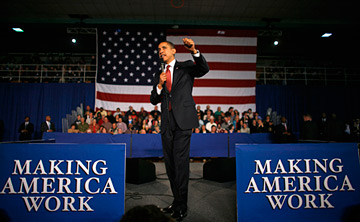

The president puts congressional pandering to the GOP in his rearview as he thrills a crowd in a Republican stronghold.

Reuters/Jim Young
President Obama takes part in a town hall meeting at Concord Community High School in Elkhart, Ind., Monday.
President Obama returned to the campaign trail Monday morning, a tad belatedly in my opinion, to sell his recovery and reinvestment plan. He went to Elkhart, Ind., which didn’t actually vote for him in November. This was smart bipartisanship, not the silly kind we’ve been seeing in Congress, where Democrats put ineffectual Republican ideas in the stimulus bill, and cut good ideas, but still get few or no GOP votes.
But the Elkhart region has the nation’s fastest-growing unemployment rate — it’s 15.3 percent, up from 4.7 percent only a year ago, and it’s been hit hard by RV-industry layoffs. The president didn’t screen his crowd or his questions, unlike his timid White House predecessor, but the rollicking hour-plus town hall felt like an Obama rally anyway. He laid out his spending priorities — getting money in the hands of people who’ll spend it, creating and saving jobs, and in the meantime, putting people to work doing things the country needs, not makework. And the crowd loved it.
Although he was speaking in a city that went for John McCain, Obama didn’t pander to congressional Republicans at all. In fact he tweaked them by repeating a line that reportedly hurts their feelings: “We can no longer … resort to the same failed ideas that got us into this mess in the first place. That was what the election was all about — that the American people rejected those ideas because they didn’t work. You didn’t send us to Washington because you were hoping for more of the same. You sent us there with a mandate for change, and the expectation that we would act quickly and boldly to carry it out — and that is exactly what I intend to do as president of the United States.” Obama warned that without bold action, “millions more jobs will be lost … and our nation will sink into a crisis that, at some point, we may be unable to reverse.”
To his credit, the president pitched his recovery and reinvestment plan as built around a “simple” core idea: “to put Americans back to work doing the work America needs done.” The plan would save or create 3 million jobs, he said, “but not just any jobs — jobs that meet the needs we’ve neglected for far too long and lay the groundwork for long-term economic growth.” Obama also laid out the underlying basis for putting money in low-income, working-class Americans’ hands, via targeted tax cuts, credits and rebates and expanded unemployment spending: “If you don’t have money, you can’t spend it. And if you don’t spend it, our economy will continue to decline.”
Then he showed exactly how it would help Indiana: by extending unemployment insurance and other support for 550,000 Indiana workers, a partially refundable $2,500-per-student tax credit “to help 76,000 Hoosier families send their kids to college,” and $1,000 tax cuts for Indiana families (he didn’t have a number for that; he needs to get one before he gets to Florida). He promised his plan would create or save 80,000 jobs in Indiana, and that infrastructure funding would improve “roads like US 31 here in Indiana that Hoosiers count on … and I know that a new overpass downtown would make a big difference for businesses and families right here in Elkhart.”
I was also happy to hear Obama strike a populist tone, to answer a question from a “foreclosure intervention counselor,” promising that he’d work to prevent foreclosures by making it easier for judges to modify mortgages in bankruptcy. “If you have a second, third, fourth or fifth home,” Obama started, to increasing laughter and then a few hisses there in Elkhart, where few have second, let alone fifth homes, “and you go bankrupt, then the judge can modify the terms of your mortgage on your second, third, fourth or fifth home. But, if you are like most people, including me, and you got one house (the house I’m in in D.C., I’m just borrowing that, it’s the people’s house) … you can’t modify that mortgage if you’re in bankruptcy.”
What Obama didn’t do: He didn’t specify which version of the recovery bill he preferred. He was mostly silent about the dysfunctional Washington debate, except to say, “Now I’m not going to tell you that this bill is perfect. It’s coming out of Washington, it’s going through Congress (laughs). But it is the right size, the right scope, and has the right priorities to create jobs that will jump-start our economy and transform it for the 21st century.” Maybe that’s smart politics; he’s trying to reach the American people, not pick a fight with any faction in Congress. He did give some signals about what he’d like to see in the bill by praising education construction and operations funding and home weatherization programs, which were reduced or eliminated by either the Senate bill or the Ben Nelson-Susan Collins compromise. I hope he’s fighting hard for those priorities behind the scenes.
Obama also didn’t zero in as quickly as he should have on how the bill would help Elkhart during the question-and-answer session. While I thought he was unbelievably effective answering these unfiltered questions — especially the one from the Republican who wanted him to have a beer with Sean Hannity — I thought he stumbled on the very first one, from a woman who wanted to know whether and how money would be spent directly in Elkhart. Obama rambled about his Recovery.gov site, which will let people see how it’s being spent, and about working with the state to find worthy programs, but he didn’t nail the question.
This is where he needs to get even more concrete, and I think over the next week he can. Wherever he goes, he should start with the estimated number of people in each city and state he visits who’ll get his tax cut or rebate. Then he should talk about working with school officials to decide on local school funding priorities, with the local mayor on city needs, then the governor on bigger state and local projects.
To prove Obama didn’t quite get the first question right, the very next person asked Obama how much of the bill would go into taxpayers’ mailboxes directly. He didn’t seem like a Republican, either: He told Obama to “support the people who got you into the office — we the people, not the fat cats.” That time, Obama got the answer right, and said he wouldn’t be giving any more tax cuts to the rich, because they don’t spend the money. But taken together, those first two questions in Elkhart showed there’s an enormous concern, even among Democrats, that the stimulus get money out directly to the people and places that need it.
As I was waiting to watch the Elkhart rally early Monday morning, I saw shots of people who slept outside Sunday night to make sure they got in to see Obama. But it turned out the cable news shots weren’t in Elkhart, but in Fort Myers, Fla., where he’s headed tomorrow (and where an excellent New York Times piece on Sunday showed the extent of the devastation and suffering). Folks in Fort Myers started lining up Sunday night for a Tuesday speech.
Obama was right, if late, taking his pitch to the voters. (GOP Gov. Charlie Crist will be by his side in Fort Myers, a nice way to flip off John McCain, who’s back to his cranky claims of “socialism!” about “that one.” This will be a decisive week in the battle over the economy, and over the future of the country. Let’s hope Obama hits the same feisty notes in his prime-time press conference tonight.
The bishops go off the deep end
Rejecting the Obama contraception compromise, they display their irrelevance to moral and political dialogue
Archbishop Timothy Dolan (Credit: AP/Patrick Semansky)
Just as I was publishing my post about Catholic tribalism on Friday, predicting that the brilliant White House “accommodation” on contraception wouldn’t mollify the U.S. Conference of Bishops, the bishops released a statement that made them seem, well, mollified, at least a little. The new Health and Human Services regulations were “a step in the right direction,” their statement read, and so I softened an assertion that the bishops would continue to wage war against the compromise.
I needn’t have soft-pedaled. Only a few hours later the bishops came out, guns blazing, insisting the only solution they would accept would be for “HHS to rescind the mandate for those objectionable services.” By any employer, for any employee in the entire country — a country where the vast majority of voters, and of Catholics, support Obama’s stand. And at Sunday Mass, bishops and parish priests throughout the nation read aloud the stunningly political letters about the controversy they already had planned. Now, with the bishops’ blessing, Republican are hard at work on legislation that would force HHS to strip the contraceptive coverage requirement for all employers, not just religious employers. Sen. Roy Blunt would allow employers to decline to cover any service they deem objectionable; Sen. Marco Rubio would restrict the legislation to contraception coverage.
I have a couple of reactions to the bishops’ extremism. First of all, as someone raised Catholic, I wonder why they’ve never read letters about any of their social justice priorities: universal healthcare, increased protection for the poor, labor rights, or action to curb climate change? Why does this topic – not even the morally challenging issue of abortion, but the universally accepted practice of birth control – merit such a thundering reaction from the pulpit?
Second, as an American, I also wonder: How do they continue to demand tax-exempt status when they’re railing in their churches about blatantly political – and divisively partisan – public concerns? As the first writer on my remarkably sane Catholic tribalism letters thread remarked, their public support for the extremist GOP position makes me think they should register as a Republican political action committee rather than remain a tax-exempt religious institution outside the bounds of politics.
Even as the bishops became more shrill and extreme, the debate over contraception coverage became smarter and calmer last week. Major Catholic organizations supported Obama’s Friday move, including the Catholic Health Association, Association of Jesuit Colleges and Universities and Catholic Charities USA. Before the president’s announcement, famed attorney David Boies did the most to usher in the new tone by framing the HHS rules as a matter of labor law. Boies doesn’t believe, by the way, that HHS is in any way required to provide the exemption for churches it wrote into its regulations even before the compromise. If the church is employing people, whether co-religionists or not, it has a responsibility to comply with employment law. He proved that even the administration’s initial regulations, exempting churches, was a strong attempt at accommodating anti-contraceptive religious groups.
But maybe the best argument on behalf of the Obama administration’s position comes from a very unlikely source, as Jay Bookman points out: Supreme Court Justice Antonin Scalia. In two different decisions, the conservative Catholic Scalia has sided with the court majority in finding that religious teachings can’t justify religious employers – or employees — failing to comply with labor law. In the 1990 Employment Division v. Smith decision, regarding an employer’s ability to fire a Native American employee who used peyote, despite the employee’s claim that using the drug was a religious rite, Scalia wrote:
“We have never held that an individual’s religious beliefs excuse him from compliance with an otherwise valid law prohibiting conduct that the State is free to regulate. On the contrary, the record of more than a century of our free exercise jurisprudence contradicts that proposition.” In an even more directly relevant 1982 decision holding that Amish employers must comply with Social Security and withholding taxes, though their faith bars participation in government support programs, Scalia wrote:
Respondents urge us to hold, quite simply, that when otherwise prohibitable conduct is accompanied by religious convictions, not only the convictions but the conduct itself must be free from governmental regulation. We have never held that, and decline to do so now.
I’ve written repeatedly that my inability to quit the Catholic Church entirely comes from the fact that its social teachings formed my social conscience, and to this day some of the people doing the most good for the poor and the excluded are devout Catholics. But the bishops are impossible to defend. Today, they are working on behalf of the Republican Party. “They have become the Pharisees,” says Andrew Sullivan, a conservative practicing Catholic. “And we need Jesus.”
I’ll be discussing the bishops’ GOP politicking on MSNBC’s “The Ed Show” at 8 pm ET.
Catholic tribalism and the contraceptive flap
Watching liberals defend a church they disagree with showed us that even Catholic insiders can feel like outsiders
Rick Santorum and David Boies (Credit: Reuters)
The resolution to the contraception contretemps seems mainly designed to do one thing: mollify the Catholics who defied the U.S. Conference of Bishops to support the Affordable Care Act in 2010. Church leaders are unlikely to officially back this so-called accommodation – the White House isn’t calling it a compromise — just as they continued to oppose the ACA even after President Obama did everything imaginable to insist the new law wouldn’t provide federal funding for abortion.
But the new agreement makes it possible for women’s groups and some liberal Catholic leaders to maintain a truce on hot-button social issues while working together around issues of women’s health and universal access to healthcare. Planned Parenthood and NARAL Pro-Choice America are happy with the solution, and so is Sister Carol Keehan of the Catholic Health Association, who endured withering heat from the bishops and their right-wing allies over the ACA. Kristen Day of Feminists for Life likewise backs the deal. Even New York Archbishop Timothy Dolan called it “a step in the right direction,” though he demanded more time to examine the fine print and suggested “legislation will still be required” to protect the church’s right to discriminate against women.
The bishops and the entire 2012 GOP field will continue to fight their culture wars, but the White House apparently believes the non-compromise will win them the middle ground and make the 24-7 cable news show wailing and hand-wringing – even by some liberals – go away. We’ll see.
But what just happened? Why did we spend 10 days listening to prominent Catholics, including even some liberals and Democrats, insist that the White House had overreached and trampled on “religious freedom” – in this case, the “freedom” of the Catholic hierarchy to impose rules that even most Catholics don’t live by? The great E.J. Dionne led the charge, but Catholic Democrats like Sens. John Kerry and Bob Case and Virginia’s Tim Kaine joined in, and occasionally, liberal TV hosts like MSNBC’s Lawrence O’Donnell and Chris Matthews seemed inclined to depict the controversy as being about the church’s right not to violate its own values. Vice President Joe Biden was said to be the leading voice within the administration warning Obama away from the issue.
“This has struck a tribal nerve in Catholicism,” conservative Catholic scholar George Weigel said to Chuck Todd on “The Daily Rundown” last Monday. “The Catholic Church has been beaten up over the last 10 or 11 years and I think Catholics are tired of the government and others beating up on the church.” His liberal co-religionist on the panel, E.J. Dionne, agreed. I found that fascinating, especially because most of us consider tribalism a bad thing in a multi-ethnic democracy.
Still, while I didn’t share that reaction, I recognized it. It amazes me sometimes, the extent to which Catholics still see themselves – ourselves — as outsiders. There’s a vestigial impulse to circle the wagons and protect our right to practice our persecuted religion (even if it’s no longer persecuted, and many of us don’t practice very much of it anymore). Where does it come from? I’ve spent a lot of time thinking about this lately, because the importance of Catholics to the old New Deal coalition, and their ongoing status as key swing-voters in key swing states, makes understanding them – us – important. This same old tribalism leaves many Catholics receptive to GOP blathering about out-of-touch “elites” who supposedly disrespect their religious freedom. It helped shift many white working-class Catholics to the Republican Party in the ’60s and ’70s.
There may be an element of remorse involved when liberal Catholics defend their faith, especially among those who defy the church (rightly, in my opinion) on its most blinkered teachings in the realm of women’s rights, gay rights and sexuality. For some it may be guilt: OK, I might not listen to the bishops, but I think we ought to demand that they’re respected in the public sphere. And for some it may be grief: We grew up with a rich tradition of social responsibility and spiritual meaning that’s unfortunately been warped by leaders who worship worldly power and have odd views about sex as well as women. While the child abuse scandal makes most Catholics sick, sometimes even I wince when non-Catholics judge the whole church by the corruption of a comparative (though very powerful) few. I have cousins and uncles and aunts who’ve joined religious orders (though, truthfully, most of them left). I don’t like seeing all of them considered perverts or pedophiles, or people who cover up for predators.
How Catholics work out their complex feelings about the church matters beyond the tribe, if only because they’re crucial to the 2012 election. One in four voters is Catholic, and Obama won a majority in 2008, while Republicans won them back in 2010. Obama lost white Catholics, however, although he won among those who say they aren’t regular churchgoers. I think Catholics remain an important, not always predictable constituency at least partly because of their own unresolved, unpredictable feelings about their religion, and their status as Americans.
I found myself thinking a lot about my own complicated feelings about my heritage as I watched Catholics grapple, not always rationally, with the contraceptive controversy. Even when I didn’t agree, I empathized.
- – - – - -
I grew up in a huge Irish Catholic clan on Long Island, but as an adult, I put away childish things (in the words of St. Paul, though not as he intended them) and became a secular feminist liberal Democrat. The first time I remember feeling anything like tribalism was after Sept. 11.
Many liberals around me criticized the overt religiosity of the public mourning for those killed that day, all that talk about God, which struck me as reflexively and needlessly anti-religion at a time when many Americans — dare I say most — found comfort in their faith. Then, after a benefit for survivors’ families turned a little rowdy, with one cop taking to the stage to say “Osama bin Laden can kiss my royal Irish ass,” the heavily Irish and Catholic cops and firefighters in attendance were roundly derided as right-wing tribalist rubes. That bothered me, too: Who did we think died trying to rescue those trapped in the World Trade Center, Susan Sarandon and Michael Moore? Members of my own family had worked in the rescue operation after the towers fell. I wasn’t down with the mockery.
A lot of my belated tribalism was a class thing: I’m not workin-class, but my parents and aunts and uncles were, and some of my cousins are still part of that ill-defined and disappearing demographic. There’s clearly an element of snobbery in the way the white working class is routinely run down as backward, racist, narrow-minded yahoos, and I’ve grown to resent it.
Yet in general, Catholics are doing pretty well for themselves. We’re well represented in certain segments of the American elite, especially elite punditry, it seems. It’s understandably hard for some people to imagine, in a world so striated by race and class, how Catholics could feel like oppressed outsiders. Yet it’s also true that while we’ve only elected one black president, we’ve only elected one Catholic president as well. I’m not trying to equate the struggles of black people and Catholics. In fact, it’s especially when you understand how relatively privileged Catholics have been, compared to African-Americans, that having only one Catholic president stands out, and makes you wonder: Why?
It’s hard not to conclude that some residue of the religious nativism that persecuted and stigmatized Catholics in the 19thcentury, defeated Al Smith in 1928, and forced John F. Kennedy to promise he wouldn’t take orders from the pope in 1960 persists to this day. So even if we haven’t personally experienced anti-Catholic prejudice, and I can’t say I have, there’s an atavistic memory, something bred in the bone, that forces many of us to defend our once-persecuted church, even when we profoundly disagree with it.
But it wasn’t until I debated the Family Research Council’s Tony Perkins on “Hardball” this week that the craziness of the right-wing Catholic alliance with conservative evangelicals became particularly obvious to me. They’ve locked arms with some of the very forces that once persecuted their ancestors – some of whom still despise Catholicism to this day. On “Hardball,” Perkins posed as a defender of the Catholic bishops’ position on Obama’s contraception rules. But he’s also been an ally to virulent anti-Catholics like Rev. John Hagee, who called the church “the great whore” and a “false cult.” And Rev. Robert Jeffress, who likened the church to Satan and labeled Catholicism a “fake religion.” Like Zionist Jews who’ve made common cause with right-wing evangelicals over Israel, some Catholics are lining up, in the name of religious freedom, alongside folks who want to wipe out their religion. I’ve heard some liberals express disdain for some of the church’s teachings, but I’ve never heard anyone compare it to Satan or call it a whore.
Zealous right-wing Catholics are in the minority, even if blowhards like Bill Donohue sometimes make the most noise. In the end, I think the contraceptive flap forced a lot of Catholics to reckon with the gulf between what they practice and what their church preaches. The truth was always there, if we wanted to find it, not merely in polling data that said 98 percent of sexually active Catholics have used birth control, but that solid majorities of Catholic voters supported Obama’s contraception regulations applying to large Catholic institutions, like hospitals, charities and universities, that employ non-Catholics. I loved the fact that students at Catholic universities held a press conference Thursday to support the president, and that organizations like Catholic Democrats and Catholics for Choice were active and vocal in standing up to their own bishops.
There are a lot of outstanding questions about the implementation of the administration’s non-compromise. But I have to disagree with Esquire’s Charles Pierce – I’m not sure that’s ever happened before – and say I don’t consider this any kind of cave on the president’s part or victory for the bishops. I prefer the interpretation of Frances Kissling, founder of Catholics for Choice, who wrote on Friday that the “accommodation” made the bishops the “losers” and women the winners. ”When the White House cares more about what a simple Catholic sister, [Sister Carol Keehan], thinks than about what the bishops think, Catholic women can applaud. Perhaps the crack in the patriarchy is becoming a deep canyon.”
I can’t go that far – especially after seeing this Think Progress report that documented what we all knew: that men dominated the debate over the controversy on cable news. It’s also a little sobering that so many of the liberal Catholic voices questioning the president were male, while most of the liberal voices backing him were female. But between this and the victory for Planned Parenthood in the Komen mess a week ago, I see evidence that we’re reaching a new place in the battle over gender. At the very least, being a woman is no longer a preexisting condition, as the Catholic Nancy Pelosi likes to say.
Reason vs. hysteria in the birth control debate
David Boies explains the issue in terms of labor law, while Santorum says Obama may lead us to the "guillotine"
VIDEO
Rick Santorum and David Boies (Credit: Reuters)
On Wednesday night we reached the high and the low, so far, in the debate over the Obama administration’s requirement that Catholic institutions that employ non-Catholics include contraception coverage in their health insurance policies.
The high, in terms of reason and clarity, came from famed attorney David Boies on MSNBC’s “The Last Word.” Lawrence O’Donnell has let male “liberal” pundits like Mark Shields wax a little shrill on his show, but to his credit, he offered the best rebuttal to all the shrieking I’ve seen so far: Boies calmly and clearly explaining the new regulations as an issue of labor law, and the government’s regulation of employers (relatively minimal, compared to other countries) on issues of health, safety and non-discrimination.
I’ve tried to make the same points: What if Catholics didn’t believe in child labor laws? Would we let church-run agencies flout them? Boies used the example of a religion that believed people shouldn’t work after age 60: Could they legally ban older people from employment? Of course, they could do neither. This is indeed an issue of religious freedom: the freedom of non-Catholics not to be bound by the dictates of the Catholic Church in the workplace.
But Boies, fresh off his 9th Circuit victory defending gay marriage, brought the legal knowledge. Watch below.
Of course, the very same night, the re-surging Rick Santorum offered the most shrill and hysterical reaction to the White House ruling, and in a week of shrillness and hysteria, that’s saying a lot. Santorum actually said that President Obama’s contraception ruling meant we are “headed down [the] road” to the French Revolution and the “guillotine.” That’s below, too.
If you watch the entire seven-minute clip, you’ll understand why, despite Santorum’s latest surge, I do not believe that even today’s Republican Party, though it’s been hijacked by the ultra-right, is capable of nominating him for president. Like so many right-wingers, he absolutely mangles what the Founders believed about religion. He says one problem with the French Revolution is that its slogan of “liberty, equality and fraternity” substituted fraternity, or “brotherhood,” for “fatherhood,” a reference to God the father, but also his right-wing belief in the centrality of male control to family and national stability. But his absolute craziness is best displayed in his remarks about the guillotine:
They are taking faith and crushing it. Why? When you marginalize faith in America, when you remove the pillar of God-given rights then what’s left is the French Revolution. What’s left is a government that gives you rights. What’s left are no unalienable rights. What’s left is a government that will tell you who you are, what you’ll do and when you’ll do it. What’s left in France became the guillotine.
Although Santorum said we’re “a long way from that,” he insisted that with the Obama presidency “we are headed down that road.” But watch the whole thing. Boies first, then Santorum. Reason before crazy. I’ll be talking about all of this on MSNBC’s “Hardball” today at 5 p.m. ET.
Reason:
Visit msnbc.com for breaking news, world news, and news about the economy
Now crazy (h/t Crooks & Liars):
We are the 98 percent
Catholics who ignore the church's teaching on contraception shouldn't expect Obama to follow it
(Credit: Reuters/Keith Bedford)
The Obama administration is facing a political crisis for making a common-sense decision: acting on the Institute of Medicine’s recommendation that health insurance plans cover contraceptive services. This is a test for the forces that mobilized to get the Susan G. Komen Foundation to reverse its politically cowardly decision to cut funding for Planned Parenthood. Clear political thinking about women’s health made a comeback in the backlash against Komen’s move; we need to make sure that clear political thinking prevails on the new Health and Human Services contraception regulations, too.
Predictably, the GOP presidential candidates are whacking Obama on the issue; fittingly, Rick Santorum is surging again, as this latest battle in the culture war rages. As always, the biggest hypocrite is Mitt Romney, who is attacking the president’s decision even though he went along with the same regulations in Massachusetts. And when the state enacted the universal health insurance law he used to be proud of, it covered the same “family planning services” as the new HHS regulations.
I knew the president’s decision would be controversial, but I underestimated the firestorm he would face. Since 98 percent of Catholics practice forms of contraception forbidden by the church at some point in their lives, according to the Centers for Disease Control, I assumed many of them would speak out in favor of the new regulations. How could they expect the president to follow church teachings if they did not?
I was wrong. Too many Catholics are insisting that while they may personally disagree with the church on contraception, they defend the bishops’ opposition to the HHS moves as a matter of “religious liberty.” Others are silent. But silence lets the most right-wing forces of reaction prevail. It’s time for the 98 percent to speak up.
This is indeed a matter of religious liberty – the liberty of non-Catholic women who work for Catholic employers to have the full spectrum of healthcare coverage, regardless of what the church believes.
Twenty-eight states already require church-run agencies to cover contraception in the health insurance they provide employees. Catholic Charities sued to oppose the regulation in New York, and lost. The world didn’t end; Catholic agencies in New York and those 27 other states now cover contraception. And they should: Women who have access to family planning services have lower infant mortality rates and healthier babies than those who don’t. Others take the birth control pill to deal with endometriosis or other reproductive system issues. Contraception has to be part of comprehensive healthcare for women.
On MSNBC’s “Morning Joe” Tuesday, Obama campaign strategist David Axelrod left the door open to a compromise with the bishops. That sounded dangerous. The worst move for the administration would be to take a courageous stand, rile up the right wing and Catholic bishops, and then cave and demoralize the women’s health advocates who are mobilizing to support the president. Later on “Daily Rundown” liberal Catholic E.J. Dionne suggested possibilities for compromise on the issue, while ultra-conservative George Weigel shot him down. There will be no “compromise” that leaves everyone happy. Either this is a matter of equity and the right approach to women’s health, or it’s not. And Catholics who ignore the church’s teaching on this issue have a special duty to speak up.
Karl Rove’s hissy fit: “Offended” by Chrysler ad
If Clint Eastwood sounded like Obama, it's because the GOP has ceded optimism to the Democrats
Karl Rove (Credit: Reuters/Fred Prouser)
I admit it: Chrysler’s “Halftime in America” Super Bowl ad reminded me of President Obama’s best recent speeches. Actor Clint Eastwood, the face of rugged American individualism, talked about “tough eras” and “downturns” and “times when we didn’t understand each other,” but then declared:
But after those trials, we all rallied around what was right, and acted as one. Because that’s what we do. We find a way through tough times, and if we can’t find a way, then we’ll make one…
This country can’t be knocked out with one punch. We get right back up again and when we do the world is going to hear the roar of our engines. Yeah, it’s halftime America. And, our second half is about to begin.
“I was, frankly, offended by it,” Rove said on Fox News Monday. “I’m a huge fan of Clint Eastwood, I thought it was an extremely well-done ad, but it is a sign of what happens when you have Chicago-style politics, and the president of the United States and his political minions are, in essence, using our tax dollars to buy corporate advertising.”
Rove wasn’t the only Republican who tried to cast the Chrysler ad as essentially payback to the president for supporting the bailout that kept the domestic auto industry alive. Michelle Malkin tweeted her horror Sunday night: “Agh. WTH? Did I just see Clint Eastwood fronting an auto bailout ad???”
Now, Clint Eastwood is no Democrat – he voted for John McCain in 2008, has been a Republican for most of his life, and now describes himself as having “libertarian” leanings. It’s hard to imagine he’d lend his name to an openly and intentionally pro-Obama ad. Chrysler has denied any political motive behind the Eastwood ad.
The flap over the ad confirms the GOP’s serious branding problem: The problem for Rove and the rest of the GOP is that their party’s narrative has become relentlessly negative, pessimistic and uninspiring. They’ve left the language of optimism and resilience, higher ground and common ground, to the Democrats, and lately President Obama has grabbed every opportunity to employ that language.
Rove is essentially complaining that anyone using rhetoric of resilience and tenacity, or suggests “we all rallied around what was right, and acted as one” sounds like a gosh-darn … Democrat. That’s good news for Democrats. There’s more good news in recent polls showing that Obama is winning back at least some white working-class voters with his feistier message of economic populism. The president’s approval/disapproval ratings have been dismal with whites who make less than $50,000, with his approval dropping into the low 30s and disapproval up in the mid-60s regularly over the last two years.
Now those numbers stand at 43-54, about where they were when Obama was elected. He may not carry that cohort, but holding the share he had in 2008 will make his reelection chances much better. There’s also good news with those same voters in some Rust Belt states, including Wisconsin, Ohio and, yes, Michigan, home of Chrysler.
Karl Rove is angry because he sees the numbers, too, and he’s got to explain them away with dark allusions to “Chicago politics.” But the fact is the president saved the auto industry at a time when Republicans, most notably Mitt Romney, urged him to let it die. If he gets credit for that unpopular decision, that’s because he deserves it.
And if Clint Eastwood sounds like a Democrat when he talks about American ingenuity and optimism, that’s because increasingly it’s Democrats who sound that way – and Republicans who don’t. Ronald Reagan co-opted buoyancy and hopefulness for a generation, painting Democrats from Walter Mondale and Michael Dukakis through Al Gore and John Kerry (with a break for Bill Clinton) as Negative Nellies, whiners and complainers always finding fault with America.
Now it’s Republicans who bad-mouth the American people, warning that lax morals and laziness are behind the problems of the poor and working class (including whites), and who paint scary dystopic pictures of America under its Kenyan anti-colonialist socialist black president. Karl Rove’s hissy fit over the Chrysler ad underscores exactly how bleak his party’s vision has become.
I’ll be on MSNBC’s “The Ed Show” at 8 p.m. ET to discuss Rove and the angry GOP.
Page 1 of 193 in Joan Walsh

Occupy fights the law: Will the law win?
The right’s lost causes
Unhappy Valentine’s Day in Israel
What a GOP cave looks like
Interview With My Bully: When I confronted my bully about racism
Iran’s Greens aim to rise again
The prettiest boy in the world
Should I donate a kidney to my friend?
America’s billionaire-run democracy
The bishops go off the deep end 

