
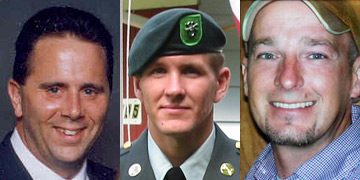

In addition to the stories of Adam Lieberman (read here) and Ryan Alderman (read here), Salon examined the cases of three other Fort Carson-based soldiers who committed suicide. A number of common themes emerged. 1) A stigma, within the culture of the Army, against seeking mental healthcare; 2) pressure to deploy soldiers despite medical problems; 3) a failure to diagnose or properly treat combat veterans with post-traumatic stress disorder or brain injuries, despite clear symptoms; 4) a tendency to overmedicate soldiers suffering from either stress disorders or injuries. Lieberman, Alderman and the three soldiers whose suicides are briefly described below all fell prey to one or more of these systemic failures.
Staff Sgt. Mark Waltz
On April 30, 2007, three days after an appointment at Evans Hospital, the Fort Carson hospital, Waltz fell asleep on the couch in his Colorado Springs home. He never woke up.
Forty-year-old Waltz, a member of the 3rd Battalion, 29th Field Artillery Regiment, had overdosed on painkillers. He needed the drugs to feel better. His body was falling apart. So was his mind. Waltz had “chronic” PTSD. Not only had a bomb exploded near him during his second tour of duty in Iraq, he had been ordered to pick up the body parts from other soldiers killed in the same explosion, according to his wife, Renea. He struggled with thoughts of harming himself. But he didn’t want to kill himself, because he didn’t want to leave his family behind.
When he died, it wasn’t a suicide. Waltz lost his life after Dr. Scot Tebo, a captain at Evans’ DiRaimondo clinic, prescribed methadone for Waltz’s chronic back pain. According to medical records, Waltz was already taking a powerful pain reliever, morphine. The combination of the drugs made a lethal cocktail. The local coroner ruled Waltz’s death a result of “mixed drug intoxication,” a medical accident.
In response, Fort Carson launched a “risk management” review, but nearly two years later still refuses to release the results, including whether any health workers were disciplined, saying the findings are protected under federal health privacy law.
Salon has learned, however, that Tebo was deployed to Iraq in 2007 to provide care for troops.
Sgt. 1st Class Kenneth P. Lehman
Lehman, a Green Beret, had served three overseas deployments — one of them in Iraq — before he was thrown from his all-terrain vehicle during a training exercise at Fort Carson in September of 2006, cracking his Kevlar helmet and causing bleeding inside his skull. He spent time in a Colorado Springs hospital and then was sent to the Veterans Affairs polytrauma unit in Palo Alto, Calif., as part of a medical boarding process that he and his parents expected meant the end of his military days — a retirement and a thank you from Uncle Sam, with benefits.
As his father, Paul Lehman, of Franklin, Penn., recalls, his son was proud to have served his country and wanted to keep doing it, but felt he could no longer live up to the Special Forces’ rigorous standards. His son suffered from memory loss, often not remembering what he’d done earlier in the day. He even had to turn his head sideways just to read a menu because of brain and vision issues: “He just wasn’t the same after the accident.”
In January 2007, Lehman was still grappling with post-concussion syndrome, a form of traumatic brain injury that gave him headaches, made it difficult to concentrate and even caused emotional turmoil. A friend said Lehman would forget medical appointments. He was seen wandering around Fort Carson lost, although he knew the post well. A doctor at Evans noted that Lehman struggled to see, suffering from double images in late January 2007, according to his medical records.
Yet Douglas McNinch, an Evans neuropsychologist, determined on Feb. 1, 2007, that although Lehman “still has some minor cognitive problems” he could be returned to the war in Iraq.
The threat of a looming deployment sparked a deterioration in Lehman’s condition that the Army missed again and again. Days later, on Feb. 10, 2007, Lehman was rushed to a clinic after his roommate found him lying unconscious on his couch next to a bottle of Valium, prescribed to him for stiffness and head pain. The clinic concluded that Lehman did not attempt suicide, after speaking with Lehman and a “psychologist who feels that the patient was never suicidal and feels that this was somewhat of a confusing episode.” Lehman also told a counselor he was eager to go to Iraq.
But his friends and family say the Army dropped the ball. Lehman privately complained about the care he was receiving and was probably telling people at the clinic what they wanted to hear. He didn’t want to appear weak; he was a Special Forces soldier. Yet the incident unmasked new problems. Lehman, who had been exposed to combat and lost friends, now had “chronic” PTSD and depression.
By November 2007, he was again admitted to a clinic, this time after a clash with an ex-girlfriend. He said he had taken “a bunch of Valium to go to sleep,” Dr. Mary Zesiewicz wrote in his medical record. Lehman again denied it was a suicide attempt, she wrote. He was released.
On Jan. 30, 2008, Lehman was at Evans. He had to discuss issues surrounding his brain injury, his medical records say. While there, he told Robert M. Lee, a mental health assistant, he was having personal and legal problems. Lee described Lehman as “frustrated,” “depressed,” “fearful” and “anxious.” Again Lehman denied that he was suicidal and was told to return for follow-up on Feb. 1, 2008. Strangely, records for that meeting show Lee noting a vast change in Lehman. He was now in “very good spirits,” “happy” and “pleased,” according to his records.
The next day, Feb. 2, 2008, Lehman would finally succeed at killing himself, using his medical knowledge. He went into his barracks bathroom with a syringe filled with Lidocaine. He released the anesthetic into his body. Then, using a surgical blade, he cut deep into his left wrist, holding his arm over the bathtub.
Fellow soldiers discovered his body and called for paramedics. It was too late. The 31-year-old Lehman was pronounced dead at Evans hospital, where he’d been one day earlier.
Lehman’s suicide was a series of missed chances. He was too tough a case for the psychological workers who served him.
“He just never seemed to get the care he deserved,” his father says. “I feel Evans never took a good look at what was really going on with him.”
Moreover, the final entry in Lehman’s medical record appears suspicious to the Lehmans. Their son’s upbeat perspective on Feb. 1 wasn’t added to his medical record until Feb. 4, two days after he died.
It is common practice for military health workers to enter information within 72 hours of a medical appointment, according to experts. The Lehmans, however, say their son’s medical record shouldn’t have been touched, especially since their son had been to the clinic before his death. They feel there should have been an investigation into whether their son received adequate psychological care. The Army’s Criminal Investigative Division launched a routine suicide inquiry following Lehman’s death, but so far has withheld its conclusions from the Lehmans.
The couple now want an independent probe by Congress regarding their son’s case.
“I think they’re going to have to clean house and get rid of all these quack doctors they’ve got working there [at Evans],” says Paul Lehman. “[The] Army let Ken down,” adds his wife, Kelly.
Staff Sgt. Chad Barrett
Linda Helton feels the same way about the death of her son, Chad Barrett, who committed suicide on the same day as Ken Lehman. “It’s just so difficult to talk about,” she says, weeping. “We all loved Chad.”
Five weeks after Fort Carson sent Barrett to Iraq with the 4th Infantry Division, he swallowed a lethal combination of prescription antidepressants and sleeping pills.
Barrett, 35, was suffering from acute PTSD, a traumatic brain injury and had trouble sleeping after two tours of Iraq, according to his medical records. And, as a third tour loomed, it seemed, he was on his way out of the Army after 11 years of service. Officials had begun the process of formally retiring him because of his PTSD, according to his medical records. In 2007, he had attempted suicide. A commander wrote: “[A]ll specialists and command agree it is time for Chad to be removed from the United States Army.”
Yet Chad’s wife, Shelby Barrett, claims her husband didn’t want to let his buddies down. So she and her husband met with commanders and convinced them to change their minds. Doctors and commanders halted a medical evaluation process meant to determine Barrett’s level of disability for retirement — a process that mandated Barrett receive “no assignments remote from definitive psychiatric care.” Instead, he would go to Iraq to serve as an overnight radio operator.
Before Barrett was deployed on Christmas Day, 2007, Dr. Jonathan A. Olin, an Evans hospital psychiatrist, concluded Barrett had “no suicidal intent.” Along with his gear, Barrett packed up eight active prescriptions, including Klonopin for his anxiety and Ambien to help him sleep.
Only weeks after arriving in Mosul, dark thoughts crept into his mind. There were heavy losses among his comrades and he told his parents in an e-mail that he had reached the breaking point: “I can try to play tough all I want, but I know that I am not and that I need help.”
His parents encouraged him to find help, but he wrote that he wasn’t sure where to turn. The Army only wanted “the correct number of people on the ground … no matter what the cost,” he wrote just hours before he killed himself, adding, “Well everyone will find out the cost soon enough.”
After receiving the e-mail, Barrett’s family tried to reach the Red Cross to get them to intervene. It wasn’t easy; many hours passed. Finally, Helton got a message through. It was relayed to Barrett’s superiors at 7:55 a.m. on Feb. 2, 2008. But by the time superiors tracked down Barrett at 8:30 a.m., his roommate and medics were already in the throes of trying to save his life.
“Next thing I knew I was getting a call that Chad was gone,” Helton says, adding, “Why didn’t the Army do more to watch him? They knew he had troubles when they sent him; they should have never sent him.”
Barrett’s note, on yellow legal paper, was simple. On the outside it was marked, “THOUGHTS IN MY HEAD.” On the inside, Barrett wrote a long list of one-line statements: “Lost,” “Hopeless,” “Anger,” “Sadness,” “Wanting to cry,” “No reason or purpose in life … Failed as a soldier … Wanting to die … Command will get rid of their problem soldier …”
The Army’s Criminal Investigative Division conducted an inquiry, but not to investigate whether the care system had failed Barrett, as Helton had hoped. Instead, in a finding that Helton calls an insult to her son’s memory, investigators concluded that when Barrett killed himself, he broke military law because he did not take his medication in the prescribed dosage. In other words, had Barrett lived, he could have faced a court-martial for “wrongful use of a controlled substance.”
Helton also wonders whether some of the drugs the Army prescribed to her son made him feel suicidal. For example, Barrett was prescribed Clonzepam and Topiramate. Both include warnings that suicide could be an adverse reaction.
After his 2007 suicide attempt, Helton argued that prescription antidepressants could be the cause. While on the drugs, Barrett seemed confused, she says: “It didn’t even sound like my son.” When Barrett was taken off the drugs during hospitalization at a clinic, he returned to his good-natured self, she adds.
Still, Barrett found it tough to adjust to life after war. “He had nightmares,” Helton says. “He told me, ‘I don’t know how to turn it all off.'”
Army care, particularly at Fort Carson, she says, should be investigated. But it seems that nobody cares. “It’s hard to get people involved when you are fighting an Army,” Helton says. “The Army said it would be there for my son in his time of need. But they weren’t. His life is truly a great loss.”
