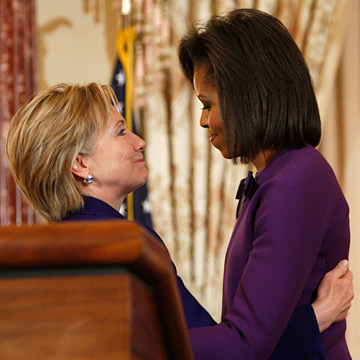

Hillary Clinton and Michelle Obama get together to advance a bold agenda. Plus: Clinton 2016?

Reuters/Jim Young
U.S. first lady Michelle Obama (R) hugs Secretary of State Hillary Clinton during a ceremony announcing this year’s recipients of the Secretary of State’s Award for International Women of Courage in Washington March 11, 2009.
Pinch me. I’m watching a lovefest between Secretary of State Hillary Clinton and first lady Michelle Obama as they celebrate Women’s History Month at the State Department. Having lived through crazy coverage of their alleged enmity last year – and honestly, I wouldn’t be surprised if feelings flared during the bitter primary – it’s a thrill to watch them work together on global women’s rights issues with such obvious warmth between them.
Melanne Verveer, the former Clinton chief of staff who’s been running the indispensable Vital Voices, devoted to women’s rights and empowerment around the world, was announced as Clinton’s new ambassador for Global Women’s Issues. Meanwhile, President Obama tapped his confidante, Valerie Jarrett, to run an Interagency Task Force on Women and Girls.
I also enjoyed learning from the New York Times profile of Sen. Kirsten Gillibrand that “hard-core Hillary supporters are fully expecting her to run again in 2016,” according to a New York official with “deep Clinton ties.” That seems like a long way off, but it’s interesting nonetheless. I met Gillibrand at an event in San Francisco Sunday and I was impressed by her; I’ll say more when I learn more.
Obama still has a big mess ahead of him, but it’s been impressive to watch the best of the Clinton and Obama teams come together. There is no more important thing we can do for developing countries than improve conditions for women, and after years of hearing that rhetoric, it’s great to know the country and the State Department are being run by people who believe it. The March madness of last year seems like decades ago, doesn’t it?
My debate with Charles Murray
His genetic fatalism made it hard to find solutions to the dangerous American class divide we both lament
Charles Murray
I debated Charles Murray today on WBUR’s “On Point” with Tom Ashbrook. You can listen to it here.
I shouldn’t admit this, but I almost didn’t review Murray’s “Coming Apart: The State of White America, 1960 to 2010.” I told my editors it was just a mashup of his two most infamous books, “Losing Ground” and “The Bell Curve:” Welfare programs make poverty worse, not better, and social support can’t help the poor and struggling rise up, anyway, because they’re low-IQ losers. Only in this book, Murray confined his analysis to poor and struggling white people, to defuse charges of racism that greeted his two earlier bestsellers. I decided to write about the book anyway, but I thought it would be of little interest except to wonky people like me.
What do I know? “Coming Apart” is No. 9 on the New York Times nonfiction bestseller list, and it’s been reviewed, with varying degrees of respect, almost everywhere that matters. The good news is, even on the right, some critics reject Murray’s fatalism. I practically never agree with the New York Times’ Ross Douthat, but in his review of “Coming Apart,” he acknowledges that finding “ways to make it easier for parents to manage work-life balance when their kids are young” might help working-class families stay together, and maybe even more important, that “high incarceration rates” are to blame for the shortage of men in low-income communities. Douthat and I found some common ground there, thanks to Charles Murray.
David Frum, a conservative with whom I agree more frequently, wrote a magisterial five-part takedown of Murray’s book here. Frum writes about something I’ve been harping on lately: the way government worked to create the American middle class after the twin shocks of the Great Depression and World War II. He notes that the so-called greatest generation was also “the statist generation,” and ties the troubles of the white working class to the decline of industries as well as policies that once provided it with security and economic mobility. Contrary to Murray’s depiction of a golden, harmonious age of unfettered capitalism, Frum shows that it wasn’t unfettered capitalism that created the mythical middle class; it was quite fettered capitalism.
I winced at one line in Frum’s review, though, and that’s when he noted that he still admires “Losing Ground.” I’m not sure how Frum can be so right about “Coming Apart” and so wrong about “Losing Ground.” Murray’s 1984 work held that poverty programs were to blame for worsening poverty, since they supposedly rewarded indolence and punished two-parent families, and he paid special attention to rising rates of welfare recipiency and single parenthood in low-income black communities. Since then, we sponsored a massive social experiment based on Murray’s claims: We ended welfare as we knew it, requiring that recipients either work or engage in serious job training and capping eligibility at two years consecutively and five years lifetime. While it may have (briefly) looked as though welfare reform encouraged industry in the underclass, more poor people got jobs in the 1990s largely because there were more jobs for the getting: 22 million were created in the eight years of the Clinton administration. Those trends have since reversed, and all the while rates of single motherhood continued to climb. Murray was as wrong about black families in 1984 as he is about white families today.
“On Point” host Tom Ashbrook did a great job parrying Murray’s claims, but we didn’t spend much time discussing Murray’s genetic fatalism. This book continues where “The Bell Curve” left off: It warns that the nation is splitting into a highly educated, highly privileged elite (the residents of his composite “Belmont”) and an increasingly large lower class (the denizens of fictional “Fishtown”). At bottom, though, Murray believes that the widening gulf is due to modern society finding better ways to identify and reward the highly intelligent among us. And since IQ is “intractable” – Murray no longer uses the words “genetic” or “innate” – the various ways we decide to structure society and create opportunity won’t make much of a difference. As I come from a people – Irish Catholics – whose median IQ has climbed along with the opportunities provided to us, I know that Murray is wrong. IQ is not destiny.
I’ve written at length about my problems with the book, and with Murray’s attributing the success of America’s uber-class to their industriousness and religiosity along with their superior intelligence. I don’t need to rehash it. But in preparing for the debate I found an interesting exchange in an online chat hosted by the Wall Street Journal that displays Murray’s thinking on these issues even more clearly than his carefully phrased and (slightly) nuanced book does. One reader asked whether predatory banking conditions in low-income communities might play a role in their unraveling, and Murray quite simply said no.
We’re talking about IQ more than culture. It helps to be living in a neighborhood where smart actions about money are common, but the main breakdown is IQ. Lots of smart people in Fishtown do the right thing, but (politically incorrect warning) there are more smart people in Belmont than in Fishtown.
If you’re looking for a quick synopsis of “Coming Apart,” you’ve got it right there.
Murray closed our debate by telling Ashbrook that he’s pessimistic about reversing these trends. I said I’m optimistic. I joked on Twitter today that my (almost finished) book is a rejoinder to Murray’s pessimism. Maybe I’ll call it “Coming Together: How the White Working Class Woke Up and Realized the Right Now Thinks They’re Dumb and Lazy, Too.” Given the role of race and racism in dividing the Democratic Party, I believe the naked class bias of the GOP might help white working-class voters see that by voting Republican, they’re dismantling the opportunity society that once made success more widely possible.
The bishops go off the deep end
Rejecting the Obama contraception compromise, they display their irrelevance to moral and political dialogue
Archbishop Timothy Dolan (Credit: AP/Patrick Semansky)
Just as I was publishing my post about Catholic tribalism on Friday, predicting that the brilliant White House “accommodation” on contraception wouldn’t mollify the U.S. Conference of Bishops, the bishops released a statement that made them seem, well, mollified, at least a little. The new Health and Human Services regulations were “a step in the right direction,” their statement read, and so I softened an assertion that the bishops would continue to wage war against the compromise.
I needn’t have soft-pedaled. Only a few hours later the bishops came out, guns blazing, insisting the only solution they would accept would be for “HHS to rescind the mandate for those objectionable services.” By any employer, for any employee in the entire country — a country where the vast majority of voters, and of Catholics, support Obama’s stand. And at Sunday Mass, bishops and parish priests throughout the nation read aloud the stunningly political letters about the controversy they already had planned. Now, with the bishops’ blessing, Republican are hard at work on legislation that would force HHS to strip the contraceptive coverage requirement for all employers, not just religious employers. Sen. Roy Blunt would allow employers to decline to cover any service they deem objectionable; Sen. Marco Rubio would restrict the legislation to contraception coverage.
I have a couple of reactions to the bishops’ extremism. First of all, as someone raised Catholic, I wonder why they’ve never read letters about any of their social justice priorities: universal healthcare, increased protection for the poor, labor rights, or action to curb climate change? Why does this topic – not even the morally challenging issue of abortion, but the universally accepted practice of birth control – merit such a thundering reaction from the pulpit?
Second, as an American, I also wonder: How do they continue to demand tax-exempt status when they’re railing in their churches about blatantly political – and divisively partisan – public concerns? As the first writer on my remarkably sane Catholic tribalism letters thread remarked, their public support for the extremist GOP position makes me think they should register as a Republican political action committee rather than remain a tax-exempt religious institution outside the bounds of politics.
Even as the bishops became more shrill and extreme, the debate over contraception coverage became smarter and calmer last week. Major Catholic organizations supported Obama’s Friday move, including the Catholic Health Association, Association of Jesuit Colleges and Universities and Catholic Charities USA. Before the president’s announcement, famed attorney David Boies did the most to usher in the new tone by framing the HHS rules as a matter of labor law. Boies doesn’t believe, by the way, that HHS is in any way required to provide the exemption for churches it wrote into its regulations even before the compromise. If the church is employing people, whether co-religionists or not, it has a responsibility to comply with employment law. He proved that even the administration’s initial regulations, exempting churches, was a strong attempt at accommodating anti-contraceptive religious groups.
But maybe the best argument on behalf of the Obama administration’s position comes from a very unlikely source, as Jay Bookman points out: Supreme Court Justice Antonin Scalia. In two different decisions, the conservative Catholic Scalia has sided with the court majority in finding that religious teachings can’t justify religious employers – or employees — failing to comply with labor law. In the 1990 Employment Division v. Smith decision, regarding an employer’s ability to fire a Native American employee who used peyote, despite the employee’s claim that using the drug was a religious rite, Scalia wrote:
“We have never held that an individual’s religious beliefs excuse him from compliance with an otherwise valid law prohibiting conduct that the State is free to regulate. On the contrary, the record of more than a century of our free exercise jurisprudence contradicts that proposition.” In an even more directly relevant 1982 decision holding that Amish employers must comply with Social Security and withholding taxes, though their faith bars participation in government support programs, Scalia wrote:
Respondents urge us to hold, quite simply, that when otherwise prohibitable conduct is accompanied by religious convictions, not only the convictions but the conduct itself must be free from governmental regulation. We have never held that, and decline to do so now.
I’ve written repeatedly that my inability to quit the Catholic Church entirely comes from the fact that its social teachings formed my social conscience, and to this day some of the people doing the most good for the poor and the excluded are devout Catholics. But the bishops are impossible to defend. Today, they are working on behalf of the Republican Party. “They have become the Pharisees,” says Andrew Sullivan, a conservative practicing Catholic. “And we need Jesus.”
I’ll be discussing the bishops’ GOP politicking on MSNBC’s “The Ed Show” at 8 pm ET.
Catholic tribalism and the contraceptive flap
Watching liberals defend a church they disagree with showed us that even Catholic insiders can feel like outsiders
Rick Santorum and David Boies (Credit: Reuters)
The resolution to the contraception contretemps seems mainly designed to do one thing: mollify the Catholics who defied the U.S. Conference of Bishops to support the Affordable Care Act in 2010. Church leaders are unlikely to officially back this so-called accommodation – the White House isn’t calling it a compromise — just as they continued to oppose the ACA even after President Obama did everything imaginable to insist the new law wouldn’t provide federal funding for abortion.
But the new agreement makes it possible for women’s groups and some liberal Catholic leaders to maintain a truce on hot-button social issues while working together around issues of women’s health and universal access to healthcare. Planned Parenthood and NARAL Pro-Choice America are happy with the solution, and so is Sister Carol Keehan of the Catholic Health Association, who endured withering heat from the bishops and their right-wing allies over the ACA. Kristen Day of Feminists for Life likewise backs the deal. Even New York Archbishop Timothy Dolan called it “a step in the right direction,” though he demanded more time to examine the fine print and suggested “legislation will still be required” to protect the church’s right to discriminate against women.
The bishops and the entire 2012 GOP field will continue to fight their culture wars, but the White House apparently believes the non-compromise will win them the middle ground and make the 24-7 cable news show wailing and hand-wringing – even by some liberals – go away. We’ll see.
But what just happened? Why did we spend 10 days listening to prominent Catholics, including even some liberals and Democrats, insist that the White House had overreached and trampled on “religious freedom” – in this case, the “freedom” of the Catholic hierarchy to impose rules that even most Catholics don’t live by? The great E.J. Dionne led the charge, but Catholic Democrats like Sens. John Kerry and Bob Case and Virginia’s Tim Kaine joined in, and occasionally, liberal TV hosts like MSNBC’s Lawrence O’Donnell and Chris Matthews seemed inclined to depict the controversy as being about the church’s right not to violate its own values. Vice President Joe Biden was said to be the leading voice within the administration warning Obama away from the issue.
“This has struck a tribal nerve in Catholicism,” conservative Catholic scholar George Weigel said to Chuck Todd on “The Daily Rundown” last Monday. “The Catholic Church has been beaten up over the last 10 or 11 years and I think Catholics are tired of the government and others beating up on the church.” His liberal co-religionist on the panel, E.J. Dionne, agreed. I found that fascinating, especially because most of us consider tribalism a bad thing in a multi-ethnic democracy.
Still, while I didn’t share that reaction, I recognized it. It amazes me sometimes, the extent to which Catholics still see themselves – ourselves — as outsiders. There’s a vestigial impulse to circle the wagons and protect our right to practice our persecuted religion (even if it’s no longer persecuted, and many of us don’t practice very much of it anymore). Where does it come from? I’ve spent a lot of time thinking about this lately, because the importance of Catholics to the old New Deal coalition, and their ongoing status as key swing-voters in key swing states, makes understanding them – us – important. This same old tribalism leaves many Catholics receptive to GOP blathering about out-of-touch “elites” who supposedly disrespect their religious freedom. It helped shift many white working-class Catholics to the Republican Party in the ’60s and ’70s.
There may be an element of remorse involved when liberal Catholics defend their faith, especially among those who defy the church (rightly, in my opinion) on its most blinkered teachings in the realm of women’s rights, gay rights and sexuality. For some it may be guilt: OK, I might not listen to the bishops, but I think we ought to demand that they’re respected in the public sphere. And for some it may be grief: We grew up with a rich tradition of social responsibility and spiritual meaning that’s unfortunately been warped by leaders who worship worldly power and have odd views about sex as well as women. While the child abuse scandal makes most Catholics sick, sometimes even I wince when non-Catholics judge the whole church by the corruption of a comparative (though very powerful) few. I have cousins and uncles and aunts who’ve joined religious orders (though, truthfully, most of them left). I don’t like seeing all of them considered perverts or pedophiles, or people who cover up for predators.
How Catholics work out their complex feelings about the church matters beyond the tribe, if only because they’re crucial to the 2012 election. One in four voters is Catholic, and Obama won a majority in 2008, while Republicans won them back in 2010. Obama lost white Catholics, however, although he won among those who say they aren’t regular churchgoers. I think Catholics remain an important, not always predictable constituency at least partly because of their own unresolved, unpredictable feelings about their religion, and their status as Americans.
I found myself thinking a lot about my own complicated feelings about my heritage as I watched Catholics grapple, not always rationally, with the contraceptive controversy. Even when I didn’t agree, I empathized.
- – - – - -
I grew up in a huge Irish Catholic clan on Long Island, but as an adult, I put away childish things (in the words of St. Paul, though not as he intended them) and became a secular feminist liberal Democrat. The first time I remember feeling anything like tribalism was after Sept. 11.
Many liberals around me criticized the overt religiosity of the public mourning for those killed that day, all that talk about God, which struck me as reflexively and needlessly anti-religion at a time when many Americans — dare I say most — found comfort in their faith. Then, after a benefit for survivors’ families turned a little rowdy, with one cop taking to the stage to say “Osama bin Laden can kiss my royal Irish ass,” the heavily Irish and Catholic cops and firefighters in attendance were roundly derided as right-wing tribalist rubes. That bothered me, too: Who did we think died trying to rescue those trapped in the World Trade Center, Susan Sarandon and Michael Moore? Members of my own family had worked in the rescue operation after the towers fell. I wasn’t down with the mockery.
A lot of my belated tribalism was a class thing: I’m not workin-class, but my parents and aunts and uncles were, and some of my cousins are still part of that ill-defined and disappearing demographic. There’s clearly an element of snobbery in the way the white working class is routinely run down as backward, racist, narrow-minded yahoos, and I’ve grown to resent it.
Yet in general, Catholics are doing pretty well for themselves. We’re well represented in certain segments of the American elite, especially elite punditry, it seems. It’s understandably hard for some people to imagine, in a world so striated by race and class, how Catholics could feel like oppressed outsiders. Yet it’s also true that while we’ve only elected one black president, we’ve only elected one Catholic president as well. I’m not trying to equate the struggles of black people and Catholics. In fact, it’s especially when you understand how relatively privileged Catholics have been, compared to African-Americans, that having only one Catholic president stands out, and makes you wonder: Why?
It’s hard not to conclude that some residue of the religious nativism that persecuted and stigmatized Catholics in the 19thcentury, defeated Al Smith in 1928, and forced John F. Kennedy to promise he wouldn’t take orders from the pope in 1960 persists to this day. So even if we haven’t personally experienced anti-Catholic prejudice, and I can’t say I have, there’s an atavistic memory, something bred in the bone, that forces many of us to defend our once-persecuted church, even when we profoundly disagree with it.
But it wasn’t until I debated the Family Research Council’s Tony Perkins on “Hardball” this week that the craziness of the right-wing Catholic alliance with conservative evangelicals became particularly obvious to me. They’ve locked arms with some of the very forces that once persecuted their ancestors – some of whom still despise Catholicism to this day. On “Hardball,” Perkins posed as a defender of the Catholic bishops’ position on Obama’s contraception rules. But he’s also been an ally to virulent anti-Catholics like Rev. John Hagee, who called the church “the great whore” and a “false cult.” And Rev. Robert Jeffress, who likened the church to Satan and labeled Catholicism a “fake religion.” Like Zionist Jews who’ve made common cause with right-wing evangelicals over Israel, some Catholics are lining up, in the name of religious freedom, alongside folks who want to wipe out their religion. I’ve heard some liberals express disdain for some of the church’s teachings, but I’ve never heard anyone compare it to Satan or call it a whore.
Zealous right-wing Catholics are in the minority, even if blowhards like Bill Donohue sometimes make the most noise. In the end, I think the contraceptive flap forced a lot of Catholics to reckon with the gulf between what they practice and what their church preaches. The truth was always there, if we wanted to find it, not merely in polling data that said 98 percent of sexually active Catholics have used birth control, but that solid majorities of Catholic voters supported Obama’s contraception regulations applying to large Catholic institutions, like hospitals, charities and universities, that employ non-Catholics. I loved the fact that students at Catholic universities held a press conference Thursday to support the president, and that organizations like Catholic Democrats and Catholics for Choice were active and vocal in standing up to their own bishops.
There are a lot of outstanding questions about the implementation of the administration’s non-compromise. But I have to disagree with Esquire’s Charles Pierce – I’m not sure that’s ever happened before – and say I don’t consider this any kind of cave on the president’s part or victory for the bishops. I prefer the interpretation of Frances Kissling, founder of Catholics for Choice, who wrote on Friday that the “accommodation” made the bishops the “losers” and women the winners. ”When the White House cares more about what a simple Catholic sister, [Sister Carol Keehan], thinks than about what the bishops think, Catholic women can applaud. Perhaps the crack in the patriarchy is becoming a deep canyon.”
I can’t go that far – especially after seeing this Think Progress report that documented what we all knew: that men dominated the debate over the controversy on cable news. It’s also a little sobering that so many of the liberal Catholic voices questioning the president were male, while most of the liberal voices backing him were female. But between this and the victory for Planned Parenthood in the Komen mess a week ago, I see evidence that we’re reaching a new place in the battle over gender. At the very least, being a woman is no longer a preexisting condition, as the Catholic Nancy Pelosi likes to say.
Reason vs. hysteria in the birth control debate
David Boies explains the issue in terms of labor law, while Santorum says Obama may lead us to the "guillotine"
VIDEO
Rick Santorum and David Boies (Credit: Reuters)
On Wednesday night we reached the high and the low, so far, in the debate over the Obama administration’s requirement that Catholic institutions that employ non-Catholics include contraception coverage in their health insurance policies.
The high, in terms of reason and clarity, came from famed attorney David Boies on MSNBC’s “The Last Word.” Lawrence O’Donnell has let male “liberal” pundits like Mark Shields wax a little shrill on his show, but to his credit, he offered the best rebuttal to all the shrieking I’ve seen so far: Boies calmly and clearly explaining the new regulations as an issue of labor law, and the government’s regulation of employers (relatively minimal, compared to other countries) on issues of health, safety and non-discrimination.
I’ve tried to make the same points: What if Catholics didn’t believe in child labor laws? Would we let church-run agencies flout them? Boies used the example of a religion that believed people shouldn’t work after age 60: Could they legally ban older people from employment? Of course, they could do neither. This is indeed an issue of religious freedom: the freedom of non-Catholics not to be bound by the dictates of the Catholic Church in the workplace.
But Boies, fresh off his 9th Circuit victory defending gay marriage, brought the legal knowledge. Watch below.
Of course, the very same night, the re-surging Rick Santorum offered the most shrill and hysterical reaction to the White House ruling, and in a week of shrillness and hysteria, that’s saying a lot. Santorum actually said that President Obama’s contraception ruling meant we are “headed down [the] road” to the French Revolution and the “guillotine.” That’s below, too.
If you watch the entire seven-minute clip, you’ll understand why, despite Santorum’s latest surge, I do not believe that even today’s Republican Party, though it’s been hijacked by the ultra-right, is capable of nominating him for president. Like so many right-wingers, he absolutely mangles what the Founders believed about religion. He says one problem with the French Revolution is that its slogan of “liberty, equality and fraternity” substituted fraternity, or “brotherhood,” for “fatherhood,” a reference to God the father, but also his right-wing belief in the centrality of male control to family and national stability. But his absolute craziness is best displayed in his remarks about the guillotine:
They are taking faith and crushing it. Why? When you marginalize faith in America, when you remove the pillar of God-given rights then what’s left is the French Revolution. What’s left is a government that gives you rights. What’s left are no unalienable rights. What’s left is a government that will tell you who you are, what you’ll do and when you’ll do it. What’s left in France became the guillotine.
Although Santorum said we’re “a long way from that,” he insisted that with the Obama presidency “we are headed down that road.” But watch the whole thing. Boies first, then Santorum. Reason before crazy. I’ll be talking about all of this on MSNBC’s “Hardball” today at 5 p.m. ET.
Reason:
Visit msnbc.com for breaking news, world news, and news about the economy
Now crazy (h/t Crooks & Liars):
We are the 98 percent
Catholics who ignore the church's teaching on contraception shouldn't expect Obama to follow it
(Credit: Reuters/Keith Bedford)
The Obama administration is facing a political crisis for making a common-sense decision: acting on the Institute of Medicine’s recommendation that health insurance plans cover contraceptive services. This is a test for the forces that mobilized to get the Susan G. Komen Foundation to reverse its politically cowardly decision to cut funding for Planned Parenthood. Clear political thinking about women’s health made a comeback in the backlash against Komen’s move; we need to make sure that clear political thinking prevails on the new Health and Human Services contraception regulations, too.
Predictably, the GOP presidential candidates are whacking Obama on the issue; fittingly, Rick Santorum is surging again, as this latest battle in the culture war rages. As always, the biggest hypocrite is Mitt Romney, who is attacking the president’s decision even though he went along with the same regulations in Massachusetts. And when the state enacted the universal health insurance law he used to be proud of, it covered the same “family planning services” as the new HHS regulations.
I knew the president’s decision would be controversial, but I underestimated the firestorm he would face. Since 98 percent of Catholics practice forms of contraception forbidden by the church at some point in their lives, according to the Centers for Disease Control, I assumed many of them would speak out in favor of the new regulations. How could they expect the president to follow church teachings if they did not?
I was wrong. Too many Catholics are insisting that while they may personally disagree with the church on contraception, they defend the bishops’ opposition to the HHS moves as a matter of “religious liberty.” Others are silent. But silence lets the most right-wing forces of reaction prevail. It’s time for the 98 percent to speak up.
This is indeed a matter of religious liberty – the liberty of non-Catholic women who work for Catholic employers to have the full spectrum of healthcare coverage, regardless of what the church believes.
Twenty-eight states already require church-run agencies to cover contraception in the health insurance they provide employees. Catholic Charities sued to oppose the regulation in New York, and lost. The world didn’t end; Catholic agencies in New York and those 27 other states now cover contraception. And they should: Women who have access to family planning services have lower infant mortality rates and healthier babies than those who don’t. Others take the birth control pill to deal with endometriosis or other reproductive system issues. Contraception has to be part of comprehensive healthcare for women.
On MSNBC’s “Morning Joe” Tuesday, Obama campaign strategist David Axelrod left the door open to a compromise with the bishops. That sounded dangerous. The worst move for the administration would be to take a courageous stand, rile up the right wing and Catholic bishops, and then cave and demoralize the women’s health advocates who are mobilizing to support the president. Later on “Daily Rundown” liberal Catholic E.J. Dionne suggested possibilities for compromise on the issue, while ultra-conservative George Weigel shot him down. There will be no “compromise” that leaves everyone happy. Either this is a matter of equity and the right approach to women’s health, or it’s not. And Catholics who ignore the church’s teaching on this issue have a special duty to speak up.
Page 1 of 193 in Joan Walsh

A match made on Craigslist adult services
Can’t see the forest for the wood
The things I carry
When I lost the ability to type
Pop art, the beaded edition
The beautiful banality of high school
The unemployed meet MacArthur’s tanks
Demi’s last night out
One day you’re in
Pitch and catch 

