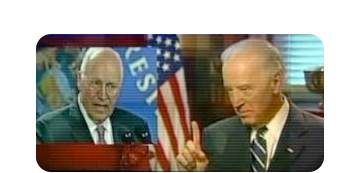

Asked about Cheney's vicious attacks on Obama by CNN, Biden struck back -- and pundits spent the day debating Biden's decorum, not Cheney's.
Vice President Biden gave a wide-ranging interview to CNN last night, but strangely the question pundits have been debating today is whether Biden should have hit back at his predecessor, Dick Cheney, who’s said repeatedly that the Obama administration is making us “less safe.”
There’s been relatively little discussion of how abhorrent and unprecedented Cheney’s attacks on President Obama (his cousin!) have been. Likewise, the last time Cheney attacked Obama, it was spokesman Robert Gibbs who was put on the media hot seat for lashing back at Darth Cheney. Let’s remember: It was years before Bill Clinton or Al Gore criticized the Bush administration in any way, and Cheney’s claim, right out of the gate, that Obama is making the nation “less safe” is the worst thing anyone can say about a new president. It’s clear Cheney’s gone rogue; President Bush has said he plans to keep his mouth shut and respect his successor, and he’s done so.
Of course, Cheney went rogue a long time ago, running his own intelligence operation in the White House, shutting out Colin Powell and Condi Rice, and most recently, lobbying so hard to pardon his loyal lawbreaking aide Scooter Libby that former President Bush, in a rare bout of spinefulness, told him to zip it. Then Cheney made the rounds publicly complaining about Bush’s failure to pardon Libby. That slap at his boss was itself outrageous, and deserved more attention than it got at the time. Cheney is truly a dangerous freak show.
But on MSNBC today, from Morning Joe Scarborough to Mike Barnicle filling in on “Hardball” tonight, the onus was on Biden for replying, not on Cheney for popping off. On “Hardball” I debated former Bush 41 Justice Department official David Rivkin on the overall issue of whether Cheney’s right, and Obama’s made us less safe — Rivkin said yes; guess what I said — and Barnicle kicked off our segment asking, “What’s with the vice president, why is he saying all of these crazy things?” I honestly thought he was talking about Cheney, but it seems he was referring to Biden, as he let Rivkin tear into Biden for “looking backward” and attacking his predecessor.
It’s worth noting that Biden didn’t rent a room at the National Press Club and invite a crowd to watch him savage Cheney; Gloria Borger and Wolf Blitzer asked him about Cheney’s remarks:
BORGER: Former Vice President Cheney took a big swipe at your foreign policies, this administration’s foreign policies. And he told John King of CNN recently that President Obama’s actions, all over the world, have made us less safe. Was Dick Cheney out of line?
BIDEN: I don’t know if he’s out of line, but he was dead wrong. This administration — the last administration left us in a weaker posture than we have been any time since World War II, less regarded in the world, stretched more thinly than we ever had been in the past, two wars under way, virtually no respect in entire parts of the world. And so we have been about the business of repairing and strengthening us. I guarantee you, we are safer today, our interests are more secure today, than they were any time during the eight years…
BORGER: So, we’re more safe?
BIDEN: We are more safe. We’re more secure. Our interests are more secure, not just at home, but around the world. We are rebuilding America’s ability to lead.
Later, Biden said more in an exchange with Wolf Blitzer:
BLITZER: What are you doing differently as vice president as compared to Dick Cheney?
BIDEN: Well, I think the biggest thing we’re doing is, I’m operating in concert with the president. There are not — there are — look, everybody talks about how powerful Cheney was. His power weakened America, in my view. Here’s what I mean by that. What I mean by that was, there was a divided government. There was Cheney as his own sort of separate national security agency, and then there was the National Security Agency. There was Powell, who didn’t agree with Cheney, and Cheney off with Rumsfeld. I mean, there was a divided government, a divided administration. The strength of this administration is that the president and I work in concert. We — I am very straightforward in my views. I’m as strong — I hold them as I strongly as I ever had, but they’re done in the concert of one National Security Agency, a united national security team.
Everything Biden said was sensible and factual, and for the record, if he wanted to rent a room at the Press Club to say it, I think he’s within his rights. Bullies like Cheney have been allowed to attack Democrats in the most scurrilous terms for far too long. David Rivkin continued the tradition today, insisting that Cheney’s Obama critique was “mild and quite respectful” — and all true. Rivkin is a big torture fan and believes that Obama’s promises to close Guantánamo, eliminate torture and restrict surveillance will make us less safe, while his outreach to other countries is a softer goal that Rivkin magnanimously insisted is a lovely aim — but has nothing to do with national security.
Of course, I disagreed. First of all, it’s still amazing how unfamiliar mainstream journalists are with the debate going on in the liberal blogosphere over Obama’s disappointing moves to continue Bush-Cheney secrecy policies, which makes it impossible to know if they’re keeping promises on torture, detention and surveillance. I tried to bring that up, but Barnicle hushed me with a “civil liberties aside,” which could go down in history as the MSM approach to the Bush administration. So I engaged Rivkin directly on the issue of whether Cheney’s torture regime made us safer, arguing that a lot of tough military interrogators say torture doesn’t work, and a lot of national security experts believe reaching out to the world, obeying the Geneva Conventions and the global rule of law can actually make us safer, by eliminating recruiting opportunities for al-Qaida and our other enemies and reinforcing an ethic of mutual protection among our allies.
Rivkin kept trying to set me and Biden up as kind of sweet, naive softies who want the world to like us; the point is that strong global alliances make us safer, it’s not a popularity contest. Rivkin sneered and smiled condescendingly and mispronounced my name, the way these right-wing guys always do (though he was much more polite that Dick Armey), and, well, you can see it below. I’m proud of the job I did, but boy, another day, another really ludicrous set of premises for debate put forward by our mainstream media. Biden’s the jerk, not Cheney? You go, Joe. We’ve got your back.
Visit msnbc.com for Breaking News, World News, and News about the Economy
Catholic tribalism and the contraceptive flap
Watching liberals defend a church they disagree with showed us that even Catholic insiders can feel like outsiders
Rick Santorum and David Boies (Credit: Reuters)
The resolution to the contraception contretemps seems mainly designed to do one thing: mollify the Catholics who defied the U.S. Conference of Bishops to support the Affordable Care Act in 2010. Church leaders are unlikely to officially back this so-called accommodation – the White House isn’t calling it a compromise — just as they continued to oppose the ACA even after President Obama did everything imaginable to insist the new law wouldn’t provide federal funding for abortion.
But the new agreement makes it possible for women’s groups and some liberal Catholic leaders to maintain a truce on hot-button social issues while working together around issues of women’s health and universal access to healthcare. Planned Parenthood and NARAL Pro-Choice America are happy with the solution, and so is Sister Carol Keehan of the Catholic Health Association, who endured withering heat from the bishops and their right-wing allies over the ACA. Kristen Day of Feminists for Life likewise backs the deal. Even New York Archbishop Timothy Dolan called it “a step in the right direction,” though he demanded more time to examine the fine print and suggested “legislation will still be required” to protect the church’s right to discriminate against women.
The bishops and the entire 2012 GOP field will continue to fight their culture wars, but the White House apparently believes the non-compromise will win them the middle ground and make the 24-7 cable news show wailing and hand-wringing – even by some liberals – go away. We’ll see.
But what just happened? Why did we spend 10 days listening to prominent Catholics, including even some liberals and Democrats, insist that the White House had overreached and trampled on “religious freedom” – in this case, the “freedom” of the Catholic hierarchy to impose rules that even most Catholics don’t live by? The great E.J. Dionne led the charge, but Catholic Democrats like Sens. John Kerry and Bob Case and Virginia’s Tim Kaine joined in, and occasionally, liberal TV hosts like MSNBC’s Lawrence O’Donnell and Chris Matthews seemed inclined to depict the controversy as being about the church’s right not to violate its own values. Vice President Joe Biden was said to be the leading voice within the administration warning Obama away from the issue.
“This has struck a tribal nerve in Catholicism,” conservative Catholic scholar George Weigel said to Chuck Todd on “The Daily Rundown” last Monday. “The Catholic Church has been beaten up over the last 10 or 11 years and I think Catholics are tired of the government and others beating up on the church.” His liberal co-religionist on the panel, E.J. Dionne, agreed. I found that fascinating, especially because most of us consider tribalism a bad thing in a multi-ethnic democracy.
Still, while I didn’t share that reaction, I recognized it. It amazes me sometimes, the extent to which Catholics still see themselves – ourselves — as outsiders. There’s a vestigial impulse to circle the wagons and protect our right to practice our persecuted religion (even if it’s no longer persecuted, and many of us don’t practice very much of it anymore). Where does it come from? I’ve spent a lot of time thinking about this lately, because the importance of Catholics to the old New Deal coalition, and their ongoing status as key swing-voters in key swing states, makes understanding them – us – important. This same old tribalism leaves many Catholics receptive to GOP blathering about out-of-touch “elites” who supposedly disrespect their religious freedom. It helped shift many white working-class Catholics to the Republican Party in the ’60s and ’70s.
There may be an element of remorse involved when liberal Catholics defend their faith, especially among those who defy the church (rightly, in my opinion) on its most blinkered teachings in the realm of women’s rights, gay rights and sexuality. For some it may be guilt: OK, I might not listen to the bishops, but I think we ought to demand that they’re respected in the public sphere. And for some it may be grief: We grew up with a rich tradition of social responsibility and spiritual meaning that’s unfortunately been warped by leaders who worship worldly power and have odd views about sex as well as women. While the child abuse scandal makes most Catholics sick, sometimes even I wince when non-Catholics judge the whole church by the corruption of a comparative (though very powerful) few. I have cousins and uncles and aunts who’ve joined religious orders (though, truthfully, most of them left). I don’t like seeing all of them considered perverts or pedophiles, or people who cover up for predators.
How Catholics work out their complex feelings about the church matters beyond the tribe, if only because they’re crucial to the 2012 election. One in four voters is Catholic, and Obama won a majority in 2008, while Republicans won them back in 2010. Obama lost white Catholics, however, although he won among those who say they aren’t regular churchgoers. I think Catholics remain an important, not always predictable constituency at least partly because of their own unresolved, unpredictable feelings about their religion, and their status as Americans.
I found myself thinking a lot about my own complicated feelings about my heritage as I watched Catholics grapple, not always rationally, with the contraceptive controversy. Even when I didn’t agree, I empathized.
- – - – - -
I grew up in a huge Irish Catholic clan on Long Island, but as an adult, I put away childish things (in the words of St. Paul, though not as he intended them) and became a secular feminist liberal Democrat. The first time I remember feeling anything like tribalism was after Sept. 11.
Many liberals around me criticized the overt religiosity of the public mourning for those killed that day, all that talk about God, which struck me as reflexively and needlessly anti-religion at a time when many Americans — dare I say most — found comfort in their faith. Then, after a benefit for survivors’ families turned a little rowdy, with one cop taking to the stage to say “Osama bin Laden can kiss my royal Irish ass,” the heavily Irish and Catholic cops and firefighters in attendance were roundly derided as right-wing tribalist rubes. That bothered me, too: Who did we think died trying to rescue those trapped in the World Trade Center, Susan Sarandon and Michael Moore? Members of my own family had worked in the rescue operation after the towers fell. I wasn’t down with the mockery.
A lot of my belated tribalism was a class thing: I’m not workin-class, but my parents and aunts and uncles were, and some of my cousins are still part of that ill-defined and disappearing demographic. There’s clearly an element of snobbery in the way the white working class is routinely run down as backward, racist, narrow-minded yahoos, and I’ve grown to resent it.
Yet in general, Catholics are doing pretty well for themselves. We’re well represented in certain segments of the American elite, especially elite punditry, it seems. It’s understandably hard for some people to imagine, in a world so striated by race and class, how Catholics could feel like oppressed outsiders. Yet it’s also true that while we’ve only elected one black president, we’ve only elected one Catholic president as well. I’m not trying to equate the struggles of black people and Catholics. In fact, it’s especially when you understand how relatively privileged Catholics have been, compared to African-Americans, that having only one Catholic president stands out, and makes you wonder: Why?
It’s hard not to conclude that some residue of the religious nativism that persecuted and stigmatized Catholics in the 19thcentury, defeated Al Smith in 1928, and forced John F. Kennedy to promise he wouldn’t take orders from the pope in 1960 persists to this day. So even if we haven’t personally experienced anti-Catholic prejudice, and I can’t say I have, there’s an atavistic memory, something bred in the bone, that forces many of us to defend our once-persecuted church, even when we profoundly disagree with it.
But it wasn’t until I debated the Family Research Council’s Tony Perkins on “Hardball” this week that the craziness of the right-wing Catholic alliance with conservative evangelicals became particularly obvious to me. They’ve locked arms with some of the very forces that once persecuted their ancestors – some of whom still despise Catholicism to this day. On “Hardball,” Perkins posed as a defender of the Catholic bishops’ position on Obama’s contraception rules. But he’s also been an ally to virulent anti-Catholics like Rev. John Hagee, who called the church “the great whore” and a “false cult.” And Rev. Robert Jeffress, who likened the church to Satan and labeled Catholicism a “fake religion.” Like Zionist Jews who’ve made common cause with right-wing evangelicals over Israel, some Catholics are lining up, in the name of religious freedom, alongside folks who want to wipe out their religion. I’ve heard some liberals express disdain for some of the church’s teachings, but I’ve never heard anyone compare it to Satan or call it a whore.
Zealous right-wing Catholics are in the minority, even if blowhards like Bill Donohue sometimes make the most noise. In the end, I think the contraceptive flap forced a lot of Catholics to reckon with the gulf between what they practice and what their church preaches. The truth was always there, if we wanted to find it, not merely in polling data that said 98 percent of sexually active Catholics have used birth control, but that solid majorities of Catholic voters supported Obama’s contraception regulations applying to large Catholic institutions, like hospitals, charities and universities, that employ non-Catholics. I loved the fact that students at Catholic universities held a press conference Thursday to support the president, and that organizations like Catholic Democrats and Catholics for Choice were active and vocal in standing up to their own bishops.
There are a lot of outstanding questions about the implementation of the administration’s non-compromise. But I have to disagree with Esquire’s Charles Pierce – I’m not sure that’s ever happened before – and say I don’t consider this any kind of cave on the president’s part or victory for the bishops. I prefer the interpretation of Frances Kissling, founder of Catholics for Choice, who wrote on Friday that the “accommodation” made the bishops the “losers” and women the winners. ”When the White House cares more about what a simple Catholic sister, [Sister Carol Keehan], thinks than about what the bishops think, Catholic women can applaud. Perhaps the crack in the patriarchy is becoming a deep canyon.”
I can’t go that far – especially after seeing this Think Progress report that documented what we all knew: that men dominated the debate over the controversy on cable news. It’s also a little sobering that so many of the liberal Catholic voices questioning the president were male, while most of the liberal voices backing him were female. But between this and the victory for Planned Parenthood in the Komen mess a week ago, I see evidence that we’re reaching a new place in the battle over gender. At the very least, being a woman is no longer a preexisting condition, as the Catholic Nancy Pelosi likes to say.
Reason vs. hysteria in the birth control debate
David Boies explains the issue in terms of labor law, while Santorum says Obama may lead us to the "guillotine"
VIDEO
Rick Santorum and David Boies (Credit: Reuters)
On Wednesday night we reached the high and the low, so far, in the debate over the Obama administration’s requirement that Catholic institutions that employ non-Catholics include contraception coverage in their health insurance policies.
The high, in terms of reason and clarity, came from famed attorney David Boies on MSNBC’s “The Last Word.” Lawrence O’Donnell has let male “liberal” pundits like Mark Shields wax a little shrill on his show, but to his credit, he offered the best rebuttal to all the shrieking I’ve seen so far: Boies calmly and clearly explaining the new regulations as an issue of labor law, and the government’s regulation of employers (relatively minimal, compared to other countries) on issues of health, safety and non-discrimination.
I’ve tried to make the same points: What if Catholics didn’t believe in child labor laws? Would we let church-run agencies flout them? Boies used the example of a religion that believed people shouldn’t work after age 60: Could they legally ban older people from employment? Of course, they could do neither. This is indeed an issue of religious freedom: the freedom of non-Catholics not to be bound by the dictates of the Catholic Church in the workplace.
But Boies, fresh off his 9th Circuit victory defending gay marriage, brought the legal knowledge. Watch below.
Of course, the very same night, the re-surging Rick Santorum offered the most shrill and hysterical reaction to the White House ruling, and in a week of shrillness and hysteria, that’s saying a lot. Santorum actually said that President Obama’s contraception ruling meant we are “headed down [the] road” to the French Revolution and the “guillotine.” That’s below, too.
If you watch the entire seven-minute clip, you’ll understand why, despite Santorum’s latest surge, I do not believe that even today’s Republican Party, though it’s been hijacked by the ultra-right, is capable of nominating him for president. Like so many right-wingers, he absolutely mangles what the Founders believed about religion. He says one problem with the French Revolution is that its slogan of “liberty, equality and fraternity” substituted fraternity, or “brotherhood,” for “fatherhood,” a reference to God the father, but also his right-wing belief in the centrality of male control to family and national stability. But his absolute craziness is best displayed in his remarks about the guillotine:
They are taking faith and crushing it. Why? When you marginalize faith in America, when you remove the pillar of God-given rights then what’s left is the French Revolution. What’s left is a government that gives you rights. What’s left are no unalienable rights. What’s left is a government that will tell you who you are, what you’ll do and when you’ll do it. What’s left in France became the guillotine.
Although Santorum said we’re “a long way from that,” he insisted that with the Obama presidency “we are headed down that road.” But watch the whole thing. Boies first, then Santorum. Reason before crazy. I’ll be talking about all of this on MSNBC’s “Hardball” today at 5 p.m. ET.
Reason:
Visit msnbc.com for breaking news, world news, and news about the economy
Now crazy (h/t Crooks & Liars):
We are the 98 percent
Catholics who ignore the church's teaching on contraception shouldn't expect Obama to follow it
(Credit: Reuters/Keith Bedford)
The Obama administration is facing a political crisis for making a common-sense decision: acting on the Institute of Medicine’s recommendation that health insurance plans cover contraceptive services. This is a test for the forces that mobilized to get the Susan G. Komen Foundation to reverse its politically cowardly decision to cut funding for Planned Parenthood. Clear political thinking about women’s health made a comeback in the backlash against Komen’s move; we need to make sure that clear political thinking prevails on the new Health and Human Services contraception regulations, too.
Predictably, the GOP presidential candidates are whacking Obama on the issue; fittingly, Rick Santorum is surging again, as this latest battle in the culture war rages. As always, the biggest hypocrite is Mitt Romney, who is attacking the president’s decision even though he went along with the same regulations in Massachusetts. And when the state enacted the universal health insurance law he used to be proud of, it covered the same “family planning services” as the new HHS regulations.
I knew the president’s decision would be controversial, but I underestimated the firestorm he would face. Since 98 percent of Catholics practice forms of contraception forbidden by the church at some point in their lives, according to the Centers for Disease Control, I assumed many of them would speak out in favor of the new regulations. How could they expect the president to follow church teachings if they did not?
I was wrong. Too many Catholics are insisting that while they may personally disagree with the church on contraception, they defend the bishops’ opposition to the HHS moves as a matter of “religious liberty.” Others are silent. But silence lets the most right-wing forces of reaction prevail. It’s time for the 98 percent to speak up.
This is indeed a matter of religious liberty – the liberty of non-Catholic women who work for Catholic employers to have the full spectrum of healthcare coverage, regardless of what the church believes.
Twenty-eight states already require church-run agencies to cover contraception in the health insurance they provide employees. Catholic Charities sued to oppose the regulation in New York, and lost. The world didn’t end; Catholic agencies in New York and those 27 other states now cover contraception. And they should: Women who have access to family planning services have lower infant mortality rates and healthier babies than those who don’t. Others take the birth control pill to deal with endometriosis or other reproductive system issues. Contraception has to be part of comprehensive healthcare for women.
On MSNBC’s “Morning Joe” Tuesday, Obama campaign strategist David Axelrod left the door open to a compromise with the bishops. That sounded dangerous. The worst move for the administration would be to take a courageous stand, rile up the right wing and Catholic bishops, and then cave and demoralize the women’s health advocates who are mobilizing to support the president. Later on “Daily Rundown” liberal Catholic E.J. Dionne suggested possibilities for compromise on the issue, while ultra-conservative George Weigel shot him down. There will be no “compromise” that leaves everyone happy. Either this is a matter of equity and the right approach to women’s health, or it’s not. And Catholics who ignore the church’s teaching on this issue have a special duty to speak up.
Karl Rove’s hissy fit: “Offended” by Chrysler ad
If Clint Eastwood sounded like Obama, it's because the GOP has ceded optimism to the Democrats
Karl Rove (Credit: Reuters/Fred Prouser)
I admit it: Chrysler’s “Halftime in America” Super Bowl ad reminded me of President Obama’s best recent speeches. Actor Clint Eastwood, the face of rugged American individualism, talked about “tough eras” and “downturns” and “times when we didn’t understand each other,” but then declared:
But after those trials, we all rallied around what was right, and acted as one. Because that’s what we do. We find a way through tough times, and if we can’t find a way, then we’ll make one…
This country can’t be knocked out with one punch. We get right back up again and when we do the world is going to hear the roar of our engines. Yeah, it’s halftime America. And, our second half is about to begin.
“I was, frankly, offended by it,” Rove said on Fox News Monday. “I’m a huge fan of Clint Eastwood, I thought it was an extremely well-done ad, but it is a sign of what happens when you have Chicago-style politics, and the president of the United States and his political minions are, in essence, using our tax dollars to buy corporate advertising.”
Rove wasn’t the only Republican who tried to cast the Chrysler ad as essentially payback to the president for supporting the bailout that kept the domestic auto industry alive. Michelle Malkin tweeted her horror Sunday night: “Agh. WTH? Did I just see Clint Eastwood fronting an auto bailout ad???”
Now, Clint Eastwood is no Democrat – he voted for John McCain in 2008, has been a Republican for most of his life, and now describes himself as having “libertarian” leanings. It’s hard to imagine he’d lend his name to an openly and intentionally pro-Obama ad. Chrysler has denied any political motive behind the Eastwood ad.
The flap over the ad confirms the GOP’s serious branding problem: The problem for Rove and the rest of the GOP is that their party’s narrative has become relentlessly negative, pessimistic and uninspiring. They’ve left the language of optimism and resilience, higher ground and common ground, to the Democrats, and lately President Obama has grabbed every opportunity to employ that language.
Rove is essentially complaining that anyone using rhetoric of resilience and tenacity, or suggests “we all rallied around what was right, and acted as one” sounds like a gosh-darn … Democrat. That’s good news for Democrats. There’s more good news in recent polls showing that Obama is winning back at least some white working-class voters with his feistier message of economic populism. The president’s approval/disapproval ratings have been dismal with whites who make less than $50,000, with his approval dropping into the low 30s and disapproval up in the mid-60s regularly over the last two years.
Now those numbers stand at 43-54, about where they were when Obama was elected. He may not carry that cohort, but holding the share he had in 2008 will make his reelection chances much better. There’s also good news with those same voters in some Rust Belt states, including Wisconsin, Ohio and, yes, Michigan, home of Chrysler.
Karl Rove is angry because he sees the numbers, too, and he’s got to explain them away with dark allusions to “Chicago politics.” But the fact is the president saved the auto industry at a time when Republicans, most notably Mitt Romney, urged him to let it die. If he gets credit for that unpopular decision, that’s because he deserves it.
And if Clint Eastwood sounds like a Democrat when he talks about American ingenuity and optimism, that’s because increasingly it’s Democrats who sound that way – and Republicans who don’t. Ronald Reagan co-opted buoyancy and hopefulness for a generation, painting Democrats from Walter Mondale and Michael Dukakis through Al Gore and John Kerry (with a break for Bill Clinton) as Negative Nellies, whiners and complainers always finding fault with America.
Now it’s Republicans who bad-mouth the American people, warning that lax morals and laziness are behind the problems of the poor and working class (including whites), and who paint scary dystopic pictures of America under its Kenyan anti-colonialist socialist black president. Karl Rove’s hissy fit over the Chrysler ad underscores exactly how bleak his party’s vision has become.
I’ll be on MSNBC’s “The Ed Show” at 8 p.m. ET to discuss Rove and the angry GOP.
Susan G. Komen’s priceless gift
A radical decision woke the country up to an alarming rightward drift, and gave new life to women’s health advocacy
Members of Planned Parenthood, NARAL Pro-Choice America and more than 20 other organizations hold a "Stand Up for Women's Health" rally in Washington (Credit: Joshua Roberts / Reuters)
The startling intensity that we saw this week in response to Susan G. Komen for the Cure’s decision to pull its grants from Planned Parenthood — an intensity that prompted the Komen foundation to reverse its decision today — may be the best thing that’s happened to the conversation about reproductive rights in this country for decades. It certainly should be.
Practically since Roe v. Wade was decided in 1973, reproductive rights activists have been left to play stilted defense against ideological opponents who grabbed the language of morality, life, love and family as their own, always deploying it with reference to the fetus. The rhetoric around reproductive rights, which has more recently begun to creep into arguments over contraception, has become suffocating in its emotional self-righteousness, but too muscular, too ubiquitous to effectively combat.
But the overreach by the Komen foundation, while surely intended to strike yet another blow on the side of antiabortion activism, succeeded instead in waking a powerful constituency — armed with precisely the language and emotional heft they’ve been lacking for too long.
That this week’s blow against Planned Parenthood came not directly from John Boehner’s House of Representatives – which, ever since taking power a year ago promising to focus on jobs, has manfully focused on the single task of attacking women’s reproductive rights – but instead from a popular, officially nonpartisan organization dedicated wholly to women’s healthcare somehow brought this argument into the open.
The response to Komen was surely so tinderbox explosive because it had been building with every politically theatrical investigation launched by Cliff Stearns and every grisly abortion scene enacted on the House floor by U.S. Rep. Chris Smith. But it was not just Washington wonkery, and was not ginned up or amplified by professional political cranks. It was the reflexive kick of a shin hit just below the knee, and the visceral anger spilled everywhere, from a Planned Parenthood Saved Me tumblr and onto Facebook, where people posted images of Komen’s pink ribbon cut in half. It poured from bank accounts, including that of New York Mayor and former Republican Michael Bloomberg.
It came from often dispassionate media figures like Andrea Mitchell, was tweeted by novelists like Judy Blume, Terry McMillan and William Gibson, actors Ellen Barkin and Martha Plimpton, politicos like Donna Brazile, Reps. Gwen Moore and Jackie Speiers, former Speaker Nancy Pelosi and from 22 senators including Frank Lautenberg, Al Franken and Kirsten Gillibrand, who signed a letter urging Komen to reverse its decision. It came from callers to radio programs, announcing their intentions to drop out of Komen races, and from the American Association of University Women, which canceled a scheduled service event with Komen. In the three days after Komen’s announcement of its Planned Parenthood break, Planned Parenthood received more than $3 million in donations, said PPFA president Cecile Richards in a press call on Friday.
More than that, though: The starkly observable attack against something as crucial and basic as breast exams for poor women, as well as the fact that so many divergent voices were pulled into it, meant that the conversation was not about partisan politics; it was about women. For the first time in what feels like forever, passion and fury were being loudly, proudly given in a full-throated voice, on behalf of women – women as moral actors; women as citizens with rights, health, bodies, freedoms; women as people with families and economic concerns.
Taken together, these factors mark this as a watershed moment in the contemporary conversation about reproductive rights. This is a story in which we see the possibility of a turned tide, a new way to gauge how the public actually feels about women’s rights and health, and a new way to talk about it, as well. Because what we saw this week was big. It was mass. It was emotional. This was so different from the various polls activists on both sides of the abortion question are always throwing around, polls that depend so much on how a question is asked; polls that offer far less clarity than head-banging confusion about where America stands on the issue of reproductive heath. This was not a poll. This was America announcing that it cared about women’s health, and more specifically, that it cared about Planned Parenthood.
In many ways, the activism that forced Komen to backtrack was ignited by Boehner’s House Republicans a year ago, when they voted to cut off all funding to Planned Parenthood because it provides abortion services. This despite the fact that since 1976’s Hyde Amendment, no federal money has been able to be used to provide abortion services. The organization Republicans want to squash provides more than 800,000 women a year with breast exams, more than 4 million Americans with testing and treatment for sexually transmitted diseases, and 2.5 million people with contraception, which prevents unintended pregnancy and thus abortion. But playing to what they must imagine is overriding public sentiment, Republicans have worked tirelessly to lodge the image of Planned Parenthood as an abortion factory deep in the American imagination.
A year ago, some of the anger at this strategy began to bubble over. In response to Smith’s description of a second trimester abortion, read on the House floor, Democratic U.S. Rep. Jackie Speier went to the House well and described her own painful second trimester abortion. “For you to stand on this floor and suggest that somehow this is a procedure that is either welcomed or done cavalierly or done without any thought, is preposterous,” Speier said, directing her comments at Smith. “Planned Parenthood has a right to operate. Planned Parenthood has a right to provide services for family planning. Planned Parenthood has a right to offer abortions. The last time I checked, abortions were legal in this country … I would suggest to you that it would serve us all very well if we moved on with this process and started focusing on creating jobs for the Americans who desperately want them.”
It was around this time that a viral “Thank You Planned Parenthood” meme cropped up online. With participants noting the instances in which they had relied on PPFA for birth control, breast exams, gynelogical care, and yes, abortions. Twitter, Facebook and blogs began to be dotted with “I stand with Planned Parenthood” emblems. Comedian Lizz Winstead kicked off a tour called “Planned Parenthood, I am here for you.”
But this recent wave of defense of Planned Parenthood has remained broad, ambient. The politics of the congressional witch hunt have been so labyrinthine, so convoluted, that it has been difficult to know how to effectively harness an angry response. When, last fall, Rep. Cliff Stearns launched an investigation into PPFA’s bookkeeping, the move was so needless, such a trumped-up piece of political stagecraft (since PPFA does receive federal funds, it must scrupulously account for every dime it spends, no special investigation required) that it was hard to even know how to make sense of it, let alone respond. This week, a caller to WNYC’s “Brian Lehrer Show” professed her belief that the Stearns investigation centered on whether Planned Parenthood was performing late-term abortions.
The demonization of Planned Parenthood should have awakened the country to the radicalism of the right, and how far it has pushed the political conversation. It’s been hard to measure the degree of the radicalism, so slowly and unceasingly has it crept across our consciousness and the political discourse. But it’s important to remember how mainstream Planned Parenthood used to be. It was the respectable, even Republican, advocate for women’s health, including reproductive services; the leaders of the National Abortion Rights Action League were the activist agitators. Sen. Prescott Bush, the father of President George H.W. Bush, served as treasurer of Planned Parenthood’s first national fundraising campaign. Richard Nixon signed the family planning legislation in 1970 that authorized its federal funding.
As a congressman, George Bush and his wife, Barbara, were reliable friends of the organization. Barry Goldwater’s wife, Betty, was a founding member of Arizona Planned Parenthood; President Gerald Ford’s wife, Betty, was a high-profile supporter of the group. More recently, Ann Romney, wife of the 2012 GOP presidential front-runner, donated $150 to Planned Parenthood in 1994. And when a Romney relative died of a botched abortion in 1963, the family asked that memorial donations go to Planned Parenthood.
But what happened this week was a clarifying moment. Right-wing extremism, coming this time not from the partisan mill but from a mainstream women’s organization, was put in a direct and unflattering spotlight. Suddenly, so much was clear, and finally, the response was unified and thunderous. Right-wing overreach — and the backlash it inspired — feels a lot like the way other radical GOP power grabs in the last year have galvanized the public to fight back. Attacks on collective bargaining, public workers and unions by Republican governors in Wisconsin, Ohio and Indiana have produced mass mobilization in those states, the likes of which we haven’t seen in decades. Public workers – cops, firefighters, nurses, teachers, paramedics, sanitation workers – once were the proud backbone of the middle class. Now they find themselves derided by the GOP as the new welfare queens who are taking more than their fair share. Ohio voters repealed a law that abolished collective bargaining in November, and pro-union organizers in Wisconsin have forced a recall election for Gov. Scott Walker.
Efforts to restrict voting rights are likewise waking up the citizenry; Maine repealed a law that banned same-day voting and registration in November, and Ohio blocked a voter photo ID bill. Even on the issue of reproductive rights, a draconian “personhood” amendment to the state constitution failed to pass in Mississippi, one of the reddest of the red states. Overreach by the right has re-inspired movements – unions, voting rights, women’s rights — that have too long been dormant and too easily dismissed by their ideological opponents as outside the mainstream of American values, when in fact, they used to represent the most American of values.
For defenders of Planned Parenthood, and more broadly for reproductive rights activists, this moment of repositioning is a valuable one. Until now, it has proven very difficult for advocates to resuscitate their side with language anywhere near as powerful as that used by antiabortion forces. Instead they have relied too heavily on the fungible, limp, endlessly open-ended language of “choice.” (Even among “pro-choice” advocates, the “I choose my choice!” joke from “Sex and the City” has become a ubiquitous critique.)
But what happened this week was powerful. It was mass. It was direct. It was emotional. And it restores women as the moral center of this conversation — which is where they belong.
Page 1 of 193 in Joan Walsh

Our non-withdrawal from Afghanistan
“We don’t need someone to think”
How rough it’s gotten for Mitt
The Grammys’ most memorable moments
A passport to utopia
“The Fault in Our Stars” and “There Is No Dog”: Not kids’ stuff
Ricky Gervais: My conscience never takes a day off
Lessons of a very sexy pirate costume
America’s failed promise of equal opportunity
Is gay literature over? 

