U.S. Economy

The prophets of doom

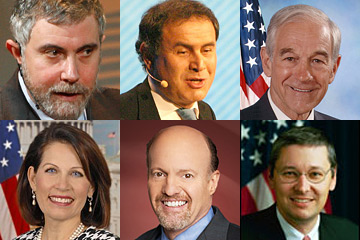
Meet the Cassandras, 14 economists, bloggers, politicians and businesspeople of all political stripes who have become the most strident critics of President Obama's stewardship of the economy.

  • more
    • All Share Services

Topics: , , ,

The prophets of doom

At a moment of economic stress greater than most living Americans have ever experienced, it is no wonder that every move made by the administration of President Barack Obama to address the multiple simultaneous crises afflicting the economy has been greeted with howls of criticism from the left, right and middle. Now is a fertile time for a harvest of Cassandras, all preaching apocalypse. But it can be confusing — is the stimulus too big, or too small? Should banks be allowed to fail, or should they be nationalized?

Hard answers are in short supply. But here’s a guide to the prophets of doom. We’ve identified them, attempted to ascertain the moment when they first turned against the White House, and summarized the basic points of their critique. We’ve included economists, members of the business community, bloggers and, just for fun, two of the most anti-Obama Republicans we could dig up.

THE ECONOMISTS

PAUL KRUGMAN: New York Times Op-Ed columnist, Princeton economics professor, Nobel Prize winner

Earliest critique: Jan. 9, 2009

Without missing a beat, Paul Krugman went from being George Bush’s most passionate and prominent critic to fulfilling the exact same role for Barack Obama.

Stimulus: Not nearly big enough to make up for the loss of potential economic output. Relied far too much on tax cuts.

Banking plan: Geithner’s plan has no chance of working. Defunct banks must be seized and nationalized, the sooner the better.

Most hurtful quote: On the Geithner plan: “This is more than disappointing. In fact, it fills me with a sense of despair.”

GREG MANKIW: Professor of economics at Harvard University; former chairman of President Bush’s Council of Economic Advisers; visiting fellow at the American Enterprise Institute

Earliest critique: Pre-inauguration, in the New York Times, Jan. 11, 2009

In the econoblogosphere, Mankiw plays a role for conservatives analogous to what Paul Krugman provides for the left, albeit without the passion.

Stimulus: Mankiw is skeptical of fiscal policy, believing that tax cuts, as opposed to spending, should be the fiscal instruments of choice. He also fears the rise of protectionism that the Buy American stimulus provisions threaten.

Banking plan: Mankiw’s bottom line: The banks need to suffer more. Specifically, he follows the influential libertarian economist Tyler Cowen’s argument (recently featured in the New York Times) that banking creditors need to accept losses on their bad bets.

Most hurtful quote: “[T]he borrowing and debt imposed on future generations will not be very different [from Bush], at least if the numbers in the Obama administration’s own budget document can be trusted.”

SIMON JOHNSON: Co-founder of the Baseline Scenario, a blog about the global economic and financial crisis; Ronald A. Kurtz Professor of Entrepreneurship at MIT’s Sloan School of Management; senior fellow at the Peterson Institute for International Economics; former chief economist at the IMF

Simon Johnson expressly disavows being a populist, but outside of Paul Krugman, few critics have been more unremitting or convincing in their attacks on Obama’s approach to the banking industry. His Atlantic magazine blockbuster, “The Quiet Coup,” paints a disturbing picture of a United States government co-opted by Wall Street’s elite.

Earliest critique: In a Joe Nocera New York Times column, Feb. 14, 2009

Stimulus: Needs to be bigger.

Banking plan: The banking and financial lobby “oligarchs” wield too much power over Washington. Their stranglehold must be broken. Insolvent banks must be placed into a government-mediated receivership. The Geithner plan won’t work.

Most hurtful quote: The last paragraph of “The Quiet Coup”: “The conventional wisdom among the elite is still that the current slump ‘cannot be as bad as the Great Depression.’ This view is wrong. What we face now could, in fact, be worse than the Great Depression — because the world is now so much more interconnected and because the banking sector is now so big. We face a synchronized downturn in almost all countries, a weakening of confidence among individuals and firms, and major problems for government finances. If our leadership wakes up to the potential consequences, we may yet see dramatic action on the banking system and a breaking of the old elite. Let us hope it is not then too late.”

NOURIEL ROUBINI: Professor of economics at New York University’s Stern School of Business; chairman of RGE Monitor, an economic consultancy firm; former senior economist in the White House Council of Economic Advisers under Clinton

At the height of the housing boom, no one was predicting an economic collapse with more fervor than Nouriel “Doctor Doom” Roubini. As the crisis kept deepening, he kept predicting it would get worse, and kept being proved right.

Earliest critique: In Forbes, Feb. 12, 2009

Stimulus: Should have included fewer tax cuts, and needs to be better coordinated with stimulus spending by other major economies.

Banking plan: Roubini believes banks in the U.S. and U.K. are largely insolvent and should be nationalized. He initially decried the Geithner plan as cumbersome and complicated in early February, but raised eyebrows around the econoblogosphere in late March when he said that the plan was viable.

Most hurtful quote: “The U.S. financial system is effectively insolvent.”

WILLEM BUITER: Professor of European political economy, London School of Economics and Political Science; former chief economist of the European Bank for Reconstruction and Development; author of the Financial Times’ Maverecon economics blog.

Buiters should get the nod as the most relentlessly caustic critic of Bush, Obama and everyone else.

Earliest critique: Jan. 5, 2009, Financial Times.

Stimulus: Against it. Won’t work, based on “Keynesian fallacies. The U.S must “focus on getting credit mechanisms and the financial system going again.”

Banking plan: The Geithner plan is “financial shenanigans.” The “zombie banks” need to die.

Most hurtful quote: Very difficult to pick, because almost everything Buiters writes is hurtful to someone. But this is typical: On housing: “Myopia, opportunistic behaviour and insider protection: welcome to U.S. home financing policy.”

MARTIN WOLF: Associate editor and chief economics commentator of the Financial Times; author of “Why Globalization Works” and “Fixing Global Finance.”

Wolf enjoys a special kind of credibility because he has gradually transformed from a staunch defender of modern capitalism to one of the most articulate critics of its failings.

Earliest critique: Jan. 13, 2009.

Stimulus: Without global coordination with other major international economies, even a large U.S. stimulus won’t be enough to restore prosperity.

Banking plan: Banking plans must be restructured, zombie banks must die. The problem is not a lack of liquidity that can be solved by the Geithner plan — banks are insolvent.

Most hurtful quote: “I am becoming ever more worried. I never expected much from the Europeans or the Japanese. But I did expect the U.S., under a popular new president, to be more decisive than it has been. Instead, the Congress is indulging in a populist frenzy; and the administration is hoping for the best.”

WILLIAM BLACK: Associate professor of economics and law at the University of Missouri – Kansas City; author of the popular book “The Best Way to Rob a Bank Is to Own One: How Corporate Executives and Politicians Looted the S&L Industry” (2005); former executive director of the Institute for Fraud Prevention (2005-07)

Earliest critique: In the Huffington Post, “The Audacity of Dopes,” Feb. 10, 2009.

Stimulus: The stimulus is too small.

Banking plan: The Geithner plan just serves the interests of the bankers who created the mess in the first place. The banks should be put into receivership, as the law requires. The Obama administration is helping to cover up fraud by using the stress tests to allow the banks to declare that they have sufficient capital.

Most hurtful quote: On the Geithner plan: “No, except that it’s trillions, if we’re lucky, [that] will go under their plan to the people that caused this crisis. And it will be the greatest looting of the American people in our history and it will destroy the Obama presidency if it continues.”

DEAN BAKER: Co-director of the Center for Economic and Policy Research, holds a Ph.D. in economics

Earliest critique: Jan. 13, 2009

Stimulus: Blames Democratic “moderates” for causing the stimulus to be too small and thus resulting in higher job losses.

Banking plan: Strongly opposed to the Geithner plan, believes it won’t work, diverts taxpayer dollars to Wall Street. The government is giving too much to the banks without getting enough control in return.

Most hurtful quote: “Treasury Secretary Timothy Geithner’s latest bank bailout plan is another Rube Goldberg contraption intended to funnel taxpayer dollars to bankrupt banks, without being overly visible about the process … It is hard to understand this plan as anything other than a last ditch effort to save the Wall Street banks. Unfortunately, Mr. Obama seems prepared to risk his presidency on their behalf.”

THE BUSINESS COMMUNITY

JIM CRAMER: Host of CNBC’s “Mad Money” and co-founder of the TheStreet.com; author and former hedge fund manager.

Earliest critique: On MSNBC’s “Hardball,” Jan. 28, 2009.

Categorizing Jim Cramer’s opinions can be a challenge, because he can change his opinions drastically from one day to the next. He has argued that the stimulus needs to be 10 times as big as it currently is, but also criticized it for pumping up the deficit. He supports taxing the rich, but not right now.

Stimulus: The stimulus is a disaster and a fraud, has instilled fear in the economy, and is far too small.

Banking plan: Cramer first supported the Geithner plan to get toxic assets off the balance sheets of banks, but has flip-flopped several times on Geithner himself. He is opposed to “lurching nationalization,” and believes the banks will be profitable again if we can remain patient.

Most hurtful quote: (On the stimulus) “But Obama has undeniably made things worse by creating an atmosphere of fear and panic rather than an atmosphere of calm and hope. He’s done it by pushing a huge amount of change at a very perilous moment, by seeking to demonize the entire banking system and by raising taxes for those making more than $250,000 at the exact time when we need them to spend and build new businesses, and by revoking deductions for funds to charity that help eliminate the excess supply of homes.”

JIM ROGERS: Legendary investor, financial commentator and co-founder with George Soros of Quantum Fund and creator of Rogers International Commodities Index

Jim Rogers is a ubiquitous presence on the financial news networks, and is never at a loss for a strong opinion. The ultimate advocate of a “let the free market sort everyone out and only the strong survive” philosophy.

Earliest critique: August 2008: “We’ll be worse off whoever is president.”

Stimulus: Won’t work because “the idea that you can fix a period of excess borrowing and excess consumption by more borrowing and more consumption to me is just ludicrous.”

Banking plan: Will lead to a duplication of Japan’s lost decade. “It’s exactly the same mistakes the Japanese have made. They haven’t recovered 19 years later, neither will we in the United States.” Would prefer to see the banks allowed to go bankrupt.

Most hurtful quote:The world is in serious trouble and American politicians and European politicians are making it much worse. This has a long way to go. I don’t particularly like to say this but it is going to be the worst recession since the 1930′s.”

THE BLOGGERS

YVES SMITH: Author of the popular financial blog Naked Capitalism since 2006; head of Aurora Advisors, New York-based management consulting firm.

It’s safe to say that in the econoblogosphere Yves Smith is the anti-Will Rogers: She has never met an Obama economic policy she liked.

Earliest critique: Dec. 8, 2008.

Stimulus: Too small, won’t work without a thorough cleanup with the financial system and an overhaul of financial regulation.

Banking plan: Will not work. Banks are insolvent and must be nationalized immediately. Obama’s efforts to fix the financial system do not deal with the “opaqueness and complexity” of the instruments that started this mess.

Most hurtful quote: “I cannot recall a major U.S. policy initiative being met with as much immediate revulsion as the so-called Geithner plan. Even the horrific TARP, which showed utter contempt for Congress and the American public was in some ways less troubling.”

BARRY RITHOLTZ: Author of financial blog the Big Picture; regular commentator on CNBC, Bloomberg, Fox and PBS; CEO and director of Equity Research at Fusion IQ, an online quantitative research firm

Barry Ritholtz has ridden his blog’s huge popularity to a bookstore near you. Keep your eye out for “Bailout Nation.”

Earliest critique: Jan. 29, 2009

Stimulus: Too small.

Banking plan: Will not work. Nationalization in the form of “prepackaged Chapter 11 bankruptcy reorganization is the fastest way to fix the banking system.

Most hurtful quote: In response to Geithner’s statement that “We have a financial system that is run by private shareholders, managed by private institutions, and we’d like to do our best to preserve that system,” Ritholtz exploded: “No! Defending these idiots was your old gig. In the new job, you no longer work for the cretins responsible for bringing down the global economy. Please stop rationalizing their behavior, and preserving the status quo!”

THE POLITICIANS

MICHELE BACHMANN: Member of the U.S. House of Representatives, Minnesota, 6th District

Earliest critique: Dec. 19, 2008

When you’re talking House Republicans, you’re not going to find too many nice things said about Obama’s economic policies. But no one has taken the criticism to further extremes than Bachmann, who is convinced that the new White House is ushering in an era of “economic Marxism.”

Stimulus: Opposed. Advocates cutting taxes and spending instead.

Banking plan: Opposed. Part of Obama’s final leap to socialism.

Most hurtful quote: “I think what we’re seeing is an implementation of all of the radical ideas that Bill Ayers and Ward Churchill, the radical ideas that we’ve seen on some college campuses, they’re now being implemented in our government and they’re taking a nefarious route … If you look at FDR, LBJ, and Barack Obama, this is really the final leap to socialism.”

RON PAUL: Member of the U.S. House of Representatives, Texas, 14th District; failed presidential candidate, 2008

Ron Paul gets special credit for being the elected politician who has most consistently warned that economic disaster lay around the corner. He was bound to be right, sooner or later.

Earliest critique: Nov. 5, 2008

Stimulus: Since nearly all government spending is bad, fundamentally opposed to fiscal policy. Stimulus spending will only further aggravate the national debt, and turn the recession into a depression. Furthermore, it is unconstitutional to expand government so greatly.

Banking plan: Ron Paul once introduced a bill calling for the Federal Reserve to be abolished, so it’s safe to say he does not fall into the nationalize-the-banks camp. The banks should live or die by the free market.

Most hurtful quote: “It is a strong ideological position to believe that government can run things because if it isn’t socialism, it’s fascistic and it’s inflationary and it’s control, and it’s loss of liberty …”

Continue Reading Close
Andrew Leonard

Andrew Leonard is a staff writer at Salon. On Twitter, @koxinga21.

Is America’s age of discovery over?

A small group of ambitious institutions gave us the Internet, lasers and TV. Now they're dwindling. Are we doomed?

  • more
    • All Share Services

Topics: ,

Is America's age of discovery over? (Credit: wavebreakmedia ltd and Christian Delbert via Shutterstock)
This article is a condensed excerpt from the new book "Demand," from Crown Business.

Not so long ago, the core skill of the United States was new industry creation. And at the same time — not coincidentally — the country boasted the world’s largest and fastest-growing economy. During the 1920s, 1930s, 1940s, 1950s, and 1960s, scientific and technological breakthroughs from the United States produced a steady stream of extraordinary new industries and products. These industries stimulated consumer demand and, by providing high-paying jobs, enabled it.

That stream of basic discoveries was produced not mainly by self-funded geniuses in backyard garages but rather by a quite unusual and focused machine for discovery and innovation — a network of institutions deliberately founded, organized, and run for the purpose of fueling scientific and technological insight. Including such legendary institutions as Bell Labs, Xerox PARC, RCA Laboratories, DARPA, and others, this network consisted of public, private, nonprofit, and for-profit efforts working in combination. Programs with clear commercial potential were supported alongside efforts at “pure science,” with the two streams resonating with and feeding off each other. This discovery and innovation machine existed because of a business and political culture that supported invention independent of immediate practical applications, as being “good for the country.”

The contributions these institutions made to science, technology, and the economy—including the creation of millions of high-paying jobs and entire industries—are both enormous and difficult to quantify.

Consider Bell Labs, for example. Founded in New York City in 1925 under the leadership of research director Frank B. Jewett as a joint venture of American Telephone & Telegraph and Western Electric to develop equipment for the Bell System telephone companies, the labs grew to include facilities in New Jersey, the Chicago area, and several other locations. Supporting both pure scientific research and technological developments with immediate applications to telecommunications, Bell Labs spawned or supported a startling number of scientific breakthroughs that played pivotal roles in the history of twentieth-century technology and that created entire new industries with millions of high-paying jobs. The invention of the transistor by Shockley, Bardeen, and Brattain is only the most dramatic and important example. Some others:

  • The first public demonstration of fax transmission (1925)
  • Invention of the first synchronous-sound movie system (1926)
  • First transmission of stereo signals (1933)
  • First electronic speech synthesizer (1937)
  • Research underpinning the development of the photovoltaic cell (1941)
  • First description of the laser (1958)
  • Development of metal oxide semiconductor field-effect transistor, basis for the large-scale integrated circuits that make modern IT possible (1960)
  • Creation of the UNIX operating system (1969)
  • Development of cellular network technology for cellular telephony (late 1960s to 1971)
  • Creation of C programming language (1973)

Seven Nobel Prizes in physics were awarded for work completed at Bell Labs. And the number of companies and entire industries built on the foundations laid at Bell Labs is almost incalculable.

However, over the last two decades, funding and staffing of Bell Labs has been drastically reduced. The number of researchers has fallen from 3,400 to fewer than 1,000. And in August 2008, its parent company, Alcatel-Lucent, announced it would be pulling out of some of its last remaining areas of basic science—material physics and semiconductor research—to focus on projects that promise more immediate payoffs.

Financial pressures made this decision inevitable. But it cost our economic system a unique asset whose value is literally incalculable, since pure scientific research often has long-term benefits that are impossible to predict.

Here’s one example. In 1948, Bell Labs scientist Claude Shannon, who is widely acknowledged today as the founder of modern information theory, published his paper “A Mathematical Theory of Communication” in the Bell System Technical Journal. At the time, it was a piece of “pure science,” with no obvious or immediate practical payoff. But years later, physicists applying Shannon’s ideas to the mathematics of data transmission discovered ways of sending digital information at ultrafast speeds over copper wires, making DSL connections possible. Today those connections bring high-speed Internet service into 160 million homes.

Thus the downsizing of Bell Labs isn’t simply a loss for scientists interested in knowledge for its own sake. It eliminates one powerful mechanism for pursuing new concepts whose potential practical benefit we will never know.

In similar fashion, the other great U.S. research institutions of the twentieth century, such as RCA, DARPA, and PARC, have also been downsized and redirected.

Formed in 1935 and based since 1942 in Princeton, New Jersey, RCA Labs (formally known as the David Sarnoff Research Center) was even more focused on wireless communication than Bell Labs. RCA Labs helped to perfect the science of black-and-white TV and laid the technical foundations for both the color television broadcast network and its system components. This new industry generated enormous demand and millions of jobs in programming, advertising, manufacturing, and TV station operation. RCA Labs went on to make discoveries that enabled space communication, satellites, disc recording, low-power MOSFET and CMOS technology, liquid crystal displays, and a host of other breakthroughs.

Today, DARPA’s [Defense Advanced Research Projects Agency, the Department of Defense's agency for the development of new technology] focus and methods have changed dramatically. Partly in response to the trauma of 9/11, DARPA has shifted its emphasis from broad-based scientific inquiry to projects with short-term military applications. Funding has been moved from universities to military contractors; publicly available research designed to spur further advances by others in the field has given way to classified programs conducted in secrecy.

PARC, Xerox’s Palo Alto Research Center—the original gestation place for the technology that ultimately gave rise to E Ink, the Kindle, and a growing array of related products—offers another, somewhat different example of the challenges now facing America’s discovery and innovation machine.

In the 1970s, PARC thrived thanks to generous funding by its corporate founder and sponsor, as well as a hands-off philosophy that encouraged independent, farsighted work regardless of immediate applications. Note that PARC was established in 1970 some three thousand miles away from Xerox’s headquarters in Connecticut—a move that both symbolically and practically emphasized its freedom to establish its own direction.

In its heyday, PARC employed some 280 researchers. It was a powerful magnet for many of the most brilliant and creative minds in its fields. And as at Bell Labs, the discoveries and breakthroughs made at PARC fed on one another, creating a uniquely valuable upward spiral of creativity and innovation. Fueled by the extraordinary talent that had grown up doing DARPA projects in the 1960s, PARC produced perhaps the greatest set of discoveries in the shortest time of any innovation engine in history: the graphical user interface, the personal computer, the Ethernet, WYSIWYG (what-you-see-is-what-you-get) design software, laser printing, and many others.

Today, the number of researchers at PARC is about 165. The focused profile and business goals of today’s PARC typify the fate of America’s once-enormous, well-funded research institutions. Although smaller versions of the great industrial labs continue to operate, the gigantic research infrastructure filled with freewheeling, visionary scientists has been dramatically reduced.

The decline of the twentieth-century discovery engines forces the question: Who is going to produce the scientific breakthroughs that will create the new industries on which tomorrow’s demand will be based?

The hopeful news: The creative spark once embodied in places like Bell Labs still burns — on a smaller scale, but as intensely as ever — at a handful of institutions that are pioneering new approaches to scientific discovery and technological innovation.

The first is a twenty-first-century microcosm of Bell Labs—a corporate-sponsored research institution that is focused not on projects with obvious commercial viability and short-term payoff but on open-ended exploration of diverse technological challenges. Honda Research Institute (HRI), a division of the automaker with facilities in the United States, Japan, and Europe, is the group behind ASIMO, a humanoid robot that boasts an amazing array of capabilities. Why would a car company be involved in such a project? And what does this have to do with demand?

Today the Honda Research Institute focuses on open-ended exploration of diverse technological challenges, with the explicit goal of “contributing to society.” Top researchers are recruited and given the resources to pursue their own projects, even if they have no direct value to the corporation’s current product line—or bottom line. ASIMO’s systems for monitoring and controlling robotic movements have yielded technologies now being used in developing Honda’s Walk Assist devices to improve the mobility of people who are elderly, frail, or disabled, such as hip/leg pads that respond to signals from the walker to provide support as needed. Just count the number of people over the age of seventy-five, and you can begin to sense the magnitude of the potential.

ASIMO also spawned DiGORO, a robot that learns how to clean and keep house by imitating human movements glimpsed through a camera on its head. And back in the auto industry, ASIMO technology has also led to Honda’s Lane Keeping Assist System, which uses cameras and steering controls to help keep cars from drifting. Thus ASIMO and the other projects under way at HRI have the potential to solve consumer hassles and human problems on a global scale—and to unlock a series of huge streams of twenty-first-century demand for Honda.

Another effective discovery-producing model for the twenty-first century is the “demo or die” research model exemplified by the famed MIT Media Lab. In the Media Lab’s new glass building, researchers working on a range of projects, including cars, robots, biomechatronic limbs, hyper-instruments, and early education projects can all watch and interact with one another—a “fish-scale model” of overlapping disciplines that reinforces the multidisciplinary nature of the lab.

Considering its relatively small size—an approximately $35 million operating bud get supporting some 40 faculty members, senior researchers, and visiting scholars, and close to 140 graduate students—the lab’s output is prodigious and broad. In twenty-five years, more than eighty start-up companies have been spun out of it. The lab’s E Ink spin-off (1997), for example, is the key to legible, low-power-consumption e-readers. One Laptop per Child, a Media Lab spin-off, was the spark that inspired ASUSTeK’s Eee netbook. Another spin-off, Sense Networks, uses cell phone data to map the real world, much as Google indexes the Internet. Harmonix (the music technology behind Rock Band video games) and TagSense (RFID and wireless sensing) also came from the lab. Other products and projects have been co-developed with industry, including WebFountain, an architecture for text analysis of billions of pages for IBM, and wireless mesh networks for Nortel.

The Media Lab is, in many ways, the antithesis of a corporate R&D lab. It focuses on human needs, but has no blinders—no time constraints or deadlines, no shareholders to please. It celebrates openness and collaboration between different disciplines and entities. But it winnows ideas quickly because of the emphasis on testing concepts through prototype building. The discoveries that work find their way into the world, with E Ink as exhibit A.

And then there is SRI. Founded in 1946 in Menlo Park, California, as the Stanford Research Institute, it is now the largest nongovernmental lab in the United States, with roughly $500 million in government-and corporate-funded projects. Like the Media Lab, SRI stretches the R&D horizon far beyond the typical corporate three-to-five-year view. But SRI shows that a research lab armed with a system for commercialization of ideas can successfully cross the so-called valley of death that separates the lab from the marketplace—a route littered with unread papers and long-forgotten patents describing products that never connected with customers.

Siri, a virtual personal assistant for the iPhone, is one of SRI’s latest spin-offs. When users speak to their phones, Siri understands the question or command, performs research, and responds. Over time, Siri adapts to users’ individual preferences, making a tailored, concierge-like experience possible.

The development of this super-sophisticated virtual assistant would not have been possible without almost $200 million in DARPA funding for artificial intelligence research spread over twenty-five universities. Then the disparate research findings were pulled together under the auspices of SRI’s CALO (Cognitive Assistant that Learns and Organizes) project. One application born from the research project was shaped for the market by Dag Kittlaus. A former research engineer at Motorola who was frustrated by the slow pace of commercialization in a large corporate environment, Kittlaus found SRI a fast and effective launch pad for vanguard products. After roughly half a year at SRI, Kittlaus spun off Siri in 2009 with $24 million in venture capital backing; a year later, the company was bought by Apple for an undisclosed amount thought to be in the $200 million range.

SRI held a stake in Siri and enjoyed one of its best investment returns ever. It’s an unusual financial model for a research lab, but one that SRI has perfected. In the last fifteen years, SRI has spun off more than forty companies, creating new industries and billions of dollars in market value. Three of the spin-offs—Nuance, Intuitive Surgical, and Orchid Cellmark—have been taken public, with a combined market cap of nearly $20 billion and more than six thousand employees.

Each quarter, an SRI Commercialization Board meets to pore through dozens of the best market-ready ideas, looking for disruptive market opportunities and a “golden nugget” solution that meets SRI’s criteria for value creation—and has a champion who has assembled a team. Once an idea is selected, SRI recruits an entrepreneur in residence—someone like Siri’s Kittlaus—who works on-site for three to eight months to prepare the venture for funding and spin-off. Throughout this period, SRI’s nVention advisory board provides close ties with Silicon Valley venture capital funds, a set of connections whose value is difficult to overstate. Out of many candidates, the Commercialization Board moves about ten opportunities a year through its pipeline—winnow, winnow, winnow—and actually launches two to four ventures.

Two very different business creation myths have long coexisted in Silicon Valley’s business culture. The better-known narrative is that of the venture-funded entrepreneur in a garage whose invention leads to an IPO. The older, now largely forgotten, story is one of the government-funded initiative, like the DARPA projects that led to personal computers, networking, and the Internet. SRI has helped build companies following both pathways, and is arguably the first institution to meld them into one coherent and potentially more powerful narrative of innovation for the twenty-first century.

Carlson sometimes worries about the long-term future of the SRI model. One reason for his concern is America’s flagging production of new scientific talent. “If it were not for our foreign-born researchers,” he observes, “America’s growth would stop.” And he points out that China today has more honor students than the United States has students. Partly as a result, America’s strategy for innovation is “inadequate.” “Solar cells were invented here,” he says, “but most of the value is going to China. Compared to America, China is buying forty-one times more manufacturing equipment for solar cells.”

Part of Carlson’s response would be a shift in national immigration policy: “I would let in all the smart, educated folks I could find,” he recommends — and he adds with a smile, “. . . and all the chefs.”

According to hoary legend, Charles Duell, commissioner of the U.S. Patent Office, is supposed to have said, in 1899, that “everything that can be invented has been invented.” Researchers have failed to unearth evidence that Duell said any such thing, and in fact he appears to have been quite bullish about the prospects for twentieth-century technological innovation—and rightly so.

But there’s this much truth in the Duell myth: Despite the brilliant work of today’s great demand creators, we are living largely off inherited riches. Many of the breakthroughs on which today’s demand is based came from four sources: RCA Labs, Bell Labs, DARPA, and PARC. The transistor, on which so much of today’s demand depends, was invented way back in 1947.

There’s no shortage of challenges that have large-scale human, social, and economic implications and—equally important for the true scientist—offer fascinating lifelong work for those who choose to tackle them. The list of Grand Challenges for the twenty-first century created by the National Academy of Engineering testifies to that. But exactly when and where will tomorrow’s big breakthroughs finally appear? The answer is still unknown—and it depends, in part, on our readiness to do two things: rebuild the engines of industry creating discovery, and make science prestigious again, in a way that encourages the best minds to take up the challenge that only they can meet—to make the basic discoveries that lead to tomorrow’s new industries and tomorrow’s new forms of demand.

Excerpted from “Demand“ by Adrian J. Slywotzky with Karl Weber © 2011 Oliver Wyman. Reprinted by permission of Crown Business, an imprint of the Crown Publishing Group.

Adrian J. Slywotzky is the author of “The Profit Zone,” (selected by BusinessWeek as one of the ten best books of the year), “Value Migration,” “How to Grow When Markets Don’t” and “The Upside.”  The Times of London has named him one of the top 50 business thinkers, and Industry Week has named him one of the six most influential management thinkers.

Karl Weber is a writer specializing in business, politics, and social issues. He has collaborated with Adrian Slywotzky on four previous books, including “The Upside” and “How Digital Is Your Business?” 

Continue Reading Close

The folly of a Chinese trade war

American workers need China's economy to grow faster. Tariff threats from the U.S. Senate won't accomplish that VIDEO

  • more
    • All Share Services

Topics: ,

The folly of a Chinese trade war A child poses in front of a giant red lantern on display at Beijing's Tiananmen Square on China's National Day. (Credit: Reuters/Jason Lee)

Moments before China successfully launched its Tiangong “Heavenly Palace” space lab on Sept. 29 — a key step toward the goal of a manned Chinese space station in orbit by the end of the decade — China’s largest television network broadcast a 90-second long animation describing the spacecraft’s journey into orbit, with the uplifting music of “America the Beautiful” as soundtrack.

Some observers considered the juxtaposition a howling blunder; others regarded the move as a calculated insult from a rising superpower to an empire in decline. But whatever the real story, of one thing there could be no doubt: In the same year that the United States retreated from space, shutting down its Space Shuttle program, China declared that the sky would be no limit to its own ambitions.

A half century ago, when the Soviet Union launched the Sputnik satellite, the U.S. responded with a massive drive to improve science education and get a man on the moon. This time around, the most obvious American response to China’s ambitions can be found in the U.S. Senate’s attempts to start a trade war, based on the accusation that China is unfairly manipulating its currency to the detriment of the U.S. economy. A procedural vote on a bill that would require the U.S. to impose unilateral tariffs on Chinese goods if China was guilty of manipulation (which it is) passed on Thursday. A vote on the bill itself is scheduled for next Tuesday.

Make no mistake: The Chinese yuan is definitely undervalued, and there are very good reasons to believe that a readjustment would be in the best long-term economic interests of both China and the United States. A stronger yuan would reduce the ballooning trade deficit between the two countries, likely resulting in faster job creation in the U.S. and increased domestic demand in China. These are things both sides want desperately.

But it’s equally true that the yuan has already been steadily rising in value, compared to the dollar, for years. In 2005, $1 equaled about 8.3 yuan; today, a dollar is worth about 6.4 yuan. Since June 2010, the yuan has appreciated about 7 percent, since 2005, about 25 percent.

So what the argument really is about is the speed of appreciation. China intends to move slowly, for the understandable reason that a sharp, rapid change in the value of the yuan could cause massive economic disruption, throwing millions of Chinese whose jobs are in the export sector out of work, and putting in grave jeopardy any chance of a stable transition to domestically driven economic growth. China wants patience: Put a few years of 7 percent appreciation together, back to back, and the yuan will no longer be significantly undervalued.

The calculus for U.S. politicians facing an oncoming election with a backdrop of 9 percent employment is quite different. They want a sharply faster upward revaluation, and if they don’t get it, they are threatening to impose tariffs on Chinese goods.

That’s a dangerous strategy, as even the most unlikely pair of bedfellows imaginable, House Speaker John Boehner and liberal economist Joseph Stiglitz, would both agree. Because China is unlikely to respond to trade war threats by simply backing right down and throwing its own economy into turmoil, a point that some of the more vociferous advocates of action, like Paul Krugman, routinely appear to downplay. A far more likely outcome — particularly from a rising superpower feeling its oats — will be that China decides to engage in some tit-for-tat retaliation. As economist Kash Mansouri notes, this could take multiple forms: eschewing Boeing jet purchases in favor of Airbus, or targeted tariffs, or a sudden cooling toward American foreign investment in Chinese enterprises.

Whatever happens will likely have some negative economic impact on the United States — so there’s a very real chance that the Senate’s strategy could backfire and result in even more job loss. We can’t be certain, and it clearly doesn’t mean that the U.S. shouldn’t be exerting steady diplomatic pressure for faster reevaluation, but we should also be careful what we wish for. Trade wars can end up hurting both sides, and right now, the Chinese economy is one of the few things holding the entire global economy upright — according to Bloomberg Businessweek, China accounted for 40 percent of global economic growth between 2008 and 2010.

In fact, the best possible outcome for workers in the developed world is continued strong economic growth in China. Because there are already signs that rising labor costs in China are resulting in “re-shoring” — the return of jobs from overseas back to the U.S. and Europe. Who knows — maybe China will eventually end up outsourcing some of its space program manufacturing back in the U.S….

Continue Reading Close
Andrew Leonard

Andrew Leonard is a staff writer at Salon. On Twitter, @koxinga21.

America’s lost economic decade

The once-powerful middle class has collapsed, and the poor have it even worse. Will the U.S. ever recover?

  • more
    • All Share Services

Topics: ,

America's lost economic decade (Credit: Jim Barber via Shutterstock)
This originally appeared on TomDispatch.

Food pantries picked over. Incomes drying up. Shelters bursting with the homeless. Job seekers spilling out the doors of employment centers. College grads moving back in with their parents. The angry and disillusioned filling the streets.

Pan your camera from one coast to the other, from city to suburb to farm and back again, and you’ll witness scenes like these. They are the legacy of the Great Recession, the Lesser Depression, or whatever you choose to call it.

In recent months, a blizzard of new data, the hardest of hard numbers, has laid bare the dilapidated condition of the American economy, and particularly of the once-mighty American middle class. Each report sparks a flurry of news stories and pundit chatter, but never much reflection on what it all means now that we have just enough distance to look back on the first decade of the twenty-first century and see how Americans fared in that turbulent period.

And yet the verdict couldn’t be more clear-cut. For the American middle class, long the pride of this country and the envy of the world, the past 10 years were a bust. A washout. A decade from hell.

Paychecks shrank. Household wealth melted away like so many sandcastles swept off by the incoming tide. Poverty spiked, swallowing an ever-greater share of the population, young and old. “This is truly a lost decade,” Harvard University economist Lawrence Katz said of these last years. “We think of America as a place where every generation is doing better, but we’re looking at a period when the median family is in worse shape than it was in the late 1990s.”

Poverty Swallows America

Not even a full year has passed and yet the signs of wreckage couldn’t be clearer. It’s as if Hurricane Irene had swept through the American economy. Consider this statistic: between 1999 and 2009, the net jobs gain in the American workforce was zero. In the six previous decades, the number of jobs added rose by at least 20 percent per decade.

Then there’s income. In 2010, the average middle-class family took home $49,445, a drop of $3,719 or 7 percent, in yearly earnings from 10 years earlier. In other words, that family now earns the same amount as in 1996. After peaking in 1999, middle-class income dwindled through the early years of the George W. Bush presidency, climbing briefly during the housing boom, then nosediving in its aftermath.

In this lost decade, according to economist Jared Bernstein, poor families watched their income shrivel by 12 percent, falling from $13,538 to $11,904. Even families in the 90th percentile of earners suffered a 1 percent percent hit, dropping on average from $141,032 to $138,923. Only among the staggeringly wealthy was this not a lost decade: the top 1 percent of earners enjoyed 65 percent of all income growth in America for much of the decade, one hell of a run, only briefly interrupted by the financial meltdown of 2008 and now, by the look of things, back on track.

The swelling ranks of the American poor tell an even more dismal story. In September, the Census Bureau rolled out its latest snapshot of poverty in the United States, counting more than 46 million men, women, and children among this country’s poor. In other words, 15.1 percent of all Americans are now living in officially defined poverty, the most since 1993. (Last year, the poverty line for a family of four was set at $22,113; for a single working-age person, $11,334.) Unlike in the lost decade, the poverty rate decreased for much of the 1990s, and in 2000 was at about 11 percent.

Even before the housing market imploded, during the post-dot-com-bust years of “recovery” from 2001 to 2007, poverty figures were the worst for any recovery on record, according to Arloc Sherman, a senior researcher at the Center on Budget and Policy Priorities. The Brookings Institution, meanwhile, predicts that the ranks of the poor will continue to grow steadily during the years of the Great Recession, which officially began in December 2007, and are expected to reach 50 million by 2015, almost 10 million more than in 2007.

Hitting similar record highs are the numbers of “deep” poor, Americans living way below the poverty line. In 2010, 20.5 million people, or 6.7 percent of all Americans, scraped by with less than $11,157 for a family of four — that is, less than half of the poverty line.

The ranks of the poor are no longer concentrated in inner cities or ghettos in the country’s major urban areas as in decades past. Poverty has now exploded in the suburbs. Last year, more than 15 million suburbanites — or one-third of all poor Americans — fell below the poverty line, an increase of 11.5 percent from the previous year.

This is a development of the last decade. Those suburbs, once the symbol of by-the-bootstraps mobility and economic prosperity in America, saw poverty spike by 53 percent since 2000.  Four of the ten poorest suburbs in America — Fresno, Bakersfield, Stockton, and Modesto — sit side by side on a map of California’s Central Valley like a row of broken knuckles.  The poor are also concentrated in border towns like El Paso and McAllen, Texas, and urban areas cratered by the housing crash like Fort Myers and Lakeland, Florida.

The epidemic of poverty has hit minorities especially hard. According to Census data, between 2009 and 2010 alone the black poverty rate jumped from 25 percent to 27 percent. For Hispanics, it climbed from 25 percent to 26 percent, and for whites, from 9.4 percent to 9.9 percent. At 16.4 million, more children now live in poverty than at any time since 1962.  Put another way, 22 percent of kids currently live below the poverty line, a 17-year record.

America’s lost decade also did a remarkable job of destroying the wealth of nonwhite families, the Pew Research Center reported in July. Between 2005 and 2009, the household wealth of a typical black family dropped off a cliff, plunging by a whopping 53%; for a typical Hispanic family, it was even worse, at 66 percent. For white middle-class households, losses on average totaled “only” 16 percent.

Here’s a more eye-opening way to look at it: in 2009, the median wealth for a white family was $113,149, for a black family $5,677, and for a Hispanic family $6,325. The second half of the lost decade, in other words, laid ruin to whatever wealth was possessed by blacks and Hispanics — largely home ownership devastated by the popping of the housing bubble.

The New Lost Decade

As for this decade, less than two years in, we already know that the news isn’t likely to be much better. The problems that plagued Americans in the previous decade show little sign of improvement.

Take the jobs market. Tally the number of jobs eliminated since the recession began and also the labor market’s failure to create enough jobs to keep up with normal population growth, and you’re left with an 11.2 million jobs deficit, a chasm between where the economy should be and where it is now. Filling that gap is the key to any recovery, but to do so by mid-2016 would mean adding 280,000 jobs a month — a pipe dream in an economy limping along creating an average of just 35,000 jobs a month for the past three months. Unless the country’s jobs engine were somehow jump-started, 11.2 million jobs in this decade would be a real stretch.

But few in Congress, and none of the controlling Republican politicians, will even think about using the jumper cables. President Obama’s relatively modest American Jobs Act, for instance, was declared a corpse on arrival at the House of Representatives. On Monday, a reporter asked House Majority Leader Eric Cantor (R-Va.), “The $447 billion jobs package as a package: dead?” Yes, Cantor assured him, indeed it was.

The president and his administration watch despondently from the other end of Pennsylvania Avenue. And for the majority of Americans, a jobless “recovery” exacts an ever-greater toll on their earnings, their families, their health, their basic ability to make ends meet.

The question on many economists’ minds is: Will the U.S. slump into a double-dip recession? But for so many Americans living outside the political and media hothouses of Washington and New York, this question is silly.  After all, how can the economy tumble back into recession if it never left in the first place?

No one can say for certain how many years will pass before America regains anything like its pre-recession swagger — and even then, there’s little to suggest that the devastating effects of the middle class’s lost decade won’t have changed this country in ways that will prove permanent, or that the gap between the wealthy and everyone else will do anything but increase in good times or bad in the decade to come. The deep polarization between the very rich and everyone else has been decades in the making and is a global phenomenon. Reversing it could be the task of a lifetime.

In the meantime, the middle class has flat-lined. Life support is nowhere close to arriving. One lost decade may have ended, but the next one has likely only begun.

To stay on top of important articles like these, sign up to receive the latest updates from TomDispatch.com here.

Continue Reading Close

Andy Kroll is a reporter in the D.C. bureau of Mother Jones magazine and an associate editor at TomDispatch. His writing has appeared at the Nation.com, Alternet, CNN.com, CBSNews,com, and Truthout, among other places. He welcomes feedback, and can be reached at his website, http://www.andykroll.com/

The end of the dollar standard

The currency's grip on the world economy is rapidly slipping -- and that could mean bad things for us

  • more
    • All Share Services

Topics: ,

The end of the dollar standard (Credit: jokerpro via Shutterstock)
This article is an adapted excerpt from the new book, "Greenback Planet," from the University of Texas press.

“It’s China’s World. We Just Live in It,” Fortune announced in October 2009. The accompanying article described a prospecting trip in Africa by officials of the China National Offshore Oil Corporation. Nigeria was renewing production licenses in its oil fields, and CNOOC was aiming to elbow aside such traditional players as Exxon Mobil and Royal Dutch Shell. “The Beijing-based company wants to secure no less than one-sixth of the African nation’s production,” the article asserted. “And CNOOC, apparently, isn’t screwing around.” China’s sudden appearance distressed the existing licensees but delighted the Nigerians. “We love this kind of competition,” a spokesman for the government said.

The Fortune piece went on to describe other properties the Chinese were snapping up. Just the previous month the China Investment Corporation, the government’s sovereign wealth fund, had spent a billion dollars on a minority stake in a Kazakhstan oil and gas company. About the same time the CIC paid $850 million for part of a Hong Kong trading firm. The China Development Bank floated Brazil a $10 billion loan to underwrite exploration off the South American coast. “So far this decade,” the Fortune correspondent recounted breathlessly, “China has spent an estimated $115 billion on foreign acquisitions. Now that the nation is sitting on massive foreign-exchange wealth ($2.1 trillion and counting), it is eager to find something (anything!) to invest in besides U.S. Treasury debt.”

The nineteenth century had been the era of the gold standard, the twentieth of the dollar standard. What the twenty-first century will be is anyone’s guess. But some guesses have been more credible than others. The dollar has had a good run. It made America rich; it saved democracy; it defeated communism. Yet it suffered from its very success. As the closest thing to a world currency, it knitted the planet into a single economy more fully than any currency before. In doing so it spread prosperity more widely than prosperity had ever been spread, but it diluted prosperity for those steelworkers in America, maize farmers in Mexico, cobblers in Italy who found they couldn’t compete in the new world market.

And it magnified the effects of the instabilities that have always afflicted dynamic markets. The financial panics of the early nineteenth century in America were local affairs, confined to a modest number of firms and affecting comparatively few people. The panics of the late nineteenth century had national effects, with some transatlantic connections via the gold standard, yet most of the world hardly noticed. In the modern era — the era of the dollar — the world couldn’t help noticing. The panic of 1929 helped trigger the global crisis of the 1930s. Not by accident did the nations of the world, gathered in London in 1933, listen for Franklin Roosevelt to declare the value of the dollar and thereby decree their fate. Richard Nixon’s closing of the gold window in 1971 rocked financial markets from London to Tokyo and Buenos Aires to Bombay. The dot-com bubble of the late 1990s burst in Silicon Valley but blew out lights in Bangalore and Mumbai (Bombay’s new name), Shanghai and Taipei, Seoul and Sydney.

And then things got really hairy. The first years of the new century witnessed risk-taking on a scale never experienced before and hardly ever imagined. Wall Street leveraged debt in real estate, in corporate shares, in derivatives, in a hundred other instruments that paid dizzying returns when the markets smiled and exacted harrowing revenge when the markets growled. Foreign firms, big and small, joined the action; the tiny country of Iceland became a banking powerhouse and the richest nation in the world on a per capita basis until the financial markets crashed and left the country staggering under a debt equivalent to seven times its total annual production. The Persian Gulf city-state of Dubai commenced a building program that would have made the Egyptian pharaohs weep tears of envy down their pyramids, until the bill came due and the government said it might have to default on $60 billion of loans. Half a world away the Dow dropped 200 points on the news; Asian markets plunged even more.

The global connections amplified the effects of the casino economy in America, corroding the social compact on which the dollar’s domestic success had been based. Ordinary Americans had rarely begrudged the wealth of the few, partly because they believed the wealth was fairly earned and partly because they hoped they or their children might become wealthy someday. But the compact weakened when corporate executives took home tens of millions of dollars a year even as workers’ pay stagnated, and it nearly failed when those same workers found themselves, through their tax dollars, cleaning up the mess the executives had created and guaranteeing, in many cases, the fat cats’ exorbitant compensation.

The anger spilled over against the Fed, the institution that had done more than any other to manage the dollar’s dominion. “Ben S. Bernanke doesn’t know how lucky he is,” financial writer James Grant said. “Tongue-lashings from Bernie Sanders, the populist senator from Vermont, are one thing. The hangman’s noose is another.” Grant explained that the Coinage Act of 1792 mandated the death penalty for any public official who fraudulently debased the dollar; Sanders and others blamed Bernanke for debasing the dollar by letting the casino economy spin out of control. “For many years I held the Federal Reserve in very high regard,” Richard Shelby, the ranking Republican on the Senate banking committee, said. “I fear now, however, that our trust and confidence were misplaced.” Bernanke was summoned to Congress and compelled to plead contrition. “There were mistakes made all around,” the Fed chief acknowledged. “I did not anticipate a crisis of this magnitude and this severity. We should have required more capital, more liquidity. We should have required more risk-management controls.”

Bernanke’s mea culpas saved his job; he was appointed to a second term as Fed chief. But they did nothing to ease the strain on the dollar. America was caught on the horns of a dilemma: reducing the deficit in the short term required raising taxes, but raising taxes risked stifling a recovery and aggravating the deficit in the long term. “Doing the prudent thing about deficits now would be an extremely foolish thing,” economist Paul Krugman observed.

The problem appeared intractable. James Grant proclaimed a “Requiem for the Dollar” in the Wall Street Journal. “The dollar is faith-based,” Grant said. “There’s nothing behind it but Congress. And now the world is losing faith, as well it might.” The dollar’s good years were all in the past. “The greenback is a glorious old brand that’s looking more and more like General Motors.”

The dollar’s demise, if it came to that, would be America’s problem, but the world’s as well. Much of the planet has come to depend on the dollar, and replacing it would be difficult and painful. No alternative reserve currency made a compelling claim. Use of the euro is spreading, but the EU’s money lacks the ubiquity of the greenback, and efforts to rescue the Greek government have revealed deep rifts in the euro zone. China’s currency, the yuan, isn’t even traded on world markets. Japan’s once-mighty yen still floundered two decades after Tokyo’s swoon. Besides, with so much of the world invested in the dollar, the costs of changing over to another root currency would be prohibitive.

But the alternative to the dollar need not be a single currency. When Gao Xiqing and others spoke of a second Bretton Woods conference, they envisioned replacing the dollar with a market basket of moneys. No one of the currencies need be as strong as the dollar had been; together they could do what the dollar no longer could. The market basket approach had its own problems, but as time passed and the American deficit continued to grow, the dollar doubters seemed ever more likely to have their way. Financial power talked, just as it had for the Americans at the first Bretton Woods conference.

A postdollar world would look different than what Americans were used to. The American economy couldn’t help but suffer, at least comparatively. The strength of the American economy had made the dollar’s hegemony possible, but the dollar’s hegemony had preserved and extended the economy’s strength. Americans could devalue the dollar and thereby transfer costs of domestic reform to the rest of the world, as Franklin Roosevelt demonstrated in the 1930s. Americans could have guns and butter despite an imbalance of international payments, as Lyndon Johnson showed in the 1960s. Americans could export inflation and cushion themselves against oil price rises, as Richard Nixon and his successors revealed in the 1970s. In a postdollar world such finesses and acts of force majeure would be far more difficult; the American economy would have to stand more solidly on its own footing.

By 2010 the decline of the dollar was already limiting America’s freedom of action. The debate over healthcare reform during Barack Obama’s first year turned as much on what the competing proposals would do to the federal deficit as on what they implied for patients and doctors. The cost of the wars in Iraq and Afghanistan, which passed a trillion dollars in 2010, effectively ruled out additional elective wars, almost regardless of the provocation. Ben Bernanke and the Fed didn’t take a step without considering how the Chinese and other big creditors would respond.

In a postdollar world Americans would learn to get by with less. The consumer binge of the 1990s and early 2000s had been financed by foreign lending; as foreign lenders diversified their portfolios Americans would be compelled to live within their incomes again. The adjustment threatened to be traumatic; the newly enforced thrift was translating into unemployment in the consumer sector, recently a pillar of the American economy. The layoffs wouldn’t be temporary, but structural; the superfluous sales clerks, shelf fillers and advertising executives would have to retool for other work. In the economy of thrift, real estate values would take years or decades to return to their prebust levels. Builders reported that the McMansion, the trophy home of the boom years, was giving way to a downsized model of the American dream.

Americans would have to take collective actions they had previously avoided. With bondholders balking at larger deficits, Americans would have to balance the books of Social Security and Medicare. They would have to stay in the workforce longer and accept smaller pensions. The elderly would have to pay more for healthcare and would receive less of it. A political war of generations could develop as Americans remembered that Social Security and Medicare transferred money from the young to the old.

On the other hand, perhaps the dollar’s run wasn’t finished. Indeed, by making the changes the dollar’s decline would force on them, Americans would increase the greenback’s chances of remaining the planet’s reserve currency. Whether this would be a good thing for America or for the planet wasn’t obvious. The dollar era had been a time of global growth, but of global fragility as well. Perhaps the growth was possible without the fragility; perhaps a new generation of financial leaders would discover how to keep booms from becoming busts; perhaps fresh minds could halt ambition short of hubris.

Perhaps.

Greenback Planet” by H.W. Brands, the University of Texas Press, copyright 2011.

H.W. Brands taught at Texas A&M University for sixteen years before joining the faculty at the University of Texas at Austin, where he is the Dickson Allen Anderson Centennial Professor of History. His books include “Traitor to His Class,” “Andrew Jackson,” “The Age of Gold,” “The First American,” and “TR.” “Traitor to His Class” and “The First American” were finalists for the Pulitzer Prize.

Continue Reading Close

Why Bernanke’s worried about Europe’s debt

How the EU crisis could lead to another giant Wall Street bailout

  • more
    • All Share Services

Topics: , ,

Why Bernanke's worried about Europe's debt (Credit: AP Photo/Evan Vucci)
This originally appeared on Robert Reich's blog.

On Tuesday, Ben Bernanke added his voice to those who are worried about Europe’s debt crisis.

But why exactly should America be so concerned? Yes, we export to Europe – but those exports aren’t going to dry up. And in any event, they’re tiny compared to the size of the U.S. economy.

If you want the real reason, follow the money. A Greek (or Irish or Spanish or Italian or Portugese) default would have roughly the same effect on our financial system as the implosion of Lehman Brothers in 2008.

Financial chaos.

Investors are already getting the scent. Stocks slumped to 13-month low on Monday as investors dumped Wall Street bank shares.

The Street has lent only about $7 billion to Greece, as of the end of last year, according to the Bank for International Settlements. That’s no big deal.

But a default by Greece or any other of Europe’s debt-burdened nations could easily pummel German and French banks, which have lent Greece (and the other wobbly European countries) far more.

That’s where Wall Street comes in. Big Wall Street banks have lent German and French banks a bundle.

The Street’s total exposure to the euro zone totals about $2.7 trillion. Its exposure to to France and Germany accounts for nearly half the total.

And it’s not just Wall Street’s loans to German and French banks that are worrisome. Wall Street has also insured or bet on all sorts of derivatives emanating from Europe – on energy, currency, interest rates, and foreign exchange swaps. If a German or French bank goes down, the ripple effects are incalculable.

Get it? Follow the money: If Greece goes down, investors start fleeing Ireland, Spain, Italy, and Portugal as well. All of this sends big French and German banks reeling. If one of these banks collapses, or show signs of major strain, Wall Street is in big trouble. Possibly even bigger trouble than it was in after Lehman Brothers went down.

That’s why shares of the biggest U.S. banks have been falling for the past month. Morgan Stanley closed Monday at its lowest since December 2008 – and the cost of insuring Morgan’s debt has jumped to levels not seen since November 2008.

It’s rumored that Morgan could lose as much as $30 billion if some French and German banks fail. (That’s from Federal Financial Institutions Examination Council, which tracks all cross-border exposure of major banks.)

$30 billion is roughly $2 billion more than the assets Morgan owns (in terms of current market capitalization.)

But Morgan says its exposure to French banks is zero. Why the discrepancy? Morgan has probably taken out insurance against its loans to European banks, as well as collateral from them. So Morgan feels as if it’s not exposed.

But does anyone remember something spelled AIG? That was the giant insurance firm that went bust when Wall Street began going under. Wall Street thought it had insured its bets with AIG. Turned out, AIG couldn’t pay up.

Haven’t we been here before?

Republicans and Wall Street executives who continue to yell about Dodd-Frank overkill are dead wrong. The fact no one seems to know Morgan’s exposure to European banks or derivatives – or that of most other giant Wall Street banks – shows Dodd-Frank didn’t go nearly far enough.

Regulators still don’t know what’s happening on the Street. They have no clear picture of the derivatives exposure of giant U.S. financial institutions.

Which is why Washington officials are terrified – and why Treasury Secretary Tim Geithner keeps begging European officials to bail out Greece and the other deeply-indebted European nations.

Several months ago, when the European debt crisis first became apparent, Wall Street banks said not to worry. They had little or no exposure to Europe’s problems. The Federal Reserve said the same. In July, Ben Bernanke reassured Congress the exposure of U.S. banks to European nations in trouble was “quite small.”

Now we’re hearing a different tune.

Make no mistake. The United States wants Europe to bail out its deeply indebted nations so they can repay what they owe big European banks. Otherwise, those banks could implode — taking Wall Street with them.

One of the many ironies here is some badly-indebted European nations (Ireland is the best example) went deeply into debt in the first place bailing out their banks from the crisis that began on Wall Street.

Full circle.

In other words, Greece isn’t the real problem. Nor is Ireland, Italy, Portugal, or Spain. The real problem is the financial system — centered on Wall Street. And we still haven’t solved it.

Continue Reading Close

Robert Reich, one of the nation’s leading experts on work and the economy, is Chancellor’s Professor of Public Policy at the Goldman School of Public Policy at the University of California at Berkeley. He has served in three national administrations, most recently as secretary of labor under President Bill Clinton. Time Magazine has named him one of the ten most effective cabinet secretaries of the last century. He has written 13 books, including his latest best-seller, “Aftershock: The Next Economy and America’s Future;” “The Work of Nations,” which has been translated into 22 languages; and his newest, an e-book, “Beyond Outrage.” His syndicated columns, television appearances, and public radio commentaries reach millions of people each week. He is also a founding editor of the American Prospect magazine, and Chairman of the citizen’s group Common Cause. His widely-read blog can be found at www.robertreich.org.

Page 1 of 217 in U.S. Economy