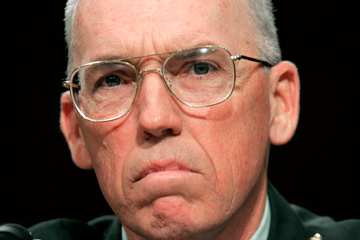

After the invasion of Iraq, Gen. Geoffrey Miller told the Iraq Survey Group they were "running a country club" and needed to get tough on prisoners.

Reuters/Kevin Lamarque
U.S. Maj. Gen. Geoffrey Miller, deputy commander of prison operations in Iraq, testifies before the Senate Armed Services Committee on Capitol Hill about Iraqi prisoner abuse, May 19, 2004.
It’s one thing if, as former Vice President Dick Cheney keeps saying, the United States brutally interrogated people to keep our kids safe from another strike by Osama bin Laden. If folks got tortured to provide a rationale for going to war with Iraq, though, that’s a whole different story.
Recent news reports have suggested the possibility that the Bush administration might have endorsed torture to prove an Iraq-al Qaida link. And a recent report from the Senate Armed Services Committee shows that months after then-President Bush had declared Mission Accomplished in Iraq, an Army general working hand in glove with top administration officials tried, albeit unsuccessfully, to convince a unit charged with finding weapons of mass destruction to get tough on its prisoners.
In August and early September of 2003, Maj. Gen. Geoffrey Miller, the man in charge of the Pentagon’s torture laboratory at Guantanamo Bay, was dispatched to Iraq, allegedly to Gitmoize operations there.
It seems to have worked, at least in one place. Soon after Miller visited with officials in charge of Abu Ghraib, guards there began to use working dogs, stress positions, extremely lengthy interrogations, isolation, yelling and nudity in order to try to wring information from prisoners — all techniques that had been used at Guantanamo and that the world would later see in photos released from an investigation in to what had gone on at the prison.
But according to the Senate committee’s report, before Miller met with the Abu Ghraib officials, he first made a little-known visit to the Iraq Survey Group, which was in charge of the hunt for WMDs in Iraq after the invasion.
Miller told the ISG they were “running a country club” by not getting tough on detainees, Chief Warrant Officer Brian Searcy, the ISG interrogation chief, told the Senate committee. Searcy said Miller suggested shackling detainees and forcing them to walk on gravel. Mike Kamin, another ISG official, told committee investigators that Miller recommended temperature manipulation and sleep deprivation.
Miller also told the ISG’s Maj. Gen. Keith Dayton that Dayton’s unit was “not getting much out of these people,” and complained that the ISG had not “broken” their detainees psychologically. Miller offered to send along suggested techniques, Dayton recalled, that would “actually break” the prisoners.
Dayton demurred, saying his unit wasn’t changing anything and that lawyers would have to carefully vet anything Miller suggested. The ISG generally balked. One of its debriefers threatened to resign if Miller got his way. After the cool reception, Miller appears to have dropped the effort with respect to the ISG.
On his return from Iraq, Miller was sent directly to the Pentagon to personally brief then-Deputy Secretary of Defense Paul Wolfowitz and Under Secretary of Defense for Intelligence Steven Cambone.
When interviewed by the committee, Miller couldn’t remember much about that visit. But in retrospect, it is pretty clear why the ISG wasn’t “getting much” out of their detainees on WMDs in Iraq: There weren’t any. Though with enough abuse, the detainees probably would have claimed otherwise.
Extraordinary rendition lawsuit also window into low point for American experiment
A fight between subcontractors leads to the publication of details of the CIA's secret kidnapping program
The lobby of the CIA Headquarters Building in McLean, Virginia, August 14, 2008. REUTERS/Larry Downing (UNITED STATES) (Credit: © Larry Downing / Reuters)
A lawsuit between two aviation companies concerning a couple hundred thousand dollars in unpaid expenses has inadvertently led to the publicizing of a great deal of information about the CIA’s extraordinary rendition program. (The program involved the illegal transport of thousands of terrorism suspects to secret CIA prisons in foreign nations and then to countries where suspects could be tortured. It is basically “kidnapping” followed by “torture” but the CIA did it so no one went to jail for it.)
The records from this lawsuit between two sub-contractors involved in the renditions will eventually be taught in an undergrad history course titled “America: Where It All Went Wrong.” Detainees were transported by the same companies that fly billionaires on private jets to their resort vacations. (The CIA doesn’t have an air force, so they relied on massive government contractor DynCorp, which… just rented some private planes.)
We learn that the CIA provided the flights with letters from a fictional State Department official (the State Department was almost certainly not involved in the rendition program) providing diplomatic cover.
We learn that one the planes used to transport a suspect (Abu Omar, captured in Italy and tortured in Egypt) was owned by the co-owner of the Boston Red Sox. The plane sported a Red Sox logo on the tail. I mean a Yankees plane might’ve been more poetically apt but either way it seems like such a pat symbol of America’s behavior in the wretched first decade of the 21st century that I’d roll my eyes at it if it turned up in a piece of fiction. An executive’s private plane, sporting the logo of a rich baseball team and carrying an Imam captured overseas by the CIA, touches down in Egypt, a nation led by an American-backed strongman, where the Imam is to be tortured. What preachy liberal hack dreamed up that one? (The executive also owns part of Liverpool FC, because we can’t forget Great Britain’s help in all this.)
Then the hedge funds took an interest in privatized torture:
DynCorp was purchased in 2003 by Computer Sciences Corp., another leading federal contractor, in a $940 million merger. Computer Sciences Corp. then took on a supervising role in the rendition flights through 2006, according to invoices and emails in the court files. CSC sold three DynCorp units in 2005 to Veritas Capital Fund, a private equity firm, for $850 million, but retained ownership of other parts of the old company. Veritas in turn sold the restructured DynCorp — now known as DynCorp International — for about $1 billion in 2010 to Cerebrus Capital Management, another private equity fund.
So at least a couple rich people got even richer off of our national shame. There’s an upside to everything.
New “sick details” emerge about water torture
On "Countdown," Jeremy Scahill discusses how the DOD hid behind waterboarding while using other water tortures
Jeremy Scahill on "Countdown"
The official government narrative, as defended by Donald Rumsfeld, is that no prisoners were waterboarded at Guantanamo Bay; the CIA did use waterboarding as an interrogation technique, but only at so-called “black sites”; and only three prisoners were subjected to this treatment.
However, new evidence is emerging to the contrary, largely in anecdotal form. As Truthout reported this week, a number of stories have come out about forced water choking and other uses of water for torture at sites including Gitmo.
Investigative reporter Jeremy Scahill discussed the issue with Keith Olbermann Thursday. He recalled an incident he had investigated (which would not be classified as waterboarding) of a former Guantanamo detainee having a high pressure water hose fixed up a nostril. Water would be forced up his head until suffocation.
Scahill noted President Obama’s “extremely poor record” at holding people accountable for torturous acts and expressed concern that little has changed at Guantanamo.
Rumsfeld currently faces a lawsuit over the alleged use of torture, bought by a former military translator held in Iraq for nine months, but Scahill emphasized that the U.S. administration always tends to get its people off the hook.
Watch the clip for “Countdown” below:
How long will the Washington Post continue to employ a lying torture-apologist, exactly?
Marc Thiessen is caught making yet another utterly false claim
Marc Thiessen
Remember Marc Thiessen, the former Bush speechwriter whose black heart loves nothing in this world besides the torturing of America’s many enemies and people who have been mistaken for our enemies? You know, the guy who has a Washington Post column, for some reason? He wrote a lie, at the Washington Post, this week! (Because he is a liar. In addition to being morally reprehensible, he also lies.) Via Adam Serwer, here’s what Thiessen said in a blog post about how Obama likes to “catch and release” terrorists, like little baby fishes:
The United States’ top special operations commander told Congress that because the United States has no place to hold captured terrorists we have simply been letting them go.
That is a lie. Even leaving aside the fact that it was written in support of an argument in favor of lawless, endless, indefinite detention forever, it’s not true.
Vice Adm. William McRaven said releasing people if they can’t be tried or send to a third-party nation “is an option.” He never said it had been done, let alone that it was the Obama administration’s standard operating procedure.
If you want the rest of the story of how Thiessen is misrepresenting the Obama administration’s anti-terrorism activities, go back to Serwer’s post. I just want to point out, once more, that Thiessen lied, in the Post, and I would like to ask if anyone at the Post cares about that.
Fred Hiatt, the Post’s editorial page editor, did specifically hire Thiessen after Thiessen wrote his book about how much he loves torture and how wonderful it is to torture people, so “staggering moral depravity” obviously does not disqualify you from a columnist gig at that fine newspaper. But I’d think lying to the readers would be frowned upon!
Not that George Will has ever gotten in trouble for repeatedly, purposefully and maliciously lying about climate change, but climate change involves “science” and editors and reporters and ombudsmen don’t understand “science”; they just understand that reasonable people disagree about it. This, on the other hand, is a very simple lie about someone’s testimony to Congress, which is very easy to find and check.
It is also a pretty minor offense, compared to repeatedly and misleadingly defending torture, but I’ve found newspaper types tend to feel like they’re on safer “objective” ground going after someone for a factual error than for a horrible, fascistic worldview.
Torture crimes officially, permanently shielded
The DOJ, with the exception of two likely murders, closes the book on all of the past decade's torture crimes
In August, 2009, Attorney General Eric Holder — under continuous, aggressive prodding by the Obama White House — announced that three categories of individuals responsible for Bush-era torture crimes would be fully immunized from any form of criminal investigation and prosecution: (1) Bush officials who ordered the torture (Bush, Cheney, Rice, Powell, Ashcroft, Rumsfeld); (2) Bush lawyers who legally approved it (Yoo, Bybee, Levin), and (3) those in the CIA and the military who tortured within the confines of the permission slips they were given by those officials and lawyers (i.e., “good-faith” torturers). The one exception to this sweeping immunity was that low-level CIA agents and servicemembers who went so far beyond the torture permission slips as to basically commit brutal, unauthorized murder would be subject to a “preliminary review” to determine if a full investigation was warranted — in other words, the Abu Ghraib model of justice was being applied, where only low-ranking scapegoats would be subject to possible punishment while high-level officials would be protected.
Yesterday, it was announced that this “preliminary review” by the prosecutor assigned to conduct it, U.S. Attorney John Durham, is now complete, and — exactly as one would expect — even this category of criminals has been almost entirely protected, meaning a total legal whitewash for the Bush torture regime:
The Justice Department has opened full criminal investigations of the deaths in CIA custody of two detainees, including one who perished at Iraq’s notorious Abu Ghraib prison, U.S. officials said Thursday.
The decision, announced by Attorney General Eric H. Holder Jr., means continued legal jeopardy for several CIA operatives but at the same time closes the book on inquiries that potentially threatened many others. A federal prosecutor reviewed 101 cases in which agency officers and contractors interrogated suspected terrorists during years of military action after the Sept. 11, 2001, attacks but found cause to pursue criminal cases in only two. . . .
The two token cases to be investigated involve the most grotesque brutality imaginable: they apparently are (1) a detainee who froze to death in an American secret prison in Afghanistan in 2002 after being ordered stripped and chained to a concrete floor, and (2) the 2003 death of a detainee at Abu Ghraib whose body was infamously photographed by guards giving a thumbs-up sign. All other crimes in the Bush torture era will be fully protected. Lest there be any doubt about what a profound victory this is for those responsible for the torture regime, consider the reaction of the CIA:
“On this, my last day as director, I welcome the news that the broader inquiries are behind us,” said a statement from CIA Director Leon Panetta, who will take over as defense secretary on Friday. “We are now finally about to close this chapter of our agency’s history” . . . . At CIA headquarters on Thursday, Holder’s announcement was greeted with relief. . . .
Consider what’s being permanently shielded from legal accountability. The Bush torture regime extended to numerous prisons around the world, in which tens of thousands of mostly Muslim men were indefinitely imprisoned without a whiff of due process, and included a network of secret prisons – ”black sites” — purposely placed beyond the monitoring reach of even international human rights groups, such as the International Red Cross.
Over 100 detainees died during U.S. interrogations, dozens due directly to interrogation abuse. Gen. Barry McCaffrey said: ”We tortured people unmercifully. We probably murdered dozens of them during the course of that, both the armed forces and the C.I.A.” Maj. Gen. Antonio Taguba, who oversaw the official investigation into detainee abuse, wrote: ”there is no longer any doubt as to whether the current administration has committed war crimes. The only question that remains to be answered is whether those who ordered the use of torture will be held to account.”
Thanks to the Obama DOJ, that is no longer in question. The answer is resoundingly clear: American war criminals, responsible for some of the most shameful and inexcusable crimes in the nation’s history — the systematic, deliberate legalization of a worldwide torture regime — will be fully immunized for those crimes. And, of course, the Obama administration has spent years just as aggressively shielding those war criminals from all other forms of accountability beyond the criminal realm: invoking secrecy and immunity doctrines to prevent their victims from imposing civil liability, exploiting their party’s control of Congress to suppress formal inquiries, and pressuring and coercing other nations not to investigate their own citizens’ torture at American hands.
All of those efforts, culminating in yesterday’s entirely unsurprising announcement, means that the U.S. Government has effectively shielded itself from even minimal accountability for its vast torture crimes of the last decade. Without a doubt, that will be one of the most significant, enduring and consequential legacies of the Obama presidency.
There is no rule of law in America
In our nation of torture, assassinations and foreign invasions, the question of legality has become obsolete
A detainee shields his face as he peers out through the so-called "bean hole" which is used to pass food and other items into detainee cells, at Camp Delta detention center, Guantanamo Bay U.S. Naval Base, Cuba, Monday, Dec. 4, 2006.
Is the Libyan war legal? Was Bin Laden’s killing legal? Is it legal for the president of the United States to target an American citizen for assassination? Were those “enhanced interrogation techniques” legal? These are all questions raised in recent weeks. Each seems to call out for debate, for answers. Or does it?
Now, you couldn’t call me a legal scholar. I’ve never set foot inside a law school, and in 66 years only made it onto a single jury (dismissed before trial when the civil suit was settled out of court). Still, I feel at least as capable as any constitutional law professor of answering such questions.
My answer is this: they are irrelevant. Think of them as twentieth-century questions that don’t begin to come to grips with twenty-first century American realities. In fact, think of them, and the very idea of a nation based on the rule of law, as a reflection of nostalgia for, or sentimentality about, a long-lost republic. At least in terms of what used to be called “foreign policy,” and more recently “national security,” the United States is now a post-legal society. (And you could certainly include in this mix the too-big-to-jail financial and corporate elite.)
It’s easy enough to explain what I mean. If, in a country theoretically organized under the rule of law, wrongdoers are never brought to justice and nobody is held accountable for possibly serious crimes, then you don’t have to be a constitutional law professor to know that its citizens actually exist in a post-legal state. If so, “Is it legal?” is the wrong question to be asking, even if we have yet to discover the right one.
Pretzeled Definitions of Torture
Of course, when it came to a range of potential Bush-era crimes — the use of torture, the running of offshore “black sites,” the extraordinary rendition of terrorist suspects to lands where they would be tortured, illegal domestic spying and wiretapping, and the launching of wars of aggression — it’s hardly news that no one of the slightest significance has ever been brought to justice. On taking office, President Obama offered a clear formula for dealing with this issue. He insisted that Americans should “look forward, not backward” and turn the page on the whole period, and then set his Justice Department to work on other matters. But honestly, did anyone anywhere ever doubt that no Bush-era official would be brought to trial here for such potential crimes?
Everyone knows that in the United States if you’re a robber caught breaking into someone’s house, you’ll be brought to trial, but if you’re caught breaking into someone else’s country, you’ll be free to take to the lecture circuit, write your memoirs, or become a university professor.
Of all the “debates” over legality in the Bush and Obama years, the torture debate has perhaps been the most interesting, and in some ways, the most realistic. After 9/11, the Bush administration quickly turned to a crew of hand-picked Justice Department lawyers to create the necessary rationale for what its officials most wanted to do — in their quaint phrase, “take the gloves off.” And those lawyers responded with a set of pseudo-legalisms that put various methods of “information extraction” beyond the powers of the Geneva Conventions, the U.N.’s Convention Against Torture (signed by President Ronald Reagan and ratified by the Senate), and domestic anti-torture legislation, including the War Crimes Act of 1996 (passed by a Republican Congress).
In the process, they created infamously pretzled new definitions for acts previously accepted as torture. Among other things, they essentially left the definition of whether an act was torture or not to the torturer (that is, to what he believed he was doing at the time). In the process, acts that had historically been considered torture became “enhanced interrogation techniques.” An example would be waterboarding, which had once been bluntly known as “the water torture” or “the water cure” and whose perpetrators had, in the past, been successfully prosecuted in American military and civil courts. Such techniques were signed off on after first reportedly being “demonstrated” in the White House to an array of top officials, including the vice-president, the national security adviser, the attorney general, and the secretary of state.
In the U.S. (and here was the realism of the debate that followed), the very issue of legality fell away almost instantly. Newspapers rapidly replaced the word “torture” — when applied to what American interrogators did — with the term “enhanced interrogation techniques,” which was widely accepted as less controversial and more objective. At the same time, the issue of the legality of such techniques was superseded by a fierce national debate over their efficacy. It has lasted to this day and returned with a bang with the bin Laden killing.
Nothing better illustrates the nature of our post-legal society. Anti-torture laws were on the books in this country. If legality had truly mattered, it would have been beside the point whether torture was an effective way to produce “actionable intelligence” and so prepare the way for the killing of a bin Laden.
By analogy, it’s perfectly reasonable to argue that robbing banks can be a successful and profitable way to make a living, but who would agree that a successful bank robber hadn’t committed an act as worthy of prosecution as an unsuccessful one caught on the spot? Efficacy wouldn’t matter in a society whose central value was the rule of law. In a post-legal society in which the ultimate value espoused is the safety and protection a national security state can offer you, it means the world.
As if to make the point, the Supreme Court recently offered a post-legal ruling for our moment: it declined to review a lower court ruling that blocked a case in which five men, who had experienced extraordinary rendition (a fancy globalized version of kidnapping) and been turned over to torturing regimes elsewhere by the CIA, tried to get their day in court. No such luck. The Obama administration claimed (as had the Bush administration before it) that simply bringing such a case to court would imperil national security (that is, state secrets) — and won. As Ben Wizner, the American Civil Liberties Union lawyer who argued the case, summed matters up, “To date, every victim of the Bush administration’s torture regime has been denied his day in court.”
To put it another way, every CIA torturer, all those involved in acts of rendition, and all the officials who okayed such acts, as well as the lawyers who put their stamp of approval on them, are free to continue their lives untouched. Recently, the Obama administration even went to court to “prevent a lawyer for a former CIA officer convicted in Italy in the kidnapping of a radical Muslim cleric from privately sharing classified information about the case with a Federal District Court judge.” (Yes, Virginia, elsewhere in the world a few Americans have been tried in absentia for Bush-era crimes.) In response, wrote Scott Shane of the New York Times, the judge “pronounced herself ‘literally speechless.’”
The realities of our moment are simple enough: other than abusers too low-level (see England, Lynndie and Graner, Charles) to matter to our national security state, no one in the CIA, and certainly no official of any sort, is going to be prosecuted for the possible crimes Americans committed in the Bush years in pursuit of the Global War on Terror.
On Not Blowing Whistles
It’s beyond symbolic, then, that only one figure from the national security world seems to remain in the “legal” crosshairs: the whistle-blower. If, as the president of the United States, you sign off on a system of warrantless surveillance of Americans — the sort that not so long ago was against the law in this country — or if you happen to run a giant telecom company and go along with that system by opening your facilities to government snoops, or if you run the National Security Agency or are an official in it overseeing the kind of data mining and intelligence gathering that goes with such a program, then — as recent years have made clear — you are above the law.
If, however, you happen to be an NSA employee who feels that the agency has overstepped the bounds of legality in its dealings with Americans, that it is moving in Orwellian directions, and that it should be exposed, and if you offer even unclassified information to a newspaper reporter, as was the case with Thomas Drake, be afraid, be very afraid. You may be prosecuted by the Bush and then Obama Justice Departments, and threatened with 35 years in prison under the Espionage Act (not for “espionage,” but for having divulged the most minor of low-grade state secrets in a world in which, increasingly, everything having to do with the state is becoming a secret).
If you are a CIA employee who tortured no one but may have given information damaging to the reputation of the national security state — in this case about a botched effort to undermine the Iranian nuclear program — to a journalist, watch out. You are likely, as in the case of Jeffrey Sterling, to find yourself in a court of law. And if you happen to be a journalist like James Risen who may have received that information, you are likely to be hit by a Justice Department subpoena attempting to force you to reveal your source, under threat of imprisonment for contempt of court.
If you are a private in the U.S. military with access to a computer with low-level classified material from the Pentagon’s wars and the State Department’s activities on it, if you’ve seen something of the grim reality of what the national security state looks like when superimposed on Iraq, and if you decide to shine some light on that world, as Bradley Manning did, they’ll toss you into prison and throw away the key. You’ll be accused of having “blood on your hands” and tried, again under the Espionage Act, by those who actually have blood on their hands and are beyond all accountability.
When it comes to acts of state today, there is only one law: don’t pull up the curtain on the doings of any aspect of our spreading National Security Complex or the imperial executive that goes with it. As CIA Director Leon Panetta put it in addressing his employees over leaks about the operation to kill bin Laden, “Disclosure of classified information to anyone not cleared for it — reporters, friends, colleagues in the private sector or other agencies, former Agency officers — does tremendous damage to our work. At worst, leaks endanger lives… Unauthorized disclosure of those details not only violates the law, it seriously undermines our capability to do our job.”
And when someone in Congress actually moves to preserve some aspect of older notions of American privacy (versus American secrecy), as Senator Rand Paul did recently in reference to the Patriot Act, he is promptly smeared as potentially “giving terrorists the opportunity to plot attacks against our country, undetected.”
Enhanced Legal Techniques
Here is the reality of post-legal America: since the attacks of September 11, 2001, the National Security Complex has engorged itself on American fears and grown at a remarkable pace. According to Top Secret America, a Washington Post series written in mid-2010, 854,000 people have “top secret” security clearances, “33 building complexes for top-secret intelligence work are under construction or have been built since September 2001… 51 federal organizations and military commands, operating in 15 U.S. cities, track the flow of money to and from terrorist networks… [and] some 1,271 government organizations and 1,931 private companies work on programs related to counterterrorism, homeland security, and intelligence in about 10,000 locations across the United States.”
Just stop a moment to take that in. And then let this sink in as well: whatever any one of those employees does inside that national security world, no matter how “illegal” the act, it’s a double-your-money bet that he or she will never be prosecuted for it (unless it happens to involve letting Americans know something about just how they are being “protected”).
Consider what it means to have a U.S. Intelligence Community (as it likes to call itself) made up of 17 different agencies and organizations, a total that doesn’t even include all the smaller intelligence offices in the National Security Complex, which for almost 10 years proved incapable of locating its global enemy number one. Yet, as everyone now agrees, that man was living in something like plain sight, exchanging messages with and seeing colleagues in a military and resort town near Islamabad, the Pakistani capital. And what does it mean that, when he was finally killed, it was celebrated as a vast intelligence victory?
The Intelligence Community with its $80 billion-plus budget, the National Security Complex, including the Pentagon and that post-9/11 creation, the Department of Homeland Security, with its $1.2 trillion-plus budget, and the imperial executive have thrived in these years. They have all expanded their powers and prerogatives based largely on the claim that they are protecting the American people from potential harm from terrorists out to destroy our world.
Above all, however, they seem to have honed a single skill: the ability to protect themselves, as well as the lobbyists and corporate entities that feed off them. They have increased their funds and powers, even as they enveloped their institutions in a penumbra of secrecy. The power of this complex of institutions is still on the rise, even as the power and wealth of the country it protects is visibly in decline.
Now, consider again the question “Is it legal?” When it comes to any act of the National Security Complex, it’s obviously inapplicable in a land where the rule of law no longer applies to everyone. If you are a ordinary citizen, of course, it applies to you, but not if you are part of the state apparatus that officially protects you. The institutional momentum behind this development is simple enough to demonstrate: it hardly mattered that, after George W. Bush took off those gloves, the next president elected was a former constitutional law professor.
Think of the National Security Complex as the King George of the present moment. In the areas that matter to that complex, Congress has ever less power and, as in the case of the war in Libya or the Patriot Act, is ever more ready to cede what power it has left.
So democracy? The people’s representatives? How quaint in a world in which our real rulers are unelected, shielded by secrecy, and supported by a carefully nurtured, almost religious attitude toward security and the U.S. military.
The National Security Complex has access to us, to our lives and communications, though we have next to no access to it. It has, in reserve, those enhanced interrogation techniques and when trouble looms, a set of what might be called enhanced legal techniques as well. It has the ability to make war at will (or whim). It has a growing post-9/11 secret army cocooned inside the military: 20,000 or more troops in special operations outfits like the SEAL team that took down bin Laden, also enveloped in secrecy. In addition, it has the CIA and a fleet of armed drone aircraft ready to conduct its wars and operations globally in semi-secrecy and without the permission or oversight of the American people or their representatives.
And war, of course, is the ultimate aphrodisiac for the powerful.
Theoretically, the National Security Complex exists only to protect you. Its every act is done in the name of making you safer, even if the idea of safety and protection doesn’t extend to your job, your foreclosed home, or aid in disastrous times.
Welcome to post-legal America. It’s time to stop wondering whether its acts are illegal and start asking: Do you really want to be this “safe”?
Page 1 of 61 in Torture
A passport to utopia
“The Fault in Our Stars” and “There Is No Dog”: Not kids’ stuff
Ricky Gervais: My conscience never takes a day off
Lessons of a very sexy pirate costume
America’s failed promise of equal opportunity
Is gay literature over?
A voice that touched us all
Whitney Houston dies at 48
Didn’t she almost have it all?
Porn’s taboo transsexual stars 

