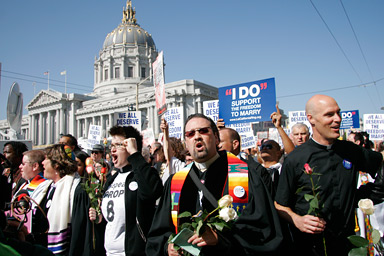
Boos, tears and civil disobedience as California decides to uphold Proposition 8
People march in protest against Prop. 8 on Tuesday in San Francisco.

Salon/Julie Coburn
People march in protest against Proposition 8 on Tuesday in San Francisco.
SAN FRANCISCO — Kory O’Rourke and Kate Sheppard huddled under a tree on the sidewalk near Civic Center Park trying to shield their children, Keaton, 3, and Corbyn, 1, from the sun and waiting to hear the fate of their marriage. The San Francisco couple had been joined in a commitment ceremony in 2000, married for the first time in 2004 and tied the knot again on June 17, 2008, just as soon as the California Supreme Court’s last ruling on same-sex marriage would allow it. Soon they’d learn that, while their marriage is still valid, the court’s ruling upholding Proposition 8 means other same-sex couples in California won’t be allowed to wed.
The family was among the hundreds of gay-marriage supporters gathered just before 10 a.m. to hear the California Supreme Court’s decision on the constitutionality of Proposition 8. Most stood in the street behind police barricades, with many in the crowd waving signs that read, “We All Deserve the Freedom to Marry,” and others wearing T-shirts that read “Separate Is not Equal.”
Amid the throng filling the street and shutting down traffic in front of the courthouse, there were only a smattering of Proposition 8 supporters, with one sign declaring, “Marriage still = 1 man & 1 woman.”
As 10 a.m. approached, the chant went up from the crowd: “What do we want? Equality! When do we want it? Now!” But the mass quieted as a handful of same-sex marriage leaders trickled out on the courthouse steps, holding the pages of the press release and the text of the decision itself in their hands. For about 30 sickening seconds, the crowd didn’t know which way the ruling had gone, although many assumed the worst, and then a chorus of boos rose as the word of the court’s ruling spread.
Despite refusing to strike down Proposition 8 on constitutional grounds, the state Supreme Court ruled that the decision does not impact the 18,000 marriages of same-sex couples that took place before the California Constitution was modified by voters to discriminate against gays and lesbians. Yet O’Rourke, a stay-at-home mom, says that the court’s decision is still “devastating” to her and her family. She expressed dismay that California, where five years ago, in February 2004, the national fight for same-sex marriage began in earnest when San Francisco Mayor Gavin Newsom began allowing the marriages of same-sex couples like O’Rourke and her wife, is now behind other states, such as Iowa and Vermont, on the road to marriage equality.
“We don’t want our kids to grow up in a society where people are not treated equally under the law,” said Sheppard, who works for the YMCA. “We are going to win this fight. In the meantime, it’s very hard to be in the middle of it having our children told that our family is less.” Both women predicted that the issue will go to the California voters again on the 2010 ballot. “We’re hopeful that California will do the right thing,” said O’Rourke.
As the crowd began to march in the street toward City Hall, Christina McGowen, a stay-at-home mom, held her almost-3-year-old daughter August’s hand, while her husband, Sean McGowen, who works for Costco, pushed younger sister Liberty, almost 1, in a stroller. The young straight couple had driven in from Antioch, about 45 miles away, to witness the decision and show their support for same-sex marriage: “I feel like it’s unfair that we’re able to get married and have all the rights for our family and other people are not,” said Christina, who held a sign that read, “Hate is not a family value.”
As the marchers moved around Civic Center Park, some had festooned a statue of Abraham Lincoln, which sits in front of City Hall, with roses, a heart and signs reading, “We all deserve the freedom to marry” and “Separation of church and state.” Marching past the protesting statue was Kurt Fausset, 29, a knitwear designer, who moved to San Francisco from Florida three years ago: “I thought California would be a place where I wouldn’t have to worry about this kind of stuff,” he said. Fausset, who is not married but has a boyfriend, said that he’s sad to think he might miss out on the joys of marriage in the future: “It’s something that I’ve looked forward to my whole life, to find out who I was going to marry.”
Ken Broshous of San Francisco described himself as hurt, saddened and disgusted by the court’s decision. To those who had voted for Proposition 8 in the name of the sanctity of marriage he had this to say: “They can outlaw divorce.”
Just down the block from Civic Center Park, same-sex marriage activists had stopped traffic by joining hands in a giant circle at the intersection of Grove and Van Ness near City Hall, and police started making arrests. Meanwhile, on Twitter, the hash tag “#rejectprop8″ received a tweet per second as reactions to the news and reports on the event piled up.
An even bigger rally and march is planned at City Hall at 5 p.m. tonight. To think, it was just a few weeks shy of a year ago when ecstatic gay and lesbian couples rejoiced at that very City Hall for their fully legal nuptials.
On Proposition 8, two judges rule
One judge's decision builds support for marriage equality by appealing to another judge: Justice Anthony Kennedy
Judges Anthony Kennedy and Steven Reinhardt (Credit: AP/Charles Dharapak/Stephanie Turner)
Save the confetti.
The two Democratic appointees to the 9th Circuit Court of Appeals ruled Tuesday that the California prohibition of gay marriage — the infamous Proposition 8 — violated the U.S. Constitution. Following the cautious counsel of a group of friends of the court, seasoned activists not part of the new litigation group that brought the suit, longtime liberal giant Judge Stephen Reinhardt passed up the opportunity to produce the gay Brown v. Board of Education.
Instead Reinhardt ruled on the narrowest possible grounds that Proposition 8 was unconstitutional, because it took away gays’ preexisting right to marry, extended to them a few months before by the California Supreme Court. No other state, not even the other states in the territory covered by the 9th Circuit, is affected by the ruling.
The opinion is an explicit appeal to Justice Kennedy, who wrote the original pro-gay Supreme Court opinion in Romer v. Evans, which involved a law that took away gay rights. It practically parrots the language of his opinion verbatim, offering him the opportunity to affirm their ruling and still duck the question of whether there is an overall constitutional right to same-sex marriage.
On their Tuesday conference call with the press after the decision, David Boies and Ted Olson, the famous lawyers behind the challenge, were lukewarm about the prospect that the Supreme Court would take their case as the opportunity to establish the constitutionality of same-sex marriage. This tone is notably different from the proclamations of national vindication that accompanied the filing of this suit after blue California handed them a black eye when they passed Proposition 8 four years ago.
They are right to be chary. Satisfying as it was to think of an avenging judiciary riding to the rescue of truth and justice, there hasn’t been a Warren Court for 40 years now. Even Judge Reinhardt’s narrow and cautious decision did not attract the vote of his Republican-nominated colleague on the panel. The political divide in the nation has long been reflected in the federal courts and nowhere as clearly as in this decision.
Thus, it’s all about Justice Kennedy, the only justice with even questionable allegiance right or left. Thanks to the long delays in trying Perry v. Brown, all the players now have a little more information about Justice Kennedy. When they filed, they knew that in 1996 and again in 2003 Justice Kennedy had written unequivocally pro-gay opinions in two landmark cases. Each year since the Perry case began, however, Justice Kennedy’s voting record, conventionally described as unpredictable at best, moves more to the right.
Last term, although he ordered thousands of inmates sprung from California’s obscenely crowded jails, almost all his other decisions served solidly conservative political interests: He protected the Westboro (“fags in hell”) Baptist Church’s picketing of service members’ funerals, allowed Arizona to punish businesses that hire illegal aliens, but struck down Arizona’s law mandating public funding of elections.
In the prior term, although he again limited the cruelty of criminal punishment (no life sentences for juveniles), he approved the unlimited expenditure of political money in Citizens United, held that suspects had to ask for their right to remain silent, and temporarily allowed a big cross to remain up on the Mojave National Preserve. Academics spill pots trying to derive a grand theory for Justice Kennedy’s rulings from, say, the libertarian writings of John Locke, but Kennedy’s erratic decision-making is more about Mr. Dooley (“the law follows the election returns”) than Mr. Locke. A professional gambler would say the odds of a favorable outcome for gay rights have diminished since the Proposition 8 suit was filed.
Meanwhile, the boring and snail-like processes of democratic self-government have produced a surprising uptick in the prospects for same-sex marriage. New York state became the first big industrial state to pass a same-sex marriage law and prospects are good in Washington state and Maryland. The losers in a 2009 Maine referendum are predicting the first victory in a direct popular vote. And the New Jersey Legislature is challenging its Republican governor to veto the increasingly popular issue. The issue gets more favor with the public all the time; approval crossed the 50 percent mark last spring.
In light of these developments, the next step in the prudent strategy that generated a narrow decision designed to minimize the demands on the Supreme Court is to delay the moment of truth as long as possible. Fortunately, the complex processes of appeal present the plaintiffs with a chance to gum things up. In reaching the constitutional issue, the 9th Circuit actually ruled against the plaintiffs on the question of whether the anti-marriage defendant-intervenors had standing to appeal the trial court’s decision at all.
Rather than sitting back and waiting for the losing side to rush the substantive decision to the Supreme Court, the plaintiffs might take a shot at asking the whole 9th Circuit (en banc) to review the decision that the defendants have standing. Such an appeal would be transparently strategic, but by the time the parties have briefed the question of whether they’re even entitled to en banc rehearing on standing (since they won on the merits), plaintiffs will have bought several more precious months for the political climate to continue to turn in their favor. Even if they do not try to pursue an appeal from a decision that gave them a victory, briefing schedules are notoriously generous, and the plaintiffs would be well served to take advantage of that opportunity. Sometimes, even Shakespeare is wrong, and there is a real advantage to “the law’s delay.”
The making of gay marriage’s top foe
Salon exclusive: How Maggie Gallagher's college pregnancy made her a single mom, and a traditional marriage zealot
Maggie Gallagher (Credit: Nik_Merkulov via Shutterstock/Salon)
In September 1978, Yale freshmen would not have voted Maggie Gallagher the member of the Class of 1982 most likely to get pregnant before graduation. Gallagher was the third of four children from a close family in Portland, Ore. When she was young, her parents, an investment banker and a housewife, had been active in their local Catholic parish, and Gallagher and her siblings spent some years in Catholic elementary school. As Gallagher got older, her parents began to drift away from the church, and Gallagher’s mother became something of a spiritual seeker (“She once took me to an Up With People concert,” Gallagher now recalls, ruefully.) But Gallagher herself moved to the right in high school. Like many precocious girls, she fell for Ayn Rand’s novels, including “The Fountainhead” and “Atlas Shrugged,” and for Objectivism, Rand’s capitalist, acquisitive philosophy. (Gallagher’s other formative influence was the science-fiction writer Robert Heinlein.) When she got to Yale, she only gingerly embraced the secular mores, the drinking and the drugs and the hookup culture, that defined life on liberal campuses in the late 1970s. She tried marijuana once and did not like it. She smoked cigarettes but, afraid of becoming addicted, never inhaled.
Gallagher’s earliest acquaintances at Yale remember a somewhat sheltered young woman, polite and likable, a bit startled by what she saw. One of the freshmen who shared Gallagher’s suite of rooms, Bird Jensen, now a musician in Australia, remembers Gallagher as “a born-again Christian” — which Gallagher was not, but the mistake is telling. She remembers Gallagher, who after all was from a progressive, metropolitan area, as if she were from a small town in the middle of the plains. “It was very different for her to have Jewish people celebrating Shabbat, or have a bunch of hippies strumming guitar, or punk people playing music in our room,” Jensen says. “That was all very new to her. But Maggie was friendly. She had strong views on things, but we all got along.” Another freshman suitemate, Faith Stevelman, now a professor at New York Law School, remembers Gallagher as intellectually provocative — “She was introducing me to ideas nobody else would introduce me to” — but a bit of a killjoy. “I think she was somewhat socially immature.” Although Gallagher recalls being totally happy to be at Yale — “It was the first time in my life I was surrounded by many intellectuals,” she says — Stevelman remembers a young woman who stiffened at everything risky about college in the 1970s: sex, drugs, radical politics. “She was not easygoing,” Stevelman says of her suitemate. “She wasn’t what you would call a fun roommate.”
As a freshman, Gallagher joined the Party of the Right, a debating society affiliated with the Yale Political Union. The YPU is a very large campus organization, with hundreds of members, whose main activity is to bring speakers to campus several times a month. But it is organized into “parties,” smaller clubs that meet for meals, pub nights and informal debates. Each party has its own flavor, political and cultural. The Tory Party is right-of-center and high Anglophile (the men wear tweed, the women plan to take their future husbands’ last names); the Liberal Party is left-of-center, earnest and wonkish. The Party of the Right has the deepest culture of the half-dozen or so parties. Its membership is diverse, comprising libertarians and monarchists, Catholic traditionalists and Objectivists, monetarists and distributivists. But they share a passionate, if often pretentious, reverence for the life of the mind. Members of the Party of the Right often major in philosophy, and they prefer debating questions about God or the Good to mundane matters of policy.
The party’s intentional eccentricity — when I was at Yale, in the 1990s, several Party of the Right men affected hats and trench coats — helps explain its reputation for cultishness. For many members, the party becomes their entire social world, and so it is not surprising that party romances are common. As a senior, Gallagher began seeing a fellow party member, a sophomore who wrote conservative editorials for a campus magazine and dreamed of being a doctor.
Today, they have different memories of the relationship — how long they had been dating, how close they were — but on one fact they agree: 30 years ago this spring, months before she was supposed to graduate, Gallagher discovered she was pregnant. Then, as now, Yale students did not get pregnant — or if they did, no baby came of it. But Gallagher knew she would have this baby. At first, she planned to give the baby up for adoption, but she soon changed her mind. The father, however, was not interested in being a father. Or so she says.
On a mild November day, Gallagher and I are upstairs at City Bakery, near Union Square in Manhattan, where after months of requests she has agreed to meet me. As Gallagher tells it, she and the baby’s father were close; they had been together “on the order of one year,” she says, so he might have been expected to stand by her. “My son’s father was my boyfriend at Yale,” is how she describes their relationship. But when she told him she was pregnant, right before spring break in 1982, he vanished on her. “I was in his room and he had to go do something, and I was going to fly out in a couple of hours, had to get to the airport. And the last thing he said to me was, ‘I’ll be back in 30 minutes.’ And then he wasn’t.”
He just left her sitting in his room. And that was the end of them. When summer came, Gallagher moved home to Oregon and took some classes to finish her degree. In the fall, she gave birth to a baby boy, Patrick.
The next year, Gallagher says, she and the father reconciled and moved in together. He was still in school, and they shared a house by the Connecticut shore with some other undergraduates. “It was one of those things that you have to be pretty young and stupid to think is going to work, because it was a very collegiate environment and, you know, basically my parents were supporting me. And so, you know, we, we broke up. I moved into a separate apartment, and he came by occasionally.” He graduated, and soon they were living near one another — she was commuting from Jersey City to Manhattan, to work at National Review, the conservative magazine, and he was in Harlem. He occasionally baby-sat for Patrick, until one day, after staying with his son while she attended a conference, he decided he wanted out. “He called me up the next day, or the next, and said that he couldn’t do it anymore, and that he didn’t really want to have anything to do with either of us,” Gallagher says. “And that was it.”
The father remembers it differently. When I ask if he and the woman he got pregnant in college were indeed a couple, he thinks for a moment, then says, “Sort of.”
He is not pleased to have been found after all these years. To get him to speak, I have promised to keep his identity secret. He became a doctor, as planned. He lives in a small town on the East Coast with his wife and family. He has not spoken to his son or to his son’s mother since that final break in the mid-1980s. He knows who she has become — she is in the newspaper and on television — but he does not pay much attention to her writings. “I don’t read them extensively, because I don’t agree with them, and I find it personally painful to do so, as you might imagine.”
His memories are vague, and rather self-serving. It seems that he did not work very hard to stay in his son’s life, but after thinking on it he apportions some of the blame to the boy’s mother. “To the best that I can recall,” he says, “initially she did want both of us to be involved in parental responsibilities, but from the beginning it was always on her terms. It’s hard to describe. It seemed to me at the time that she had an idea of how she wanted things to go, and it was not particularly important whether I had an idea of how things would go or not.” I ask if he might have done more, 30 years ago, to make the three of them into a family. “There’s a million things I wish I’d done differently back then,” but, he adds, “it would have required me to be a different person.”
That was not really his fault, Gallagher says. Neither of them thought they should get married. Nobody did. “There was literally no one — not his mother, not my parents, not the counselor I talked to, none of my friends, nobody in that world,” she says, who suggested they get married. “And in fact I would say the concern was that we not get married” — that they avoid the mistake of marrying too young.
“But I think, looking back, that if he had said, ‘You know, Maggie, I love you, I love you, let’s get married,’ I would’ve been thrilled. You know, he was my boyfriend.”
- – - – - – - – - – - -
Counterfactual history is a dangerous business, but it seems fair to say that Gallagher’s was the non-marriage that changed the world. If that sophomore cad had married Gallagher, she might never have become a writer. “I don’t know what I would have done,” she tells me. “I became a writer because I had a baby and had to make money.” And what she writes about is same-sex marriage: why it’s bad for children, bad for America, simply bad. In her books and newspaper columns, and above all in her fundraising and political organizing, Gallagher has done more than any American to stop same-sex marriage. The organization she founded in 2007, the National Organization for Marriage, helped organize the successful effort in 2008 to pass Proposition 8 in California, overturning that state’s same-sex-marriage statute. (A federal appeals court ruled Tuesday that it violated the Constitution, setting up a likely appeal to the U.S. Supreme Court.) In 2009, her organization contributed over 60 percent of the entire budget of Stand for Marriage Maine, the primary organization behind Proposition 1, the referendum that overturned Maine’s same-sex marriage law. In 2010, National Organization for Marriage money helped determine the election that ousted three Iowa Supreme Court justices who had upheld same-sex marriage.
Gallagher stepped down as president of the National Organization for Marriage in 2010 — before it made news by doctoring a photograph of a thronging Obama rally to make an anti-gay-marriage rally look well attended. She was its chairwoman until last August, but now writes a blog called Culture War Victory Fund, which offers commentary on “marriage, life [and] religious liberty.” The organizations Gallagher founded, and the fundraising and activist networks she continues to build, are active everywhere that same-sex marriage — currently legal in six states and Washington, D.C. — is being contested. Her armies are working to pass anti-gay-marriage amendments in North Carolina and Minnesota and to stop gay-marriage bills or referendums in Maryland, New Jersey, Rhode Island and Washington state. In 2011, when New York state passed its gay-marriage law, the number of people living in states that permitted same-sex marriage doubled; in 2012, the number could double again. The issue has not yet dominated the presidential race, largely because the Republican candidates are uniform in their opposition; but it’s hard to see how same-sex marriage will not roar back in the general election.
Which means this could be the year of Maggie Gallagher. Among the leading generals in the fight against same-sex marriage, she is not as cerebral as Robert P. George, the Princeton professor whose articles provide intellectual ammo for the movement; and she does not move as smoothly across enemy lines as her former boss David Blankenhorn, whose politic tone makes him gay-marriage supporters’ friendliest enemy. But Gallagher is shrewd, she is indefatigable and she is everywhere, from Fox News to a campus near you. If you turn on C-SPAN and see a stout, black-haired, middle-aged woman in modest clothing — the stern elementary school teacher who, you later realized, taught you all the grammar you know — patiently explaining to a campus auditorium of skeptical, liberal collegians why the definition of marriage is immutable, you are watching Maggie Gallagher.
Gallagher’s unplanned pregnancy — so great a rupture in a young conservative woman’s sense of life’s proper path, coming at so young an age — focused her politics, and gave her traditional-family conservatism a messianic tinge. But her path to marriage activism was not quite so straight and uncomplicated. When Gallagher returned to the New Haven area the year after graduation, to live with her son’s father, she continued to socialize with her conservative crowd. One of her fellow campus conservatives, Charles Bork, the son of the future Supreme Court nominee Robert Bork, got Gallagher her first work in journalism. Along with another student, Bork had sneaked into Afghanistan one spring break to take pictures of the anti-Communist mujahedin. When Bork’s traveling companion failed to produce the accompanying article he had promised to write, Bork asked Gallagher to step in, and on Aug. 28, 1983, the New Republic published her article “Inside Afghanistan.” Gallagher was soon hired at National Review, where her early pieces included articles on pro-life politics, attacks on Legal Services, an essay about the nascent “men’s movement,” a review of a book about Afghanistan, a penetrating analysis of the “Baby M” surrogacy case, and a sympathetic obituary for the Bork nomination (in which she never mentions that Bork’s son was her close friend and patron).
As a Yale-educated journalist living in Brooklyn, Gallagher was an enviable type. Although being a young single mother made her unusual, nothing about her situation was an obvious prescription for bitterness. But in 1989, when Patrick was 7, Gallagher published a book that remains startling for its combination of sadness and anger; it’s hard to believe any author can sound so hopelessly disappointed before the age of 30. In a sense, “Enemies of Eros,” a jeremiad about the sorry state of sexual culture and gender relationships, must have been gestating since her son was born. Its author is sad that lifelong marriage is no longer an accepted norm; that many children do not grow up with fathers; that sex has been decoupled from marriage and parenthood. And she is angry at everyone she finds culpable for these changes, including “elite women, magazine editors, book publishers, screenwriters, advice columnists, and auteurs who are the moral guardians of the new generation, mentors to guide young women through the thickets of modernity into a sexual utopia that seems to be receding ever further into the horizon.”
Gallagher charges these women, sitting in “their perch atop the towers of Manhattan,” with conspiring — “conspiracy” is indeed her word — to delude women into thinking that the sexes are basically the same. But the sexes are obviously not the same, Gallagher argues. Men are different. “Sometimes they prefer a hotel room to a house in the suburbs, or beg us to exchange bodily fluids without ever exchanging phone numbers. Sometimes they do not appreciate that making a baby is making a long-term commitment you cannot just walk out on when you’re feeling unfulfilled.” Because men are so different, society developed norms to pressure men to take responsibility they might wish to avoid. The naive hope of the women’s movement, that gender roles could wither away, has only tangled ladies’ stockings in a hopeless knot: Without marriage norms, and the sex norms that go with them, men can get away with anything — all the sex they want, and no more of the housework than before.
Undoing feminism’s damage will involve better laws, retrenching to older views of gender, and gentle condescension to men. Gallagher was years ahead of her time in arguing, as writers like Kay Hymowitz do today, that contemporary society has left men without a role. “We will never find a solution to the New Man shortage, unless we jettison gender neutrality,” Gallagher writes. “Men need a role in the family. What men need, loath though we are to utter the word, is a sex role.” Gallagher approvingly offers the example, drawn from a Wall Street Journal article, of one Millie Stephens, “a 28-year-old manager for Bell of Pennsylvania who earns $46,000 a year.” Her husband, Carl, a state trooper, earns $31,000 a year, and “to disguise her salary, they put all of her earnings in the bank and live off his income.” “Mrs. Stephens” also washes the dishes and irons her husband’s shirts. “I don’t mind treating him like a man,” she says.
Starting with “Enemies of Eros,” marriage policy became the focus of Gallagher’s career. In September 1992, while she was working as an editor at City Journal, the conservative journal she helped found, Vice President Dan Quayle criticized the television character Murphy Brown for becoming a single mother by choice. It was a perfect occasion to see the contemptible liberal elites in action: They swarmed Quayle, attacking him for his backwardness. In the vice president’s defense, Gallagher wrote “An Unwed Mother for Quayle,” an Op-Ed column for the New York Times in which she offers her bits of advice, learned over 10 years of single-mothering, for women who might be tempted to follow Murphy Brown’s lead. “Have relatively affluent parents who got and stayed married themselves,” she writes. “Be able to choose a profession with flexible hours … Find a boss who doesn’t mind if you bring a sick 4-year-old and his dinosaurs to the office, which will happen regularly … Expect to give up all the advantages of single life — freedom, romance, travel … Prepare for the nights when your child cries himself to sleep in your arms, wondering why his father doesn’t love him.”
Although she was, for the time being, without a father for her son, Gallagher was not alone. Co-workers at National Review remember a cheery young woman with a gift for friendship. And Sherry Weaver, who met Gallagher on their sons’ first day in kindergarten at P.S. 321, in Park Slope, moved in with Gallagher and Patrick after her third marriage fell apart, in 1992. Weaver remembers a crowded and happy house, filled with guests, many of them from the conservative movement. Charles Bork was often there, and sometimes stayed over.
Weaver says that Gallagher is one of the kindest people she has ever met, and that Gallagher was happy to blend their families for months on end. “She housed my two children and me for seven months,” Weaver told me in an email. “But it was not in the spare bedroom or the family room downstairs in some out-of-the-way space that would not interfere with her life. No, she lived in a small two-bedroom house, so we slept in her bed and she slept on the couch. She slept on the couch for seven months! Who would do that? And she did it with grace and generosity. She paid all the bills, gave me some work that I did horribly, in order to give me money. She did all the cooking and nurtured us with unbelievable kindness. She was never grumpy or out of sorts. My children and I were completely traumatized, and this time with Maggie was a time of healing for us.”
One of the other frequent guests, Weaver says, was Raman Srivastav, a fellow conservative from Gallagher’s Yale days. “He was always around the house when I was living with her,” Weaver says. Near the end of Weaver’s seven months in residence, Gallagher and Srivastav got engaged. Weaver moved out, around Christmastime, Gallagher and Srivastav married on Jan. 2, 1993, and immediately afterward he moved in. Gallagher is coy about their courtship — “How do things go from friendship to more?” she muses, and that’s as much as she will say. David Wagner, now a law professor at Regent University, knew both Gallagher and Srivastav in the Party of the Right, and he puts a romantic spin on their eventual union: “She eventually married another Party member who had adored her from the beginning, and he adopted Patrick and gave them a better life. And that is a happy outcome.”
In 1996, Gallagher began writing a weekly newspaper column, published a second book, “The Abolition of Marriage: How We Destroy Lasting Love,” and joined the Institute for American Values, a New York think tank. David Blankenhorn, the institute’s founder, says he is a political liberal, and his image is that of a cosmopolitan: He is a Harvard graduate, a Presbyterian with a Jewish wife, and to all appearances an unconflicted New Yorker (although born in Mississippi). Blankenhorn founded his institute in 1987 to unite those of varying political persuasions around the urgency of keeping nuclear families together. (Blankenhorn’s first book was called “Fatherless America.”) Today, Blankenhorn is second only to Gallagher as the face of the anti-gay-marriage movement: In 2010 he was a witness for the defense in the appellate trial over Proposition 8, the ballot measure that ended same-sex marriage in California. But until recently he tried to keep his institute away from so divisive an issue.
When she joined Blankenhorn’s institute, Gallagher was not interested in same-sex marriage either. She was busy writing about easy divorce, out-of-wedlock births, and the high costs of feminism. Gay men and lesbians, for their part, were focused on increased funding for AIDS research, hate-crimes statutes, and the dim prospect of someday, maybe, ending “don’t ask, don’t tell.” They did not believe they would live to see the legalization of same-sex marriage, and neither, of course, did Maggie Gallagher.
- – - – - – - – - – - -
In early April 2003, the Institute for American Values invited two dozen activists, scholars and journalists to Osprey Point, a conference center near the Chesapeake Bay in Maryland, for a “marriage leaders summit.” Wade Horn, the Bush administration’s point man for pro-marriage policies, was there, as was Ann Hulbert, then of the New York Times Magazine; Will Marshall, of the centrist Progressive Policy Institute; and David Popenoe, who runs the National Marriage Project at Rutgers University. The Massachusetts Supreme Judicial Court had agreed to hear the Goodridge case the following November, and Gallagher suspected, correctly, that same-sex marriage would become the central front, in fact the only front, in the marriage wars. This gathering was probably the last occasion that a large group with reasonably diverse political views could amicably discuss marriage.
“The official meeting had nothing to do with gay marriage,” Gallagher says. “But it was the first time I remember sitting down and at least expressing my concern. Before that time — I don’t think, I can’t say for sure — but I had rarely if ever thought about or read about or taken same-sex marriage seriously, and it was at that meeting I first raised the question, which is what do people who care about marriage think about this same-sex marriage issue, because it’s not theoretical. It’s coming.”
The meeting lasted three days, and one evening, after the main sessions had ended, Gallagher gathered a group of attendees to talk about same-sex marriage. “The questions began by talking about what people think about homosexuality,” Gallagher recalls. “And I said that’s a perfectly legitimate question, but that’s not my concern. My concern is that marriage really matters because children need a mom and a dad, and after gay marriage, I can’t say that anymore. I won’t be allowed to say it. Marriage will not be about that anymore. We will not have an institution dedicated to putting together mothers and fathers and children.”
As Gallagher saw it, her fellow marriage enthusiasts were not prepared to face the implications of same-sex marriage. “It was a new idea for them,” she says. Blankenhorn, her boss, was as unsure as the rest, she says, and after they returned from Osprey Point he expressed his concern that if the Institute for American Values became entangled with same-sex marriage, it would find itself on one side of a very bloody culture battle. “He felt quite rightly that my doing what I wanted to do would be distracting to the main mission of the institute,” Gallagher says.
In November 2003, the Massachusetts Supreme Judicial Court ruled in favor of the plaintiffs, and the following spring same-sex marriage came to Massachusetts. By that time, Gallagher had left the institute — Blankenhorn refused to be quoted for this article — and founded the Institute for Marriage and Public Policy, a small think tank promoting conservative positions on all aspects of marriage, including no-fault divorce law, adoption and, of course, same-sex marriage. IMAPP had its largest budget in 2005, when it reported income of just over $413,000. By 2008, the last year it made public its tax forms, revenue was down to about $161,000, the bulk of which, $125,000, went to Gallagher’s salary.
By then Gallagher had started the National Organization for Marriage, the least think-tanky, and most activist, of all the organizations that have paid her a salary. She recruited Brian Brown, a fellow Catholic who had worked, unsuccessfully, to stop same-sex marriage in Connecticut, as her chief organizer. And together they went to California to work for Proposition 8. Gallagher still wrote, but she was no longer a writer: She was a networker, fundraiser and organizer. She made things happen, or stopped them from happening.
Frank Schubert, the conservative referendum specialist who helped quarterback the anti-gay-marriage referendums in California and Maine, first met Gallagher in 2008, at a meeting of potential donors in Orange County. He says that the National Organization for Marriage “was central in getting Prop. 8 qualified to the ballot.” The organization has a nationwide database of three-quarters of a million people. “They are the nation’s largest group in support of traditional marriage, so they know people who care passionately, and that includes donors.” Besides raising money, Schubert says, the organization uses “robo-calls, targeted direct mail, online advertising, petition gathering, Facebook — all these things are done.”
Schubert says that Brown is the main tactician, but Gallagher is something rarer: a visionary. She was the first person, on the right anyway, to see the train speeding around the bend. It is easy to forget how new this fight is; 10 years ago, few gay men or lesbians thought they would live to see same-sex marriage in America, at least beyond certain very liberal enclaves. They never would have imagined how quickly support for gay marriage, from heterosexuals, no less, would materialize. But Gallagher saw, before anyone else, “that there had to be a coalescing to defend marriage as we know it,” Schubert says. She had the conservative-movement contacts, in both intellectual and activist circles, to marshal an army. “I don’t know this would have happened were it not for Maggie’s vision and force of will. Her great skills are in crafting message, seeing a vision, articulating a pathway to travel.”
- – - – - – - – - – - -
Gallagher and her husband live in suburban Washington, D.C. It has been an enduring marriage, but not always an easy one — Sherry Weaver, Gallagher’s friend, told me in an email that the couple separated for a time. “She doesn’t believe in divorce,” Weaver wrote, “so when she was having problems in her marriage, her husband moved in with his parents on Long Island for (if I remember correctly) a couple of years while they were dealing with the issue. Every weekend, she drove from upstate New York to Stony Brook so that her husband and their child could spend time together.” Neither Gallagher nor Srivastav would comment on their marriage.
Together with her husband, Gallagher has a second son, who is a junior at the Heights, a Catholic boys’ school in Potomac, Md. The Heights is affiliated with Opus Dei, the conservative Catholic organization made famous by its exaggerated portrayal in “The Da Vinci Code.” Although there are no conspiracies hatched at the Heights, still less any albino monks, the school has attracted the sons of many prominent Catholic conservatives, including Rick Santorum; former Florida Sen. Mel Martinez; former FBI director Louis J. Freeh; and Kate O’Beirne, the Washington editor of National Review. Weaver told me that Gallagher left New York for the Washington area, in 2008, mainly so that her son could attend the Heights. “She decided her son needed to go to a particular high school in Washington, and they moved at great consequence for them,” Weaver says, “just because she felt that was the right thing to do.”
In 2010, Gallagher ceded the presidency of the National Organization for Marriage to Brian Brown. She is still consulted on all aspects of anti-gay-marriage strategy, but she seems to be reverting to her role as an author, speaker and debater (although when she and I met in New York, she had just come from fundraising meetings, with whom she would not say). In December, she finished the manuscript for “Debating Same-Sex Marriage,” a point-counterpoint volume, to be published this June by Oxford University Press, co-authored with the philosopher John Corvino, a gay man who supports same-sex marriage.
Reading Gallagher’s portion of “Debating Same-Sex Marriage” and watching numerous clips of her debates, what surprises me is how little Gallagher talks about gay people, or even gayness. Gallagher’s opposition to gay marriage seems to have very little to do with gay people, indeed with people at all. What really excites her is a depersonalized idea of Marriage: its essence, its purity, its supposedly immutable definition. If properly supported by the right laws and the right customs, Gallagher’s heroic Marriage is good for women, children and society. For Gallagher, gay people are the enemy only insofar as their desire to marry is yet another attack on Marriage: Like no-fault divorce, the welfare state and the normalization of single parenting, same-sex marriage challenges the idea that every child should be with its biological mother and father.
Gallagher is a Roman Catholic, but in truth she is not very theologically oriented. When I ask her whether gay people are sinners, her answer sounds almost dutiful, as if she knows what she is supposed to say: “Well, I am a Catholic,” she says. “If you told me you were gay, and asked if you should have sex with a man, I would say no.” Despite being surrounded by Catholic conservatives in college, and then spending much of her 20s thinking about family structure, she did not return to the church until her late 20s, after writing “Enemies of Eros.” Her return was a gentle process, more intellectual than passionate, and she describes it without much fervor.
“I’m a revert,” Gallagher says. “I was raised Catholic. When I was 8, my mother left the church, and she ended up doing a lot of spiritual seeking … I was an atheist from the youngest age. When I was 16, I became a Randian. Becoming a Catholic began as an intellectual thing. In college, I reasoned my way into the pro-life stance. I could not come up with any good reason why the person inside a woman was not a person. Also, I had completely separated sex from procreation, and after I got pregnant, I realized that was a mistake. All the smartest people in the world, draped in all their Ph.D.s, were saying that sex and procreation were separate things, and of course that was just completely not true. The Catholic Church was the only institution that was saying that was not true. On the big issues, I began to realize that on all the issues I thought most deeply about, the church was right.”
The great trauma of Gallagher’s youth, her unplanned pregnancy and subsequent alienation from the father of her child, was rooted in failing to understand that sex and procreation are connected. It is understandable that, having grasped the truth, she is intent on emphasizing its importance. So it follows that gay marriage and, above all, gay parenthood, more than gay people themselves, presents a real challenge to her belief system. Same-sex marriage advocates offend her hard-won wisdom in two ways. First, they imply that sex and love can in fact be separate from procreation, and no less valid for it. Second, and perhaps more troubling for Gallagher, the increasingly visible column of attentive, loving gay parents — gay male parents in particular — mocks her own romantic choices. It mocks her own son’s good-for-nothing father. There must be something wrong with these gay dads, something contrary to the natural order, such that even when they appear to be splendid dads themselves, their agenda is the cause of poor parenting in others.
When I ask about the salvific status of gay people, whether or not they are going to hell, she backs away from the question. “I’m very earth-centered,” she says. “I don’t think a lot about the afterlife. Maybe it’s because nobody else in my family is Catholic, so that is a potentially painful subject for me.” Her husband is a “lapsed Hindu,” she says, and she makes it sound as if her two sons do not think of themselves as Catholic. Patrick, now 31, a New York University graduate and aspiring musical-theater librettist, would not be interviewed. And I did not ask to speak to Gallagher’s 16-year-old son.
For Gallagher, the principal problem with gay couples is not the act of sodomy: It’s that they cannot be a mother and a father. Gallagher believes that what is best for any child is to be raised by its natural mother and father — what happens when Marriage succeeds — and any law that honors an alternative arrangement is thus harmful. Adoptive parents may succeed in raising a child well, single parents may succeed, but they are both inferior to biological mother and father, the paradigm that Marriage has always supported, throughout history. In a way, Gallagher is making a more sophisticated, slightly updated version of the argument of “Enemies of Eros”: there she argued that the sex act must go with a family, and now she is arguing that the family must go with the (heterosexual, monogamous) sex act.
In a passage from her forthcoming book, Gallagher connects the poignant regret of “Enemies of Eros” with the political agenda of her work today: “Since I was a girl, in the middle of a sexual revolution, I was repeatedly taught that we had separated sex from reproduction … Under the influence of this teaching, whole generations of formerly young women of my age grew up shocked, shocked to discover they are pregnant, and the men who impregnate them feel minimal responsibility. They had consented to sex, not to babies, and what did sex have to do with babies? … Same-sex marriage is the end point, the ultimate institutionalization of this view of sex, gender and marriage, and it is false. Sex between men and women is freighted with the reality that this is the act that creates new human life, even if in any particular instance, new life never takes place … That ‘sexual union of male and female’ points to a real union of the flesh in the child, is the reality we are suppressing, the only perspective from which it makes sense to regard a union of two men as anything like the unions that reaches across the challenging gender divide in the service of new life.”
Gallagher is aware of the growing literature arguing that children raised by gay or lesbian couples turn out fine, although she believes it is inconclusive. She also surely knows that the children of gay and lesbian couples have not been wrenched away from happy hetero homes — either they are the natural children of one parent in the couple; or they are the products of sperm donation or surrogacy; or they are adoptees, given up by mothers who could not raise them; or they have been abandoned or taken away from abusive or neglectful homes. So Gallagher is not claiming that same-sex-couples are preventing proper heterosexual rearing for any actual, existing children. Rather, she is asserting what to her is a timeless social fact: that institutions and norms are delicate, and that if you mess with them — say, by expanding the definition of marriage — bad things are likely to happen.
There is an obvious problem with this sort of argumentation: it is not really susceptible to evidence. Gallagher is unwilling to make any predictions of what doom will befall families after the legalization of same-sex marriage. She just has faith that marriage, the central institution of good child-rearing, will be weakened if same-sex couples are allowed its prestige and protections. When I ask her if any kind of evidence could change her mind, she says that in theory such evidence could exist, but it would be awfully hard to come by: “Yes, you could produce the evidence that children are just as well off in same-sex couples, and that the change isn’t bad for the institution of marriage as a whole. It would take a long time to get that kind of evidence, and it’s not going to come from Massachusetts here, Iowa there.”
Gallagher points out, correctly, that everything has multiple causes, and so if gay marriage were allowed in all 50 states tomorrow, and 20 years from now divorce rates were much higher — or much lower — we would not really be able to say what caused what. So she believes that, given how difficult it will be to get good social-science data on what same-sex marriage means for children, it’s best just to assume that it’s bad for them. In her forthcoming book, she writes that “including same-sex unions in the legal category of ‘marriage’ will necessarily change the public meaning of marriage for the entire society in ways that must make it harder for marriage to perform its core civil functions over time.” How do we know? We just do.
And even if somehow the evidence showed, conclusively, that same-sex marriage were good for children? Gallagher would still be dissatisfied: “Nothing could make me call a same-sex couple a marriage, because that’s not what I believe a marriage is.”
The political writer Jonathan Rauch, the author of “Gay Marriage” and a prominent supporter of same-sex marriage, was a classmate of Gallagher’s at Yale, although he did not know her there. I ask him what he thinks motivates Gallagher. “I don’t believe she’s a homophobic bigot who hates gay people,” Rauch tells me. “She often says she didn’t want to get involved in the gay marriage debate. She says it found her. She is not like the Family Research Council or the American Family Association or Focus on the Family — she wasn’t involved in antigay stuff. She says she had been working to improve, strengthen marriage, and just as she was getting somewhere, this comes along. I have no reason to disbelieve her. She has always been good to me and my husband, Michael. She doesn’t say we’re sick, or ‘Which one of you is the woman?’ or that other stuff on talk radio.
“On the other hand, her arguments aren’t that good, and she is a very smart person. She thinks we won’t survive this last fatal blow to the family and its values, and that makes no sense to me. I wonder if it’s some type of panic. But I do not know the answer to your question.”
- – - – - – - – - – - -
Sherry Weaver says that Gallagher “is not perfect but perfectly formed,” and that one key to understanding Gallagher is her almost otherworldly consistency. As an illustration, Weaver tells the story of once taking communion in a Catholic Church, even though she is not Catholic. A friend’s husband had told Weaver she was wrong to take communion, and when Weaver recounted the story, Gallagher said that the friend’s husband had been correct. “If you can understand this story, you can understand Maggie,” Weaver concludes. “For her, life is a set of rules, not arbitrary rules but rules that have been carefully pondered and considered. And her most amazing attribute is that there isn’t emotion and judgment attached to her. She doesn’t hate anyone. She has no anger or hostility. She is pure thought.”
That phrase “pure thought” reminded me of the most disconcerting moment in my interview with Gallagher. At one point, breaking from my script of questions, I interrupted her to ask if, despite all of her fears about same-sex marriage, she didn’t find it heartwarming to see those pictures of joyous gay couples in Massachusetts or Iowa or California, crying and hugging as they celebrated their marriages. Before answering, she takes a long pause, the only long pause of our conversation. “Am I happy for them?” she finally says. “That’s a tough question. I like to see people happy. It’s better than seeing people sad. So yes, I am happy for them. But I am sad. But I am not sad because they are happy.”
She sounded so Jesuitical, so overly reasoned. I was just asking if she was happy to see people so happy. I was asking about her emotions. Her reply was, to use Weaver’s words, pure thought.
Self-styled intellectuals take a certain pride in our aspirations to pure thought, in the hope that we can segregate our emotions from our work, that in our public roles we can make arguments uninflected by personal chauvinisms or bigotries, arguments that will appeal to anyone who coolly appraises the evidence and uses basic powers of deduction. Still, it is especially odd to approach family law and family structure with such a cool disinterestedness. Gallagher seems emotionally indifferent to one of the grand ways that same-sex marriage promotes happiness and welfare — of gay parents, and by extension, one imagines, of their children. It is far easier for me to understand evangelical Christians who oppose same-sex marriage because they are worried about America sinking further into a toxic pit of sin. Unlike Gallagher, they at least are profoundly moved, in their own way, by the plight of gay- and lesbian-led families. They are not cool about it.
And what’s odder still is that Gallagher is actually quite movable. She is not the unfeeling Darth Vader that many of her opponents imagine (the anti-Gallagher rhetoric one finds on the Web is despicably cruel, often focusing on her weight). Her family means everything to her. She adores her siblings; her older sister, Kathleen Gallagher, who like their father is an investment advisor, says that although none of Maggie’s siblings share her politics, it doesn’t matter. “We’re all very close,” Kathleen says. “We communicate all four of us frequently, we see each other several times a year, our kids know each other.”
And, as I learned, Gallagher feels the tug of nontraditional family, too. In November 2010, she used the Internet to track down an old woman, living in the South, who happens to be her son Patrick’s biological grandmother. Gallagher remembered that Patrick’s father, her old college beau (boyfriend? fling?), had been adopted as a child. As a teenager, he located his biological mother, and they became close; she even came to visit him at Yale, where he introduced her, briefly, to the woman he was seeing: Maggie Gallagher. He is still in touch with his biological mother, and she knows his current family, but he never told her that he fathered a child back in college. She learned it from Gallagher, her grandson’s mother, reaching out over broadband 30 years later.
When I spoke to the woman — let’s call her Grandma — she said the conversation with Gallagher was difficult for her. “I was never told about her child,” Grandma said, last November. “It was kind of kept a secret from me. I wasn’t real pleased about that. She knew of me ever since the child was born. I made a point to visit her this past spring … It was kind of difficult for me to speak to her. I told her I didn’t agree with her on her views of things. But that is immaterial. She has a child, a young man now, and my biological son is supposedly the father of this child …”
I asked Grandma if she had spoken with her grandson, Patrick. “No,” Grandma said. “And I asked her that: Why she would seek me out and deny me to see him? She said that he wasn’t interested. Now why she looked for me — it would be different if the young man said, ‘I want to know my biological family, who I come from, who I look like,’ that kind of thing. A lot of people look for answers to health questions. But she said no, he isn’t interested. And I said to myself, ‘Isn’t that weird she would look for me with her kid not being involved?’”
“I don’t really know,” Gallagher says, when I ask why she reached out to this woman. “It was one of those random late-night things. You know? Sometimes you just send off an e-mail. She was very warm and responsive.”
It has been many months since I spoke to Grandma, and I still cannot decide what to make of this story, or what to make of Maggie Gallagher. God knows I have Googled and Facebooked people from my past way more trivial than my son’s biological grandmother. I have bookmarked them, lurked on their blogs, taken notice of friends we have in common. But I have not emailed them, especially when I have good reason to believe that they would wish to be left alone. The kind of person who sends a late-night email to the elderly woman who, if the story had been written differently, would have been one of her two mothers-in-law is a strange mix of over-emotional and totally mind-blind: The impulse comes from pure pain, but the execution is indifferent to the pain of others.
With Gallagher, it is not that the personal is political but that the personal gave birth to the political. They were umbilically linked, and they are related, but they are separate. Two anima live within her; when you are talking with her, sometimes the personal answers back, sometimes the political. The personal is uncauterized emotion; the political is pure thought, almost autistically so. The personal facts do not always impinge on the political conclusion. Gallagher’s family life is a cobbled-together, junk-strewn, happy, loving mess: absent baby-daddy, later husband (of a different religion), separation then reunion, two sons by two fathers, and an annoyed biological grandmother on Facebook. But Gallagher’s political philosophy brooks no uncertainty.
“I have no doubts who will win in the end,” Gallagher says. “One hundred years from now the globe will not be full of societies that endorse same-sex unions as marriages. What happens between now and then is going to be less certain and full of struggle. In the long struggle, I’ll bet on human nature to overwhelm ideology. The thing about same-sex marriage is it’s based on a fundamental untruth: same-sex unions are not the same as opposite sex unions. They are not marriages.”
In May 2011, a Gallup poll found that 53 percent of Americans believe the law should recognize same-sex marriages. It was the first time any major national poll found majority support for same-sex marriage. And support was strongest among young people, those 18 to 34, and weakest among those over age 55. Gallagher’s people are dying off; her enemies are breeding. Meanwhile, the repeal of the military’s “don’t ask, don’t tell” policy proceeded without incident last year: a non-event that surely bodes well for same-sex marriage, one more aspect of gay men’s and lesbians’ full inclusion in civil society. One prominent ally of Gallagher’s told me that the “fight is over.” There will be minor victories to come, but “we’re going to lose,” the ally said.
Those would seem to be the hard facts, the evidence on which pure thought would operate. But for Gallagher these facts are temporal, contingent and ultimately meaningless. They just appear to be facts. In an email two months after our first conversation, she explains why her opponents are mistaken: “One of the lessons I learned as a young woman from the collapse of Communism is this: Trying to build a society around a fundamental lie about human nature can be done, for a while, with intense energy (and often at great cost); but it cannot hold.” Same-sex marriage is just a big lie, she believes, like Communism. It is weak at its foundations, like the Iron Curtain. It may get built, she seems to concede — in 10 years, or 20, there may be more states that recognize same-sex marriage, more shiny, happy couples raising rosy-cheeked, well-adjusted children, children who play with dogs and go to school and fall from jungle gyms and break their arms, children often adopted after being abandoned by the heterosexuals who did not want them or could not care for them — but in time (big time, geological time, God time) the curtain will be pulled back, or it will fall. Because it has to. It cannot be otherwise. Because a son, as Maggie Gallagher will tell you, needs a dad.
Santorum surges as culture wars heat up
Is the far-right Catholic candidate benefiting from a conservative fixation on gay marriage and contraception?
Rick Santorum (Credit: AP)
Thrilling news, Americans! After today, we all have an excuse to pretend that Rick Santorum might win the Republican presidential nomination. And we will get to pretend this for weeks, or as long as he can pretend to have some sort of vaguely defined “momentum.”
After weeks of Mitt Romney and Newt Gingrich angrily hurling wads of third-party cash at one another, Republican voters have realized (for the second or third time) that Romney is an aloof job-destroying multimillionaire rentier and Newt Gingrich is an erratic narcissist scam artist. Being mostly ignored turned out pretty well for Rick Santorum, whose repellant bigoted sanctimony reads as righteous piety to the die-hard evangelicals and old cranks actually showing up to vote in these increasingly depressing Republican contests. And so, as Steve Kornacki writes, he’s the new not-Romney, and he’s poised to win Missouri or Minnesota or Colorado or some combination of the three today.
Santorum was also the recent beneficiary of one of those slightly fishy Rasmussen polls showing him besting the president nationally 45% to 44%.
Some pundits are already preemptively deflating the hype they haven’t even bothered to fully build up surrounding the not-yet-transpired Santorum victory. The Washington Examiner’s Byron York predicts a good day for Santorum, but notes that both the Gingrich and Santorum campaigns are praying for the other one to just give up already so they can consolidate the anti-Romney vote. It ends, sadly: “it’s entirely possible that neither Santorum nor Gingrich will pull ahead in the race to challenge Romney.”
But if there’s one factor (besides the political press’ institutional bias in favor of long, drawn-out races) that could actually give Santorum a real advantage in the near future, it’s the surprising number and variety of “culture war” issues that have suddenly become very prominent.
There is today’s Ninth Circuit ruling affirming the striking down of California’s gay marriage ban (Newt Gingrich, having already promised to have the entire Ninth Circuit tarred and feathered, is predictably excited). There is the Susan G. Komen for the Cure meltdown over grants to Planned Parenthood, which culminated in the minting of a brand new conservative martyr as Karen Handel resigned to take stock of the think tank and cable news opportunities available (possible VP pick?). And there is the most obviously manufactured of the current outrages, over the Obama administration’s decision to require that employers cover contraception and birth control in health insurance plans, even if those employers are people who subscribe to the Catholic Church’s morally repugnant and indefensible anti-contraception policy. (Which most American Catholics don’t.)
All of these, most of all the last one, are perfect stories for a candidate like Rick Santorum, so long as this remains a contest to win over outraged elderly ultra-conservatives. And indeed, Santorum has launched an unfair-ish attack on Romney, accusing him of forcing Catholic hospitals to provide emergency contraception. Santorum wants the voters to know that he’s always been the candidate most dedicated to protecting women from the responsibility of having any agency whatsoever over their role in the reproductive process!
(Would it be conspiratorial to note that these divisive cultural issues began attracting a great deal of right-wing attention very soon after the release of a positive jobs report? A little bit, probably.) (Also: Remember when the Tea Party meant the GOP was going all libertarian and abandoning social issues? Ha, ha.)
Not that you should take any of this to mean that Santorum’s good day (which has not yet happened and still may not actually happen) is indicative of anything other than a fickle minority of conservative voters drifting toward whomever was least recently savaged in the press and in attack ads. But if you note your favorite anti-Romney conservative pundits and bloggers rather suddenly talking a lot more about contraception and the gay agenda, don’t be too surprised. Santorum’s positions on these issues horrifies most Americans (“I will force rape victims to carry their pregnancies to term!” is not a general election winner), but most Americans don’t vote in Missouri Republican primary elections.
The polyamory trap
The right wants to use the "slippery slope" of polyamory to discredit gay marriage. Here's how to stop them
Supporters of same-sex marriage cheer in front of San Francisco's City Hall (Credit: AP/Darryl Bush)
Newt Gingrich may have scored political points by refusing to talk about an ex-wife’s assertion that he asked that their marriage be “open,” but he also thrust polyamory into the national conversation.
This was new territory for many people, but not for LGBT advocates, who hear about it all the time. Won’t legitimizing same-sex marriage lead to legitimizing polyamorous relationships too? If two men can marry one another, why not one man and two women? This argument is a favorite of former U.S. Sen. Rick Santorum, the so-called Christian right and the right-wing blogosphere.
Responding to these arguments is a challenge. On the one hand, I reject the tactic of distinguishing the good gays from the “bad” poly people. Further marginalizing the marginalized is just the wrong trajectory for any liberation movement to take. And it reminds me of the way that some mainstream gay activists have sold out transgender and gender-nonconforming groups. We’re the married gays who make neighborhoods stable and herald the arrival of cool coffeehouses; we’re not those awful drag queens. This is all trash, it sells out members of our own community who deserve more than that, and it’s a punt, really, not an argument.
On the other hand, I don’t want to fail to draw any distinction, either. I don’t know what polyamory’s approval ratings are, but I bet they aren’t high — Newt Gingrich notwithstanding. At the very least, it would be bad politics to agree and argue that there really is no difference.
How about this response, instead: to question whether the “slippery slope” is the right way to argue at all. Philosophically speaking, it certainly isn’t. You don’t decide the ethical value of a decision based on other decisions; you decide based on the decision at hand. Is euthanasia of a brain-dead human being morally permissible? Maybe or maybe not, but the answer does not depend upon the slippery slope of whether it’s permissible in other cases, say, of chronic pain, or mere dislike of aging. The slippery slope is a dangerous fallacy.
Of course, policy is not the same as philosophy, and in policy discussions, the slippery slope is commonplace. We draw bright-line rules to prevent slippery slopes all the time, even if the lines may be a little over- or under-inclusive. Driving a car while texting may be safe if you’re an excellent driver or if you’re on an empty road. But we as a society can’t get into those details, and if we allow even some texting, we might allow too much. So, bright line: no texting while driving.
Some value choices, though, are just too important for bright-line, prevent-slippery-slope decision making. Marriage is one of them. It affects too many people, and asks too many important questions on its own.
Consider interracial marriage. When the Supreme Court held that it was a constitutional right in the case of Loving v. Virginia, it represented a change from centuries of law and custom (including what some called a Biblical justification: Genesis 9:25, the “Hamite myth”). And, indeed, the precedent it set led to various slippery slopes of subsequent court decisions. Yet the decision was right. The laws were racist. They violated the Constitution. And, although obviously not part of the court’s ruling, they were morally wrong as well.
As it turned out, Loving was part of a “slippery slope” of personal liberty cases that also includes Roe v. Wade, cases we still argue to this day. But it’s a common occurrence for Supreme Court opinions to recognize that they may open doors to other questions, but expressly reserve judgment on them for later.
We should do the same when it comes to polyamory: just decline to answer. Really, there are a host of questions that arise in the case of polyamory to which we just don’t know the answer. Is polyamory like sexual orientation, a deep trait felt to be at the core of one’s being? Would a polyamorous person feel as incomplete without multiple partners as a lesbian or gay person might feel without one? How many “truly polyamorous” people are there? Are there compelling policy reasons why we would want to discourage polyamory (as we do incest or sex with minors), or are those reasons really just fears? These are all important questions, and the answers are not self-evident. We don’t really know.
Yet we do know the answers when it comes to same-sex marriage. We do know that sexual orientation is “a deep trait felt to be at the core of one’s being.” We do know how incomplete and alone many gay people feel without the possibility of fully accepted partnership, and we know there are millions of gay people out there in the world. We do know that the policy arguments sometimes brandished against gay people (child welfare, encouragement of homosexuality) are hot air, unsubstantiated by evidence.
These are all important bits of information that we lack when it comes to polyamory, but that we possess when it comes to homosexuality. We as a society are in a position to make an informed decision about same-sex marriage, but not yet, it would appear, about polyamorous relationships.
This position neither endorses nor rejects such relationships. And because the distinction is one of process (how to make an informed decision), rather than substance, it clearly distinguishes same-sex marriage from polygamy and polyandry, without stigmatizing the latter. Now, it may alarm some people not to totally shut the door to legitimized polyamory. Maybe it’s not a strong enough rebuke to curry favor with some conservatives. But it is the only intellectually responsible position for LGBT activists (and allies) to take. Whether Newt is our ally or not.
Gay rights’ surprise weapon: Morality
Morality, not tolerance, moved gay marriage into the mainstream in 2011
Genora Dancel, left, and Ninia Baehr, plaintiffs in a Hawaiian anti-gay marriage case. (Credit: AP)
Forget pink; nothing less than lavender champagne will do justice to gay 2011.
I’m not talking about New York passing a same sex marriage law in June. I’m not even talking about the certification of repeal of “don’t ask, don’t tell,” which happened the very same July weekend New Yorkers thronged to Niagara Falls for the first legal weddings. These events mattered a lot. But not as much as the report, on May 20, 2011, that “For First Time, Majority of Americans Favor Legal Gay Marriage.”
For the first time ever, a majority of people polled — 53 percent — told Gallup that “Marriages between same sex couples should be recognized by the law as valid.” Crossing the 50 percent mark on marriage means much more than any specific victory and more than the approval of gay service or equal employment or any of the other hallmarks of citizenship. Approval of marriage represents moral acceptance. Both sides have always known that. Evan Wolfson, the father of the same sex marriage movement, says marriage is the central social institution of our society. “Marriage opponents like Iowa conservative Robert Vanderplaats insist that same sex marriage violates the very definition of marriage.”
Same sex marriage is a classic example of what political scientists call “morality politics”: “a fundamental, first-principled conflict with the values embodied in some aspect of a morality policy.” In a lot of politics, Americans are willing to hold their noses and tolerate people they disapprove of or to change their positions based on evidence from the material world. But in morality politics, voters have their first principles and don’t want compromise-inclined elites confusing them with stuff like social science data about harm.
So issues of morality politics surface disproportionately in the context of direct democracy. Hawaii voters overturned their Supreme Court’s decision recognizing same sex marriage in a referendum while the ink was still wet on the decision. The Hawaii decision generated a federal law refusing to recognize any such rogue development, and a similar decision from Massachusetts in 2003 was met with a tsunami of state referendums forbidding such shenanigans in their states in 2004. Gay marriage activists were not going to win that battle by arguing that anything between consenting adults in private is nobody’s business.
How did they do it? They did it – and this is the lesson that the gay revolution holds for any progressive movement – not by asking for “tolerance.” They didn’t ask people to accept gay marriage by holding their moral noses. Rather, they set out to change change people’s minds about what is moral.
Moral relationships are not about what sexual positions or organs are involved, the movement argued, no matter what the Bible said (or didn’t say) and no matter what Queen Victoria thought. Against the impermeable wall of religious sexual morality, the gay marriage movement fired the armament of other measures of morality. Sexual relationships are about relationships. What is the content of a moral relationship with another human being?
The gay marriage movement told the stories of its courtships, invoking the ancient Platonic idea of love as the recognition of the goodness in the other person.
Genora Dancel and Ninia Baehr, the original plaintiffs in the Hawaii case, had a nine-hour first date. They told the stories of their caring, invoking the morality of the strong helping the weak and making a world you yourself would want to live in.
Ron Wallen, 77 years old, told a panel of the U.S. Senate, which was considering repealing the Defense of Marriage Act, about his four years in hell nursing his partner of 58 years through fatal leukemia. “And as rotten as those four years were,” Wallen testified, “they were made ever so much easier because we had each other for comfort and love.” Slowly, story by story, the gay marriage movement began to remake the conversation about morality.
It was an uphill battle. For too long in America the subject of morality has been collapsed into sexual morality. For most of Western history, morality had richer content. Morality meant proper conduct regarding wealth, just as one example. In the Old Testament, people were taught to leave some of their harvest behind in the fields as charity. The Greek virtues included the virtue of “temperance,” “liberality” and “magnificence” – all counseling moderation in the relationship to money and physical pleasure. The Enlightenment philosopher Immanuel Kant asked his followers to imagine they were living in a world in which everyone behaved as they did. The English utilitarians, horrified by the inequalities of the first Industrial Revolution, suggested that the millionaire’s millionth dollar did not mean as much to him as the same dollar meant to a poor man.
But as inequality rose, moral debates about economic justice fell until only sex was left as a subject for moral conversation. Worse, in response to the sexual revolution of the ’60s, moral sex was defined by a snapshot of the 19th century Protestant, monogamous, heterosexual, reproductive family. Same-sex sex was the definition of the immoral. Except for those uppity women wanting to abort their “babies,” it dominated the field. With the arrival of religious activists into U.S. politics in the ’70s, this religiously defined sexual morality was promoted as a proper subject for politics.
Gay activists reversed this trend. Asserting their claim to marriage, gay activists told the predominantly straight world that there are more ways to think about morality than the Evangelical Christian morality of Victorian sexuality. And they were persuasive. When conservative lawyer Ted Olson, former solicitor general under President Bush, explained why he sued to establish gay marriage as a constitutional right, he invoked the essentials of the activists’ argument: “We believe that a conservative value is stable relationships and stable community and loving individuals coming together and forming a basis that is a building block of our society, which includes marriage.”
In this, as in so many things, the gay community were early adopters of the only strategy that beats the resurgent religious right: fight morality with morality. Once the category of morality was opened, every kind of debate became possible — and so did victory. It arrived in 2011.
Page 1 of 66 in Gay Marriage
Do we still need Black History Month?
Trench warfare rages over Keystone pipeline
An offensive advocate for LGBT rights
Why Ron Paul is still relevant
The deep roots of the war on contraception
Our stubborn faith in aphrodisiacs
Did the war on drugs kill Whitney Houston?
Why everyone is still writing off Santorum
The hysterical American decline
Occupy Valentine’s Day 

