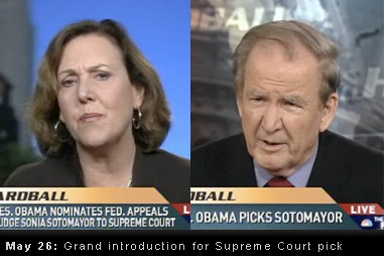

If Republicans keep trashing the Supreme Court nominee, they'll wind up an even tinier minority than they are now.
Let’s take a moment to acknowledge the history made when President Obama chose 2nd Circuit Judge Sonia Sotomayor to replace David Souter on the Supreme Court. The Latina standout from the Bronx, beloved daughter of a widow who worked two jobs to put her children through the best schools, is a woman who also happened to graduate Phi Beta Kappa and summa cum laude from Princeton; who ran the Yale Law Journal; who worked as a prosecutor and a civil litigator before being appointed to the federal bench. She has more judicial experience than any of her other eight would-be colleagues did when they joined the court.
In short: She’s got an American dream story, she makes women and Latinos proud, and she’s also supremely qualified. It doesn’t get any better than that for Democrats.
And it can only get worse for Republicans if they’re going to hit Sotomayor the way MSNBC political analyst Pat Buchanan did debating me on “Hardball” today. (Actually, Mike Huckabee may have sunk lower than Buchanan. Earth to Mike: Calling Sotomayor “Maria” is not going to win you Latino votes in 2012.)
On “Hardball” (video below) Buchanan tossed me some weak softballs about Sotomayor. It was the same handful of charges that make up the key, easily refuted GOP talking points: that she claimed in a speech that appellate judges make policy (she did not); that she voted to discriminate against white men in the New Haven firefighter case (she merely upheld a lower court’s ruling); that she said her gender and race would influence her court rulings, improperly, according to Buchanan (I’ll deal with that one later). Amazingly, Buchanan’s final shot was the widely derided and debunked Jeffrey Rosen piece in the New Republic that let anonymous sources trash Sotomayor, mostly to call her “domineering and dumb,” in the words of Rebecca Traister. “She is not that intelligent,” Buchanan insisted, a ridiculous assertion given her educational and professional accomplishments.
Unbelievably, Buchanan compared Sotomayor to Harriet Miers, President Bush’s personal attorney who was, in fact, not at all qualified to be a Supreme Court justice. Ever notice it’s the Republicans whose “affirmative action” picks aren’t qualified (as in Miers and Clarence Thomas)? Watch it all here:
Visit msnbc.com for Breaking News, World News, and News about the Economy
Where do I begin? First of all, if Republicans are going to be tin-eared enough to attack Sotomayor on her intelligence and qualifications, they are going to wind up an even tinier minority party than they are now. Acting as though Obama had to lower his standards to appoint the first Hispanic justice is offensive to more than just Hispanics; it exposes a profound prejudice and lack of knowledge about the vast talent pool in our country. Certainly Sotomayor will face tough questions on her judicial philosophy from liberals and conservatives, and she should, but to insinuate she’s merely an affirmative action pick is wrong and repellent.
The irony is that Sotomayor is more centrist than some of Obama’s other possible appointees. She disappointed abortion rights advocates by failing to strike down the Bush administration’s global gag rule, which prohibited organizations that received U.S. family planning funds from counseling abortion. She’s been criticized for upholding a school’s decision to discipline a student for differing with school officials on her private Live Journal account. The American Bar Association termed her a “moderate,” not a liberal. Glenn Greenwald, while praising the choice of Sotomayor, has already noted that Diane Wood might have been a more reassuring pick to those concerned about Obama’s assertion of executive powers; Sotomayor hasn’t left a record in such cases.
I happen to think that at her confirmation hearings, she might want to explain and elaborate on one much-criticized sound bite. Taking issue with the famous notion frequently attributed to Justice Ruth Bader Ginsburg — that a wise old man and a wise old woman would reach the same conclusion when deciding cases — she said instead: “I would hope that a wise Latina woman with the richness of her experiences would more often than not reach a better conclusion than a white male who hasn’t lived that life.” Even I might quibble with the use of the term “better conclusion”; certainly Justice Harry Blackmun’s work on abortion rights is as important to women as the many decisions of Sandra Day O’Connor and Ruth Bader Ginsburg. We’ll see what Sotomayor has to say about that quote, and her philosophy about diversity, during her confirmation hearings, I’m sure. But it would be silly to deny the possibility that a court made up of individuals with diverse backgrounds may well draw different conclusions than one made up of nine white men.
I find the reliance on old racial and gender stereotypes, when it comes to debating the Sotomayor pick, extremely depressing. Buchanan also said she’s known as a “bully” on the bench, and I never got to ask him and Chris Matthews: Why is it that strong women are so often called bullies and ballbreakers, while strong, opinionated men are often called, simply, Justice Scalia. But this time, I don’t think it will work. If Pat Buchanan and other right-wing pundits want to savage the pride of the Bronx’s Cardinal Spellman High School, I’m sure Democrats will say “bring it on.”
On Proposition 8, two judges rule
One judge's decision builds support for marriage equality by appealing to another judge: Justice Anthony Kennedy
Judges Anthony Kennedy and Steven Reinhardt (Credit: AP/Charles Dharapak/Stephanie Turner)
Save the confetti.
The two Democratic appointees to the 9th Circuit Court of Appeals ruled Tuesday that the California prohibition of gay marriage — the infamous Proposition 8 — violated the U.S. Constitution. Following the cautious counsel of a group of friends of the court, seasoned activists not part of the new litigation group that brought the suit, longtime liberal giant Judge Stephen Reinhardt passed up the opportunity to produce the gay Brown v. Board of Education.
Instead Reinhardt ruled on the narrowest possible grounds that Proposition 8 was unconstitutional, because it took away gays’ preexisting right to marry, extended to them a few months before by the California Supreme Court. No other state, not even the other states in the territory covered by the 9th Circuit, is affected by the ruling.
The opinion is an explicit appeal to Justice Kennedy, who wrote the original pro-gay Supreme Court opinion in Romer v. Evans, which involved a law that took away gay rights. It practically parrots the language of his opinion verbatim, offering him the opportunity to affirm their ruling and still duck the question of whether there is an overall constitutional right to same-sex marriage.
On their Tuesday conference call with the press after the decision, David Boies and Ted Olson, the famous lawyers behind the challenge, were lukewarm about the prospect that the Supreme Court would take their case as the opportunity to establish the constitutionality of same-sex marriage. This tone is notably different from the proclamations of national vindication that accompanied the filing of this suit after blue California handed them a black eye when they passed Proposition 8 four years ago.
They are right to be chary. Satisfying as it was to think of an avenging judiciary riding to the rescue of truth and justice, there hasn’t been a Warren Court for 40 years now. Even Judge Reinhardt’s narrow and cautious decision did not attract the vote of his Republican-nominated colleague on the panel. The political divide in the nation has long been reflected in the federal courts and nowhere as clearly as in this decision.
Thus, it’s all about Justice Kennedy, the only justice with even questionable allegiance right or left. Thanks to the long delays in trying Perry v. Brown, all the players now have a little more information about Justice Kennedy. When they filed, they knew that in 1996 and again in 2003 Justice Kennedy had written unequivocally pro-gay opinions in two landmark cases. Each year since the Perry case began, however, Justice Kennedy’s voting record, conventionally described as unpredictable at best, moves more to the right.
Last term, although he ordered thousands of inmates sprung from California’s obscenely crowded jails, almost all his other decisions served solidly conservative political interests: He protected the Westboro (“fags in hell”) Baptist Church’s picketing of service members’ funerals, allowed Arizona to punish businesses that hire illegal aliens, but struck down Arizona’s law mandating public funding of elections.
In the prior term, although he again limited the cruelty of criminal punishment (no life sentences for juveniles), he approved the unlimited expenditure of political money in Citizens United, held that suspects had to ask for their right to remain silent, and temporarily allowed a big cross to remain up on the Mojave National Preserve. Academics spill pots trying to derive a grand theory for Justice Kennedy’s rulings from, say, the libertarian writings of John Locke, but Kennedy’s erratic decision-making is more about Mr. Dooley (“the law follows the election returns”) than Mr. Locke. A professional gambler would say the odds of a favorable outcome for gay rights have diminished since the Proposition 8 suit was filed.
Meanwhile, the boring and snail-like processes of democratic self-government have produced a surprising uptick in the prospects for same-sex marriage. New York state became the first big industrial state to pass a same-sex marriage law and prospects are good in Washington state and Maryland. The losers in a 2009 Maine referendum are predicting the first victory in a direct popular vote. And the New Jersey Legislature is challenging its Republican governor to veto the increasingly popular issue. The issue gets more favor with the public all the time; approval crossed the 50 percent mark last spring.
In light of these developments, the next step in the prudent strategy that generated a narrow decision designed to minimize the demands on the Supreme Court is to delay the moment of truth as long as possible. Fortunately, the complex processes of appeal present the plaintiffs with a chance to gum things up. In reaching the constitutional issue, the 9th Circuit actually ruled against the plaintiffs on the question of whether the anti-marriage defendant-intervenors had standing to appeal the trial court’s decision at all.
Rather than sitting back and waiting for the losing side to rush the substantive decision to the Supreme Court, the plaintiffs might take a shot at asking the whole 9th Circuit (en banc) to review the decision that the defendants have standing. Such an appeal would be transparently strategic, but by the time the parties have briefed the question of whether they’re even entitled to en banc rehearing on standing (since they won on the merits), plaintiffs will have bought several more precious months for the political climate to continue to turn in their favor. Even if they do not try to pursue an appeal from a decision that gave them a victory, briefing schedules are notoriously generous, and the plaintiffs would be well served to take advantage of that opportunity. Sometimes, even Shakespeare is wrong, and there is a real advantage to “the law’s delay.”
Obama’s new weapon v. Citizens United
The business lobby is up in arms about a proposed executive order to shed light on corporate campaign contributions
Rep. Anna Eshoo wants to shed light (Credit: AP/Charles Dharapak)
A executive order requiring that federal contractors disclose their electoral spending—by top officers and as corporations—is being reconsidered by the White House despite stiff opposition from the business lobby after it was first proposed last spring, according to civil rights attorneys working on the issue.
“There’s a lot of movement at the White House,” said Craig Holman, government affairs lobbyist for Public Citizen. “I just had a meeting at the White House counsel’s office, trying to encourage them to move forward with the executive order. They have the perfect window of opportunity to get the executive order done.”
“It’s simple—any company that is paid with taxpayer dollars should be required to disclose political contributions,” said Rep. Anna Eshoo, D-California, who has pushed for the White House to issue the order. “With public dollars come public responsibilities, and I hope President Obama will issue his executive order right away.”
The order, if issued, would likely be the only campaign finance initiative to emerge from Washington this year as nothing is expected from Congress. It would take effect after the Federal Acquisition Regulatory Council adopts new disclosure rules. That could come as the 2012 election season moves beyond the primaries and offer a new way to see who is behind the newest independent groups spending millions on political attack ads.
“Most of the major corporate players are also government contractors,” Holman said. “So if we get this executive order approved, we will get a comprehensive picture of how corporations are spending money in elections.”
Spending on federal contracts was $541 billion in 2010, which was about 4 percent of the gross domestic product, according to the Congressional Research Service, and almost 15 percent of the federal budget. The top 100 contractors are some of America’s biggest firms, and include support services for the military overseas, weapons makers, computer companies, telecommunication firms and other service providers. Companies that could fall under the disclosure order employ about 22 percent of the domestic workforce, CRS said.
The proposed executive order emerged last April, where it swiftly drew condemnation from some of Washington’s biggest business lobbies, including the Professional Services Council, the Aerospace Industries Association and the U.S. Chamber of Commerce. Almost immediately, Republicans in the House and Senate began adding amendments to appropriations bills prohibiting federal agencies from collecting the political contribution information as part of the procurement process.
Rep. Eshoo led the Democrats’ response by making floor speeches and introducing short amendments to spending bills requiring the contractor disclosure.
“I rise to call for transparency and disclosure in our system and throughout our government,” Eshoo said, in a typical speech. “In 2002, when we voted to pass the historic McCain-Feingold campaign finance bill, most Republicans voted no, saying we needed disclosure… They said we needed to put spending out in the open and let the voters assess it. Today, when the president proposes requiring contractors to disclose their spending and not to limit it, Republicans are up in arms. They say it will politicize the contracting process. But when contractors can spend money in elections, the contracting process is already politicized.”
In July 2011, Eshoo sent a letter, signed by 62 other House Democrats, urging President Obama to issue the executive order. That letter noted that a handful of states ban forms of political spending by contractors, citing Connecticut, New Jersey, West Virginia and Hawaii. It also noted that since 1994, the Securities and Exchange Commission has barred brokers and securities dealers and their PACs from making campaign contributions to bond-issuing officials. The SEC rule was upheld in court.
“Political expenditures are already well-known to those that make them and to the officials who benefit,” she concluded in the letter urging the administration to action.
However, the White House took no further action after last summer. Meanwhile, every time Eshoo offered a disclosure amendment it prompted a counter measure from House Republicans. The stalemate ended in December, when a compromise was reached. The GOP’s stated objections concerned disclosing political contributions before contracts were awarded—in the bidding stage. The House Republicans withdrew their objection once Eshoo and Democratic leaders agreed to limit disclosure to after federal contracts had been awarded.
The most recent spending bill to pass the House removed those barriers, Eshoo said last month. “Today’s compromise omnibus spending bill leaves the President free to require disclosure from any company receiving taxpayer dollars,” she said, alluding to the new window for the White House to move ahead with an executive order.
“Now we have the perfect window to get it done,” Holman said. “The [Republicans' legislative] riders have been removed.”
Neither Eshoo’s office nor Public Citizen’s Holman have seen newer drafts of the executive order since it circulated in April. That initial draft would report contributions to third-party groups, including the super PACs that spent millions on television ads before the Iowa Caucuses—supposedly independent of candidates.
The biggest threat to Citizens United
The Montana AG explains why his state's challenge to the controversial decision could hold up in the Supreme Court
Montana Attorney General Steve Bullock (Credit: AP/Matthew Brown)
Last week, while the national press corps was busy pretending the tiny Iowa caucus was the only news in America, a major ruling out of Montana paved the way for a likely U.S. Supreme Court showdown over the role of corporate money in politics.
In the case, which was spearheaded by the state’s Democratic Attorney General Steve Bullock, Montana’s top court restored Big Sky country’s century-old law banning corporations from directly spending on political candidates or committees. Legal experts believe that upon appeal, this case will come before the nation’s highest court. While there, it could serve as the first test of the precedents in the infamous Citizens United decision that essentially allows unfettered corporate spending in campaigns.
This week on my weekday morning radio show on KKZN-AM760, I spoke with Bullock about the case. What follows is an edited transcript of our discussion (you can find the full audio podcast here).
Walk us through what this case was all about and why it’s important not just for Montana but for politics all across the country.
It’s interesting because while this case is rooted in Montana, I think that it does have implications for politics throughout the country.
Montana (through) my office was the lead in writing the brief that half the states joined when the Supreme Court was considering Citizens United. (The brief) said that state elections, and corporations, and unlimited corporate spending don’t necessarily go together.
Montana has had on its books since 1912, which was passed by citizens initiative, a law called The Corrupt Practices Act. And what The Corrupt Practices Act did is essentially said that corporations cannot make expenditures or contributions in the political system. And we got there because our history was rooted in corporate domination of elections. It was in 1906 that a paper in Montana said, “the greatest living question of the day is whether corporations shall control the people or the people shall control the corporations.” And at the time the Copper Kings as they were called, those mine (owners) that mined copper in Montana literally owned our legislature, our judges, our local county planning boards. It was all throughout and it was at one point called “the Montana situation.”
So we have a real background in the unfortunate effects of unlimited corporate expenditures in elections and as a result when Citizens United came down dealing with federal law and federal elections it wasn’t something that I wanted to just give up on the last hundred years in Montana. We defended out laws, right before New Year’s Eve the Montana Supreme Court said that our ban on corporate expenditures remains constitutional.
And so this means that the case will likely go to the U.S. Supreme Court and that then raises the question: If the U.S. Supreme Court has already ruled on Citizens United, isn’t the deck already stacked against you?
Well, I think and what we argued at the state level is, this isn’t Citizens United. There’s different burdens, different interests and different tailoring.
The Citizens United court went on and on about how difficult it is for corporations through political action committees (PACs) to actually participate in the political system. But in Montana, literally, it’s a two-page form that takes two minutes to fill out and there’s not all these texts that the Federal Election Commission has. There’s a different burden to participate. And it’s also different interests.
Unlike Citizens United, we presented a history, not only history in Montana of corporate control but concerns from some of the contemporary leaders of our state of what unlimited corporate dollars would end up causing.
If you could pick one state that was an example of what happens when there aren’t these laws on the books it would be Montana. I think back to the story of Sen. William Clark, the Copper King who literally bought a United States Senate seat for himself. Do you think it’s an overstatement to say that if Montana loses and/or Citizens United isn’t overturned, that American politics could start resembling Montana’s at the beginning of the 20th century?
I don’t think it is an overstatement. Ironically, in February 2010 I was asked and testify to a U.S. Senate committee on the effect of Citizens United and this was a successor committee to literally the same committee that had refused to seat William Clark.
Clark’s testimony back then, what he said, is that many people have become so indifferent to voting in Montana by reason of large sums of money that have been expended in the state, that you have to a great deal of urging and it takes a lot of men to do it to go around among them and stir them up and get them out. So a hundred years ago William Clark said, because of all the corporate dollars, democracy is broken.
You are going to be standing, potentially, in front of the U.S. Supreme Court and somebody like Justice Scalia is going to say: “Mr. Bullock, don’t you agree that money is speech? After all, we have precedent on the books in Buckley v. Valeo stating that money is speech. So how can you defend what Montana is doing, and how can other states defend similar bans on corporate money?” What will you say?
I think what we can say is that even if money is equated to speech, that that doesn’t mean you can’t demonstrate compelling state interests that allow you to put some restrictions on speech. Just like you can’t yell “fire!” in a movie theater, there are state interests in making sure that that speech has some limitations. And that’s what our Montana Supreme Court stated is that we have compelling interests in the integrity of the election process. We have a compelling interest in encouraging full participation.
You’re running for governor, which, even in a smaller state like Montana, costs a lot of money. Did you ever think that if you pushed this case so hard, it might make it more difficult for you to raise the money you need? Do you think your role in this case will put at least part of your campaign fundraising in peril?
Well that calculation, David, right there underscores that money can corrupt in politics. Because if an individual is making their decisions based on either what case to take or what land commissioner’s action to take or what vote to take, based on the amount of money that could flow in for an individual or against an individual, that shows that money can corrupt in the system.
For me the calculus was relatively simple. The voters entrusted me with an incredible job as Attorney General and for a hundred years we’ve had a ban aptly named The Corrupt Practices Act that has served Montana well. And as a result, people participate, everybody has a seat at the table. So for me the calculus was: I owe it to a century of Montanans going forward to do all I can to defend this irrespective of what might happen in my next campaign.
Our ethically permissive Supreme Court
Conservative justices wink at their own conflicts of interest
Antonin Scalia, Clarence Thomas and Samuel Alito (Credit: AP)
It is “do-as-I-say, not what-I-do” time at the U.S. Supreme Court. In a majority opinion in a 2009 case involving the conflict of interest of a state Supreme Court justice in West Virginia, Justice Anthony Kennedy wrote:
Courts, in our system, elaborate principles of law in the course of resolving disputes. The power and the prerogative of a court to perform this function rest, in the end, upon the respect accorded to its judgments. The citizen’s respect for judgments depends in turn upon the issuing court’s absolute probity. Judicial integrity is, in consequence, a state interest of the highest order.
By that standard, the Supreme Court needs to review the actions of three of its own members. And if the courts won’t act, Congress should.
As Common Cause and Alliance for Justice have documented, the past activities of Justices Clarence Thomas, Samuel Alito and Antonin Scalia raise questions about the propriety of some of their extracurricular experiences. In September, the two groups, along with more than 100 law professors and ethicists, called upon Congress to require the nine justices of the high court to apply to themselves the existing ethical code of conduct rules covering all other federal judges, and to require them to publicly provide valid reasons rejecting recusal for alleged conflicts of interests. As the professors pointed out, the Supreme Court now has no policy on recusal. The justices simply decide for themselves if they have a conflict of interest.
At a time when all government officials are held in diminishing repute, one would think the Supreme Court would not need to be told that it, of all institutions, is not beyond the law and is subject to meticulous standards over which it alone should not be the exclusive decision-maker. A recent poll found 46 percent of the public approves of the Supreme Court; a favorable view higher than that enjoyed by Congress and the president but lower than at any time since 2001. Fatuous criticisms of the federal judiciary by the current crop of Republican presidential candidates exacerbate the image problem – important for an unelected body’s power of moral suasion, and compounded by real problems like this one.
Lawyers are reticent to question the judiciousness of judges trying their cases, for obvious tactical reasons. Most judges are careful about displaying their dispassionate distance from the matters before them. The system usually works, and the rules governing judicial conduct and conflicts of interests are there to assure uniform and fair standards. It is perverse that the highest court in the country is not covered by the same ethics rules governing all their judicial colleagues, all the more so when the justices themselves are the sole arbiters of these questions when they arise. A classic truth of judicial behavior is that no one should be a judge in his or her own case. Yet the court has no guiding comprehensive code of ethics. Its denials of challenges are not reviewable or sanctionable.
Don’t expect the justices to discipline themselves. When it comes to its own administrative behavior, the justices consider themselves their only judges. Claims for televising its public proceedings, for example, are denied because they do not want to be viewed publicly – to be recognized in the supermarket, one of them said. As the late great jurist Jerome Frank observed, the justices historically have protected their mystic aloofness. Even the more liberal, now retired, Justice John Paul Stevens recently dismissed the call for reform of recusal and conflict of interest rules as something that doesn’t concern him. It seems justices – even admirable ones – take their institutional arrogance with them when they leave the court. Stevens just doesn’t get it that “we know what’s right and wrong about ourselves” isn’t an acceptable attitude for Supreme Court justices.
The prevailing 1973 Code of Conduct for judges sets out ground rules for assuring integrity and independence of federal judges, avoiding partiality (and the appearance of it), prohibiting activities inconsistent with their judicial obligations, and barring economic or political activity by them or their families.
The behavior of Justice Clarence Thomas calls into question the code’s rules about the private interests of family members. On the financial disclosure forms required of all federal judges Thomas failed for five years running to report his wife’s income of nearly $700,000 from the Heritage Foundation, the conservative think tank that advocates positions on matters before the court. Between 2003 and 2007, on the box for spousal income, Thomas checked the box labeled “None.” When questioned about this, he corrected the forms, saying he didn’t understand the filing requirement of the Ethics in Government Act of 1978. Some answer for a Supreme Court justice!
And even that lame excuse may not be true. In a letter to federal court administrators last month, the Alliance for Justice and Common Cause reported that Thomas had properly filled out his forms and accurately disclosed his wife’s income as early as 1987, while serving as the chairman of the Equal Employment Opportunity Commission, and then as a judge on the DC Circuit Court of Appeals, and then for five years as a justice on the Supreme Court. “These revelations call into question Justice Thomas’ explanation that his omissions were due to a misunderstanding of the filing instructions,” they wrote.
Nor is Virginia Thomas’ unreported income the only possible conflict. Justice Thomas also received valuable gifts and generated funding for personal pet projects from Harlan Crow, founder and activist for conservative causes. These activities might well be violations of Canons 4 and 5 of the federal judges’ code. As the Alliance for Justice has documented, Thomas and Scalia have appeared at private events sponsored by the billionaire Koch brothers that were “overtly political” and where the justice’s attendance was used to lure a crowd. Justice Samuel Alito attended an American Spectator fundraising gala; the magazine’s Conservative Action Project opposes President Obama’s healthcare program whose constitutionality will be decided by the court in the coming year. When questioned, Alito reportedly said, “It’s not important that I’m here.” End of story.
There are three options for dealing with these ethical questions: One is politically unlikely, one is practically unlikely, and one is feasible enough to be actively pursued.
The politically unlikely legal solution is the impeachment process, as established by Articles 1 and 2 of the Constitution. Since 1803 there have been 15 attempted impeachments of judges, mostly for crimes such as bribery and perjury. Two of the judges retired before Senate trials, and seven were removed after being charged by the House of Representatives and convicted by the Senate. The first and only accusation against a Supreme Court justice was in 1805, and involved charges of indecent remarks by Justice Samuel Chase. He was acquitted. The most recent impeachment of a federal judge (not a Supreme Court Justice) was in 2010.
Given the conciliatory nature of this president and the political character of the current Congress, there is no chance that Justice Thomas’ false financial disclosures will lead to his impeachment. But, imagine that there was a conservative president and Congress, and a divided, liberally tilted Supreme Court that voted 5-4 on most critical and controversial issues, and the one justice who voted consistently with the liberal majority had done what Justice Thomas admits he did: filed inaccurate financial disclosure forms and attended liberal political events. Would we be watching impeachment proceedings?
The likelihood of the Supreme Court itself modifying its present practices is remote. Unless, of course, it is pressed to do so by existing officials who, sensitive to separation of powers concerns, performs its powers of oversight, and the court is prompted to act on its own in order to preserve its administrative autonomy. That would be a proper and admirable course. In a recent piece for the Huffington Post, Nan Aron, president of the Alliance for Justice, urged the U.S. Judicial Conference, which has the power to investigate and refer violations of financial disclosure laws to the attorney general, to do so. Violators are subject to civil action or criminal prosecution if the attorney general determines that the barred activity is done willfully. “The Supreme Court of the U.S., whose authority is rooted in perceptions of integrity and probity, has the lowest compulsory ethical standards in the government,” Aron wrote.
The propriety of Justice Thomas’ actions could be assessed by the designated officials, and at least proscriptive guidelines for the Supreme Court might be pressed upon it. Questions to be considered are whether Thomas’ wife’s organization’s work dealt with matters before the court during the period her work was not listed on required disclosure forms. Justice Thomas predictably would have voted the conservative side, nonetheless, but there would be appearance-of-justice questions were this the case.
The clearest, least vindictive and most constructive approach would be for Congress to approve the Supreme Court Transparency & Disclosure Act (H.R. 862), which would apply the current Code of Conduct governing all federal judges to Supreme Court justices, provide transparency thorough disclosure, and set procedures to review independently the justices’ denial of challenges. The proposed legislation has a growing number of supporters, and the public should demand that its representatives vote for it, or reform will not come to the Supreme Court.
Cornel West meets the Man
The civil rights activist was detained by Capitol police yesterday during a protest against Citizens United
VIDEO
Civil rights activist Cornel West was arrested in the nation’s capital yesterday during a protest against the influence of corporate money on Washington politics. After attending the dedication of the Martin Luther King Jr. Memorial, West led a group of protesters to the Supreme Court for an impromptu sit-in demonstration against the Citizens United decision.
In a speech immediately prior at Washington’s Freedom Plaza, the Princeton professor hinted that he was expecting to be taken into custody before the day was out:
[West] jokingly said he has come today to Freedom Plaza and to Washington DC, because he finally wanted to get arrested in DC to make the sacrifice Martin Luther King was expecting from him in the fight for justice and freedom.
In the video below — in which West was interviewed by NoCureForThat.org — Capitol police are shown cuffing West and escorting him inside the court building. (The arrest footage begins at around the 2-minute mark.)
Page 1 of 99 in Supreme Court


Whitney Houston dies at 48
Porn’s taboo transsexual stars
The Internet makes magic disappear
The case for a global currency
Bridging the Irish-Italian divide
Paul Gauguin’s Polynesian “paradise”
Taking sex out of the city
“Walking Dead” creator: Get ready for breakneck pace
Female soldiers fight the brass ceiling 

