
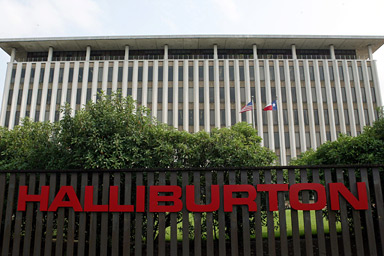

The Houstonian Hotel is an elegant, secluded resort set on an 18-acre wooded oasis in the heart of downtown Houston. Two weeks ago, David Lesar, CEO of the once notorious energy services corporation Halliburton, spoke to some 100 shareholders and members of senior management gathered there at the company’s annual meeting. All was remarkably staid as they celebrated Halliburton’s $4 billion in operating profits in 2008, a striking 22 percent return at a time when many companies are announcing record losses. Analysts remain bullish on Halliburton’s stock, reflecting a more general view that any company in the oil business is likely to have a profitable future in store.
There were no protesters outside the meeting this year, nor the kind of national media stakeouts commonplace when Lesar addressed the same crew at the posh Four Seasons Hotel in downtown Houston in May 2004. Then, dozens of mounted police faced off against 300 protesters in the streets outside, while a San Francisco group that dubbed itself the Ronald Reagan Home for the Criminally Insane fielded activists in Bush and Cheney masks, offering fake $100 bills to passersby in a mock protest against war profiteering. And don’t forget the 25-foot inflatable pig there to mock shareholders. Local TV crews swarmed, a national crew from NBC flew in from New York, and reporters from the Financial Times and the Wall Street Journal eagerly scribbled notes.
Now the 25-foot pigs are gone and all is quiet on the western front. How did Halliburton, once branded the ugly stepchild of Dick Cheney — the company’s former CEO — and a poster child of war profiteering, receive such absolution from antiwar activists and the media? Of course, the defeat of the Republicans in the 2008 election, the departure of the Bush administration, and a general apathy toward the ongoing, but lower-level war in Iraq are part of the answer, but don’t ignore a potentially brilliant financial sleight of hand by Halliburton either. That move played a crucial role in the cleansing of the company.
“Burn & Loot”
Halliburton has been doing work in war zones since the early 1960s, when it acquired the construction company Brown & Root and was tasked by the Pentagon with building the infrastructure for the Vietnam War. Back in those days, it was vilified as “Burn & Loot.” After more than three decades in news obscurity, in March 2003, with the invasion of Iraq, it suddenly returned to national attention. After all, not only had its former CEO been beating the public drums for an invasion, but its subsidiary KBR (the old Brown & Root) had been given a vast, open-ended, multi-billion dollar contract to build and maintain the new infrastructure of bases that the U.S. military was rushing to construct in that country.
More than six years later, KBR has taken in over $31 billion for a variety of services to the U.S. military, notably in the field of logistics, and the money continues to flow in. As of April 2008, under a renewed contract, the company estimated that it had served more than 720 million meals, driven more than 400 million miles on various convoy missions, treated 12 billion gallons of potable water, and produced more than 267 million tons of ice. While these numbers may be impressive, so are the multiple claims from Pentagon investigators of Godzilla-like overcharges and waste, not to speak of spiraling claims of workplace negligence, including faulty electrical wiring that led to deaths and injuries on bases KBR built, and a failure to provide adequately clean water supplies to the troops; and then there are those allegations of war profiteering made by activist groups and politicians.
In September 2004, Lesar announced that Halliburton was considering spinning off KBR as a separate company, in part he claimed because it was bearing the brunt of a “vicious campaign” of political attacks and its employees didn’t “deserve to have their jobs threatened for political gain.” It took three years, but in April 2007 the spinoff of KBR was completed. It is now officially on its own, and the results for both companies seem little short of miraculous. No protesters even attended the three annual shareholder meetings that KBR has since held, though its activities in the war zones have hardly changed, and only five made it to Halliburton’s in 2008. This year, of course, the protesting larder was bare.
Five shareholder activists did manage to attend Halliburton’s annual meeting, including me. (I own a single share of Halliburton stock.) When I asked Lesar about the company’s links to KBR, he responded unequivocally, “First of all, let’s be very clear, KBR and Halliburton are legally separated.”
Just three months ago, however, Halliburton didn’t hesitate to pay off $382 million in fines to the U.S. Department of Justice as part of the settlement of a controversial KBR gas project in Nigeria in which the company admitted to paying a $180 million bribe to government officials. Halliburton, Lesar assured us, had been willing to pony up such a sum to ensure that KBR could survive on its own. He painted the payment as an act of corporate generosity. I asked Albert Cornelison and Mark McCollum, Halliburton’s top lawyer and chief financial officer, if the company had similarly agreed to pay off any future judgments against the company on its monster military logistics contracts in Iraq. Cornelison responded that he doubted the company had financial obligations for KBR’s work in Iraq.
Military investigations continue
In reality, Halliburton’s decision to spin the company off was surely tied to hopes that it might indeed escape a number of pending Iraq investigations and lawsuits, as well as tamp down the bad publicity KBR was generating. Still, those investigations are ongoing. At Fort Belvoir, Va., the headquarters of the Defense Contract Audit Agency (DCAA), the office in charge of reviewing the Pentagon’s payments to KBR, a small group of investigators continue to pursue that company’s failures.
In early May, at a hearing on Capitol Hill, DCAA director April G. Stephenson told the independent, bipartisan, congressionally mandated Commission on Wartime Contracting in Iraq and Afghanistan that, since 2004, her staff had sent 32 cases of suspected overbilling, bribery and other possible violations of the law to the Pentagon inspector general. The “vast majority” of these cases, she testified, were linked to KBR, which accounts for a staggering 43 percent of the dollars the Pentagon has spent in Iraq. “I don’t think we’re aware of a program, contract, or contractor that has had this number of suspensions or referrals,” she told the hearing. (In the allied area of overpricing services, DCAA also recommended $4.3 billion worth of reductions to proposed or billed costs and pointed to another $3.3 billion worth of costs under the KBR contract that they believed were simply not supported.)
Stephenson’s staff, she indicated, recommended not paying the costs KBR had billed to the Pentagon on more than 100 occasions, among other things suspending or blocking some $553 million in payments. In but one example of typical KBR practices revealed at the hearing, the company allegedly billed the Pentagon for 4,100 prefabricated living units for military bases in Iraq at an average price of $38,000, even though another contractor offered to provide similar units for $18,000 each.
None of this may, however, matter, if the Pentagon continues to follow the precedents it has recently set. As Stephenson notes, the Pentagon has already agreed to pay out at least $439 million of the $553 million the DCAA questioned, after accepting the company’s explanations for each incident.
“I’m struck by the fact [that] the military doesn’t seem to care about the cost as long as they get the service,” said Commissioner Christopher Shays, former Republican congressman from Connecticut. “Is part of the problem that, in essence with this one contractor, we’ve basically said, ‘KBR is too big to fail’?”
Shocking revelations
The Pentagon even appears willing to pay KBR for contracts that may have resulted in the deaths of military personnel in Iraq, allegedly electrocuted due to shoddy work by the company’s electricians.
Just as Lesar was addressing Halliburton’s shareholders in Houston, Sen. Byron Dorgan’s Senate Democratic Policy Committee was holding a hearing on Capitol Hill focused on KBR. Testifying was Jim Childs, a master electrician hired by the U.S. Army to help review military facilities in Iraq.
Childs claims that as many as 70,000 KBR-maintained buildings where troops lived and worked were unsafe because of faulty electrical wiring. “When I began inspecting the electrical work performed by KBR, my co-workers and I found improper electrical work in every building we inspected,” Childs said. Hundreds of soldiers are believed to have received electrical shocks in showers and elsewhere as a result. There have been four documented fatalities, including Staff Sgt. Ryan Maseth of Pittsburgh, Pa., a Green Beret, who died of electrocution while showering in his barracks in Iraq on Jan. 2, 2008. (Maseth’s family has sued KBR, alleging wrongful death.)
According to Sen. Dorgan, documents show that KBR was paid huge bonuses by the Pentagon for this work, much of it after the allegations became public. If accurate, this gives “shocking” a new meaning. “How could it be that, given these obviously widespread problems with KBR’s electrical work, the Pentagon decided to give KBR bonuses totaling $83.4 million for such work?” he wondered.
KBR, of course, denies everything. “We believe the standards that we did employ were standards that were known and thought to be acceptable in an expeditionary environment,” KBR’s William P. Utt told the Associated Press in response. “We don’t think the wiring that we installed was potentially dangerous.” In a brief statement about the deaths, the company wrote: “Based on our current knowledge and the information we have gathered to date, KBR has found no evidence of a link between the work the military tasked KBR to perform and the reported deaths that have resulted from electrocution.”
Who is responsible?
One of the biggest problems with the sprawling 2008 KBR mega-contract appears to be that not enough people are watching the store (and evidently, some of those who do regularly doze off when payment issues arise).
In early May, Michael Thibault, co-chairman of the independent Commission on Wartime Contracting in Iraq and Afghanistan, highlighted a simple, if disturbing statistic at the second hearing of his newly established commission. Out of 504 oversight officials that, by Pentagon estimate, are needed to keep an eye on KBR’s contract in Afghanistan alone, just 166 were actually in the field in April 2009. As Thibault added:
“After more than six years of fighting, this is just one example of serious and persistent shortfalls in staffing and training. In military parlance, no one is pulling guard duty on contractor performance. This example, an issue by itself, points to another broader question. Who is responsible? Who’s going to fix these types of issues?”
At the Democratic Policy Committee hearing in late May, Charles M. Smith, a 31-year veteran of contract management in the U.S. Army, testified that Pentagon officials were deliberately ignoring criticism in deciding to reward KBR. Smith was in charge of KBR contracts in Afghanistan and Iraq, as well as of the award-fee or bonus-payment process that went with them. He refused to allow any bonuses to be paid out, however, because the company was not able to provide proper documentation of its costs. This was one reason, he believes, that he was taken off the contract in August 2004. Smith became a whistle-blower after he retired a year ago. Here is a sample of his testimony:
“The award-fee process is supposed to evaluate a contractor’s performance level and provide a ‘bonus’ or award fee for superior performance. Failure to perform satisfactorily should result in a significantly lower or no award fee. [The award system] appears to me to have failed to work as it was intended and to have led to poor service for American troops, wasted taxpayer money, and possibly the deaths of soldiers in KBR operated facilities…
“The problems for operating in the environment of Iraq and Afghanistan are not insignificant. However, the major failure appears to me to have been a culture that decided KBR was too big to fail and too important to be held to account. The Army was aware of KBR’s poor performance in Iraq. There have been numerous government inspections and reports. The Army, however, continued to give KBR high award fees. Those high award fees appear to have sent a message to KBR that performance did not really matter. Award-fee boards and decisions are a communications tool between the government and the contractor. The contractor learns what is important to the government and will respond accordingly.”
And the record shows that KBR did “respond accordingly.”
Remembering Halliburton
In the meantime, Halliburton, which provided so many years of corporate “oversight” for KBR, has been cleansed of all charges in the court of public opinion and has essentially dropped from view. It has also done its best to ignore a shareholder resolution brought by Patrick Doherty, the comptroller of the city of New York, that raises the obvious issue of war profiteering in Iraq, based on the Pentagon dollars it raked in while its former CEO helped oversee the war that was making it so much money.
Some shareholder activists continue to pursue the company by other means. For instance, the pension fund of the Policemen and Firemen Retirement System of the City of Detroit filed a lawsuit in mid-May against David Lesar and other executives of KBR and Halliburton, accusing them of a “reign of terror.” The lawsuit listed a number of complaints including bribes in Nigeria, overcharging the Pentagon for services rendered, accepting kickbacks, engaging in human trafficking, and concealing the rape of an employee.
“Under defendants’ watch, and supposedly under their control and supervision, the companies were permitted to engage in conduct so notorious that the name ‘Halliburton’ has become virtually synonymous with ‘corruption,'” the pension fund said in a complaint filed at the Harris County District Court in Houston. “Defendants’ failures have caused the Companies to suffer hundreds of millions of dollars in damages, and to be exposed to substantial additional judgments in the future.”
Heather Browne, a company spokeswoman, responded: “It appears that the lawsuit is based on unfounded allegations. We intend to vigorously defend ourselves.”
Another shareholder activist, John Harrington, a socially responsible investment manager in California, used his KBR shares to file a protest resolution against the company this May. According to Harrington’s press release:
“KBR’s management is obviously not taking their human rights footprint very seriously. The board of directors is accountable to shareholders, but only if we assert ourselves as the real owners of the company. Understandably, shareholders don’t like being associated with atrocities. If ever there was a need for responsible fiduciary human rights oversight within a company, it is with KBR. This company has been castigated in the press, sued, and accused of bribery, rape, murder, political corruption, tax avoidance, and who knows what else.”
KBR nonetheless took in another $5.7 billion from the U.S. taxpayer in 2008, up 15 percent from the $4.8 billion it received in 2007. With the planned drawdown of U.S. troops in Iraq, KBR expects its revenue to fall this year. But shareholders need not worry: Its contract with the Pentagon, signed in April 2008, potentially sets it up to make more than triple the maximum profits allowed in the previous six years.
Recently, the Financial Times ran an interview with KBR’s Utt, aptly headlined “KBR believes it is ready to construct a new image.” The same day stock analyst Will Gabrielski raised his profit estimate for KBR, causing company shares to jump.
If forgiving and forgetting are now the norm when it comes to the records of Halliburton and KBR in the Bush years, the question remains: Will the Pentagon complete this cleansing ritual or engage in the serious task of investigating both companies?
