
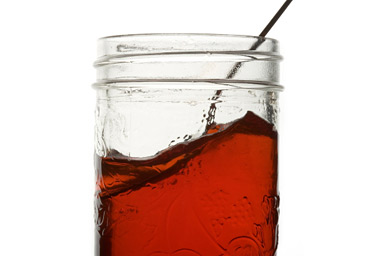

Yesterday, for lunch, I ate a $17 peanut butter and jelly sandwich. Its appearance was deceptively humble: not layered with slices of foie gras or rare Amazonian fruit, nor served on handmade whole grain flecked with gold leaf. There were no white tablecloths or waiters to attend me. I cut the sandwich into two triangles on a plastic plate and chewed while surveying the scrubby view from my fire escape. When I was finished, I wiped my sticky fingers on my bare knees. So, how to account for the eye-popping price tag? I can’t blame Skippy or Pepperidge Farm. No, I blame myself — and my $15 per pint, straight-from-the-Greenmarket, homemade and canned in Brooklyn, N.Y., macerated and simmered in unprocessed sugar, spiked with organic chiles and small-batch Kentucky bourbon strawberry jam.
Yes, the sandwich was delicious, and given the quantity of said jam in my cupboard, I’ll probably have one for lunch today, too. But I never meant to be the Daniel Boulud of the PB&J. No, like pretty much everyone else who ties on an apron now and again, I’d been hearing the buzz about how the combination of growing food consciousness, urban homesteading, rising unemployment and the diving economy was spurring a canning renaissance. And indeed, for months it seemed as though a glossy new book or stylish blog appeared on the scene every day, bursting with tempting chutneys and conserves, and eager to tutor the uninitiated in the art of food preservation. Then summer arrived, with its parade of seductive fruits and veggies, and on Facebook, my friends’ updates began including portraits of their rhubarb pickles. I left my secure staff job as an editor in order to write more, and suddenly had the leisure hours and dwindling bank account to prove it. I thought: I’m handy! I’m hungry! I’m broke! So, I joined the club. I hurried to my farmers market, and plunked down $16 for two perfect quarts of wild strawberries. Hours evaporated as I trolled the Web for the just-right recipe. And when, on the proud morning I stirred up my first batch of jam, I gazed on each jewel-colored jar and saw an act of thrift, a gesture of do-it-myself get-up-and-go, a symbolic high-five to all the generations of women before me who wasted not.
But now, a few weeks of sticky counters and countless Ball jars later, I see that I may have gotten just a teensy bit caught up in the romance of it all. Because the truth no one tells you is that while canning and pickling and curing your own (locally grown, organic) food may be many things — rewarding, sustainable, health-conscious, creative and challenging, even — one thing it ain’t is cheap.
OK, maybe it’s not that simple. In fact, before the angry hordes descend, allow me to hedge a bit. Sure, putting up food can be a budget-conscious choice. It definitely used to be, when everyone and their grandmother (literally) had a half-acre plot out back, bursting with bumper crops every August. This, I imagine, is why in many older canning texts, including the bible of food preservation — the “Ball Blue Book of Preservation” (currently sold out on Amazon, natch) — the recipe yields sometimes stretch into the dozens of pints. But today, the desire and ability to pick, pickle and distribute a bushel of kirby cukes in a single day presumes either a boatload of brine-crazy friends or an amount of both garden and pantry real estate of which I can only daydream. And let’s not forget the ultimate unrenewable resource: time. These days, even if you’re not a city dweller short on arable acreage, if you’ve got a full-time job, or a kid, or even just a needy cat, you’re probably tight on the hours it would take to plant, nurture, weed and water a small homestead. So maybe you find time to head to a pick-your-own farm. But mostly you march over to the Greenmarket and lay down your greenbacks. And you buy the books, and the jars, and the spices, and the salt. Making beef jerky? Gotta be grass fed, of course. Yes, there are a million worse ways you could spend your money. Maybe you’re OK with having a $20 jar of homemade maraschino cherries. (I am.) I’m just saying, people: It adds up.
Who wants to talk about that, though — and forfeit the Everyman satisfaction that comes along with trotting out maple syrup from your own tap and homemade salt-cured bacon at your next brunch? This isn’t the first time suburban and urban cooks have latched onto old-timey kitchen ways to fire their domestic fantasies; indeed, anyone unsure about shelling out for the latest crop of preserving cookbooks might want to check used bookstores for some classics from the ’70s and early ’80s, during the last wave of DIY-food publishing — titles like Jean Anderson’s “Green Thumb Preserving Guide,” “Fancy Pantry” by Helen Witty, “Stillroom Cookery” by Grace Firth, and the enormous back-to-the-land lifestyle manual Carla Emery’s “Old Fashioned Recipe Book.” (A note of caution: The USDA revised the canning guidelines in the early ’90s, so make sure to reference its most recent guidelines when using books published prior to that year.) But don’t be disappointed when you open them and find newsprint pages and “Little House on the Prairie”-style ink illustrations instead of glossy photos and artsy fonts. Back then canning was hippy, not haute.
So how’d we get back here? It can’t just be the recession, dummy — because the DIY-food craze started years ago, when everyone was still stinking rich and oblivious. In fact, the whole DIY scene seemed to gain ground just when everyone needed new, hipper, cooler creative things to spend their money on. Cases in point: the “everybody knit your own socks out of $30 skeins of mohair” trend and the “sew your own purse out of vintage bark cloth” trend. The DIY-grub trend, like a slightly more practical younger sibling, has been nurtured by years on a steady diet of hipster, locavore, get-your-hands-dirty, foodie propaganda — articles like “Yes, You Can” and “My Empire of Dirt,” New York magazine’s 2007 memoir of brownstoner homesteading, and at restaurants like Dan Barber’s farm-to-table mecca, Blue Hill Stone Barns. It’s been boosted by books like the agriculture-chic River Cottage series (one of which features a helpful chapter on caring for a shotgun) by British chef Hugh Fearnley-Whittingstall, and the recently released “Farm City,” Novella Carpenter‘s charming chronicle of her life as a farmer in downtown Oakland, Calif. And, of course, we’ve eaten it up. The figureheads of the DIY food movement are lovable oddball heroes, doing hard work, with delicious consequences. Who wouldn’t want to be them a little?
But, here comes the bubble burst: These people are also professionals. As in, giving the rest of us something to fantasize about is what they do for a living. They can justify the time and the expense and the maddening everything of it all because it is the central project of their lives, at least for right now. What the rest of us are is hobbyists. As in: We noodle around on the guitar, we knit scarfs, and on Saturday mornings, we wander the farmers market and amuse and entertain ourselves by deciding whether today we will make carrot or okra pickles. We choose our little comforts and we sell the leftovers in adorable vintage jars with handmade labels and vintage calico-cloth lids on Etsy.
That’s why, in my opinion, the best new guides to food preservation are “Jam It, Pickle It, Cure It” by Karen Solomon (Ten Speed Press, 2009) and “Well Preserved,” by Eugenia Bone (Clarkson Potter, 2009): two beautiful books that embrace today’s canning craze for what it really is — a small, sustainable luxury and a craft — and take into account the fact that fig jam, while delicious, is not actually a dinner. Instead, like embroidery, they present preserved foods as lovely accents that need a foundation garment (or, in this case, foundation recipes) to give them shape. To that end, Bone (the daughter of acclaimed Italian food writer Ed Giobbi, and an urbanite who nonetheless has been “putting up” small stashes of seasonal food in her New York City apartment her entire adult life) chooses to limit her book’s focus to a few dozen “master recipes” — like spiced apples, green olive tapenade, smoked chicken breast, and olive-packed tuna — which she then adapts in a trio of heartier forms, such as a warm potato and tuna salad or a spiced apple strudel or a thin-crusted pizza layered with mozzarella and tapenade. The genius of her approach is in the connections it makes and the new possibilities it presents with ingredients one might otherwise take for granted. But budget-minded cooks who read closely will see that Bone, who admits to walking to the Greenmarket repeating the mantra “I will not overbuy, I will not overbuy,” doesn’t so much set out to save money by preserving, as to make sure that the splurges she does allow herself don’t go to waste wilting in the fridge.
Similarly, Karen Solomon, who now lives in San Francisco but grew up in Massachusetts “eating Miracle Whip and drinking diet Shasta,” doesn’t hide her skepticism about the links the media has tried to draw between the surge of interest in food preservation and the economy. She says the main reason she wrote “Jam It” was that she “was always looking for a kind of Girl Scout Manual for the kitchen.” And it’s easy to see that playful, unself-conscious ethos reflected in her book — as though each “cooking project,” whether marshmallows, mayonnaise or homemade Pop-Tarts — might come with a mail-order merit badge, to be awarded upon completion. For Solomon, the connection of cooking to the larger craft culture is clear. “I’ve done collage, I’m a knitter, and all of those things are fun — but, really, how many hats can you give away?” she says with a laugh. “At least when you’re putting up food, the results are edible and shareable and storable. But is it a money saver? Not really. Basically, I care what I eat, and I think, like a lot of people, I just wanted to get creative in a new way.” Solomon’s book takes an iconoclastic approach from other preserving books on the market, focusing on easy condiments like spicy mustard and mayonnaise and quick refrigerator pickles, like a tart Thai cucumber salad and a garlic- and ginger-doused Korean kimchee, which don’t require the time or equipment commitment of recipes that call for preserving jars in a boiling water bath. Come to think of it, they’d be perfect for a lazy lunch after a morning at the Greenmarket.
Still, maybe the trend watchers haven’t gotten everything wrong. Maybe the latest craze for canning (or any kind of craft, for that matter) is connected to the economic crash — but just not in the bottom-line way it’s easy to assume. Maybe for the downsized and jobless, the appeal of all this preserving and pickling and curing is not that it’s a money-saver but rather that it’s a time-spender. In my new freelance life, I pass more hours in my pajamas than I’d care to admit, and have succumbed to the allure of procrastination in the shape of a canning kettle. But there’s also no denying the satisfaction that comes with holding one of those hot little jars in your hand, imagining the pop of the lid and the bright memory of summer months from now. Amid whatever other uncertainties the day brings, it is a little moment that rings of the physical and the nourishing, the productive and reassuringly tangible. That story pitch I spent three hours writing this morning? I may never hear from the editor. But a jar of apricot butter? That I can hold in my hand. That I can swallow.
****
Worth Every Penny Cherry-Almond Conserves
Yields about 6 half-pints
Adapted from “Well Preserved” by Eugenia Bone (Clarkson Potter, 2009)
Conserves are jams that are made from a combination of stewed, sugared fruit and ground nuts. In “Well Preserved,” Bone features a simple recipe for Concord grape and walnut conserves, which she uses as a tart filling and an accompaniment to cheese. But I like a little kick of booze, am allergic to walnuts, and was too impatient to wait for September, when Concord grapes are in season. This midsummer adaptation, I hope, tweaks Bone’s ingredients but preserves the essence. For detailed canning safety instructions, see the USDA Guide to Home Canning.
8 cups of sweet cherries, pitted
5 1/2 cups of sugar
1/2 cup brandy
3 tablespoons of orange zest
2 cups unsalted almonds, semi-crushed
1. Prepare 6 half-pint jars and their bands for packing by scalding them in a large kettle of boiling water. Set pieces aside to dry on a clean towel.
2. Place the cherries and sugar in a heavy pot over medium heat; add 1/2 cup water. As the mixture heats, gently mash the cherries with a potato masher or the side of a wooden spoon, to help them break down. Monitor the pot, stirring to prevent burning, until the sugar dissolves completely. Cook for 15 minutes, until the cherries are dark and glossy and have begun to fall apart.
3. Add orange zest to the pot; simmer for 20 minutes, or until the mixture has thickened. Add the brandy and almonds, then continue cooking for 5 more minutes.
4. Pour the conserve into clean, dry jars, allowing 1/2 inch of space between the mixture and the rim. Wipe any excess conserve from the rims, and screw on the jar lids.
5. Process the sealed jars in a large pot of water fitted with a rack at the bottom. (The jars should be covered by at least 3 inches of water.) Bring to a boil; then allow to simmer for 30 minutes. Turn off the heat, carefully remove the jars, invert them, and allow them to cool upside down on the counter for 5 hours. (As the jars cool, you should hear the popping sound of the vacuum seal as it sets.) Store in a cool, dark place and refrigerate after opening.
