Arlington National Cemetery Investigation

What’s trashed at Arlington National Cemetery

Many personal mementos of dead soldiers are being thrown out -- a stark contrast to the Vietnam Veterans Memorial

  • more
    • All Share Services

Topics:

What's trashed at Arlington National Cemetery

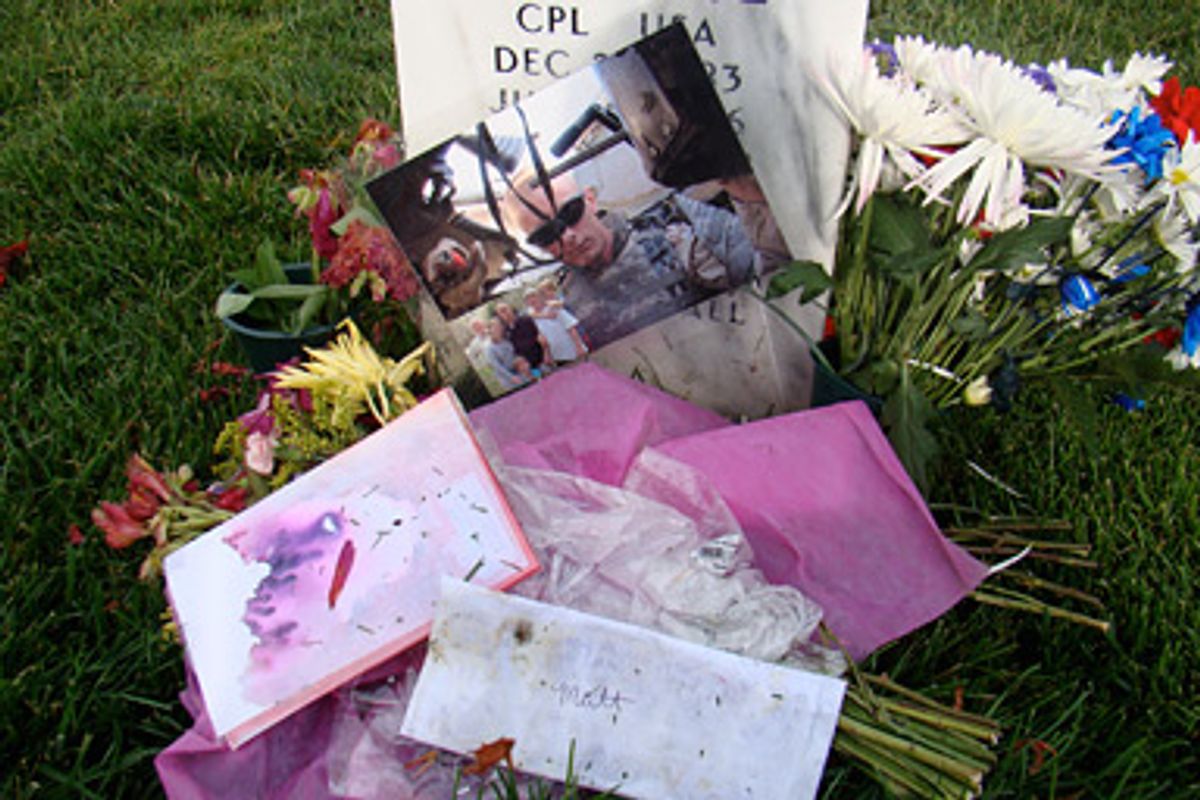
A few days after Memorial Day, I walked across the sprawling, plush lawn of Arlington National Cemetery. I headed toward Section 60, a remote area of the famous burial ground, where 600 service members from Iraq and Afghanistan are laid to rest. Gina Gray, former public affairs officer at the cemetery, had testified that mismanagement at Arlington had resulted in callous treatment of personal mementos and artifacts left on grave sites in Section 60. The sun was out after several days of rain. As I approached the gravestones, I saw that Gray was right.

Left out in the rain to rot were crayon drawings by children who had lost a parent, photographs of soldiers with their babies, painted portraits and thank-you notes from grade-school kids to fallen soldiers they had never known. Colors of artworks ran together. Photos were blurred and wilted. Poems and letters were illegible wads of wet paper. A worker in a brown uniform wandered among the graves, blasting the headstones with a power washer without regard to what was left of the mementos — or the obviously uncomfortable mourners looking on. Some items got further soaked. The worker blasted others across the grass. Many of them would end up in a black trash bin in the cemetery’s service area.

Arlington’s poor treatment of the mementos and gifts — testaments to the personal cost of the post-9/11 wars in the Middle East — appeared to stand in contrast to practices at other cemeteries. The U.S. Department of Veterans Affairs, which runs 130 cemeteries across the country, asks people not to leave items other than flowers on the graves. But when it does find those items, it collects and holds them for 30 days in case the family wants to claim them. Across the Potomac, the Vietnam Veterans Memorial maintains a much stricter policy. It collects virtually everything, down to the last cigarette, left at “the wall.” Every item is then recorded and placed in a climate-controlled warehouse, often visited by historians and researchers.

The parents I met in Section 60 were stunned to hear that grave-site artifacts often end up in the trash. Karen Meredith’s son, Lt. Ken Ballard, was killed in Iraq in 2004. She and her family regularly lavish Ballard’s Arlington grave with flowers, potted plants, flags and other mementos. “Our goal was to have the most decorated grave,” she said. She told me about her Section 60 acquaintances who leave silk roses on Valentine’s Day and Peeps on Easter. On Mardi Gras, another family decorates headstones with beads. This Memorial Day, Meredith and another family whose son was killed in Iraq raised a glass of champagne to Ken. “Ken would have loved that,” she said. “That is a way to celebrate his life.” They left the champagne glassed behind.

I later showed Meredith a photograph of Ballard’s grave after the rains, heaped with dead flowers and crumpled flags. She was distraught. “It looks like they used Ken’s grave as a repository of crap,” she said. “It makes me sad. People leave things that are really meaningful.” Jean Feggins, whose son, Albert Markee Nelson, was killed in Iraq in 2006, had a similar response when I told her I had seen mementos from Section 60 being hosed off grave sites and piled into trash heaps. “They are throwing out people’s photos and letters?” she exclaimed. “That is very insensitive. I’ll bet people would not leave that stuff if they knew. They really should archive those treasures — and that really is what they are to the families that leave them.”

So why were artifacts left on the graves of Iraq and Afghanistan soldiers being treated so poorly? “The photos, letters and signs are picked up when they become weather-worn and unsightly, similar to how the flowers are picked up once they’ve wilted,” cemetery spokeswoman Kaitlin Horst wrote me in an e-mail. “The medals, badges, religious items and other mementos are saved and kept with our historian.”

I asked to meet with the cemetery historian. Two days later, Horst met me at the information kiosk underneath the arching glass-paneled ceiling of Arlington’s air-conditioned visitor center. She was with the mustachioed historian, Tom Sherlock, who has been working there since the 1970s. “Maintaining Arlington is a sign of respect, maintaining these grounds pristinely so that they are not cluttered,” Horst began.

Horst led us into the basement of the visitor center and into a windowless conference room. There, spread out neatly across an average-size conference table, were dozens of military awards and coins, a clutch of rosaries, a soldier’s jacket, a U.S. Army Ranger flag, and two or three pieces of artwork made by children. It was everything, Horst explained, the cemetery had collected since 9/11, or in nearly eight years.

“Is this it?” I asked, thinking about the huge volume of material I had seen during my walks through Section 60. Sherlock nodded.

He said the workers who care for Section 60 turn in some of the material to him, and Sherlock collects the rest on his own. He stores it all in his office. During our discussion, the process of what to save and what to toss out seemed surprisingly ad hoc and arbitrary, based more on Sherlock’s personal sentimentalities than preserving history.

“My sensitivity is to any armed forces decorations, such as the Bronze Star here,” he said, gesturing to the award on the table. He said he also saves “flags, like uniform flags, or anything that is a religious icon, regardless of what it is.”

Horst and Sherlock said the rest of the material gets thrown in the trash. “We don’t save, like, teddy bears or those types of things,” Sherlock noted. “Birthday balloons — we don’t retrieve those. Or an open can of beer. There have been lots of things like that.”

I didn’t see many of the items that I recall from Section 60 that, according to Sherlock’s criteria, should have been saved. I only saw one “KIA” bracelet, for example, in Arlington’s collection, though I’d seen several atop the graves during my treks.

Horst added that the cemetery also throws out cards, photos and letters because they get wet in the rain. “We don’t want to pick stuff up too early off the graves,” she said. “Think about the stuff that has been blown between graves. How do you know where it came from? The notes that are left, and then it rains, become unrecognizable.” In Section 60, she recalled, “I’ve seen a mug of hot chocolate. You know, do you save a mug? You can’t save the hot chocolate.”

She continued. “We went out there after Memorial Day and there was a birthday package. We let it go for a few days and it had gotten wet and the crews picked it up. Tom and I both felt very uncomfortable opening it because we thought, Maybe it is something we need to save? We opened it and it was just a wooden block.” They threw it out.

Horst defended the cemetery’s practices. “This is not an ill-intentioned policy,” she said. “We are not trying to wrong people. We are not trying to throw away history. We do make an effort here. We are not throwing rosaries away. We are not throwing [uniform] patches away. I guess we can’t claim to catch all of it,” she acknowledged.

Sherlock admitted that preserving and recording everything might create “a very valuable tool for the American people.” But he added he would want to discuss the idea with families that visit Section 60.

“Is that something you have explored?” I asked.

“No,” Sherlock said.

I asked Sherlock whether he had ever visited the facility in Landover, Md., that holds the Vietnam Veterans Memorial Collection. He had not.

I contacted Rick Weidman, director of government relations at Vietnam Veterans of America, who has walked through Section 60 himself. For families and friends of those killed in Iraq and Afghanistan, the section “has become their Vietnam Veterans Memorial,” he said. “That is where people go to square away their feelings about their comrades who got blown away.” He was surprised to hear that some of the memorabilia he had seen at Section 60 was thrown out. “This is a major hole that needs to be filled,” he said.

At the Vietnam Veterans Memorial Collection in Landover I stared at one lone cigarette. Since 1986, the National Park Service, which manages the Vietnam memorial in Washington, has collected all of the artifacts left at the wall by mourners.

But a cigarette?

Duery Felton Jr., the Vietnam collection curator and a Vietnam veteran himself, had been leading me on a tour of some of the artifacts preserved from the wall. Each piece — no matter how mundane it might appear at first glance — is collected nightly to protect it from the elements. It is then recorded, placed in labeled blue boxes and stacked on 15-foot shelves in a climate-controlled warehouse.

Felton and I now stood in a room off of the main storage area, where some of the collection is on display in tall glass cases. Felton stood next to me, looking through his wire-rimmed glasses at the cigarette. “There are a lot of subtleties to this collection,” he noted.

I must have looked confused or incredulous. The value of saving a single cigarette was clearly lost on me.

“Look closely,” Felton said quietly.

I peered in at the cigarette. Someone had taken a pen and written on it in tiny letters, “It ain’t wet. It ain’t broke.”

Felton waited. He could see this didn’t help me much. He smiled. Then he explained the sensation of patrolling the jungles of Vietnam, completely soaking wet, for weeks on end. You felt like you would never, ever be dry again. “A dry cigarette was worth a million dollars,” he explained.

As Felton and I walked slowly through the Vietnam collection, it was easy to see that some items screamed a message loud and clear. One person left at the wall a bamboo tiger cage of the type used to hold American POWs. But some objects whispered in a language decipherable only by those who served in Vietnam, like that cigarette. The significance of others can only be imagined. Someone left a bag of M&M’s, potentially remembering the occasional use of the candy as a placebo by medics when supplies ran out, Felton explained. A can of Budweiser, a can of Chef Boyardee beef ravioli and a pack of cigarettes is labeled in commemoration of “the great feast of August, 1967.”

In the Landover facility, shelves are overflowing with everyday items. There are safety pins from a baby’s diaper, birthday and Christmas cards, watches, dollar bills with notes scribbled on them and even toilet paper. (Dry toilet paper also came at a premium in the wet jungle.) A baseball is labeled: “In memory of Richard Allen Brekken, December 14, 1945 – January 6, 1999.” There’s a bottle of sand from Vietnam, chewing tobacco, a can of Spam and the AK-47 bullet that killed a soldier named Henry Lee Bradshaw on August 12, 1968. Teddy bears rest forever in glass cases.

“This is tangible evidence of the effect of Vietnam on the psyche of the public,” Felton said. “Most of this collection is also a reflection of the evolution of social history, the history of the everyday person.”

In fact, staff at Felton’s facility manage a total of 40 historic collections in the Landover facility. Those include items owned by Frederick Douglass and Clara Barton, and artifacts from Ford’s Theater and the Antietam battlefield. But Felton said the facility receives more requests from researchers for access to the Vietnam collection than the other 39 collections combined.

Gary Patnosh is co-director of the Jersey Explorer Children’s Museum, which currently displays more than 100 artifacts on loan from the Vietnam collection. “That collection teaches more than anyone can imagine, he said. “Certainly it teaches people to think about the past and think about a war. But it teaches folks what it is like for a mother to lose a son or a sister to lose a brother, or how somebody had wished they had said something and they did not.”

Patnosh said students often find the seemingly mundane objects left at the wall to be the most provocative. Among the items he features in the Jersey Explorer Children’s Museum is a broken home plate from a baseball diamond. “Maybe it was for coming home,” Patnosh said. “Maybe he played ball. Maybe his father played ball. Who knows? But there is magic in that home plate.”

Some of the most moving items in the collection are photographs and letters. Numerous photos show young soldiers clad in green, mostly men, smiling out from under metal helmets. Sometimes deceased men are circled or labeled in the photos by an unknown hand. In many letters, people are talking to the dead. “For twenty two years I have carried your picture in my wallet,” one veteran wrote in a letter, placed alongside a photo taken off the body of an enemy Vietnamese soldier. The photo shows the Vietnamese soldier, in uniform, posing with a girl.

“I was only 18 years old that day that we faced one another on that trail in Chu Lai, Vietnam,” the veteran continued in his letter to the dead Vietnamese soldier. “Why you did not take my life I’ll never know. You stared at me for so long armed with your AK-47 and yet you did not fire. Forgive me for taking your life, I was reacting just the way I was trained, to kill V.C. or gooks, hell you weren’t even considered human, just gook/target, one in the same. So many times over the years I have stared at your picture and your daughter, I suspect. Each time my heart and gutts [sic] would burn with the pain of guilt.”

Another letter reads: “Sorry about leaving you on the chopper pad. Wish I had stayed and missed my flight to the world. Should have gone to the hospital with you. I didn’t know you was hit that bad. Never once did I think you wouldn’t make it.”

As I read those words, I could not stop thinking about the countless letters I’d seen on the graves in Section 60 over the previous weeks. What war stories had been lost forever? What words from a father to a son or wife to a husband were sitting in some landfill? What meaningful personal artifacts had been relegated to the Arlington trash bin?

Arlington National Cemetery superintendent John Metzler took exception to my questions. “I am a Vietnam veteran. I served a year in Vietnam,” he said. “There is a tremendous difference between a memorial, such as the Vietnam memorial, and an operating national cemetery like Arlington. We are doing close to 7,000 funerals a year. We are an active cemetery, which means we are excavating graves, we are conducting services, we are closing graves, we are doing sod and seeding, we are refilling graves and we are doing all kinds of maintenance activities in order to maintain the appearance of the cemetery.”

He pointed out that Arlington posts regulations that ask families not to leave items other than flowers on the graves. But even when they do, he said, he was being extra mindful of them.

“In Section 60, I have made a conscious decision because of the sensitivity of what is in Section 60 right now — our young men and women who have passed away in our nation’s current wars — to leave things on there a little bit longer,” he said. “Even things that aren’t supposed to be there, we leave for a period of time, and then pick them up. It just would not be practical from an operation standpoint to try to collect everything, to warehouse it or to leave it on the graves for an indefinite period of time.”

In contrast to the upset families I had spoken to, and the neglected and trashed memorabilia I had seen, Metzler said, “The comments I get from the families are overwhelmingly thankful of the maintenance of the cemetery, of how people are treated here and how they are received by Visitor Center staff or my employees out in the cemetery.”

——————–

(Research assistance by Christopher M. Matthews and Josh Loewenstein)

Continue Reading Close

Mark Benjamin is a national correspondent for Salon based in Washington, D.C. Read his other articles here.

Marine’s father: Arlington officials broke their word on disinterment

Scott Warner just wanted to make sure his son's remains were properly buried, but officials wouldn't cooperate

  • more
    • All Share Services

Topics: ,

Marine's father: Arlington officials broke their word on disintermentMarine Col. Gregory Boyle, left, pays his respects to the parents of Pvt. Heath D. Warner, of Canton, Ohio, Melissa and Scott Warner, after handing them the U.S. flag that was draped his casket, during funeral service at Arlington National Cemetery, in Arlington, Va., Tuesday, Dec. 12, 2006.

Scott Warner traveled to Washington from Canton, Ohio, this week for the disinterment of his son’s remains at Arlington National Cemetery. Warner wanted to be sure his son Heath, a Marine killed in Iraq in 2006, was buried in the right spot. He was worried because the Arlington National Cemetery scandal, uncovered by Salon in a yearlong investigation, had unnerved him, and some of his son’s burial paperwork contained disturbing discrepancies.

The media covered Heath’s disinterment Wednesday closely, including the conclusion that Heath was buried correctly. But that’s far from the whole story.

“This thing has been portrayed as some big success story,” Warner told Salon during a telephone interview Thursday as he drove back to Ohio. “It was a disaster. It was a desecration of honor.”

It was also macabre. Warner says what really happened that day shows just how far the public trust in Arlington has evaporated and that the Army should be stripped of oversight of the cemetery. “Did I expect to be digging through my son’s casket looking for an arm? No,” he said. “For a family to go through what my family went through yesterday is beyond reproach.”

Warner had been suspicious even before he arrived in Virginia. During a Sept. 9 phone call with Kathryn Condon, the new executive director at the cemetery who was put in place this summer to clean up the scandal, Condon said a local funeral home had confirmed holding Heath’s remains just prior to his burial at Arlington in 2006. The same funeral home, however, had informed Warner there were no such records, Warner said.

Next, when Condon agreed to dig up Heath’s remains, she wanted it all done at 7 a.m., Warner says, before the cemetery opened to the public. “She tried to change the time from 8 a.m. to 7 a.m. so she could keep people out,” Warner said. “I told her I would be there at 8.” (He was.)

Then Condon said that Warner could bring two reporters to the cemetery with him, but no photography or video was allowed. “I said to her, you don’t have a problem with the media when everything is picturesque and you get those amazing photos,” Warner recalled. “But when it gets to the ugly side of your mistakes, you want to hide it.” (Warner lost this battle.)

Warner was so suspicious of the cemetery, he made Arlington agree not to open Heath’s casket until he got there. He wanted to see that process to make sure it was on the up-and-up.

“They said they were going to dig out the grave the night before and pump out any water that was in the vault,” but not open his son’s casket. Warner said he was insistent and the agreement was clear. “They said they would not open the vault or open his casket until we arrived on the 15th.”

The plan was that Arlington would pull up the casket with Warner there, and a friend of Heath’s would look at the remains to confirm his identity. This way, Warner would not have to see his son’s remains. Heath was killed in a roadside bomb attack in Anbar Province, Iraq. His body was badly ravaged by the blast, requiring a closed-casket funeral.

But when Warner arrived near his son’s gravesite, he was shocked when Condon handed him Heath’s dog tags. “Kathryn approached and said that they had opened the grave,” he said. “They proceeded to tell us they opened the vault, brought up the casket and made an external identification and gave me his dog tags,” he remembered. “They broke the agreement,” he said.

Warner said his mind raced. He felt unsure of who or what to trust. “Everything had been compromised,” he said.

Warner insisted they raise his son’s casket again. Arlington agreed. “The lid was (partly) open,” Warner said he noticed as the casket came up. “It looked like my son’s remains were going to fall out.”

Arlington workers put Heath’s casket on a flatbed truck, covered it with plastic and an American flag, and drove to a secluded warehouse on the cemetery perimeter. “It was like a garage,” Warner recalled.

When the casket was opened, Warner panicked. He felt like he would never get real closure unless he did the unthinkable. “I literally jumped up on the flatbed. Don’t ask me how I did it,” he said.

He looked at the remains. His son’s body was unrecognizable from the blast and the decomposition. “I could not even tell you what was there,” he said, describing the grisly inside of his son’s coffin. “It was so bad. It was a ghastly sight.”

Warner remembered a distinctive tattoo on his son’s arm. “I took my hat off. I took my jacket off. I began to dig in his casket,” he said. “They gave me a pair of latex gloves.”

Warner found his son’s torso. “The body had rolled,” he said. Under the torso was Heath’s arm. “It was underneath his back,” Warner said. “I began to rub some mud off his arm. I was able to make an identification because his tattoo was intact and viewable.”

Warner said he wants people to know what happened that day, how a scandal and further missteps by Arlington have driven grieving families past the edge. He says the scandal at Arlington followed by the cemetery’s bungling of the disinterment made him desperate for closure, and that his trust in Arlington has deteriorated to nothing. “I had no choice,” he said about going through his son’s remains. “This was just beyond anything I ever imagined. It is something I will have to live with for the rest of my life.”

Warner said he has no confidence that the Army, which has overseen the cemetery for years, can also be responsible for fixing the problems there: “These people should all just be fired.”

For weeks, the Army has not responded to any questions from Salon or any requests for interviews about the Arlington scandal, including a request to interview Condon.

Continue Reading Close

Mark Benjamin is a national correspondent for Salon based in Washington, D.C. Read his other articles here.

Investigators blast Arlington contracting

Officials confirm millions in "questionable or improper" spending with little oversight first reported by Salon

  • more
    • All Share Services

Topics:

Investigators blast Arlington contractingA member of the honor guard taking part in a wreath laying ceremony by Britain's Prime Minister David Cameron walks past the gravestones at Arlington National Cemetery outside Washington, July 21, 2010. REUTERS/Jim Young (UNITED STATES - Tags: MILITARY)(Credit: © Jim Young / Reuters)

Army contracting officials have produced a scathing report on Arlington National Cemetery that documents the “questionable or improper” spending of millions of taxpayer dollars, supposedly used to pay contractors and purchase supplies at Arlington. The Army probe found little proof of services rendered for some contracts and payments.

Investigators mostly discovered a convoluted, incomplete and sometimes conspicuously absent paper trail to account for the money — both at the cemetery and in the files of Army contracting officials who oversee the cemetery.

The Army launched this stand-alone financial investigation in June as the yearlong Arlington scandal exposed by Salon rapidly became more public. Salon reported that many at Arlington had tried to blow the whistle on questionable spending to computerize burial records, under the supervision of deputy superintendent Thurman Higginbotham, with contracts going to some of the same people more than once, even after they failed to produce a product. After spending somewhere between $5 million and $20 million, Salon reported, the cemetery’s years-long effort to computerize its records wasn’t completed.

Last week, Higginbotham invoked the 5th Amendment when he was asked about the contracts during a congressional hearing.

Army contracting specialists reviewed cemetery contracts and spending on everything from landscaping work to cellphone bills over the past five years. The resulting July 27 “Procurement Management Review of Arlington National Cemetery” report documents a dizzying blizzard of disappearing money, missing or incomplete contracting paperwork and fishy-looking spending on all sorts of things.

In one section of the report, investigators examined between $400,000 and $800,000 of spending per year on various purchases at Arlington. The probe found numerous examples of “no evidence of delivery and/or acceptance of services and supplies” in return. The report documents the purchase of cameras, refrigerators, computer equipment, software and car parts, as well as cellphone charges and payments for car repairs. For those expenditures, investigators found “limited or no supporting documentation or validation of the location of the items.” The report called signatures on some purchase orders at the cemetery “questionable,” noting that, “signatures purported to be signed by the same person appeared to be totally different.”

“Based on the lack of documentation, justification for the items being purchased, independent receipt and acceptance, and the location of property purchased which should be maintained in the files, most of the purchases reviewed … would be considered questionable or improper,” the report says. When it comes to the Army, which oversees Arlington, the report says the Army failed to “ensure only authorized items were purchased, and receipt and acceptance was documented.”

In addition to the purchase of items, the Army report also looks into millions of dollars paid to contractors for services. Here, too, investigators found widespread lack of proper documentation and common deviation from government contracting procedures designed to ensure fair competition among contractors and preserve taxpayer funds — but that was only when the Army investigators could find the files at all. Investigators were unable to locate more than half the files for 167 Arlington contracts awarded through the Army’s National Capital Region Contracting Center, covering everything from horticulture work to construction.

The investigators also sought to review a separate set of 34 cemetery contracts awarded through an Army Corps of Engineers office in Baltimore. Four of those files were “incomplete” enough that they could not be reviewed, investigators found.

The report is particularly critical of millions the cemetery spent on contractors to computerize Arlington’s antiquated, faulty burial records still managed in a flurry of paper that has resulted in thousands of burial errors at Arlington. Despite payments to contractors who were close to top cemetery officials, Arlington received little to nothing in return, leading to the scandal exposed by Salon over the past year. “The contract files did not contain evidence that the government received deliverables as stated in the contract,” the report said of this modernization effort that was supposed to prevent burial mistakes. Arlington blew somewhere between $5 million and $20 million on this fruitless endeavor. No one is sure of the total amount, or exactly where the money went.

The report highlights the role of cemetery deputy superintendent Thurman Higginbotham, who handpicked the contractors who were supposed to perform that computerization work and managed the contractors to carry it out. “Contract file documentation indicated that the deputy superintendent ANC acted with apparent authority to receive services and provided direction to the contractors,” according to the report. “Receiving reports reviewed at ANC were signed by the deputy superintendent ANC. The contract files did not contain evidence that the government received deliverables as stated in the contract.”

The Army allowed Higginbotham and cemetery superintendent Jack Metzler to retire unscathed last month. The Army has shown no sign of any intent to hold any Army officials accountable for anything that took place at Arlington.

The report was released Tuesday by Sen. Claire McCaskill, D-Mo. McCaskill chairs a Senate subcommittee that is investigating the scandal at Arlington and that held the hearing last week. 

Continue Reading Close

Mark Benjamin is a national correspondent for Salon based in Washington, D.C. Read his other articles here.

Hostile senators unload on ex-Arlington chiefs

Jack Metzler and Thurman Higginbotham make excuses, but a panel of senators doesn't buy them

  • more
    • All Share Services

Topics: ,

Hostile senators unload on ex-Arlington chiefsFormer Arlington National Cemetery Superintendent John Metzler testifies in Washington on Thursday.

Jack Metzler, the former superintendent of Arlington National Cemetery, and his ex-deputy, Thurman Higginbotham, faced a hostile Senate investigative panel on Thursday as they struggled to answer questions about the burial scandal that played out on their watch.

At various times, Metzler tried to say he was unaware of the issues at the cemetery, which include graves with no headstones, unknown remains in graves, urns of cremated remains tossed out in the landfill, and the apparent waste of millions in public funds that were designated to address the problems. (Salon documented these issues and others in a year-long investigative series.) Metzler also claimed that, as he became aware of problems, he fixed them — but Sen. Claire McCaskill, who chaired the panel, would have none of that.

“You did know about it and you did nothing,” she said. Then she turned to Higginbotham: “And you knew about it, Mr. Higginbotham, and you did nothing.”

Metzler went on to blame an inadequate budget — which senators quickly pointed had increased dramatically during Metzler’s tenure — and a busy burial schedule. But again, McCaskill was unsatisfied.

“This is not complicated,” she said. “It’s called keeping track of who you bury, where. That is not a complicated task.”

The subcommittee also examined the apparent waste of millions in taxpayer funds. Higginbotham directed somewhere between $5 million and $20 million to a group of handpicked contractors to modernize burial records at Arlington, but the contractors produced almost nothing in return, and burial records are still tracked on pieces of paper, which go missing. Higginbotham invoked the 5th Amendment when he was asked about the contracts.

Subcommittee ranking member Scott Brown, R-Mass., said it’s astounding that Arlington still tries to track 30 burials a day with a flurry of paper: “Let me get this straight: It is 2010 and you guys…are still dealing in cards? I just can’t get my head around that.”

Officials from the Army, which oversees Arlington, testified that they were mostly kept in the dark about the missing money and burial mishaps. Claudia Tornblom, the Army deputy assistant secretary who oversees the cemetery’s budget, claimed she was aware of burial paperwork “discrepancies,” but did not know that those discrepancies might reflect burial problems in the ground. “Obviously, we did not ask enough questions,” she explained.

Brown said the idea that the country’s most famous cemetery could not keep track of the dead was unimaginable. “It’s almost like learning there is no Santa Claus or Easter Bunny,” he observed.

Continue Reading Close

Mark Benjamin is a national correspondent for Salon based in Washington, D.C. Read his other articles here.

Arlington Cemetery ex-official accepts blame

The former superintendent of the scandal-wracked military burial site offers "sincere regrets to the families"

  • more
    • All Share Services

Topics:

The former superintendent of Arlington National Cemetery says he accepts “full responsibility” for the mix-up of graves at the famous military burial ground.

John Metzler ran the cemetery for 19 years before he was forced out because of the scandal. He told a Senate committee on Thursday that it pains him that his team didn’t do its job. He expressed his “sincere regrets to the families.”

Missouri Sen. Claire McCaskill said at the hearing that as many as 6,600 graves at Arlington could be unmarked or mislabeled because managers didn’t do their job properly.

That’s much higher than the estimate last month from Army investigators, who said about 211 remains were affected.

Metzler’s former deputy, Thurman Higginbotham, also appeared. Higginbotham says he plans to assert his Fifth Amendment right not to answer questions.

THIS IS A BREAKING NEWS UPDATE. Check back soon for further information. AP’s earlier story is below.

WASHINGTON (AP) — A Senate Democrat says that as many as 6,600 graves at Arlington National Cemetery could be misidentified because managers there didn’t do their job properly.

Sen. Claire McCaskill, D-Mo., spoke at a hearing Thursday, where the cemetery’s former superintendent and deputy superintendent were scheduled to testify.

McCaskill says she believes that between 4,900 and 6,600 graves may be unmarked or mislabeled on cemetery maps.

The estimate far exceeds one given by Army investigators last month that some 211 remains could be affected by the graves scandal.

Continue Reading Close

Senate memo: As many as 6,600 burial mistakes at Arlington

On the eve of a hearing, Claire McCaskill's office lays out far worse problems than the Army has acknowledged

  • more
    • All Share Services

Topics: ,

Senate memo: As many as 6,600 burial mistakes at ArlingtonRows of headstones are aligned in Area 60 in Arlington National Cemetery in Arlington, Va., Friday, July 2, 2010. (AP Photo/Alex Brandon)(Credit: Alex Brandon)

The total number of unmarked, improperly marked or mislabeled graves at Arlington National Cemetery could be well over 6,000, according to an estimate by a Senate subcommittee investigating the cemetery.

The Senate Subcommittee on Contracting Oversight, chaired by Sen. Claire McCaskill, D-Mo., is conducting an investigation into the burial and contracting scandal at Arlington first uncovered in a year of reports in Salon. A July 27 memo to subcommittee staff credits Salon with exposing the problems now being investigated. The memo also warns that “The problems with graves at Arlington may be far more extensive than previously acknowledged. The Subcommittee has obtained information suggesting that 4,900 to 6,600 graves may be unmarked, improperly marked, or mislabeled on the Cemetery’s maps.”

The memorandum says that estimate is based on a review of more than 5,300 pages of Army documents, material from whistle-blowers, and interviews with current and former government officials.

McCaskill’s estimate of missing or mismarked graves could well be correct, and may even be conservative. The Army last month released a report documenting 211 problems in three sections of the cemetery, where paperwork showed remains in a grave for which there was no headstone in that section. (Or, conversely, there was a headstone in that section for a particular grave, but no paperwork to match.) But there are 70 sections at Arlington, holding a total of over 330,000 graves. And as Salon outlined over the past year, each single burial blunder can create a domino effect: If the wrong person is named on a headstone, then where is the body that should be under that headstone?

Salon reported Tuesday that Arlington budget chief Rory Smith tried to warn Army higher-ups of management and contracting problems as early as 2003, to no avail.

Read the full subcommittee memo here:

ANC Public Memo Final


Continue Reading Close

Mark Benjamin is a national correspondent for Salon based in Washington, D.C. Read his other articles here.

Page 1 of 8 in Arlington National Cemetery Investigation