
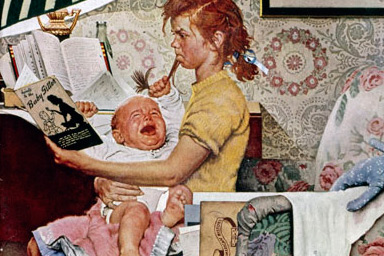
The specter of the bad baby sitter has long haunted parents.
In the ’20s, a parenting guide cautioned Mom that a sitter might trundle her tender charge out on the town, so she could flirt on street corners. In the ’40s, Newsweek reported that one veteran and his wife had hired a girl who turned out to be a dance-crazed “bobby-soxer” inviting friends over to party, while the toddler in her care teethed on marbles.
Since then, the bad baby sitter’s renown has only grown, as she’s come to play a prominent role in urban legends, horror movies, pornography and even pop music, according to Miriam Forman-Brunell’s new book “Babysitter: An American History.”
The bad baby sitter’s a teenage girl, often dressed inappropriately, who is an unreliable scatterbrain, more interested in doing her nails or texting than the kids. When she’s not glued to the TV, she’s gabbing on the phone all night while eating Mom and Dad out of house and home. Or maybe she’s sneaking her boyfriend in after the kids are asleep, or batting her eyelashes suggestively at Dad on the drive home. The bad baby sitter can be a threat not only to the children left in her care, but also to the very marriage of the parents she’s working for.
But as historian Forman-Brunell’s research reveals, the archetype of the bad baby sitter has more to do with adults’ fears about the changing nature of girlhood today — whether today is in 1945 or 1995 — than it does with the reality of girls caring for younger kids for pay.
Baby-sitting emerged in the 1920s, when a shortage of immigrant domestic workers met a rise in teen consumer culture, which found mothers looking for help and teen girls looking for extra cash. Yet, even then, baby sitters had an ambivalent relationship to the job, which came with low pay, sporadic hours and household duties that went beyond diapering and breaking up scuffles between siblings.
While the role of the baby sitter did offer girls some economic opportunity, responsibility and independence, it also placed them squarely in a traditional role, inside the home. When jobs opened up to girls that offered them the chance to socialize with their peers, even for lowly minimum wage (see: mall food court), they jumped at the chance.
As a teen, Forman-Brunell, 54, who is now a professor of history at the University of Missouri-Kansas City, worked as a baby sitter herself. As a mother, she periodically hired sitters to care for her two children, who at 16 and 18 are now old enough to be sitters themselves. But while her son has baby-sat a bit, Forman-Brunell hasn’t actually encouraged her own kids to become sitters. That mirrors the current trend; yes, with the rise of today’s overscheduled tweens and teens, the baby sitter has stopped taking parents’ calls.
I spoke with Forman-Brunell by phone from her summer place in Estes Park, Colo., about what sitting has meant over the decades, and means today.
Has there ever been a golden age of baby sitting?
There really never has. Many parents continue to think that way back when, in the postwar years, girls were affable and also plentiful.
But in fact that was not the case. Back in the 1950s, and even before that, during the war and during the Depression, girls complained about the working conditions and the ways in which they felt they were being treated unfairly by their employers.
I was surprised that some girls even formed baby-sitting unions.
In the years right after the war ends, when the baby boom really begins to soar, parents are desperate for baby sitters. These baby sitters really have developed a sense of themselves as being workers. And they have a sense of what is acceptable to expect of a worker and what isn’t.
In various parts of the country they begin to organize these informal unions. Girls get together to draw up a code in terms of what’s the minimum wage, what can their employers expect of them. Basically identifying the do’s and the don’ts.
The unions don’t last. And one of the reasons is that that kind of worker solidarity, agency and empowerment is something squelched during the 1950s, in light of fears about communism, and replaced by notions of domesticity and femininity.
You document pop culture portrayals of the baby sitter as feckless, irresponsible, barely competent. Why do you think this image of the baby sitter developed?
The emergence of that character is very much informed by a larger critique about teenage girls, and the ways in which teenage girls were developing their own culture, their own identity, and the ways in which adults really feared them. The stereotype that emerges is one that’s created by adults, not by teenagers, and it’s one that casts them in a negative light.
During the war, it has a sexual dimension to it. And of course that resurfaces during the 1960s as the kind of sexy sitter who poses a threat to marital stability by being attractive to the male employer.
But simultaneously there were these images of the boy baby sitters as the Boy Scouts who could really get things done.
Girls, fairly consistently over the course of 80 years or something that we’ve had baby sitters, are identified as being unreliable and irresponsible and indulgent. And boys are consistently seen as being responsible and reliable, and using their intelligence in order to control difficult children.
What are some of the most long-lasting and persistent urban legends about baby sitting?
There are two that are really the most dominant. Both of them emerge sometime in the early 1960s. People who study urban legends have identified them as the Babysitter and the Maniac and Wasted and Basted.
In the Babysitter and the Maniac, the children are upstairs usually asleep, and the baby sitter gets a phone call asking her if she’s checked the children. She gets that phone call three times. After the third time she calls up the police to trace the call. He calls back and they call her to tell her that the man is in the house and that she has to get out of the house immediately. What usually happens is that she runs upstairs and finds the kids have already been murdered.
Because she failed at her duties, and she didn’t check the children?
Exactly. Also, she’s been watching television, which in the 1960s is really seen as her entryway into fantasy life, and doing something that she’s not supposed to be doing, which is not being attentive to the children.
That story gets circulated very widely, from coast to coast during the 1960s and throughout the 1970s. Kids actually contribute to the spread of it at summer camps and they share it as a true story. And finally by the end of the 1970s it gets made into a movie, “When a Stranger Calls,” and doesn’t stop there. There are very recent versions of it that are increasingly more gory and violent, sexually violent, sadistic.
And then there’s an entire subset of horror movies that comes from that. Why is the baby sitter such a common figure in those kind of slasher films?
Slasher films emerge in the 1970s, and it’s during the 1970s that feminism has really expanded and had a significant influence on teenage girls. They’re searching for greater freedom and greater economic empowerment and political and social and cultural empowerment. That’s true for women also, obviously.
And the baby sitter — because she’s a wage earner, she’s leaving home, though of course she’s ambiguously going into somebody else’s home — she becomes an object for anxieties about these profound social changes having to do with women and liberation.
The maniac really turns into this male rage toward the ways in which society is changing. Men are losing their position of authority, and girls and women are gaining. It’s a way to contain girls by getting them frightened.
And in fact it was very successful. These legends, whether they’re spread by word of mouth, or on the screen, lots of girls heard them and then they just stopped baby-sitting. They were too frightened. Or, if they did baby-sit, they talked on the phone the whole time so that the maniac couldn’t call.
The baby-sitting role is interesting because it gives the girl a sense of independence and responsibility, yet at the same time it does so in this very traditional role of caring for children.
Since the 1930s, baby-sitter handbooks and manuals have been really playing that up, trying to appeal to that side of girls that is more interested in being independent. Yet what you see is the real tension within the job itself because girls often feel the exploitation of it, and might feel that they’re being held back or held down.
This is a girl’s job. It is a job that is associated very closely with being a girl. For girls who are increasingly being informed by feminist ideals, they begin to see it as a job that is not desirable.
You document a lot of adult fears about baby sitters being irresponsible and bringing their friends or boyfriends over. But isn’t there also an element of the job that allows girls to snoop in an adult world, like going through the parents’ stuff?
I think that definitely does go on. It’s a question of, does it go on to the extent parents assume or fear it does? Some baby sitters have their boyfriends come over, and some do spend a lot of time talking on the telephone, but it’s a question of proportion.
Certainly, from the baby sitters that I spoke to, male as well as female, I have heard about a certain amount of snooping for erotic literature and that kind of thing. It does provide opportunity to maybe peer into the private lives of adults other than their parents. But my suspicion is that it is far less prevalent than what parents fear to be the case.
What about the issue of the sort of sexual fears on both sides — girls being afraid of the leering, drunk husband making advances in the car on the way home, or the family being threatened by the young girl’s sexuality. What do you see as reality versus myth there?
The line between reality and fantasy is kind of blurry. It was really impossible to count how many baby sitters were in fact having sex with their employers, as opposed to how many parents thought that they were.
However, that said, there are police blotters and court cases that do document the ways in which men are being accused and arrested and tried for molesting and raping baby sitters. Now that’s at the furthest end of that spectrum. The more in between is the innuendo, subtle messages.
There are lots of girls I spoke to who would say, “Well, he drove me home in the car and he talked about his marriage. And I felt uncomfortable but nothing happened. It didn’t go further than that.” And it’s a question of what was his agenda there? If she reacted a certain way would he have gone further or not?
On the other hand, some girls talked about men who would drink and who would strip down to their underwear, and who would push it a lot further than innuendo.
In terms of parents’ expectations and fantasies about girls, I would say women and men probably have very different ones. In the pornographic videos, you increasingly have women who are participating in that fantasy. It’s mothers and fathers participating in that fantasy with the baby sitter. There is always the anticipation and the expectation that the baby sitter will be sexual in some kind of way. And there again, the vast majority of baby-sitting experiences, that’s not a part of what goes on.
Of course, if you read newspapers or watch the evening news, there are examples of girls being accused of various activities. Though, typically, if you look at the headline, it’ll say “Babysitter Molests Child,” and then when you read the story what you generally find out is, it was a male and not a female.
This was interesting. While boys consistently are lauded by experts and educators, recent research on baby sitters who are child abusers show that it is more likely to be a male than a female.
Girls, while they’re seen by popular culture as the most potentially dangerous to children and to family life, in fact they’re the least dangerous. Leslie Margolin has done a number of different studies about baby sitters where he not only looks at adolescents, but also looks at the boyfriends of women who have children, uncles and aunts, grandmothers and grandfathers, and consistently finds that gender is really the controlling factor here.
What about the rise of the super sitter? Because that seems to run counter to the incompetent girl baby sitter image.
During the 1980s, once again the birthrate begins to rise. And at the same time you have teenage girls who are now spending more time doing extracurricular activities, there’s a rise in sports. There’s much greater attention paid to their scholastic and educational opportunities.
Too busy to baby-sit!
They’re too busy to baby-sit. And there’s also an expansion of malls from coast to coast, and so there are job opportunities for teenagers. And so who’s left to take care of this new generation of children being born in the 1980s but pre-adolescent girls?
And so the question is: How do you convince parents to hire pre-adolescents to take care of their babies? To feel confident in them? And then also, how do you get pre-adolescent girls to want to baby-sit, because in many ways they are being influenced by the same social forces that are shaping their older sisters.
So, during this period, an explosion of baby-sitter manuals emerges that are geared largely toward the pre-adolescent girl. They construct her as this super sitter, kind of analogous to the superwoman, you know, the super mother.
The super sitter is this confident, energetic, clever, pint-size businesswoman, who can do anything and can do it very well. Then, there’s also an emergence of educational, vocational safe-sitter programs, offered in hospitals and churches and schools and things like that.
And the age of the sitter which these manuals are aimed at just comes down increasingly because there just aren’t enough sitters.
To what age?
It starts going down to 11 and 12. And it even goes down further than that if you look at the popular culture. That’s where “The Baby-sitters Club,” the book series, comes in. It’s no coincidence that during this period where you have a sitter scarcity, and yet you have enough pre-adolescent girls around, that the “Baby-sitters Club” book series emerges. It really becomes a juggernaut into the next century.
Through these characters girls can imagine they are empowered and independent. In the stories, they’re baby sitters who enter these other domains that would be off-limits to tweens, as they go out into their community in a Nancy Drew-like way, solving mysteries.
It was really a way to groom girls to want to become baby sitters. There again is the double-edged quality to baby-sitting — on the one hand appealing to the girl’s desire to be independent, and yet on the other hand really directing it toward domestic ends.
How has the rise of the modern tween precipitated the fall of baby-sitting as we know it?
The teenage girl is consistently, especially in the ’70s and very much so in the ’80s, seen as a very, very dangerous figure. Like, at the same time you see the “Baby-Sitter Club” confident girl with this business acumen and creativity, the flip side is the teenage murderous baby sitter who appears in all kinds of made-for-TV movies in the 1980s.
Teens are really demonized?
The teens are demonized and where they’re seen as whorish, the pre-adolescent girl is seen as wholesome. The culture not only gets girls to think about themselves in these ways but also gets parents to think of them in that way so they will hire them.
The tween is very much following in the footsteps of her older sister, and so what happens is that the 13-year-old doesn’t have time, or the inclination, and then neither does the 12-year-old, or the 11-year-old. As aspects of girlhood autonomy seep downward into younger girls, they also have less and less of a desire to baby-sit, and also more responsibilities in terms of academic, extracurricular activities.
Do you think parents are just not going out as much now, or are they more reliant on adult baby sitters, or nanny-type of figures?
By the end of the 1990s and then into the new millennium, parents are using a great variety of methods in much the same way that parents had in the 19th century.
They might rely on grandparents. One benefit of being caught up in that sandwich generation is that maybe you do have a grandparent around to watch or at least keep an eye on children.
Sometimes they bring their children with them when they go places. Children have Gameboys, and they have computers, and they have cellphones.
Ah, they have the electronic baby sitter!
Exactly. And so in a way you can take them along shopping and stick ’em in a corner and they’re perfectly happy with their game. In fact, they’re too happy, right? And with rising divorce rates, you have two different households. So, a wife has more freedom to go out because her children are at her ex-husband’s.
I wonder about the impact the recession has. I know one of my students who is a baby sitter was telling me recently that she doesn’t like to baby-sit any more because the parent will stay home while she’s baby-sitting, using her more like a mother’s helper. The mother or the father will be working in the den on their computer trying to find a job.
So your student doesn’t have the autonomy of the old-fashioned baby sitter?
She doesn’t, and she doesn’t like that. I wonder whether there might be a shift toward that. I mean, obviously in some cases people aren’t hiring baby sitters because they can’t afford them because they lost their job. But in other cases they might be hiring a baby sitter because that frees them up from childcare so that they can try to pursue job opportunities.
