Barack Obama

Joe Wilson wasn’t the only disrespectful Republican

The House GOP offered a case study in how not to sit and listen to a president, and they'll pay a political price

  • more
    • All Share Services

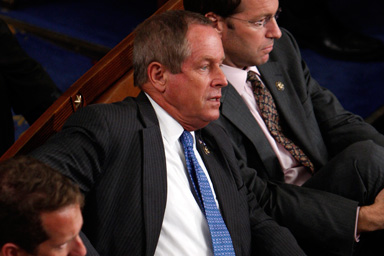
Joe Wilson wasn't the only disrespectful RepublicanU.S. Representative Joe Wilson of South Carolina listens to President Obama's speech after yelling out "You Lie" during the President's speech about healthcare reform to a joint session of the Congress on Capitol Hill in Washington, September 9, 2009.

Whoever came up with House Republicans’ strategy for a real-time response to President Obama’s address to a joint session of Congress Wednesday night should probably have given the whole thing just a little more thought.

The original Republican plan, which was to carry in copies of various GOP-sponsored healthcare bills with the words “What bill?” written on the back in case Obama accused the opposition of not having proposed its own solutions, might not have been so bad on its own. It would have looked petty, sure, maybe a little childish — certainly it wouldn’t have been the most dignified thing to do while sitting in the House chamber as the president speaks. But it might not have gotten much attention, save a few puzzled questions, were it not for Rep. Joe Wilson, R-S.C., who interrupted the president’s speech with a shout of “You lie!”

Wilson has already put out a statement apologizing for his outburst, and even called the White House to offer his apologies to Chief of Staff Rahm Emanuel. (After the speech, Emanuel reportedly approached two Republican leaders and demanded that apology, saying, “No president has ever been treated like that.”)

But the damage has already been done. The story now — and, most likely, on Thursday — is congressional Republicans looking like a bunch of townhall protesters during the speech, being generally disrespectful to the president. And there’s more fodder for that story still percolating out there. There’s video of Rep. Eric Cantor, R-Va., the Minority Whip, on his BlackBerry during the speech, for instance. And then there’s this, from an article by the Washington Post’s Dana Milbank:

When Obama addressed the charge that he plans “panels of bureaucrats with the power to kill off senior citizens,” someone on the GOP side shouted out “shame!” The president went on: “Such a charge would be laughable if it weren’t so cynical.” “Read the bill!” someone shouted back. Obama mentioned those who accuse him of a government takeover of health care. “It’s true,” someone shouted back …. Even as Obama delivered a tribute to the late senator Ted Kennedy, Rep. Tom Price (R-Ga), a leader of House conservatives, perused his BlackBerry. Shortly before the speech ended, Rep. Patrick McHenry (R-N.C.) walked out to beat the rush.

All of this is a gift to the White House. All of it will serve to reinforce the impression, which reform supporters have been working hard to create and spread, that Republicans have gone around the bend, that they’re more interested in attacking Obama than in reaching across the aisle to work on reform. And it makes Obama look calm, bipartisan and presidential.

There’s some damage to Wilson himself, too. As of this post, his Democratic opponent for 2010, Rob Miller, had raised about $50,000 since the speech.

Alex Koppelman is a staff writer for Salon.

Obama’s Iran charade

The shrill, militaristic Manichean worldview that brought us the Iraq war is gone -- except when it comes to Iran

  • more
    • All Share Services

Obama's Iran charadeThe main reactor at the Bushehr nuclear facility in Iran. (Credit: Reuters/Raheb Homavandi)

The nuclear summit that concluded last week between Iran and six world powers was a ridiculous charade. The Obama administration never intended it to succeed. Its sole purpose was to placate hawks in U.S. Congress, ensure that Democratic donors keep writing checks during election season, and buy another month of time during which Israeli Prime Minister Benjamin Netanyahu will not be able to bomb Iran. In the meantime, American drivers can sit back and enjoy more $4-per-gallon gas.

The talks failed because the U.S. and the rest of the P5+1 (Russia, China, Britain, France and Germany) refused to take yes for an answer. The key issue on the table was Iran’s accumulation of uranium enriched to 20 percent – not a high enough level to make a nuclear weapon, but close enough that it would be much easier for Tehran to do so. Iran made it clear that it was prepared to stop enriching to 20 percent and to even ship its stockpile of enriched uranium out of the country, if the U.S. and the other powers agreed to relax the draconian sanctions they have imposed on the country.

This deal would have been a major diplomatic breakthrough. It would have greatly reduced Iran’s capacity to develop a nuclear weapon, defused tensions in the region, calmed the oil markets, driven prices at the pump down and made it impossible for Netanyahu to attack Iran. In a presidential campaign as tight as this one, a significant drop in gas prices could be the difference between Obama being reelected and Romney defeating him. So why didn’t the Obama administration take the deal?

The ostensible reason, piously mouthed by Secretary of State Hillary Clinton, is that the U.S. believes that the upcoming, even harsher round of sanctions on Tehran will generate even further concessions. According to this line of reasoning, Iran only came to the bargaining table because of sanctions, and more sanctions will produce better results.

But this justification is transparently false. First, Iran has made it clear again and again that it will never allow itself to be seen as folding under U.S. pressure. It is prepared to negotiate, but successful diplomacy requires not just sticks but carrots. The carrot the P5+1 offered at Baghdad was ridiculous: If the Iranians agreed to suspend 20 percent enrichment, what they would receive in return was not a reduction in sanctions, but rather spare aircraft parts. For Tehran, accepting this deal would have been tantamount to surrendering. As Iranian analyst Hasan Abadini said, “Giving up 20 percent enrichment levels in return for plane spare parts is a joke.” These are not arcane diplomatic mysteries. As Iran expert Gary Sick pointed out in an interview on NPR, what it will take to reach a resolution of this issue is clearly understood by all the players involved. It is no more possible that the Iranians would have taken that deal than that the Palestinians would agree to establish their state in Jordan.

Second, Clinton’s argument that the Iranians will make more concessions begs the question: what concessions? The only remaining significant concession Iran could make would be to agree to give up enriching uranium altogether – and it has made it clear that it is never going to give up that right, which it is guaranteed as a signatory of the Non-Proliferation Agreement. In an interview with Washington Post columnist David Ignatius, former Iranian negotiator Seyed Hossein Mousavian made it clear that Iran would be prepared to give up 20 percent enrichment if its rights to enrich uranium were recognized.

All of this makes clear that the U.S. knew going into the negotiations that they were not going to succeed. The entire process was an elaborate ritual whose dual purpose was to inoculate President Obama against charges that he was “soft on Tehran” and to make it impossible for Netanyahu to go postal.

In fact, despite the conventional wisdom, it is extremely unlikely that the far-right Israeli leader will attack Iran. His constant threats to do so were the reason that Congress imposed the latest round of sanctions, against the Obama administration’s wishes. But despite Congress’s lockstep support for Netanyahu and anything he decides to do, up to and including an attack on Iran, it would be far too risky for Netanyahu to actually do it. The American people, unlike their bought-off, coerced and/or ideologically myopic political representatives, are sick of Middle East wars. Many, including increasing numbers of American Jews, are growing weary of Israeli intransigence and extremism. They’re also broke. An Israeli attack on Iran would draw in the U.S. and plunge the world into a depression – and the American people would hold Israel to account. Netanyahu may, as the former head of Israel’s spy service said, be “messianic,” but even he knows better than to jeopardize his country’s relationship with America. However, in order to manipulate America, it is essential that he constantly give the impression that he is about to attack Iran.

The Obama administration probably knows that Netanyahu is bluffing. But it has to play out this farce to placate Congress, keep pro-Israel Democrats writing checks, remove a Romney attack line and generally appear tough on Iran.

The irony is that the U.S. and Israel are always claiming that Iran uses negotiations over its nuclear program to play for time while it works feverishly to develop a bomb. But playing for time is precisely what the U.S. just did.

Obama is trying to run out the clock on Iran before the November election. He adroitly stalled the nuke-Iran hysteria that built up during the AIPAC conference in March, but he did so at a price, painting himself into a corner with tough rhetoric denying that containment of a nuclear Iran was an option and threatening to use military force. The negotiations in Baghdad had to fail in order for him to maintain that posture.

His strategy may work. He may stumble over the finish line in November, still dragging out negotiations. And he may overcome the serious headwind of high gas prices and beat Romney. But there is nothing good to be said about his weak and pandering approach. It will not stop the Iranian nuclear program, it is causing the Iranian people to suffer, and it hurts the average U.S. citizen. At bottom, it is an approach predicated not on achieving real progress in dealing with the Tehran regime but on overthrowing it. As such, it is antithetical to Obama’s proclaimed desire to reach out to Iran and to reset America’s relationship with the Middle East. In the long run, he will have to decide whether he really wants to continue a brinkmanship game that locks the U.S. into the self-defeating Middle East policies it pursued during the Bush years.

For the truth is that Obama’s Iran policy represents the last vestige of Bush-era neoconservative extremism. The moralistic, shrill, militaristic Manichean worldview that brought us the “Axis of Evil” and the Iraq war is gone – except when it comes to Iran.

Obama’s schizoid foreign policy – extreme and ideological on Iran, pragmatic and flexible everywhere else — was brought into sharp relief this week. Even as the Baghdad summit broke down, events elsewhere in the Middle East and South Asia demonstrated the utter failure of Bush’s approach – and provided a cautionary warning to Obama of the follies of continuing it with Iran.

Start with Iraq, where Bush’s nine-year-long military adventure is coming to an inglorious end. That unprovoked invasion was supposed to bring an end to an evil regime and transform the Middle East – the same reasons neocons now give for attacking Iran. It left an ethnically fractured, horribly wounded land in the grip of a strongman that is just now emerging from a nightmarish civil war and is still plagued by sectarian violence and terrorism. Our moral responsibility predates the war: America’s crippling pre-war sanctions devastated Iraq’s entire society, and they were one of the reasons why it was so difficult to rebuild it. Congressional proponents of sanctions against Iran should take note.

Then there’s Afghanistan, where after 11 agonizing years we have essentially given up. Afghanistan has proven beyond the shadow of a doubt that even a superpower cannot always succeed in imposing its will, that cultural and anthropological differences are critical, and that trying to combine nation building and counterinsurgency in one of the most backward and impoverished places on Earth is a recipe for disaster. The best we can hope for now is that not too many more U.S. troops are shot dead by the Afghans they are training – and that the Taliban does not roll into Kabul the moment we roll out.

Next there’s Syria, where an appalling regime is locked in a brutal struggle with a murky opposition and where all the options are so bad that we have no choice but to remain on the sidelines.

Finally, there’s Egypt, where a nascent democracy is fighting to be born. Everything about this inspiring, painful and threatened revolution, culminating in this week’s elections, was generated by the Egyptian people themselves. America had nothing to do with it. Contrary to claims made by Bush apologists, the appalling example of Iraq was actually a disincentive to throw off Mubarak’s tyranny. As for the rise of the Muslim Brotherhood, that dire event so feared by neoconservatives and Islamophobes, they may turn out to be the stable, conservative, don’t-rock-the-boat party.

The lessons these different situations hold for our dealings with Iran are very simple. First, we have far less ability to control what happens in the Middle East than we think. In Iraq and Afghanistan, we tried to impose our will directly and failed. In the other two, we either do not have the ability to intervene (Egypt) or the risks of doing so would be too high (Syria). Second, none of these situations are susceptible to the kind of good-and-evil moralizing that characterized Bush’s approach to the Middle East. Individually they are incredibly complex, and as a whole they are even more complex. There is no simple way to approach any of them. Basing our policy toward them on a Manichaean, good guys vs. bad guys worldview is self-defeating. Bashir Assad is a bad guy, but if we sided with the rebels, we could unleash a civil war even more catastrophic than the one going on now. Some of the Salafis in Egypt may be planning to ban beer and abrogate the Camp David treaty, but if we tried to prevent them from taking power, we would be thwarting the will of those Egyptian people who want those outcomes. Nouri al-Maliki may be a sectarian thug, but the alternative could be worse. Hamid Karzai may be a corrupt, drug-addled charlatan, but he’s the guy who’s there.

And so on, down the list, from Pakistan to Hamas to Netanyahu to Libya. The real world, as opposed to the black-and-white world of the neocons, is all about complexity, grey areas, compromises, diplomacy, flexibility. It’s about accepting that America will have to deal with regimes that do not toe our line. It’s about realizing that our soft power is more effective than our military power. It’s about putting down the Big Stick and trying to actually listen to what the people in the region are saying. It’s the opposite of the Bush Doctrine.

Obama knows this, but the dead hand of neoconservative ideology still drives his Iran policy. Until he shakes it off and accepts that Iran is a regional power and must be dealt with realistically, even though it does not always share our interests, his Middle East policy will continue to resemble that of his predecessor.

Continue Reading Close

Gary Kamiya is a Salon contributing writer.

Obama campaign raps Romney on Trump rhetoric

McCain has yet to speak out against "Birthers"

  • more
    • All Share Services

Obama campaign raps Romney on Trump rhetoricRepublican presidential candidate, former Massachusetts Gov. Mitt Romney, looks out the campaign charter airplane window during the flight between San Diego and Hayden, Co., Monday, May 28, 2012. (AP Photo/Mary Altaffer)(Credit: AP)

WASHINGTON (AP) — President Barack Obama’s re-election campaign is releasing a television advertisement accusing Mitt Romney of failing to stand up to “the voices of extremism” in his party.

The ad was released Tuesday as Romney was poised to clinch the Republican presidential nomination in the Texas primary. It takes the former Massachusetts governor to task for failing to speak out against real estate mogul Donald Trump, a supporter who has consistently charged that Obama is not a U.S. citizen.

The commercial opens by showing 2008 nominee John McCain brushing aside a woman who raised the citizenship issue at a town hall-style meeting, and asks, “Why won’t Mitt Romney do the same?”

A Romney aide is shown telling a TV interviewer that “a candidate can’t be responsible for everything a supporter has said.”

Guess who’s coming to dinner?

George and Laura Bush dine with the Obamas

  • more
    • All Share Services

Judy Gold

Emmy Award-winning actress and comedian Judy Gold is best known as the star of her two critically acclaimed off-Broadway shows, "The Judy Show - My Life As A Sitcom," and "25 Questions For A Jewish Mother." Judy has had her own comedy specials on HBO, Comedy Central and Logo. She appears regularly on Tru TV's World"s Dumbest. Check out www.JudyGold.com and follow her on Twitter at @JewdyGold.

Presidential race is most costly ever

The election is poised to dwarf the cost of 2008, when Super PACs didn't pump millions of dollars into the race

  • more
    • All Share Services

Presidential race is most costly everPresident Barack Obama, left, tours TPI Composites, a manufacturer of wind turbines blades, with plant manager Mark Parriott, Thursday, May 24, 2012 in Newton, Iowa. In Obama’s second visit as president to Newton, a city of about 15,000 east of Des Moines, he argued for Congress to renew wind energy tax credits.(AP Photo/Pablo Martinez Monsivais)(Credit: AP)

The battle between President Barack Obama and Republican Mitt Romney will be the most expensive presidential contest ever — by a long shot.

There are two main reasons. It’s the first time both major-party candidates are declining post-Watergate federal campaign financing — and the spending limits attached. And the proliferation of super PACS is pumping untold millions into the fray on both sides, mostly for advertising.

So fashion your seat belts and prepare for a howling tempest of broadcast ads, especially if you live in a battleground state.

Obama and Romney were both coming off a week of intensive national fundraising.

Without Democratic primary opposition, Obama had a huge early advantage.

But Romney, likely to surpass the 1,144 delegates needed for the GOP nomination next Tuesday with a primary win in Texas, is starting to catch up as major conservative donors begin opening their wallets.

Through April, Obama and Democratic groups supporting him have raised nearly $450 million and have more than $150 million in the bank. Romney and Republicans backing him have collected more than $400 million during the same stretch and have about $80 million at their disposal.

Both candidates are shooting for raising around $800 million, which would put their combined campaign spending at roughly $1.6 billion. Add another few hundred million from super PACs and convention spending.

Obama opted out of public financing in 2008 and raised $750 million. His spending swamped GOP rival Sen. John McCain, limited to spend the $84 million he received from taxpayers. Super PACs didn’t exist then.

We know what happened in that race. Romney didn’t want to see it happen to him.

Neither candidate had public appearances Friday. Romney was taking a long weekend California hiatus from campaigning, while Obama planned several ceremonial events on Memorial Day.


Continue Reading Close

When leaders actually lead

Some Obama backers insisted the president could do nothing on his own to advance gay marriage. Boy, were they wrong

  • more
    • All Share Services

When leaders actually leadU.S. President Barack Obama speaks at a campaign fund raising event in Denver, Colorado May 23, 2012. (Credit: Reuters/Kevin Lamarque)

I count myself as a supporter of President Obama who reserves the right to criticize him when I disagree. And I disagreed with his reluctance to come out in support of gay marriage for a long time. I’m also on record wishing he’d taken a stronger public stance behind several big progressive priorities — a larger stimulus, tougher Wall Street reform, a public option for health insurance, a big jobs bill – whether or not he had the congressional support to make it happen.

Throughout the president’s first term, his most ardent supporters have reacted to those of us pushing him to do – and say – more on such issues with frustration and anger, some of it nasty and personal, some of it thoughtful and well-argued. They rightly blame Congress for blocking action on key progressive priorities, but strangely downplay the power of presidential leadership. Late last year, New York magazine’s Jonathan Chait twice attacked liberal Obama critics for being “unreasonable” about what the president alone could accomplish, because “liberals, on the whole, are incapable of feeling satisfied with a Democratic president.”

Chait took particular aim at lefty image guru Drew Westen, a one-time Obama admirer who criticized the president in the New York Times not merely for what he hadn’t accomplished, but for failing to tell a compelling story. Chait accused Westen and other progressives of embracing:

…a model of American politics in which the president in not only the most important figure, but his most powerful weapon is rhetoric. The argument appears calculated to infuriate anybody with a passing familiarity with the basics of political science. In Westen’s telling, every known impediment to legislative progress — special interest lobbying, the filibuster, macroeconomic conditions, not to mention certain settled beliefs of public opinion — are but tiny stick huts trembling in the face of the atomic bomb of the presidential speech. The impediment to an era of total an uncompromising liberal success is Obama’s failure to properly deploy this awesome weapon.

Chait caricatured Westen’s argument (and the beliefs of those who agreed with it), but he got lots of love for both pieces in the pro-Obama blogosphere, where folks finally felt they had a real diagnosis for the illness of those they dismissed as “emoprogs.” But now that we see the changes wrought by Obama’s politically risky embrace of gay marriage, maybe it will be easier for folks to understand that it’s the job of political advocates not merely to praise, but to push their leaders forward.

Steve Kornacki runs down the astonishing political changes we’ve seen in the mere two weeks since the president carefully announced his supposed change of heart on gay marriage. The nation’s largest African-American organization, the NAACP, has come out behind it – and maybe most important, recognized it as an important civil rights issue. Maybe most dramatic, in Maryland, African-American voters have now flipped to support the state’s gay marriage ballot measure 55 to 36 percent –almost the exact percentage by which they opposed it in previous polling on the state issue. And in the latest ABC News/Washington Post poll, African-Americans’ support for gay marriage jumped to 59 percent from 41 percent in the wake of the president’s historic announcement.

Now, I’m not going to argue that Obama’s turnaround alone caused this sea change. The arc of the moral universe has been bending toward justice on gay rights for a long time, and as I wrote last week, the president gave it an additional tug. There have been advocates within the NAACP working to make this happen for a long time, and they deserve a lot of credit. African-American voter opinion had already been trending in this direction, even if black voters had been less receptive to gay marriage than other demographic groups. There is also an emotional and personal component to the president’s stance that makes his moral suasion hard to replicate on behalf of, say, the jobs bill or the public option. (And let’s also remember it’s white voters who are most hostile on some of those economic issues, thanks to the divide and conquer politics of the GOP over the last 40 years.)

Still, it’s hard not to conclude that Obama’s words made a significant difference in the political course of this debate. Ironically, it was once critics of Obama who mocked the power of words, and specifically the candidate’s own oratorical gifts. Obama shot back at them many times.

“Don’t tell me words don’t matter,” he told Wisconsin Democrats in February 2008. “‘I have a dream’ — just words. ‘We hold these truths to be self-evident, that all men are created equal’ — just words. ‘We have nothing to fear but fear itself’ – just words. Just speeches.” At many times over the last three years, I’ve been amazed at how Obama’s critics and supporters seemed to change sides on the question of the power of his words.

I give the folks who call themselves “prag progs” – pragmatic progressives, as opposed to “unreasonable” emoprogs – a lot of credit for fixing attention on what the president has accomplished, and reminding others not merely to fixate on what he hasn’t. But I think it’s time that all of us acknowledge that there’s a role for constructive pressure, too. Progressive change has always required impatient agitators – and it will continue to.

Continue Reading Close
Joan Walsh

Joan Walsh is Salon's editor at large.

Page 1 of 586 in Barack Obama