
Afghanistan
Who are “the deciders”?
It's upside-down for political leaders to defer to military decisions
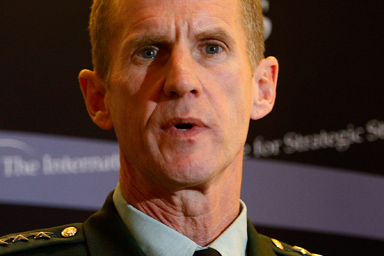
General Stanley McChrystal, Commander, US Forces Afghanistan delivers a speech in London, Thursday, Oct. 1, 2009. The war in Afghanistan poses two important questions: What should be done and who should be “the deciders”?
Congressional Republicans say the answer to the first query is military escalation. But according to polls, most Americans disagree. At the same time, many experts wonder “whether or not we know what we’re doing,” as President George W. Bush’s former deputy national security advisor said last week.
One thing’s for sure: The U.S. commander in Afghanistan, Gen. Stanley McChrystal, says he wants more troops. His new memo calling for a bigger Afghanistan deployment prompted President Obama to begin carefully considering different ways forward — and Washington to hammer the White House for entertaining any alternative to McChrystal’s request.
Republicans lambasted Obama for letting “political motivations … override the needs of our commanders,” as Sen. Kit Bond, R-Mo., said. Likewise, the Washington Post insisted that Obama’s failure to promptly back McChrystal’s surge proposal could “dishonor” America, while the New York Times said no matter what the president wants, “It will be very hard to say no to General McChrystal.”
The coordinated assault sharpens that question about who “the deciders” should be — elected officials or the military?
The Washington establishment clearly believes the latter, and that’s no surprise. The war-mongering political class has called for presidential and congressional deference to military demands since Hollywood movies and anti-communist ideologues began countering the public’s “Vietnam Syndrome” by blaming that quagmire in Southeast Asia on elected officials. In the purest articulation of the argument, Ronald Reagan asserted in 1980 that Vietnam was lost not because of flaws in mission or strategy, but because politicians allegedly forced soldiers to fight “a war our government (was) afraid to let them win.”
Avoiding another Vietnam, says this school of thought, requires a figurehead government — one that delegates all military decision-making power to generals and effectively strips it from elected civilians who will supposedly be too “politically motivated” (read: influenced by voters). This authoritarian ideology explains not only today’s vitriolic reaction to the president’s Afghanistan deliberations (including the conservative magazine Newsmax fantasizing about a military “coup” to “resolve the Obama problem”) but also some of the most anti-democratic statements ever uttered by American leaders. It explains, for instance, Vice President Dick Cheney’s assertion that public opinion “doesn’t matter” when it comes to military policy, and President Bush saying Iraq “troop levels will be decided by our commanders on the ground, not by political figures in Washington.”
Of course, the Constitution deliberately gives “political figures in Washington” final say: Article I empowers Congress to declare and finance wars; and Article II states that while the White House “may require the opinion” of military officers, ultimately “the President shall be Commander in Chief.”
Those provisions were no accident. By separating political from military power, and vesting our elected representatives with ultimate authority, the Founders purposely constructed a democracy that seeks to prevent the dictatorial juntas that often arise when no such separation exists.
In that way, the Constitution doesn’t worry about elected officials’ “political motivations” as Sen. Bond does, nor does it fret about “a disconnect … between the military leadership and the White House,” as Sen. John McCain, R-Ariz., lamented. It views “political motivations” and a “disconnect” as democratic forces guaranteeing that public opinion, via elected “deciders,” is somewhat involved in military policy.
Certainly, Obama and Democratic congressional leaders may still end up defying public will by making the lamentable choice to escalate the Afghanistan war. But after recent quagmires justified by knee-jerk subservience to military prerogative, America should at least applaud these lawmakers for refusing to immediately rubber-stamp that course of action. In exploring all options, they are honoring the Constitution’s separation of powers — and our nation’s most democratic principles.
© 2009 Creators.com
David Sirota is a best-selling author of the new book "Back to Our Future: How the 1980s Explain the World We Live In Now." He hosts the morning show on AM760 in Colorado. E-mail him at ds@davidsirota.com, follow him on Twitter @davidsirota or visit his website at www.davidsirota.com. More David Sirota.
Memorial Day’s lessons in amnesia
If nothing else, the holiday allows us to reflect on our commitment to forgetting bloody conflicts
(Credit: Carly Rose Hennigan via Shutterstock) It’s the saddest reading around: the little announcements that dribble out of the Pentagon every day or two — those terse, relatively uninformative death notices: rank; name; age; small town, suburb, or second-level city of origin; means of death (“small arms fire,” “improvised explosive device,” “the result of gunshot wounds inflicted by an individual wearing an Afghan National Army uniform,” or sometimes something vaguer like “while conducting combat operations,” “supporting Operation Enduring Freedom,” or simply no explanation at all); and the unit the dead soldier belonged to. They are seldom 100 words, even with the usual opening line: “The Department of Defense announced today the death of a soldier who was supporting Operation Enduring Freedom.” Sometimes they include more than one death.
Continue Reading CloseTom Engelhardt, co-founder of the American Empire Project, runs the Nation Institute's TomDispatch.com. His latest book, "The United States of Fear" (Haymarket Books), has just been published. More Tom Engelhardt.
Where the wounded are
Wars don't just cause casualties among soldiers, they drain medical staff. I traveled to see the costs firsthand
A soldier is prepared for an operation at Landstuhl Regional Medical Center. (Credit: Reuters/Kai Pfaffenbach) The weather’s getting warmer in Afghanistan and the war there is heating up again. That means – as it has meant every year for more than a decade — that the pace will quicken at the Landstuhl Regional Medical Center in Germany. More casualties will be brought to this largest American military hospital outside the United States. The Critical Care Air Transport teams and their C-17 Globemasters will fly in from “downrange,” as they call the Afghan battleground, and the injured will be brought by ambulance bus from nearby Ramstein Air Force Base to the hospital front door.
Continue Reading CloseMichael Winship is senior writing fellow at Demos and a senior writer of the new series, Moyers & Company, airing on public television. More Michael Winship.
NATO invites Pakistan to summit
A sign that Islamabad is ready to reopen its western border to NATO troops on their way to Afghanistan
Oil tankers, which were used to transport NATO fuel supplies to Afghanistan, are parked at a compound in Karachi, Pakistan, Tuesday, May 15, 2012. NATO on Tuesday invited Pakistani President Asif Ali Zardari to the alliance's summit in Chicago, after signs that the country could be moving to reopen its Afghan border to NATO military supplies. (AP Photo/Shakil Adil)(Credit: AP) ISLAMABAD (AP) — NATO on Tuesday invited Pakistan’s president to the upcoming Chicago summit on Afghanistan, the strongest sign yet that Islamabad is ready to reopen its western border to U.S. and NATO military supplies heading to the war in the neighboring country.
Pakistan blocked the routes in November after American airstrikes killed 24 of its troops on the Afghan border. The attack sent ties between Washington and Islamabad to new lows, threatening regional cooperation needed for negotiating an end to the Afghan war.
Continue Reading CloseAfghanistan, I can’t quit you
My mom pushed me to join the Marines. Now that she's gone, I'm still drawn to war zones
A child flies a kite in Kabul on Tuesday Mar. 27, 2012. (Credit: Geoffrey Ingersoll) The heat. That’s what I remember most. Shimmery and bright. Blinding. Stifling. Heeee-eeaat.
The kind that’s not just on you, wrapped around you, but balled up and pulsing inside you — a desert blanket with teeth. It’s a type of heat that makes your skin cry and your eyeballs sweat, even in the shade; heat like a predator you can’t run away from.
I notice it right as I get off the plane — not just the degrees but also the dust. Dust you can smell, kicked up by a thousand years of struggle. In a region this old, I’m sure each breath carries a dose of unintended history: Inhale, Alexander the Great; exhale, the Ottoman Empire; inhale, the USSR; exhale, the Taliban.
Continue Reading CloseGeoffrey Ingersoll is a freelance journalist, documentarian, writer, photographer, and veteran of Operation Iraqi Freedom. He is the recipient of the Sam Stavisky Award for Combat Reporting. More Geoffrey Ingersoll.
What Obama didn’t mention in Kabul
Just outside the Afghan capital, the Taliban is in control and preparing for a wider war
President Barack Obama addresses troops at Bagram Air Field, Afghanistan, Wednesday, May 2, 2012. (AP Photo/Charles Dharapak)(Credit: AP) MAHMUD RAQI, Afghanistan — The office of Kapisa’s governor sits high on a hilltop overlooking the provincial capital, Mahmud Raqi. It has a beautiful view of the river below and the mountains, trees and fields that stretch into the distance.
Beneath the tranquil surface, however, lies a grim truth. Just outside town roadside bombs are planted to target NATO convoys.
Page 1 of 122 in Afghanistan