
Salon Home
Topic

Parenting

Monday, Dec 7, 2009 4:08 PM UTC2009-12-07T16:08:00Zl, M j, Y g:i A T

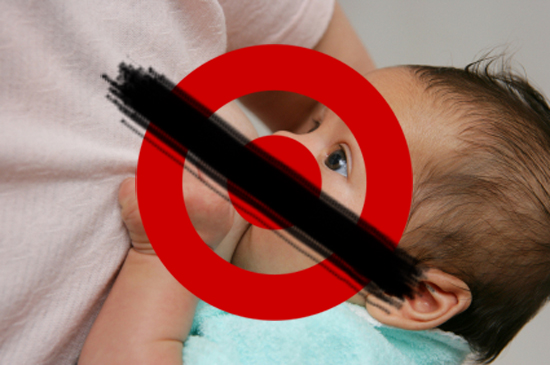
Target calls cops on nursing mother

Security guards at a Michigan store tell a woman that feeding her baby in public is illegal

Target calls cops on nursing mother

While Mary Martinez was shopping in a Target store in Harper Woods, Mich., recently, her 4-week-old baby got hungry. And because some people still haven’t gotten it through their heads that women often use their own breasts to feed hungry babies, a security guard who saw her doing just that told her she had to leave because she was breaking the law. Which she was not. Target mistake No. 1.

When Martinez and her husband, Jose — a police officer who knew full well his wife wasn’t doing anything illegal — refused to leave, the security guard called the cops. Target mistake No. 2. Although the local officers who arrived confirmed that it is not against the law to breast-feed in public in Harper Woods, Mary Martinez says she felt humiliated and forced out of the store anyway. “Two security guards, the manager or team leader, two officers, they just made a spectacle and a scene. I feel like I can’t go to that specific Target anymore.”

Continue Reading

Kate Harding is the co-author of "Lessons From the Fatosphere: Quit Dieting and Declare a Truce With Your Body" and has been a regular contributor to Salon's Broadsheet.   More Kate Harding

Thursday, Jan 26, 2012 12:15 AM UTC2012-01-26T00:15:00Zl, M j, Y g:i A T

Stop diagnosing my son

When we adopted Jake at 7, we waited years before letting a psychologist label him. Others haven't been so kind

diagnosed_boy

 (Credit: Shutterstock)

“Sounds like your son has Asperger’s syndrome,” she said. “Have you ever thought of that?”

I looked back at my son, hanging upside down on the monkey bars. “Sounds like you have Asshole syndrome,” I said. “Have you ever thought of that?”

In my head, I said that. What I said out loud was something like, “We think he’s just Jake, and that’s good enough for us.”

“Well, he might have Asperger’s,” she pursued. “And you should have him tested.”

“Well, you might be a bitch,” I said, in my head. “Is there a test for that?”

Continue Reading

Debra Hanlon is a former high school English teacher and community college composition and literature instructor, now a home-school mom. She lives in northern Illinois with her husband, her son and their five German shepherds. Her occasional blog is LifeItIs.org—Insights and Incidents.  More Debra Hanlon

Monday, Jan 16, 2012 5:00 PM UTC2012-01-16T17:00:00Zl, M j, Y g:i A T

Get used to living with Mom and Dad

The era of empty nests may be over unless we change our work culture and our economy. An expert explains

It’s a growing trend: More and more adults are living with their parents. According to the Census Bureau, the number of 25- to 34-year-old adults in the U.S. living at home rose from 14 percent in 2005 to 19 percent in 2011. The trend is present in other developed countries across the globe too: In Italy, 37 percent of men 30 years of age and older have never left home; in Japan, men living under their parents’ care are pushing their 40s. Such individuals are easily disparaged as lazy, overgrown babies, content to mooch off their aging parents rather than strike it out on their own. (Remember all those biting jokes Archie Bunker would throw to his “meathead” of a son-in-law.) But are they really?

Continue Reading

  More Alice Karekezi

Monday, Jan 16, 2012 1:00 AM UTC2012-01-16T01:00:00Zl, M j, Y g:i A T

Attachment parenting dropout

I was eager to be a crunchy mom who swaddled her baby and breastfed. But even I couldn't take this much sanctimony

Mother with baby

 (Credit: Elena Rostunova via Shutterstock)

I’m a crunchy person up to a point. I trek to the farmers market every weekend to fill up my recycled-plastic shopping bags with kale and purple cauliflower, but I’ve never made my own reusable fabric toilet paper squares. I’ve sworn off disposable plastic water bottles, but I periodically take my compact fuel-efficient car through the McDonald’s drive-thru for a Snickers McFlurry.

When my daughter was born, I decided I’d be the kind of mother who emphasized bonding and nurturing touch over schedules and order. I pored over attachment parenting manuals and message boards. Versed in the lingo of my new way of parenting, I set out to find like-minded mom friends, the kind of ladies who knew the virtues of calendula.

Continue Reading

JJ Keith lives in Hollywood, CA with her husband and two toddlers. She's a freelance writer and blogger, and is working on a memoir, "Behind the Green Apron," about being a disgruntled, underemployed barista to the stars.  More JJ Keith

Sunday, Jan 15, 2012 2:00 PM UTC2012-01-15T14:00:00Zl, M j, Y g:i A T

The science of getting along

Research shows that our first years of life shape our ability to play well with others. Here's how

baby_cooperation

 (Credit: hxdbzxy via Shutterstock)

This article is excerpted from the new book "Together: The Rituals, Pleasures and Politics of Cooperation," from Yale University Press.

I’m sure every parent could tell a distinctive story about how their children grew. You might well observe, whatever your own views about children, that learning to cooperate is not easy. That very difficulty is, in a way, positive; cooperation becomes an earned experience rather than just thoughtless sharing. As in any other realm of life, we prize what we have struggled to achieve.

The child psychologist Alison Gopnik observes that the human infant lives in a very fluid state of becoming; astonishingly rapid changes in perception and sensation occur in the early years of human development, and these shape our capacity to cooperate. Buried in all of us is the infantile experience of relating and connecting to the adults who took care of us; as babies we had to learn how to work with them in order to survive. These infant experiments with cooperation are akin to a rehearsal, as infants try out various possibilities about getting along with parents and peers. Genetic patterning provides a guide, but human infants (like all young primates) also investigate, experiment with and improve their own behaviour.

Continue Reading

Richard Sennett's works include "The Craftsman," "Respect," "The Fall of Public Man" and "The Corrosion of Character." He taught for many years at the New York Institute of the Humanities and also at the London School of Economics where he is emeritus professor of sociology. He is now a Distinguished Visiting Scholar at the University of Cambridge.   More Richard Sennett

Thursday, Jan 12, 2012 4:40 PM UTC2012-01-12T16:40:00Zl, M j, Y g:i A T

The war on only children

Smaller families are becoming the norm. So why are we still so quick to judge people without siblings?

Stop dissing only children

 (Credit: amok.lv via Shutterstock)

Topics:

I was making small talk with a woman I’d just met when the inevitable subject of family came up. “Do you have any brothers and sisters?” she’d asked. “No,” I’d replied. And there it was: the subtle change in her expression, the quick reassessment, the pinched face I’ve seen a thousand times before. “Well, that must have been nice for you,” she replied. “You must have been so spoiled.”

It’s one of the standard responses we “onlies” get — near strangers denigrating us because of our parents’ reproductive habits. Nobody ever says, “Youngest of four? So you’re really immature, right?” or “You’re a twin? Wow, you must be a total dick.” But I didn’t answer, “Yeah, after my dad left my 21-year-old mom when she was pregnant with me, you can imagine what a cosseted, pampered existence this princess had.” That’s because I didn’t want to get the other classic reaction: unbridled pity for my no doubt sad, lonely existence. Hi, what year is this?

Continue Reading
Mary Elizabeth Williams

Mary Elizabeth Williams is a staff writer for Salon and the author of "Gimme Shelter: My Three Years Searching for the American Dream." Follow her on Twitter: @embeedubMore Mary Elizabeth Williams

Page 1 of 38 in Parenting

Other News