
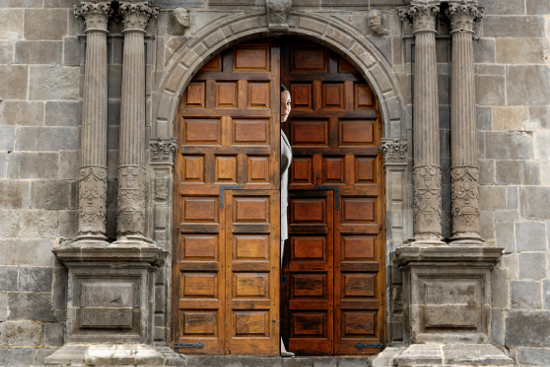

It was Sunday morning in my scruffy Brooklyn, N.Y., neighborhood, and I was wearing a dress. Walking to the subway, I ran into a friend heading home from yoga class. She wore sweats and carried her mat over her shoulder. “Where are you going so early all dressed up?” she asked, chuckling. “To church?” We shared a laugh at the absurdity of a liberal New Yorker heading off to worship.
The real joke? I totally was.
Inside the church, it’s cool and quiet. I read the Collect of the day in the Book of Common Prayer, which urges us: “While we are placed among things that are passing away, to hold fast to those that shall endure.” My recent layoff no longer seems like the end of the world. I take Communion and exchange the peace and listen to the sermon. As I’m walking back up the aisle, I feel reoriented and calmer, the indignities of the week shift into perspective.
These moments are not only sacred; they are secret. Outside, on the steps of the downtown Manhattan church, I think I see someone familiar coming down the sidewalk, and I bolt in the other direction.
Why am I so paranoid? I’m not cheating on my husband, committing crimes or doing drugs. But those are battles my cosmopolitan, progressive friends would understand. Many of them had to come out — as gay, as alcoholics, as artists in places where art was not valued. To them, my situation is far more sinister: I am the bane of their youth, the boogeyman of their politics, the very thing they left their small towns to escape. I am a Christian.
I certainly wasn’t born one. I was raised bohemian in New York’s East Village in the ’80s. I was fascinated by religions but also baffled by them. (If anything, I assumed I was Jewish.) When I began traveling around the world alone at 18, I longed for a religious experience, something that would inspire me to cast my lot with a denomination the way you choose a political party. But nothing really clicked.
I got a taste of the divine at Hindu shrines in south India, and when Mother Teresa grabbed my head and blessed me while I was working for her ministry in Calcutta I felt a kind of electricity rush through my body. Later, when I almost died from amoebic dysentery in New Delhi, I did hallucinate that the Jesus poster on the wall of the clinic moved. But these experiences were no more formative than the Tolstoy books I read on those 24-hour train trips across India.
In college, I majored in Sanskrit and translated part of the Atharvaveda for my senior thesis. I studied Jewish history, Zen and Hinduism with equal interest. The closest thing to my religious sensibility back then was either Pure Land Buddhism (“the world is emptiness … and yet”) or Gnosticism (though my penchant for makeouts kept me from achieving their level of physical self-denial).
When I hit my early 20s I found existential gratification in that feeling at the end of the night, drunk and awake and looking out into the rain while the bar closed and not knowing what was going to happen next. I worshiped at the altar of the Replacements and had romances that only made sense in the context of a Paul Westerberg song. I felt closest to figuring things out when I drank too much coffee and smoked too many cigarettes and stayed up too late.
Sometime later I got married, and the priest with whom my husband and I did premarital counseling had firsthand experience of closing bars, but he also was smart and eloquent and fulfilled. He showed me the best side of Christianity. Not how it’s right or just, but how — and this may sound stupid, but it’s what I think about religion in general — it works.
All of us need help with birth and death and good and evil, and religion can give us that. It doesn’t solve problems. It reminds you that, yes, those challenges are real and important and folks throughout history have struggled and thought about them too, and by the way, here is some profound writing on the subject from people whose whole job is to think about this stuff.
The idea of an eternal community brings me comfort: I like the image of a long table extending backward and forward in time, and everyone who’s ever taken Communion is sitting at it. The Bible at the 1920s stone church where my husband and I were married was filled with the names of people in the community who’d married, been born and died. When my son was baptized in our church in a traditional Easter eve service, the light spreading from candle to candle through the pews of the dark church made me feel, at least for one moment, we were united in a sense of gratitude for new life and awe in the face of the numinous.
Oh, I don’t know. Unless you’re William James or Saint Catherine of Siena it’s hard to talk about any of this without sounding dumb, or like a zealot, or ridiculous. And who wants to be lumped in with all the other Christians, especially the ones you see on TV protesting gay marriage, giving money to charlatans, and letting priests molest children? Andy Warhol went to mass every Sunday, but not even his closest friends knew he was a devout Catholic until his death. I get that.
“[Closeted Christianity] definitely exists in Manhattan, some Democratic corners in Washington, and I’d bet parts of Northern California,” says Amy Sullivan, author of “The Party Faithful: How and Why Democrats Are Closing the God Gap.” Sullivan says after her book about the Christian left came out, “colleagues in New York were taking me out for these clandestine lunches and leaning across the table and whispering excitedly, ‘Pssst! I’m one of them!'”
The Panel Study of American Religion and Ethnicity asked people how they felt about those outside their close friends and family knowing they were religious. About 2 percent said they didn’t want people to know, and that percentage is higher among people with liberal politics and people, like me, who are part of Generation X.
Barry Kosmin at the Institute for the Study of Secularism in Society and Culture at Trinity College says it’s ridiculous that, in a city like New York, where there is a church on every corner, anyone would hide their religion. He says he was at a conference in Seattle recently where atheists complained about having to hide their lack of beliefs. “Everyone’s paranoid!” he says.
But if you’re in a place like New York City — or Austin, Texas, or Portland, Ore., or Los Angeles — the “new atheists” surround you. In October 2009, the atheist organization Big Apple Coalition of Reason (COR) started a poster campaign to celebrate non-belief. “A million New Yorkers are good without God. Are you?” reads one such poster. A similar campaign in London led by the bestselling author Richard Dawkins reads, “There’s probably no God. Now stop worrying and enjoy your life.”
Writers like Dawkins, Daniel Dennett, Sam Harris, Christopher Hitchens and Victor J. Stenger — and, of course, performers like Bill Maher — get loads of press mocking the dummies gullible enough to believe some guy a couple thousand years ago was God’s son. But come on. It’s like shooting Christian fish car magnets in a barrel.
I’ll give the atheists a lot: The Creation Museum is a riot. The psychos shooting up abortion clinics and telling gay couples they’re going to hell are evil, and anyone of faith has an obligation to condemn them. Abominable stuff has been done in God’s name for centuries. The Bible has a lot of crazy shit in it about stoning people for using the wrong salad fork. Up with science and reason!
And yet, atheists are at least as fundamentalist and zealous as any religious people I know, and they have nothing good to show for it: no stained glass, no great literature, no great art, no comfort in the face of death. Just dissipated Christopher Hitchens sounding off on “Larry King Live” and a stack of smug books with childishly provocative titles.
A lot of my best friends are atheists, and there’s no reason they wouldn’t be. They find what I get from religion elsewhere, like from music and art. Not long ago, I told a priest at my church that my friends equated religion with horrible things. I expected her to tell me I had some obligation to stop hiding my faith, but she said, pulling a scarf around her neck to hide her priest’s collar, “Those preachers on the subways make me cringe.” She said she prefers Saint Francis: “Preach the gospel at all times. If necessary, use words.”
I could reassure my atheist friends that the Episcopal Church is a force for equality and social justice. It ordained its first gay bishop, Gene Robinson, in 2003. It takes the Bible as a mandate to fight hunger and disease and to rebuild after disasters. I believe that the Church of Jesus Christ of Latter-day Saints and other politically involved religious groups who take the gospel as an excuse to spread hate and support specific candidates and propositions should have their tax-free status taken away.
Maybe, though, apolitical Christianity is on the rise. The Obamas are now in office — a good Christian family in the truest sense of the term — and the right wing is more marginalized than it was a year ago. My friend, the young (and kind of ridiculously hot) priest the Rev. Astrid Storm, whom I used to edit at Nerve.com, says she’s sensing more acceptance:
“When I said I was a priest, it was always a conversation stopper,” she says. “Recently someone asked what I did, and when I told him he said, ‘How interesting. There are a lot of exciting things happening right now in the Episcopal Church, aren’t there?’ The diversity of opinion people are reading about in the news — about gay marriage, female priests, poverty issues — are showing how Christianity isn’t monolithic.”
Christianity in the popular imagination is decreasingly linked with evangelicals, agrees John Spalding, founder of the SoMa Review, so it’s freed up people who were once embarrassed to self-identify as Christians. “It’s no longer like, ‘You’re just like Pat Robertson. Leave this dinner party,'” Spalding says.
But faith and religion are hard to talk about; maybe they’re not necessary to talk about. Even though I am a feminist, I’ve always had a problem with the personal being political. It gave me a lot of anxiety back in the ’90s. If I enjoyed a book with a titillating rape scene in it, did that mean I should be stripped of my membership in the Women’s Action Coalition? If I liked wearing Blackberry Revlon lipstick and an off-the-shoulder shirt, was I a tool of the patriarchy?
And now, too, I wonder: When I go to church, am I liable for every monstrous thing every denomination has ever done in the name of Jesus? Am I allowed to get spiritual fulfillment from something that has been, and continues to be, so disastrously invoked by other people? Am I allowed to just go to church sometimes and read the Bible sometimes without wearing a huge cross necklace and checking an official box on forms?
But also, increasingly, I wonder: When I’m getting a ride from some friends and they start talking about how stupid religious people are and quoting lines from “Religulous,” do I have an obligation to point out how reductive and bigoted they’re being, the way I would if they were talking about a particular race? Increasingly I wonder if I should pipe up from the back seat and say, “Excuse me, but these fools you’re talking about? I’m one of them.”
