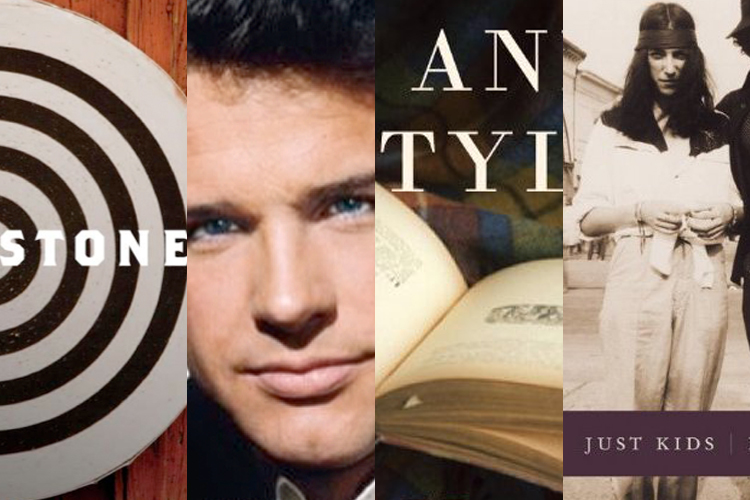
Books to watch out for

January books: DNA, drugs and Patti Smith

A reader's checklist for the first month of 2010

  • more
    • All Share Services

January books: DNA, drugs and Patti Smith

Compiled by Salon staff, a short list of  upcoming works to keep your eye on.

Nonfiction

  • Just Kids by Patti Smith
    The music legend about bohemian life in New York City in the ’60s — and her friendship with Robert Mapplethorpe.

Fiction

  • Noah’s Compass by Anne Tyler
    The author of “The Accidental Tourist” writes about a retired teacher and father of three grown daughters as he contemplates the end of his life.

“The Rogue” embodies the art of the hatchet job

Joe McGinniss' new book gives Palin critics new ammunition, but also helps deepen the image of her as media victim

  • more
    • All Share Services

Describing the moment when he rented a house next door to Sarah and Todd Palin, Joe McGinniss writes how in “forty years in the business … I’ve never had a piece of luck like this.” But good books require more than a lucky break. “The Rogue: Searching for the Real Sarah Palin,” officially released on Tuesday, has already received a fair bit of media attention. But its claims — Palin snorted cocaine, has a subpar sex life and tramples on any foe in her path – actually arrive at a moment of limbo in Sarah Palin’s political career. It’s difficult to imagine how she will ever again hold elected office. She long ago left the governor’s chair and has so far sidestepped the GOP’s once wide-open presidential primary race. Michele Bachmann and Rick Perry have largely replaced her in the pantheon of Tea Party heroes.

Increasingly defined as a media sensation rather than a political insurgent, Palin will likely continue to exploit her celebrity status; she will rake in millions of dollars while keeping herself and her family in the public eye.

Enter “The Rogue,” which may well help Palin in her new career path. It’s been well chronicled how McGinniss’ book is laced with anonymous sources and numerous allegations of sex, drugs and other bad behavior on the part of the Palins. These charges — salacious though they are — don’t necessarily make the book all that newsworthy. What’s most notable about “The Rogue” is that in its claims, its use of sources and in its broader concerns, it stands alongside a generation of exposé books that have sought to cast particularly controversial national politicians as the ultimate hypocrites and as monstrous frauds.

Such exposés, woven into the democratic fabric, are traceable to the nation’s founding. One pamphlet charged that Treasury Secretary Alexander Hamilton had had an affair with Maria Reynolds — a charge that ultimately led to the duel in which Aaron Burr shot and killed Hamilton. In the early Republic, historian Mark Feldstein has written, enemies used “the media as an instrument of political warfare.”

In his book “Poisoning the Press,” about columnist Jack Anderson and Richard Nixon, Feldstein reminds us that “venomous editors [also] savaged Jefferson with … bile.” “One newspaper claimed that the Chief Executive kept ‘as his concubine, one of his slaves’ and with ‘this wench Sally, our president has had several children.’” While “predatory politics and merciless media” faded in the 19th century, Feldstein argues that it “returned with a vengeance” in the mid-to-late 20th century.

McGinniss’ book suggests that that era is still ascendant, and “The Rogue” can be understood as the latest addition to a lengthy list of scandal books, ‘”sex-posés” (Feldstein’s term), and vituperative takedowns of marginal and major politicians alike. Moreover, these books — far from being tossed into the dustbin — have an impact. They shape politicians’ public images, frame debates about whether somebody is fit for national office, and fuel already simmering battles that pit the politician’s defenders against his or her equally committed and ferocious foes.

Virtually every first couple in modern times has confronted some form of McGinniss-like exposé during their time in the nation’s spotlight. Kitty Kelley’s 1991 “unauthorized biography” of former first lady Nancy Reagan charged that she was having sex with Frank Sinatra when Ronald Reagan was governor of California. Her book didn’t fade away quickly, either; instead, People magazine announced in a headline that both “sources and victims” were warring over the allegations featured in Kelley’s takedown. And at the same time, Maureen Dowd pointed out in the New York Times that this “new book … by Kitty Kelley, could … add allegations of scandalous sexual behavior to the folklore of the Reagan era.”

Kelley’s book was actually milder than the invective that the Clintons soon had to endure. And the attacks on the Clintons rather effortlessly slipped into the popular discourse. As pundits chatted about allegations against Clinton, the charges often drew mainstream news coverage.

In “Partners in Power: The Clintons and Their America,” Nixon’s former national security aide Roger Morris linked the Clintons to such things as “drug money and organized crime.” His book relied on anonymous sources and tarnished the Clintons with sexual among other moral and legal transgressions.

“All sorts of scandalous and criminal things are alleged and believed about Clinton by his enemies,” journalist Martin Walker said in a piece about Morris’ book. “An almost Manichean standoff between the loathers and the loyalists” had sunk roots in American politics; “Clinton seems to inspire this kind of antagonistic intensity, and all books about him seem condemned to fuel it.”

The industry of books about Palin — pro and con — not to mention the documentaries and commentary, reflects a similarly Manichean struggle over who she is and what she represents. And, of course, when the Clintons were the topic, the scandal-mongering skyrocketed. One-time New York Times Magazine editor Edward Klein accused Hillary Clinton of lesbianism in his takedown of her life. He charged that her sexual tendencies had pervaded her public positions as well. “The culture of lesbianism has influenced Hillary’s political goals and personal life since she was a student at Wellesley,” he asserted.

President Barack Obama has endured his share of innuendo, conspiratorial charges and other byzantine accusations, as well. The Swift Boat Veterans for Truth leader Jerome Corsi is among those who have written, for instance, that Obama’s birth certificate was fraudulent so he was never actually eligible for the White House. (McGinniss writes toward the end of his book that there remained “one unanswered question … Trig. Is he really Sarah’s child?” Conspiracies surface in almost all of these books.)

Money — to state the obvious — is one factor behind such books; the books often become major bestsellers. Partisans also play a role. Critics often use the morsels included in these books as clubs for bashing their enemies; in the meantime, the politicians’ defenders hype the books, often unwittingly, by decrying publication as proof of their enemies’ ruthlessness. The response from authors and the authors’ supporters is that political hypocrisy on the part of the politician justifies the focus on personal misdeeds. Klein, for instance, claims on his website that his book “exposes the truth” about Hillary Clinton’s hidden sexual activities.

Similarly, McGinniss explained in an interview that “What makes some of the things about [Palin's] personal life relevant” is that her image “has very little to do with who she really is.” The carefully cultivated impression of a “grizzly-mama” who is pro-family values “turns out not to be true.” Palin has so manipulated her image — so assiduously covered up her true self — that her efforts surpass even Richard Nixon’s evasions. McGinniss, author of “The Selling of the President,” about Richard Nixon’s 1968 campaign, regards Palin as more duplicitous than Nixon ever was.

The exposé authors, therefore, claim that politicians who lie to the public about who they are deserve to be exposed. Their personal lives become fair game and the norms and obligations that most reporters adhere to fall by the wayside in the search for the “real Palin” or the “real Obama.”

Like its predecessors, McGinniss’ “The Rogue” is likely to have at least some impact on Palin’s image and the debate about her role in American life. The back-and-forth between McGinniss and the Palins has created a carnival-like atmosphere surrounding the book’s publication. Palin posted on Facebook that McGinniss was using his perch to peer into her 9-year-old daughter’s bedroom. McGinniss responds that this ludicrous charge showed just how vicious Palin could be. Todd Palin gleefully trumpets negative reviews of “The Rogue.” McGinniss, for his part, accuses the Palins of fanning “fear” and using intimidation to silence their critics.

While “The Rogue” gives Palin’s critics new ammunition, Palin’s defenders have used, and will continue to use, the book as proof that her enemies will not stop in their single-minded quest to destroy Palin. Thus, a book like “The Rogue” actually helps the former governor, deepens the image of her as a media victim, lending the veneer of credence to her charge that enemies are out to tarnish her reputation at any price.

It’s improbable that Palin will mount a serious run for national office any time soon. But the publication of “The Rogue” suggests that she’ll continue to draw a crowd, as surely as a circus does. And Joe McGinniss” book will help her fill the seats. 

Continue Reading Close

Right-winger foresees end of America

But Mark Steyn's shoddy evidence, confused logic and witty style say more about the conservative psyche

  • more
    • All Share Services

Right-winger foresees end of AmericaMark Steyn

In his new book, “After America: Get Ready for Armageddon,” conservative provocateur Mark Steyn takes direct aim at the dogma of “American exceptionalism,” an ideological framework that now plays a role in American conservatism roughly equivalent to that which Marxism-Leninism played in the Soviet Union (everything that happens supports it, and nothing that happens can disprove it). Refreshingly, Steyn evidences little patience for the idea that America is unique in some fundamental and eternal sense. As he writes in the introduction:

“The United States joined the rest of the cosseted Western world in voting itself a lifestyle it was not willing to pay for … the ‘bubble’ is not the property market or cheap credit. The bubble is twenty-first century America itself, from the financial sector to a wretched education system culminating in languorous, undemanding ‘college’ courses whose absurd soaraway prices were affected not a jot by the economic downturn.”

Indeed, if Steyn’s book has a unifying theme amid its many digressions and tangents, it’s that America, due to pervasive mismanagement and fecklessness, is headed for a major decline in power and influence. Compared to some of the magical thinking about America’s role in the world that characterizes today’s intellectual right — Charles Krauthammer, for example, once gave a speech whose thesis was that “decline is a choice” — Steyn’s is admirably realistic about America’s declining influence, and some of his predictions (he’ll surely be appalled to learn) actually mimic those of many leading progressives.

But the larger picture that Steyn paints is confused and internally inconsistent to such an extreme extent that it’s not clear he actually means any of “After America” to be taken seriously. Steyn, a prolific and witty writer, is a prime example of the extent to which contemporary conservative commentary generates negative value added.

“Negative value added” is a somewhat esoteric economic concept I became familiar with in graduate school. In the wake of the Soviet collapse, Boris Yeltsin and his advisors set out on a course of economic “shock therapy.” It was hoped that the moribund economy would be “shocked” back to life by the rapid introduction of market prices. However, since Soviet industrial firms had never operated in an environment of market prices and had instead received unaffordably lavish state subsidies, almost all of their manufacturing techniques were hopelessly inefficient. Some firms, in fact, were so epically mismanaged and horrifically uncompetitive that they generated negative value added; the sum total of their activity and efforts actually subtracted value from the raw materials they used as inputs.

So although his demolition of the claptrap of “American exceptionalism” is most welcome, Steyn’s parallel attempts to prove that “statism” is the source of all of the world’s problems (from increasing obesity to stagnating median wages) and that the Islamic world, particularly Iran, is ready to run roughshod over an effeminate and degenerate West, relies on such a tendentious and selective presentation of facts that it actually winds up subtracting from his readers’ understanding of what is actually going on in the world.

According to Steyn, Europe is in a demographic death spiral caused by statism and, at a deeper level, the loss of religious belief and “civilization confidence.” Iran, on the other hand, is on the fast track to becoming the dominant power in the Middle East.

Yes, in reality, in 2009, Iran’s fertility rate, which Steyn uses as a heuristic for a society’s overall health, was actually lower than that of Brazil (barely mentioned in “After America”), the United States (doomed, according to Steyn), France (even more doomed, according to Steyn), or the United Kingdom (which is well and truly f*****). If an Islamic revolution and the full-fledged implementation of hardcore Shariah enforced by “morality police” can’t keep Iran’s fertility rate from rapidly collapsing, perhaps the “problem” of declining fertility is actually better explained by the basic pressures of modernity than by the craven adoption of liberalism.

Consider the experience of Muslim countries like Morocco, Algeria and Tunisia. Despite not being “liberal” in any recognizable sense of the word (indeed, being almost the exact opposite of the coddling social-democratic “nanny states” that Steyn blames for the West’s decline), these countries all experienced sustained and rapid decrease in fertility over the past 20 years. Today, according to the CIA World Factbook, Tunisia and Algeria are below replacement rate (the number of children required to keep a population at a constant level) and several other Muslim-majority countries are right on the cusp. Steyn avoids the problems these facts present for his thesis through the simple and effective tactic of not mentioning them.

Steyn’s knowledge of demographics is remarkably confused. In the concluding chapter, for example, he argues that “much of America is now in need of an equivalent to … post-Soviet Eastern Europe’s economic liberalization in the early nineties.”

He seems unaware that fertility rates collapsed during Eastern Europe’s experiment with economic liberalization. Indeed, not a single post-communist Eastern European country has yet regained the level of fertility it had at the time of communism’s collapse:  Once again, Steyn avoids the problems this presents for his thesis by simply leaving it unmentioned.

What I take away from Steyn’s sincere but confused attempt at comparative demographics is the following: He confidently predicts the future supremacy of countries (Iran) that are doomed according to metrics of his own choosing (the total fertility rate) while simultaneously making policy prescriptions (radical economic liberalization) that, when implemented in other countries, have had the effect of exacerbating the trend (decreasing fertility) he’s attempting to reverse.

Steyn has a habit of rapidly alternating between reasonable observation and fact-free raving,  making it one of the more disorienting book I’ve ever read. To take one example among the dozens scattered throughout the book, let’s look at what Steyn has to say about the role of the “Anglosphere” during the Second World War:

The Usual rap against the Security Council is that it’s the Second World War victory parade preserved in aspic, but, if that were so, Canada would have a greater claim to a permanent seat than either France or China. The reason Ottawa didn’t make the cut is because a third anglophone nation and second realm of King George VI would have made too obvious a simple truth: that, when it mattered, the Anglosphere was the all but lone defender of civilization and liberty.

There is so much that is wrong with this paragraph it’s hard to know where to start. First of all, China started fighting the war in 1937, a full two years before the British Empire became involved, which means that the Chinese actually fought the longest of all the allied belligerents. Additionally, in comparison to the Canadians, the Chinese suffered casualties on an entirely different order of magnitude: Roughly 50,000 Canadian soldiers died in the war in comparison to somewhere between 3 million and 4 million Chinese soldiers and another 10 or so million civilians.

More important than the sheer number of casualties, though, was the fact that stubborn Chinese resistance and unrelenting guerrilla warfare forced the Japanese to keep massive quantities of men and materiel in China (at times more than half of the entire imperial army), forces that could otherwise have been used to attempt to stymie the Americans and resulted in far greater losses. To suggest that Canada deserved a seat on the postwar Security Council more than China is not a serious argument, and can only be made with the, seemingly deliberate, omission of a number of important facts.

Steyn presents a depressing account of the steady erosion of American liberty that keeps a laser-like focus on the petty indignities of modern life. Is it ideal that in 21st century America you need to get a large number of permits before opening a small business? No, I suppose it’s not. Some licensing and regulatory requirements make no rational sense. But you know what’s a lot worse than waiting in line at city hall for permits? Being exposed to pervasive terrorism and mob violence, while simultaneously and systematically being excluded from all public institutions, simply because of the color of your skin. That was the lived reality of tens of millions of African-Americans over the course of many decades. The abolition of Jim Crow is just one of the massive and noteworthy advances for human freedom and dignity that are entirely and utterly absent from Steyn’s account.

The rapid and commendable progress achieved by women, gays and minorities has no place in “After America” because of Steyn’s quite remarkable ability to ignore the perspectives of the various “others” who haunt the pages of his book. Consider his pithy formulation:

“After the slaughter of 9/11, the civilized world fought back, hit hard, went on the attack, rolled up the Afghan terrorist camps, toppled the Taliban. In the battle cry of a soon forgotten man called Todd Beamer, ‘Let’s roll!’

After the Danish Cartoons, we weaseled and equivocated and appeased and apologized, and signaled that we were willing to trade core Western values for a quiet life. Let’s roll over! It’s a lot less effort.”

The Danish cartoon controversy took place early in the fall of 2005. During the next six years, supposedly a period of rank appeasement and cowardice, the United States continued to militarily occupy two Muslim countries it had recently invaded (Iraq and Afghanistan), bombed four others (Somalia, Libya, Pakistan and Yemen), placed “crippling” economic sanctions on yet another (Iran), and ran a worldwide torture regime in close cooperation with the intelligence services of various “pro-Western” dictators such as the reviled, and now deposed, Hosni Mubarak, Moammar Gadhafi and Zine El Abidine Ben Ali.

Steyn simply doesn’t even attempt to rebut the rather obvious counterargument that the United States and its allies are detested by large number of Muslims not for their “freedom” but for their habit of militarily intervening in various Muslim countries and closely supporting unpopular pro-Western dictators.

Far from being a weakness, though, Steyn’s myopia is what makes him a far better weaver of narratives than many America conservatives. Steyn’s wit and pen are sharp, but it is his utter lack of interest in either doing justice to the alternate liberal explanation, or in placing his observations inside any sort of broader context, that gives his prose its power and rhythm.

Yet while it is an entertaining read, as a practical guide to understanding the world, “After America” is so tendentious and selective as to be value subtracting — people who read it will end up with an extremely distorted view of a number of important topics, and will imagine that “the government” is some sort of almost supernatural and constantly growing malevolent force.

However, as a window into the mind-set of the contemporary right (equal parts resentful, angry, confused and uninformed), it is invaluable. If you want to understand the viewpoint of those Americans — primarily, but not exclusively, older whites — who are angry with where the country is headed, you could do quite a lot worse than read this book. 

Continue Reading Close

Mark Adomanis is a consultant in Washington DC. In his spare time, he writes The Russia Hand blog at Forbes http://blogs.forbes.com/markadomanis/

Today’s must-see viral videos

Watch: Taylor Kitsch as John Carter (of Mars), a little girl gets a new TARDIS, and pet makeovers ... for people

  • more
    • All Share Services

Today's must-see viral videosTaylor Kitsch as John Carter of Mars, as shirtless as God intended.

1. “The Jerk,” revisited:

Ben Schwartz (from “Parks and Recreation”) and Zooey Deschanel (from “Yelling at the L.A. Times“) cover “Tonight You Belong to Me.”

 So who did it better? Steve Martin and Bernadette Peters, or these guys?

2. Doggie makeovers for people:

Last night’s sketch “We’ll Make You Look Like Your Pet“  on Comedy Central’s “Jon Benjamin Has a Van” is just further evidence of the comedian’s brilliance. Not that we needed any.


Jon Benjamin Has a Van


3. “John Carter” official trailer:

I guess since it’s the first one of a potential series, they’ve decided to leave out the part where our hero is “of Mars.” Man, Tim Riggins is really out of his element here. Clear eyes, full hearts, red planet.

“John Carter” comes out March 9, 2012, and I’d like to officially challenge Taylor Kitsch to remain shirtless until then as a promotion for the film.

4. Book trailer of “Humiliation”:

Critic Wayne Koestenbaum has managed to do the (nearly) impossible: make an on-topic, funny book trailer. His collection of letters (and subsequent advice) on “Humiliation” is sure to be a great read … but it’s even more fun to watch.

Check out the rest of the videos here.

5. The line between reality and “Doctor Who” gets a little more blurry:

Forgive me, but I totally thought the headline “The Internet replaces little girl’s stolen TARDIS” was going to lead to some kind of fake Onion video. The fact that it’s a real story makes it all the more magical. Good job, Internet.

But also? Bad job television anchor, who refers to “Doctor Who” as a movie. Unless she happens to be a super-fan of “Daleks’ Invasion Earth: 2150 A.D.

Continue Reading Close

Drew Grant is a staff writer for Salon. Follow her on Twitter at @videodrew.

Publisher pleads with fans: No spoilers for new George R.R. Martin book

The fifth novel for "A Song of Ice and Fire" is almost here, but concerns grow over early Internet leaks

  • more
    • All Share Services

Publisher pleads with fans: No spoilers for new George R.R. Martin bookDon't ruin George R.R. Martin's new book, fans!

 Fans of HBO’s “Game of Thrones” may be grumbling about having to wait a year until next season, but for the millions who read the books on which the show is based, that may seem like a very short time indeed. George R.R. Martin’s series “A Song of Ice and Fire” is a six-book fantasy series, but the fourth book came out in 2005 and there have been no releases since then. In the interim, fans have been getting kind of antsy, with many turning on Martin for taking so long to write the story.

Perhaps that’s why, with 14 days left until the fifth book finally arrives in stores, Martin’s publishers have made an official plea online to anyone in the U.K. who has an embargoed copy of “A Dance With Dragons” to refrain from posting any spoilers about the long-awaited tome. Also, they’d appreciate it if you stayed off of any unofficial “GRRM” sites, in case someone does decide to leak some crucial bit of information.

An excerpt from the post on Voyager Publishing’s website, titled “A Plea to George R.R. Martin fans“: 

And so, Voyager is asking you – if you can bear it – to avoid your favourite GRRM-related sites (except for George’s official site, and the Voyager site of course, where we will be screening comments as always) to ensure that the latest instalment of this epic story is not spoiled for you. You’ve got a remarkable journey ahead of you, and some stunning surprises, and nothing should come between you and that experience. The embargo is now being thoroughly enforced by all accounts and customers around the world to ensure that no more copies are sold early.

It seems odd to ask fans to stay away from message boards about their favorite series. Information is usually leaked one way or another in the entertainment industry (look at all the musicians whose albums have been put online before the release date!), and people will choose to click on it, or they won’t. Begging them to stay away from the communities that generate the most buzz about the upcoming book doesn’t just seem futile, but counterproductive as well.

Continue Reading Close

Drew Grant is a staff writer for Salon. Follow her on Twitter at @videodrew.

Samuel L. Jackson, Werner Herzog narrate “Go the F**k to Sleep”

Adam Mansbach's surprise children's lit hit gets two major Hollywood names reading his book

  • more
    • All Share Services

Samuel L. Jackson, Werner Herzog narrate Samuel L. Jackson knows where you can stick your bedtime story.

Yesterday we featured an interview with “Go the F**k to Sleep” author Adam Mansbach, who managed to make it to the New York Times bestseller list with a status update-turned-children’s book. Now we’re hearing word that acclaimed German director and actor Werner Herzog is getting ready to do an audiobook recording for Masbach’s hit, turning lines like “The flowers doze low in the meadows / And high on the mountains so steep. / My life is a failure, I’m a shitty-ass parent. / Stop fucking with me, please, and sleep,” into something much darker and treacherous than your normal “Curious George” story.

Then again, a Herzog impersonator has been doing children’s book readings on the Internet for over a year now, including “Winnie the Pooh” and “Where’s Waldo.” Having the actual Herzog read “Go the F**k to Sleep” could hardly be an improvement on the parodies, but it’s exciting nonetheless.

Especially since “Go the F**k to Sleep” already has one famous name attached to the audio recordings: Samuel L. Jackson’s. Check out the full version below. (NSFW language, obviously.)

Jackson said he was anxious to do the audiobook because he used to tell his own daughter to “go the f**k to sleep” when she was growing up.

Charming.

Continue Reading Close

Drew Grant is a staff writer for Salon. Follow her on Twitter at @videodrew.

Page 1 of 3 in Books to watch out for