
Tom Schaller: Welcome to Salon Conversations.
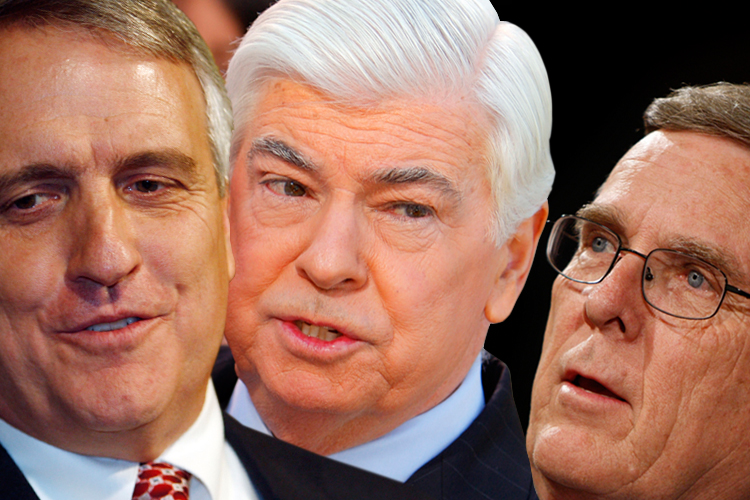
In the wake of the back-to-back-to-back announced retirements of Sens. Byron Dorgan and Chris Dodd, and Gov. Bill Ritter of Colorado — all Democrats — we’ve asked some of the country’s top electoral analysts to talk about what the political environment looks like 10 months out from the 2010 midterms.
Nathan Gonzalez is political editor of the Rothenberg Political Report and a contributing writer for Roll Call. Amy Walter is with us; she’s the editor in chief of the Hotline, Washington’s premier daily briefing on American politics, and she writes her “On the Trail” column for the National Journal. And Isaac Wood is associate communications director for University of Virginia Center for American Politics, where he specializes in U.S. House race analysis. Thanks all for being here.
Let me jump right in and ask each of you to give me the answer to a three-part question, which is: How bad is the political environment right now, 10 months out; how much do you expect it to change, if at all, between now and November; and what, if anything, can the Democrats or the Republicans do to make it better or worse for the Democrats?
Let’s just go alphabetically. We’ll start with Nathan Gonzalez.
Nathan Gonzalez: Well, I think that the Democrats, after winning so many races over the last four years, over 50 seats in the House and a dozen seats in the Senate and winning the White House, were limited in their opportunities coming into 2010. I think it’s going to be a classic midterm where the in-party is going to face losses; we just don’t know how heavy the losses will be on the Democratic side.
I think the 2009 election showed that Democrats have some obstacles. They have to figure out how to keep the ’08 Obama voters engaged, and get them out to the polls to avoid some losses there. Republicans are excited even though they’re out of power. I think it’s easier sometimes for a party to be out of power and rally against something rather than for something. Independents who have been acting like Democrats over the last two election cycles are now at least open to voting for Republicans and are now up for grabs. So things will be tough for Democrats.
I don’t see things changing significantly unless there’s a breaking news event. I think things may actually end up getting worse for the Democrats. We don’t know yet, we have to wait to see how some of this legislation, like this stimulus bill, cap-and-trade, and what ends up happening with this healthcare reform bill. There are still some big question marks coming up with 2010.
Schaller: Amy?
Amy Walter: I totally agree with Nathan and the political environment is bad for Democrats. I don’t expect it to get better. I think it is very difficult to believe that over the next eight months we’re suddenly going to see a significant uptick in the economic climate or a significant downward movement in terms of the unemployment numbers. I think the election is a referendum on both of those things.
I think the frustration level of voters continues to be high and, quite frankly, the more that Congress gets in the middle of things — for example, the more voters see them doing their job — whether it’s healthcare reform or other pieces of legislation that Nathan brought up, I think it is actually worse for them because it keeps a focus on the “sausage-making process” and the insider-ness of Washington. And I think voters are just really sort of fed up with anything, everything, all major institutions right now. So, the further away that members of Congress can get from Washington the better it will be.
Isaac Wood: I think that Amy and Nathan have hit the nail on the head here. It’s going to be a tough year for Democrats especially on healthcare and the economy, the two most important issues. Both issues are almost completely out of the Democrats’ control right now. There’s going to be a lot of “wait-and-see.”
It’s not all doom and gloom for the Democrats, however. The Republican Party is still pretty disorganized. It doesn’t have one strong voice like the way that President Obama can lead the Democrats. So there could be some light at the end of the tunnel for them. But if you really want to know how things will change between now and November, I think you need a panel of economists, and not a panel of electoral analysts. So, there’s a certain limitation to how much we can predict this far out.
Schaller: Let me go back around and ask this: There are certain things that you all mention that are largely beyond the control of any party, like what the employment rate’s going to be in 10 months. Policies do matter to a certain degree, but there are some things the parties can control, and Democrats are touting big numbers in fundraising. The DNC and the Democratic Governors Association are bragging about their latest filing. The RNC didn’t have a particularly good recent filing. Recruiting is obviously something, [and] retirements, if we’re going to bring that discussion in. What things, if anything, politically in terms of fundraising, in terms of the quality of candidates or messaging, can the Democrats do to ameliorate the situation or can the Republicans do to exacerbate the expected plight of Democrats in November? Let’s go the other way around, start with Isaac.
Wood: On the House side, it’s kind of interesting because the Democratic Congressional Campaign Committee is still out-raising its Republican counterpart even though it looks like 2010 is going to be a Republican year. Right now the Democratic committee that funds House races has $15 million in cash on hand and the Republicans only have about $4 million. That’s not an insignificant gap at all, especially with House races costing more and more, and with the Republicans talking a lot about trying to “expand the playing field.”
The question with Republicans is: Are their members going to be more excited about regaining the majority or are they more depressed about not being in the majority anymore? That’s really whether they can get that enthusiasm that we saw in 2009 in the gubernatorial races in New Jersey and Virginia, for example, where you had Republicans very excited even though they were out of power. And the question definitely on the House side is whether they can continue this trend in 2009.
Schaller: Amy, can the Democrats buffer this coming defeat?
Walter: I definitely believe that candidates and campaigns do matter, but where they matter is really on the margins. If you’re talking about the environment itself, that alone is bad for Democrats. Some Democrats can survive based on running a better campaign, or getting lucky enough to have a challenger who is very flawed. Money, of course, does matter. I think Isaac is very right, but I think if you look back at where Democrats and Republicans were back in 2006, this was the same argument that Republicans were making: “We’ve got tons of money, we have people on the ground in these campaigns who are going to run smart campaigns; they’re experienced, we know how to run good campaigns.” And in the end, again, that could have saved a handful of members, but they still lost control of the House. In this case, the good news for Democrats is that they’re not just holding onto a 15-seat majority like Republicans were in 2006; they have a 40-seat majority and that is a much tougher number to overcome if you don’t have the resources and the candidates to take advantage of it.
But I still think in good/bad environments; the environment still can push a lot of people over the finish line that — quite frankly — would have no business winning when the winds were blowing in a different direction.
Schaller: Nathan, do you see the gubernatorial fundraising numbers or anything helping the Democrats?
Gonzalez: I think that money when it comes to governors’ races is a little bit different than the Senate — it’s actually quite a bit different than it is in the Senate or the House.
First of all, the RGA has more money on hand going into 2010, I believe; $25 million to $17.5 million. The RGA’s and DGA’s roles are significantly different; they have to abide by state laws. Because these governors’ races are state races and so it varies state by state as to how they can be involved, to what extent. You’d rather have more money than not. But the party committees are D.C. committees doing their best to guide and help some of these races. They have a different and I would almost say less influential role than what Senate and House committees can have. But, in general, the RGA and DGA have done a good job of looking ahead and not just going year-by-year, which both Republicans and Democrats had done in the past, and they have set themselves up to have plenty of money going into 2010.
We’ll just see. Money can’t cure all ills, but it can help sometimes.
Schaller: As to these retirements, Steve Benen over at the Atlantic Monthly’s Web site, Political Animal, points out that there are more announced Republican retirements in the House, the Senate and gubernatorial levels than there are Democratic. But there seems to be this meme that this is the opening of the floodgates with Dodd and Dorgan and Ritter. Do you guys get a sense from your intel or just your intuition or historical patterns that we’re going to see a lot of retirements in the next couple of months as primaries start to approach and candidates start to figure their ox is going to be gored this cycle? You guys take take it anywhere you want.
Walter: I think we have to look at two things. The first is the meme today seems to be, “Boy, we have these three big retirements” from Democrats — the two in the Senate and then Bill Ritter as governor — basically coming back-to-back-to-back. “Democrats are running for the doors, what a disaster.” The reality, though, is that two of those three things are actually good things for Democrats. We all know that Dodd was in a lot of trouble reelection-wise and that the Democrats now have a much better chance of holding his seat than they did with Dodd sitting in it.
Same with Bill Ritter. He was going to face a very tough reelection campaign, quite frankly. We just talked about the political environment. Being an incumbent in this kind of environment isn’t very much fun, especially as a governor. Now you can see a situation in Colorado where Democrats get a stronger gubernatorial candidate. Especially when we’re talking about names like Ken Salazar, the current interior secretary. [He’s] very popular back in Colorado. Mayor [John] Hickenlooper from Denver, also mentioned. That’s actually pretty good news.
Dorgan is obviously bad news and it was also unexpected. A day ago it wasn’t considered competitive, and now you put it in the Republican column. To be fair, my sense was [Republican John] Hoeven, the governor of North Dakota, is taking a very serious look at running and most likely would decide to run, which would have made a competitive race even if Dorgan had stayed in. So, it wasn’t guaranteed that Democrats would be able to hold this seat.
As for other retirements, quite frankly, in the Senate, at least, there aren’t that many left. Again, for governors’ races — not to step on anybody’s toes here — I do think that for Democrats, David Paterson, who has very bad numbers in New York, to announce that he’s not running would actually be good news for Democrats. No retirements are created equal; the numbers don’t tell the whole story. If you look at the number of retirements in the House, there are more Republicans, but some of those are in “safer” districts. These are not apples-to-apples comparisons; you have to look district-by-district and state-by-state.
Schaller: Gentlemen?
Wood: In the House, at least, yes it’s true that there are more Republicans right now who have announced that they will not be running for reelection. What’s important is not the number of open seats; what’s important is the number of competitive seats that will be open in 2010. And right now Democrats are leaving open a few more, but you’re not going to see a situation that you’ve had in past years where there may be double-digit competitive open seats.
I just don’t see more than a handful of Democrats in the House retiring. A half-dozen, maybe 10, would be very surprising to me. Especially since there’s only 11 months left and we now have a pretty good idea of who could still be on that list of potential retirements. I think you’re not going to see what can be a big problem of a lot of competitive seats on the Democratic side, but I wouldn’t read much into the number that more Republicans have announced retirement than Democrats in the House.
Schaller: Nathan, is this Ritter retirement a blow? This is a guy in a state that the Democrats have wanted for so long. They dominated it; so much has turned around in Colorado over the last three or four cycles with Obama taking it, capturing the governorship, the state Legislature. What’s your sense of the fallout in Denver?
Gonzalez: I think Colorado remains a competitive state. Obama’s performance probably overstated the Democrats’ performance there somewhat. But it’s going to be a competitive race. Like Amy said, we need to wait and see who Democrats end up getting … to run as an outsider. At least the person won’t be the incumbent. And so I like to wait and see how the race shakes out a little bit. I think we’ll keep it as a tossup and see how things play out a little bit, and there are so many open seats in governor’s races already, largely based on term limits, that there aren’t really, as Amy said, too many opportunities for retirements.
Besides Paterson, [Republican Jim] Gibbons in Nevada could be a retirement. But if he runs I don’t expect him to win the primary anyway. And [Republican Jan] Brewer in Arizona, who ascended to office when [Democrat Janet] Napolitano took the Cabinet position, was a kind of retirement watch. But she’s announced she’s running for a full term. So there really aren’t too many other options out there. I mean, we’re looking at 20 open seats now in 37 governors’ races.
Schaller: Nathan, there’s a topic of the interview you mentioned, this question about how many of the Obama surge voters will we see. Will the Democrats be able to mobilize, get people to come out? I’m wondering if I can go around — Nathan covering the governors, Isaac the House and Amy the Senate — and ask how much you think Obama is either an asset or liability to the candidates? Obviously, it can vary from race to race, and maybe region and state to state. I mean, is President Barack Obama a yoke for Democrats or is he a coattail — how do you assess that?
Gonzalez: I think that … this probably goes for most Democratic candidates, they’d like to be known as independent, but still get the excitement from the Democratic base that comes with being a loyal Democrat. They kind of want the best of both worlds when it comes to the president’s shadow or involvement in the race. That’s going to be a line that I think Democratic candidates are going to have to toe.
I think that when it comes specifically to governors’ races, they tend to be more focused on state issues. But the water gets murky because when you’re talking about the economy, that’s both a national and a state issue. It’s more difficult this cycle, just because of the economic situation, to divide out state issues from national issues. So it’s going to be tough for the incumbent party to run. You know, Democrats may have the most optimism in governors’ races because there are so many Republicans in blue states that are term-limited. So there are a number of Democratic opportunities there. Particularly on the House side, Democratic opportunities aren’t great, and I’m sure Isaac can talk about that some.
Schaller: Well, Isaac and Amy, you can distance yourselves from Washington a little bit when you’re a gubernatorial candidate. But when you’re a federal candidate, a congressional candidate, whether an incumbent or a challenger, that’s a little harder to do, especially if [as] the incumbent you’ve got votes to defend. So I’m wondering how you guys feel about Obama: liability or asset on the balance sheet?
Wood: I mean, Obama is definitely going to be an asset to Democrats running in certain districts. The problem is, those aren’t the districts that are going to be challenging. The districts that are the potential turnovers are ones that are actually fairly Republican, and that is a symptom of the Democratic gains in 2006 and 2008, where they picked up a lot of seats that are in very unfriendly territory for them and now they’re going to be forced to defend those with Barack Obama in the White House.
So you are going to see just an unbelievable number of contrast ads that are going to say that, “You know, Incumbent X is a friend of Barack Obama, voted with him this percentage of the time … you know, send a message to Barack Obama, and kick this guy out of Congress.” And the problem for Democrats is, they have seats they’re defending in Louisiana, Alabama, Mississippi — states like this where … Obama is not going to be popular. And these incumbents are going to have to demonstrate that they’re independents and run against challengers that are going to try and tie them to Barack Obama at every opportunity.
Schaller: Amy, do you have the Senate candidates in mind who are going to be … running from Obama and may be running toward him?
Walter: Yes, well it’s very similar to what Isaac is saying, which is that it’s a state-by-state case. Obviously, in a place like Connecticut where Chris Dodd had already brought in the president and the vice-president to stump for him and to endorse or raise money for him, he’s still going to be an asset.
Now the question is, is [Obama] going to be as popular in Pennsylvania or Nevada as he was a year ago? He’s obviously looking at numbers under 50 percent nationally, and in some of those states he’s right on that borderline between 48 and 50 percent. So you might want to decide what’s the difference between bringing in a president on the tarmac versus having him in for a fundraiser. And this is nowhere near what Republicans had to face with President Bush in 2008, when you’re looking at a president with a 30 percent approval rating, right? There was no question that that was nothing but a downer, to bring in or to be seen with the president.
The bigger issue, I think Nathan raised this as well, is the issue matrix. So I think you’re looking at a whole bunch of incumbents who are going to try and run ads as their own person, not part of Washington: “I’m there as an individual representing your interests, I’m not part of the big bad mess that’s been created there. I’m trying to clean it up or solve it.” And so in that case, you don’t want to do much to associate yourself with what Washington is. The good news for Democrats right now is that President Obama has been in some ways able to rise above some of that partisan rancor as opposed to being part of it. The one person clearly who is the most unpopular, and that I doubt we’ll see stumping for anybody in the swing areas, is Speaker [Nancy] Pelosi. And, in fact, I wouldn’t be surprised if we see her name used in more campaign ads — negative ads — against Democrats than even Obama.
Schaller: That’s interesting. All right, let me ask you guys a couple of quick questions, because we’re almost out of time. Who, if you had to pick somebody on your respective level — Senate, governor and House — will be like a surprise Democrat who people think is in jeopardy but who you think might hold on? Or a Democrat whom maybe people aren’t paying attention to — this may be more interesting — who could end up on the loser’s list in November? And I guess we’ll start back with Amy on the Senate, and then go to Isaac, then Nathan with the governors.
Walter: Well, it’s funny, is there anybody left on the Democratic side, on the Republican side? Are we now getting into [Maryland Sen.] Barbara Mikulski, and in a way these are now some of the safest seats in the country.
But the real question I’ve been wrestling with a long time is, Who do I think is more vulnerable, Chris Dodd or [Nevada Sen.] Harry Reid? And with Dodd gone, Reid wins that contest. Everything on paper says this is a guy who shouldn’t win, so I would say that would be the surprise — that he’s able to turn his money advantage, and that Republicans haven’t recruited a strong candidate, so he’s actually able to do something with that, and hold onto this thing.
Schaller: OK, Isaac?
Wood: One Democrat whom I had down as a safe member for reelection was Stephanie Herseth Sandlin in South Dakota. She represents the at-large seat there. I had her as pretty safe, but then Republicans have done a pretty good job as far as recruiting’s concerned. It’s not clear that she’s actually very popular in the state. It’s pretty hard for Democrats to win statewide, in that part of the country. But she will be facing difficult opponents; the state senator and the secretary of state actually are both running against her. So she’s going to have a very tough contest and I think that’s going to be kind of a bellwether, if South Dakota can ever be a political bellwether. If Obama is doing quite poorly in approval ratings, and if Democrats are losing across the nation, I think you see that’s someone who you thought was going to be safe, and ends up losing.
But as far as a Democrat who might just hold on, here in my own district Tom Periello, Virginia’s 5th District. It was the closest race in the country last time, and Republicans have him at the top of their target list. But he still has a lot of outs left, as they say in poker. There might be a third-party candidate in this race, and the Republicans have a race coming up with I believe seven candidates running. So it’s really still a crapshoot there for them, and he might be able to still pull this one out. And no one thought he was going to win two years ago, so maybe he’ll pull out another squeaker.
Walter: I had another question for Isaac. Do you think Herseth Sandlin runs, that she runs and loses or she’s a danger to not run at all?
Wood: Runs and loses. I don’t have any reason to believe she won’t run. And she’s still very popular there. But I still think this could be a case where the toxic environment for Democrats could poison her chances, even though she has substantial personal popularity.
Walter: Got it, thanks.
Schaller: Nathan?
Gonzalez: I always like this question because I think it’s our job as analysts to avoid surprises. And I hope by the time we get to Election Day that we won’t be caught by surprise. Even though on the House side it’s tough to get everything under control in a wave election, the other factor I think, talking about surprises, is there is so much polling going on these days. Not by just the parties, but media groups, interest groups, whether it’s blogs or outside groups. So surprises are going to be tougher and tougher by the time we get to November.
So on the governors’ side, we already have so many open seats. I guess I don’t even know who to throw under the bus. I guess if Republicans can compete in Oregon — now this is an open seat — that would be a sign of a very bad night for Democrats. I mean, this is a once-competitive state. I think the Democrats have gained in registration and hold almost every significant office. But if Republicans can — I don’t think they have a significant nominee – but if that open seat becomes competitive, I would say that’s a surprise and I would say that wouldn’t be a good sign for Democrats.
Schaller: All right, last little quick exit question. With most of the focus here on the assumption that Democrats are going to lose, let’s flip the script: For seats at all levels, what constitutes a bad night for Republicans? We’ll go in alphabetical order with Nathan.
Gonzalez: I think a bad night for Republicans on governors’ races is the status quo. And it’s going to be tougher for Republicans to gain in governorships, because I think they’re going to lose probably five or six — they’re defending open seats in states like Hawaii, California, Rhode Island, Connecticut, Vermont.
So they’re on defense, and they’re going to have to make up those and open seats like Oklahoma, Tennessee, Kansas. But I think Republicans, if it ends up being 25-25 in governorships, then I think that’s a disappointing effort for Republicans.
Schaller: Harry Reid. What’s a good headline for him, Amy?
Walter: Can I make two points? The good news for Democrats would be to hold onto the trifecta, holding on to Hawaii, Illinois and Nevada. It takes away the Republican argument that, “Boy, look at this referendum on the Democrats — we picked up the seats of the former president, the vice-president and, of course, the majority leader.”
Barring that, a bad night for Republicans would be that they pick up fewer than two seats. They should be not only able to keep Democrats under 60 going into 2011, but they should be able to pick up at least two to three or more seats at this point.
Schaller: And Isaac, what does [House Minority Leader] John Boehner not want to read in his paper the day after this election?
Wood: From the Republican perspective, they need to pick up more than 20 seats. They need to cut the Democratic majority in the House at least by half. And they’ve been making some noise earlier in the cycle about trying to recapture the House. That’s preposterous: It’s not going to happen unless there’s a lot of unspeakable things happening, either in the economy or on the terrorism front.
Really, their goal should be to beat the average, and the average in the House in a midterm election is a loss of about 20 to 30 seats for an incoming party. And so they need to cut it in half. 2012 could be a tough year for Republicans again if Obama runs the same strategy he did last time, concentrating on a wide variety of states, and really boosting turnout among various Democratic groups, especially minorities. So they need to really concentrate on chipping away at that majority right now, and I’d say 20 seats is probably the watermark they’re shooting for.
Schaller: Well, I really appreciate all your time and working the races through all the levels. I want to thank Nathan Gonzalez, Amy Walter and Isaac Wood. For Salon conversations, this is Tom Schaller.
