
Environment
Would you eat this fish?
The chef who tried to get us to eat the nutria turns his attention to the invasive carp. Will people buy it?
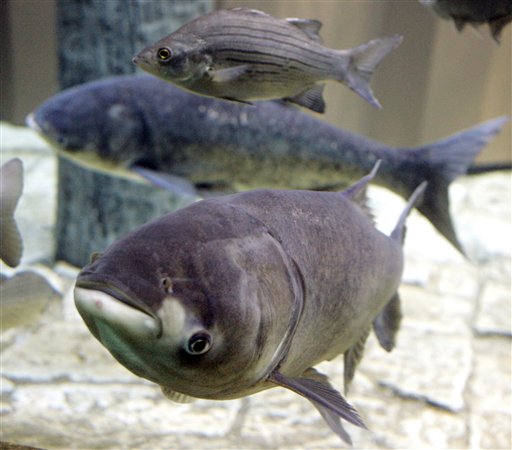
FILE - In this Thursday, Jan. 5, 2006 file photo, a bighead carp, front, a species of the Asian carp, swims in a new exhibit that highlights plants and animals that eat or compete with Great Lakes native species, at Chicago's Shedd Aquarium. Illinois environmental officials will dump a toxic chemical into a nearly 6-mile stretch of the Chicago Sanitary and Ship Canal Wednesday, Dec. 2, 2009 to keep the voracious Asian carp from entering the Great Lakes while an electrical barrier is turned off for maintenance. (AP Photo/M. Spencer Green, File)(Credit: AP) Invasive species are not, by any means, a new problem on American soil. From zebra mussels to boa constrictors, they’ve been pushing out indigenous animals for centuries. Louisiana chef Philippe Parola, however, has an unusual strategy to get rid of them: putting them in our stomachs. (His oh-so-subtle eating philosophy: “You’ve got to have balls.”)
In 1998, the flamboyant Parola was involved in the notorious (and unsuccessful) attempt to make the nutria, a large aquatic rodent pest, into a nationally popular meat. (It probably didn’t help that the animal looks like that giant rat from your childhood nightmares.) Now he’s turned his attention to another invasive species, the Asian carp. The large fish, which can reach up to 30 pounds, has muscled out indigenous fish in American waterways, including the Mississippi, and has the dangerous habit of jumping out of the water near moving boats (to see them in terrifying YouTube action click here). Now, working with the state of Louisiana, Parola is hoping to curb its numbers by marketing the fish as a menu item. As part of his outreach, Parola will be promoting the fish to the 1,500 members of the annual National Grocer’s Association convention in Las Vegas.
Salon spoke to the energetic Parola over the phone about America’s conservative eating habits, his name-change marketing campaign, and why it’s so hard to get people to eat a giant rat.
How did you get involved in this effort to turn Asian carp into a menu item?
I was riding on my boat, going fishing, when these two fish literally jumped into my boat and landed on my feet. I’m a chef and I love exploring new avenues for new food, so when I saw them I decided to bleed them, bring them to my restaurant and fillet them. I found it was a delicious white meat. Then I called the Louisiana Department of Wildlife and Fisheries and let them know that this fish needs to have a marketing campaign.
Why haven’t people been eating this fish the whole time?
It was classified as a trash fish — destroying nets, killing people [by knocking them out of boats], wiping out the native fish species by eating their food source. But there were two reasons we weren’t eating them: If you don’t bleed the fish, the meat is grayish-looking without much flavor, and there’s a lot of bones in this fish. Those were two things that nobody could overcome. I overcame them by bleeding the fish and steaming the meat so I could remove the bone.
Why are you so passionate about getting people to eat Asian carp?
I believe that if you kill, you eat it. The No. 1 goal is to resolve this ecological problem. The second goal is to create jobs. The third thing is for consumers, who have the most to gain. This fish is extremely healthy. It’s rich in omega 3 and there is no mercury because the silverfin is a filter feeder.
The silverfin? Is this your new name for the Asian carp?
Some clown from the USDA classified it as a carp. Carps are a bottom feeders and this is a filter feeder. The shape of the fish, the way it grows, the color: Literally there is no similarity to the carp. There’s no other species named the silverfin, so what’s the problem?
Well, off the top of my head, shouldn’t it be up to scientists to name the fish?
But what I’m saying to you — very loudly — is that this fish doesn’t have any similarity with the carp. I want somebody out there to redo that research and help us out.
You were part of an initiative to get people to start eating nutria, which is a rodent commonly found in Louisiana. It didn’t get a lot of national traction. What happened?
It was successful until the government went in and stopped it. The FDA wouldn’t allow us to use the FDA stamp because the nutria needed to be killed in a slaughterhouse. The idea was to hunt them in the wild, but nobody would buy something without the FDA approval. I’m very proud I was involved with that. To quote one of our presidents, ask not what your country can do for you, ask what you can do for your country.
To be fair, it was also pretty hard to imagine people eating an animal that looks like a giant rat.
Yes. That was the biggest difficulty to overcome. I did a promotion with alligator meat, and that went fine, but with nutria, the fact that it’s classified as a rodent, and that cops were shooting nutria in the gutters kind of killed it. At least this fish doesn’t have a rat tail.
Why do you think Americans are so reluctant to eat unconventional animals?
America has been spoiled in many ways. People can get boneless fillet of fish, and consumers got used to that. Any other country in the world you will eat a fish with a head and bone and tail on — which tastes better.
Are there any other maligned animals that you’re going to try to turn into food?
You can tell people that if they send one to me, I guarantee that I’ll find a way to sell it. If it flies, crawls or swims we can eat it. I recently got a call from Australia about a carp there that nobody’s eating. I said, hey, send it to me. I’ll give it a try.
The key is to be smart about it. When I was doing nutria promotion, there was guy on a radio station who asked me, Why should I eat nutria when I can have chicken every day? I wanted to tell him, listen dumbass, this animal is invading your city, that’s why you want to eat it.
Thomas Rogers is Salon's Arts Editor. More Thomas Rogers.
Farmers’ sand-frac nightmare
Some parts of rural America are being ruined by an unstoppable new mining industry -- and it's spreading
Frac sand piles up at a processing plant in Chippewa Falls, Wis. (Credit: AP/Steve Karnowski) If the world can be seen in a grain of sand, watch out. As Wisconsinites are learning, there’s money (and misery) in sand — and if you’ve got the right kind, an oil company may soon be at your doorstep.
March in Wisconsin used to mean snow on the ground, temperatures so cold that farmers worried about their cows freezing to death. But as I traveled around rural townships and villages in early March to interview people about frac-sand mining, a little-known cousin of hydraulic fracturing or “fracking,” daytime temperatures soared to nearly 80 degrees — bizarre weather that seemed to be sending a meteorological message.
Continue Reading CloseWorse than Keystone
Environmentalists are focused oil and gas, but a bigger carbon disaster may be brewing in the Pacific Northwest
A coal mine owned by Arch Coal Co. (Credit: AP/Matthew Brown) Coal is without question our dirtiest fuel source: When burned, it dumps toxins like mercury and nitrogen oxides into the air and packs an outsize punch when it comes to carbon emissions. Since America has a lot of it, though, we’ve tended to use a lot: Historically, around half our electricity has been generated by coal combustion plants. But as a result of sustained anti-coal activism, low prices for natural gas, and new EPA regulations on power plant emissions, Americans are using a lot less coal than we used to, and the future of the sooty stuff in this country is looking dim. So the U.S. coal industry is pinning its hopes on China. While historically most of our exported coal has gone to Europe, U.S. exports to China increased 176 percent between 2009 and 2010, and that number is likely to keep rising as the Asian market for coal continues to expand. The prospect of shipping coal across the Pacific is even more appealing considering that Western states like Wyoming and Montana have vast coal reserves in the Powder River Basin, one of the largest coal deposits in the world.
Continue Reading CloseAlyssa Battistoni writes about the environment and politics from Seattle. More Alyssa Battistoni.
Is it ethical to drive stick?
More drivers are buying manual transmissions -- a boon for auto sentimentalists but bad news for the environment
(Credit: cristapper via Shutterstock) Ever since I first watched my dad drive his chocolate brown Datsun 280 ZX back in the early 1980s, I’ve been inculcated to believe that driving — true driving — can only be performed with a stick shift. From that childhood experience, I came to see the manual transmission as a birthright passed down from my grandfather, to my father, and eventually to me via a series of tense, stall-filled lessons when I turned 16. In my case, after ripping apart the transmission one too many times, my dad went barking drill sergeant on me, eventually teaching me that a stick requires a special kind of focus, and that I needed to ease up more slowly on the clutch in order to get into first gear on those damn inclines. Through the experience, I learned to consider my stick-shifting skill a special talent with transcendent value.
Continue Reading Close
David Sirota is a best-selling author of the new book "Back to Our Future: How the 1980s Explain the World We Live In Now." He hosts the morning show on AM760 in Colorado. E-mail him at ds@davidsirota.com, follow him on Twitter @davidsirota or visit his website at www.davidsirota.com. More David Sirota.
An eco-pioneer’s final words
The visionary author of "Ecotopia," who died in April, warns of dark times ahead, but sees a path through the decay
To all brothers and sisters who hold the dream in their hearts of a future world in which humans and all other beings live in harmony and mutual support — a world of sustainability, stability, and confidence. A world something like the one I described, so long ago, in “Ecotopia” and “Ecotopia Emerging.”
As I survey my life, which is coming near its end, I want to set down a few thoughts that might be useful to those coming after. It will soon be time for me to give back to Gaia the nutrients that I have used during a long, busy and happy life. I am not bitter or resentful at the approaching end; I have been one of the extraordinarily lucky ones. So it behooves me here to gather together some thoughts and attitudes that may prove useful in the dark times we are facing: a century or more of exceedingly difficult times.
Continue Reading CloseGorgeous saga, global crisis
"Last Call at the Oasis" paints a haunting, even poetic, portrait of the global water crisis. Will anyone listen?
Here’s the short version of humanity’s relationship with water, as delivered by hydrologist Jay Famiglietti in Jessica Yu’s compelling and often gorgeous documentary “Last Call at the Oasis”: “We’re screwed.” Yes, we should all install low-flush toilets and plant gardens that require less watering, but conservation is simply insufficient to cope with a global fresh-water crisis that involves many interlocking factors: overpopulation and overdevelopment, depletion of groundwater, climate change, and widespread contamination.
Continue Reading ClosePage 1 of 158 in Environment