
Cooking School Forever

Ancient Japanese fish secrets — revealed!

Crashing a master sushi chef's classes for professionals

  • more
    • All Share Services

Topics: , , ,

Ancient Japanese fish secrets -- revealed!

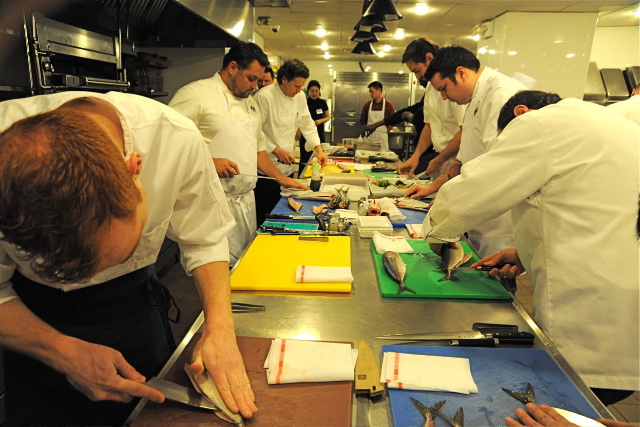
In the interest of cultural and culinary exchange, the Gohan Society offers professional chefs — including ones from Daniel and wd-50 — the opportunity to learn the art of Japanese fish mastery, taught by chef Toshio Suzuki of Sushi Zen restaurant. This is the first of a series of reports and reflections from that course.

As the subway car rumbled toward home late one night, I saw a man doing something unusual, which is saying a lot considering what happens late at night on subway cars. He stroked the air with two fingers of his right hand and brushed them, quickly, on his left palm, next to what looked like a big white pill. He closed his fist, pressing his fingers into it, the veins bulging in his thin, taut forearms showing a firm, controlled pressure. He wore a certain look of concentration, opened his fist, and repeated all this again and again.

I walked over to him. “Excuse me,” I said. “But what are you doing?”

His intense focus warmed into a tooth-filled smile. “I am training,” he said. “Sushi.”

I looked at his hand; the pill was actually a towel, rolled up to the size of the rice in his sushi. He was practicing dabbing wasabi into his hand, rolling the rice forward to pick it up, squeezing it with the exact amount of force for it to hold together in a neat bed for the fish.

Daisuke was his name, recently arrived from Kyoto, inspired to explore the West after a stint as the chef of the Japanese embassy in Belgium, where he prepared the traditional high-cuisine called kaiseki. He is an accomplished chef. So why did he have to practice squeezing rice on his way home?

“In America, people think all Japanese food is sushi,” he said. “So I must learn sushi.”

But something else occurred to me, about sushi and Japanese cuisine in general. A friend once told me about meeting a team of Japanese master chefs. Chief among them, the oldest and most respected, most deferred to, was the man who had perfected cooking rice. Seventy years of experience behind him, and his most revered accomplishment was rice. This is a cuisine, I realized, of finding the complexities in simple things, of perfecting the humble. It’s a cuisine of contemplation, deliberateness and concentration, a cuisine that asks you as a cook and as a diner to understand and to appreciate the difference between rice that is cooked well and rice that is cooked perfectly. And so Daisuke felt compelled to practice and hopefully master the art of squeezing rice for sushi.

And, as it happens, Daisuke had just started working at the restaurant Sushi Zen, whose owner, Toshio Suzuki, is renowned not just as a top-flight sushi chef, but as an ambassador for traditional Japanese culinary arts. Arranged by the Gohan Society, Chef Suzuki teaches an eight-session course for professional chefs on the master’s way with fish: how to clean and handle fish to be served raw or cooked; how to read their anatomies and how to cut them to best effect; how to bring out their flavors.

Attending these classes, I hope to learn — and to share with you — some lessons applicable to curious cooks. Probably very little will be done perfectly in these classes, even by the four-star chefs sitting beside me. But that’s OK; when you’re not a master yet, you don’t have to let the perfect be the enemy of the good. And today’s two lessons, on mackerel and what’s probably going to be your new favorite, jackfish, are most certainly very good. 

Continue Reading Close

Francis Lam is Features Editor at Gilt Taste, provides color commentary for the Cooking Channel show Food(ography), and tweets at @francis_lam.

Having a Japanese knife makes you a serious chef

Descended from samurai swords, artisanal blades inspire sharper cooks

  • more
    • All Share Services

Topics: , , ,

Having a Japanese knife makes you a serious chefEddy Leroux (left) and other chefs "unrolling" their daikons

In the interest of cultural and culinary exchange, the Gohan Society offers professional chefs — including ones from Daniel and wd-50 — the opportunity to learn the art of Japanese fish mastery, taught by chef Toshio Suzuki of Sushi Zen restaurant. This is a series of reports and reflections from that course.

Eddy Leroux is a French chef of the first order, commander of the kitchen at the four-star Daniel, but right now, he’s struggling with a radish. As I look over the room of Western chefs practicing a cutting technique just taught to them by the sushi master Toshio Suzuki, it’s Leroux I notice first — his slicked-back hair trembling at the ends, his face flushing with color and beads of sweat gathering on his forehead.

OK, so it’s not really the daikon radish that’s frustrating him. It’s the near-impossible task of cutting it first into a perfect cylinder and then rotating it against his knife to shave off a see-through-thin layer that piles up on the table in one long ribbon. I mean, it’s not every day chefs try to turn a vegetable into a roll of toilet paper.

It’s a traditional Japanese test of the sharpness of your knife, but even more so of control and patience. And since today’s class focused on the history of Japanese knives and how to care for them, I thought it may have also been a little bit of a chiding joke, a gentle rebuke to those chefs who came to class with their very beautiful, very expensive Japanese knives but without the proper skills to use them.

For as long as I’ve been interested in professional cooking, I’ve heard about Western chefs trading in their European blades for their harder, better, faster, stronger Japanese counterparts, especially the traditional hand-forged ones. Aside from being gorgeous objects, they can simply do things other knives can’t. I once blind-tasted daikon cut with different knives and nearly everyone agreed that the sample made with a traditional Japanese knife tasted better — the flavor was brighter; it bloomed as you ate, and we learned that the sharper edge cut more cleanly, leaving more cells intact, and leaving the full flavor to be released only as you chewed.

You can quibble over whether that difference is worth the thousands of dollars one of these knives can cost, but when you combine expensive, high-performance tools with the proud culture of professional cooking, you’re probably going to get some macho my-knives-are-bigger-than-yours collectors, shallow poseurs with hard-hit credit cards. And so I looked around the room, secretly searching for chefs with oversize swagger and undersize seriousness.

But I didn’t see that person. Instead, I saw Eddy Leroux, with his intense determination to get his cuts right. I saw Top Chef Master Wylie Dufresne of wd-50, humbly trying, failing and trying again to unroll his daikon. I saw Michael Romano, chef of the Union Square Café, Zagat’s most popular New York restaurant for nearly a decade, working on a way to sharpen his knife just a little more precisely.

Instead of showing off, what I saw was humility and earnest work. Why was everyone so serious? “In Europe, there isn’t this culture of the knife,” Dufresne said to me. Earlier in the class lecture, we heard about master smiths folding glowing metal and pounding out their edges by hand, just like samurai swords, and about how the samurai themselves treated their cooking knives with the same spiritual reverence as their more lethal blades. “There’s just this extreme level of discipline,” Dufresne continued. “And while there’s more involved care, it’s actually kind of easier to maintain your knives, because the Japanese care so much about them they really try to explain and communicate everything that goes into them.”

Michael Romano picked up his first traditional Japanese knives nearly 30 years ago. He was drawn to their artistry, but, when he described to me the moment when he decided to buy one, I was struck by how he made no mention of their sharpness. Rather, he said, “I knew they would challenge me to improve my knife skills and control.”

And when I asked Leroux why he was breaking a sweat, he said, “The knife I have requires more skill to sharpen and to use; it will take me at least a year before I can really perform with it. I first saw it in 1998, and it was too expensive, but as I progressed in my career, I became mature enough. I’m very happy I could buy it for myself for Christmas; I have a feeling of a piece of art in my hand … this kind of knife forces you to be excellent.”

While all of these chefs love how these knives cut, they all saw a larger purpose to why you would spend several months’ worth of rent on one — the challenge of making it worth it, or, rather, of making yourself worthy of it. It’s not that you can own a tool made by a master smith, a master artist and craftsman; it’s that once you own it, you have to demand of yourself work worthy of the tradition and skill that went into it. It’s talismanic, a call to a higher authority even when you’re in the weeds and the food is just begging to be cooked and sent out and forgotten about. You put your hand on that knife, and you remember that every cut has to be as good as you can make it.

I thought back to what I imagined might have been Suzuki-san’s test of these Japanese knife fans’ true dedication, and I realized that I was looking at it the wrong way. The point wasn’t that they didn’t know how to do what they were doing, but that they were all trying so hard at it. They were challenging themselves to honor the knives the owned.

Continue Reading Close

Francis Lam is Features Editor at Gilt Taste, provides color commentary for the Cooking Channel show Food(ography), and tweets at @francis_lam.

What to do with a mackerel, the Japanese way

A master sushi chef shares his techniques

  • more
    • All Share Services

Topics: , , ,

What to do with a mackerel, the Japanese way

Mackerel’s not the sexiest fish in the sea: We’re not talking about a big (probably endangered) bluefin tuna or a chef’s-darling hamachi yellowtail. And its oily flesh can, admittedly, degrade quickly if it’s not handled properly (read: kept really cold all the time). Degraded oily fish flesh doesn’t sound very good, does it? It doesn’t taste real good either.

BUT! When fresh and handled well, mackerel’s qualities are more than charming. That oiliness gives the meat a smooth richness with a minerally finish, while keeping a sweet flavor, like if tuna and fluke had a secret love child. Its texture is meaty and resilient. Its iridescent skin, a shimmering silver and blue, is gorgeous on the plate, and in a world where it seems that every tasty fish is doomed to feed us until extinction, mackerel stocks are plentiful and sustainable.

Traditionally in Japan, mackerel, called saba, are cured lightly with salt and vinegar when served raw. The original reason for this was to kill any bacteria that may have come from the fish’s particular digestive system, but the salt and vinegar also serve to balance the oiliness and brighten the flavor. Chef Toshio Suzuki of Sushi Zen restaurant also adds a subtle, unusual twist: He lets it sit first in sugar, not enough to make it sweet, but enough to help the flesh retain some moisture and interact with the salt and vinegar to bloom the umami and flavor of the fish. “Japanese cuisine,” he says, “is about bringing out the flavors inherent to the product, not creating flavor through sauces and such.”

If you’re getting your mackerel whole, Chef Suzuki urges you to gut it immediately and scrub the belly cavity under cold running water thoroughly, scale it, filet it, and get curing.

Japanese cured mackerel (saba)

Very fresh mackerel filets (leave belly and pin bones in; they keep the cure from penetrating too much)
Sugar
Kosher or sea salt
Rice vinegar (best if it’s not super harsh; if so, dilute it with a little water)
Sake (the cheap stuff is fine)

For serving, sashimi-style:
Good-quality soy sauce
Finely minced fresh ginger
Wasabi

Special-ish equipment:
A very sharp knife
Fish bone tweezers (your eyebrow pluckers might work, but make sure they’re clean)

  1. First, take off your rings and watches. “Sushi chefs never wear anything on their hands — jewelry, watches, etc.,” Chef Suzuki says. “Treat it as if you are going into surgery.” This man is serious about keeping his fish as bacteria-free as possible.
  2. Cover a dish or pan with sugar. Dredge the filets in the sugar, making sure to cover both sides, and let them sit for a minute or two. Take them out and set them on a surface where they can drain, like a rack set on a dish. Let cure in the refrigerator for 30 minutes.
  3. Rinse the filets of the sugar under cold running water. Pat dry with paper towels, and repeat the procedure with salt instead of sugar. Let cure in the refrigerator for 40 minutes.
  4. While the mackerel is salt-curing, prepare your rinsing vinegar. You want a 9:1 ratio of vinegar to sake, and enough of the mixture to just kind of dunk the filets in and rinse off the salt. Alternatively, you can use cold water.
  5. Once the filets are rinsed, set them skin-side down in a pan where they can fit in one layer. A little touching is OK, but don’t let them squish one another. Pour in vinegar and sake, again at a 9:1 ratio, until you just cover the filets. (If you intend on doing this again, you can save this vinegar to rinse the mackerel with next time). I found it easiest to set the pan, fish and all, on a scale and pour in pretty much enough vinegar to cover, keeping an eye on how much vinegar I’ve used. Then I added 10 percent of that weight in sake, and swished it around to mix. Let this sit in the fridge for 30 minutes.
  6. Now take the filets out and dry them thoroughly with paper towels and wrap them tightly with plastic wrap. Wait at least 4 hours to let the cure slowly work its way through the fish, equalizing its effects. Keep the filets in the coldest part of your fridge until ready to serve, up to 2, maybe 3 days later.
  7. To serve: Lay the filets skin side down. Find the row of long belly bones, behind where the head was, arcing down toward the bottom of the filet. With a very sharp knife (if you don’t have one, consider using a sanitized razor. I’m serious.), find the underside of that row of bones, and in one swoop, cut them and the belly out.
  8. Once you’ve cut the belly out, look at the skin at the end of the cut: You may find a translucent layer. It’s thin, but tough. Using your fingers, get a good hold on it and peel it off the skin side. It should come off in one piece, revealing the stunningly beautiful metallic skin underneath. Flip the filet back skin-side down. Run your fingers down the centerline of the fish to find the pin bones, and firmly but smoothly pull them out, angling toward the head, with tweezers.
  9. Now working skin-side up, cut the fish into slices just under a ½-inch wide. Chef Suzuki’s knife was so sharp he literally tapped at the flesh two times in between slices, scoring slits that can absorb soy sauce or be used to set very small pinches of minced ginger.
  10. Serve with wasabi, minced ginger, and soy sauce to dip. Alternatively, you can paint or drizzle the soy sauce onto the fish, letting it settle in the slits, and splashing its color, beautifully, on the silvery skin.

Recipe by Toshio Suzuki, as presented at Mastering Fish the Japanese Way, by the Gohan Society


Continue Reading Close

Francis Lam is Features Editor at Gilt Taste, provides color commentary for the Cooking Channel show Food(ography), and tweets at @francis_lam.

Miso-jackfish tartare (Namerou)

A recipe from a Japanese fish master class

  • more
    • All Share Services

Topics: , ,

Miso-jackfish tartare (Namerou)

Jackfish, which the Japanese call aji, can come on like a revelation. It hints at the fatty richness of yellowtail, but with a cleaner flavor, a scallop-y sweetness, and a ringing umamiliciousness. Yes, I just wrote the word “umamiliciousness.”

It’s gorgeous on its own, but may be even better as a backdrop for the sweet, earthy flavors of miso, as it is here in namerou, a dish whose name means “to lick,” as in, “You’re going to lick this plate after it’s all gone.” No, really. That’s why they call it that.

Most simply, namerou can be fish dressed with miso, ginger, a few other aromatics, but the technique is interesting: a chopping/pounding process that turns the meat into a sort of instant pâté. Except it’s raw. So it’s like a raw pâté. That doesn’t sound so good. A raw fish sausage? Oh, forget it. Just make it and eat it. It’ll blow your mind, and maybe you’ll do a better job of describing it than I can.

Miso-jackfish tartare (Namerou)

If you can’t find jackfish (aji), this recipe also works wonderfully with fresh sardines, squid, horse mackerel, mackerel pike, mackerel and sea bream.

 Per person:

3 ounces jackfish filet, scaled thoroughly (or skinned, as appropriate with mackerel)
1 teaspoon white miso paste
1 shiso leaf, chiffonade
1 pinch thinly sliced scallions (green parts)
1 pinch finely minced peeled ginger
1 pinch sesame seeds
¼-inch slice myoga* (Japanese ginger) finely minced (if you can find it)

  1. Dice the fish into roughly ½-inch pieces.
  2. Leaving the fish on the cutting board, add the miso, spreading it somewhat over the fish with the side of your knife. Now chop the two together. Don’t hold back! You can resharpen your knife later. Scrape up and fold the fish on itself after every few chops to thoroughly combine the miso.
  3. As you chop, keep an eye on the meat — as it gets finer, the fish will start to get a little tacky. What’s happening is that the proteins are unraveling and looking for other proteins to stick to. When you start to notice that tackiness, sprinkle on the other ingredients one by one, separated by a few chops, just enough to start to incorporate them.
  4. Now turn your knife upside down, and chop at the fish with the flat spine of the blade. In smashing the fish, you’re encouraging that protein action, creating a tartar with some integrity; it will want to hold together a bit. It’s up to you how far you want to take this; in theory, you can keep pounding until it’s a smooth paste. Chef Suzuki serves it at the point where the whole mass likes to hold together — where you could form it into a meatball — but where about ¼-inch dice of fish are still visible, giving a yielding resistance when you chew.
  5. To serve: The namerou is delicious served like this, each chew bringing out a different flavor, or you can lightly broil it: Mound it on a wooden spoon or paddle and wave it over the flame of your stove until you get slight spots and specks of char. The intention isn’t to give it a crust or cook it through, but to lightly cook the outer layer. The contrasting texture of firm, cooked fish and yielding core is lovely, and the slight charring brings out the earthy, smoky flavors of the miso. Gorgeous stuff.

* Myoga is not, in fact, a relative of ginger, but a Japanese bud with pinkish skin, a very floral aroma and a mild, shallot-like bite. It’s lovely, but if you can’t find it, don’t let that stop you from making namerou.

Recipe by Toshio Suzuki, as presented at Mastering Fish the Japanese Way, by the Gohan Society 

Continue Reading Close

Francis Lam is Features Editor at Gilt Taste, provides color commentary for the Cooking Channel show Food(ography), and tweets at @francis_lam.