
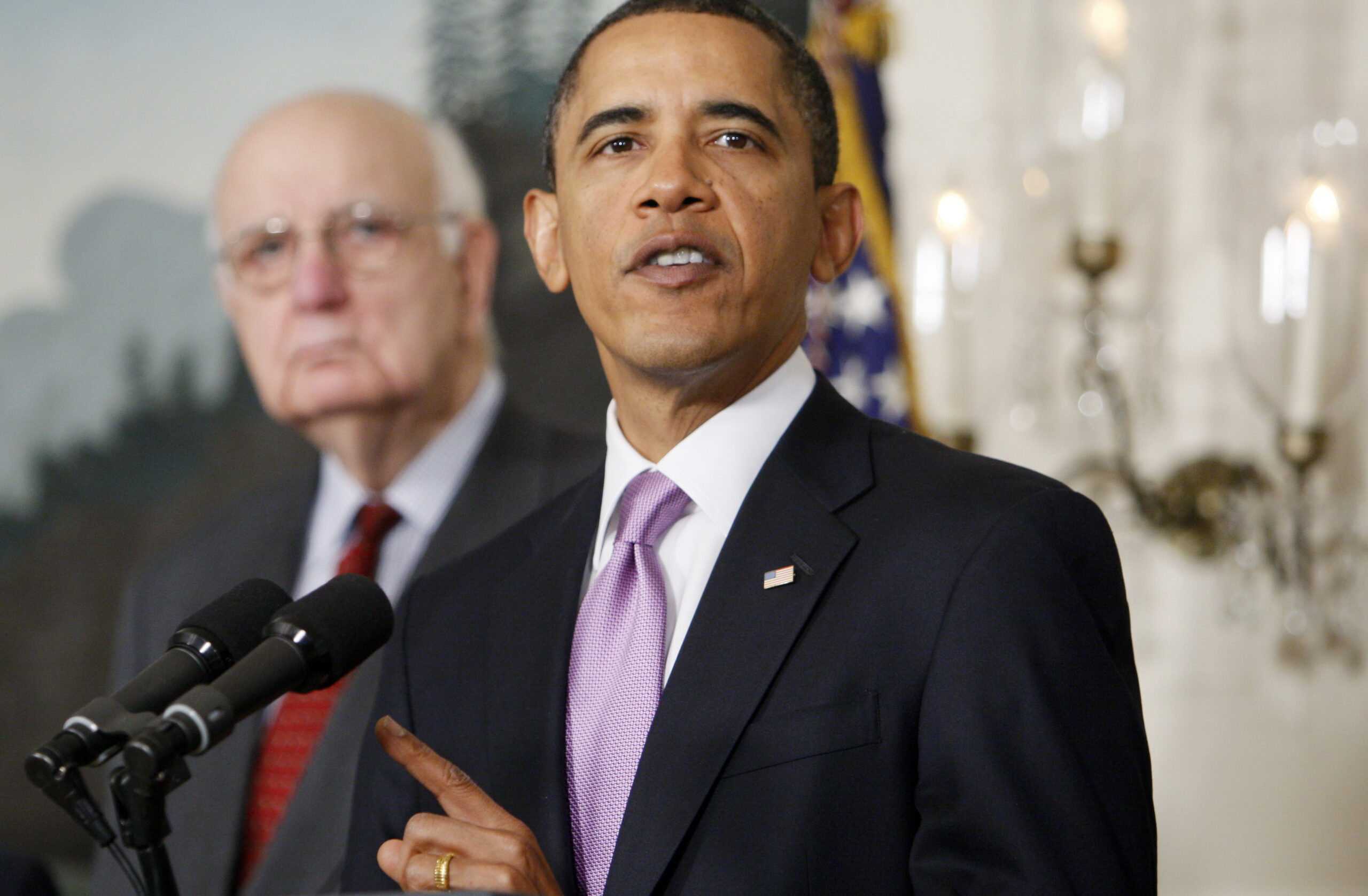

Following Republican Scott Brown’s capture of Ted Kennedy’s Senate seat in Massachusetts last Tuesday, President Obama last Thursday surprised everyone by recalling his advisor Paul Volcker from political exile and endorsing Volcker’s plan for restoring the Glass-Steagall law’s prohibition on speculation by deposit-taking commercial banks. Even more encouraging were reports that Obama’s support for reform in the spirit of Glass-Steagall had been in the works since December. Criticisms that a new Glass-Steagall law, by itself, would not have averted the crisis are correct, but that is like saying that we shouldn’t try to prevent nuclear terrorism because that won’t necessarily prevent global pandemics.
Obama also struck a populist pose in response to the Supreme Court’s decision striking down limits on the amount of money corporations can spend on political campaigns. In his weekly radio and Internet message, the president declared, “This ruling opens the floodgates for an unlimited amount of special interest money into our democracy.” This was more than a bit ironic, inasmuch as it was Obama who rejected public financing during the presidential campaign and raised more money from Wall Street than Hillary Clinton or John McCain. And it was Obama who allowed the pharmaceutical lobby to dictate portions of the healthcare bill, in return for promising not to run TV ads against it. But redemption is always possible, and a series of events — losses of governors’ races in New Jersey and Virginia, mass retirements by frightened Democratic legislators, and now Massachusetts — would seem to justify a near-death conversion.
How genuine is Obama’s alleged new populism? Is it the real thing, or is it like the cue card that President George Herbert Walker Bush accidentally read in its entirety during the 1992 presidential campaign: “Message: I care”?
Unfortunately, it appears that Obama’s newfound populism lasted less than a day. On Saturday, two days after his appearance with Volcker and four days after the Massachusetts election, President Obama had to make a decision about the most anti-populist measure conceivable: the budget deficit commission supported by some of the hostage takers who populate the U.S. Senate — this time, Sen. Kent Conrad, D-N.D., and Sen. Judd Gregg-R-N.H., the highest-ranking members of their party on the Senate Budget Committee. Conrad and Gregg want a panel of 18 Democrats and Republicans to come up with a plan to reduce long-term U.S. deficits and debt with a mix of program cuts and new taxes. The most shocking feature of the plan: Congress would be forced to vote yes or no on the entire package, without any debate or amendment.
The Conrad-Gregg budget commission is profoundly anti-populist, in two ways. It reverses the outcome of the last election, by putting Democratic and Republican members of Congress on the same panel in the same numbers, eight per party. In defiance of the separation of powers, the Obama White house is allowed to appoint two other members. Why?
Even worse are the restrictions on congressional debate and amendment.
There’s nothing wrong with commissions issuing recommendations, but this commission’s recommendations would automatically become law, unless House and Senate majorities voted them down without debate. Why should Congress be banned from asking any questions? Why shouldn’t Congress be allowed to make changes in the recommendations before they become law? Are 16 members of Congress and two White House appointees really smarter or less corrupt than 535? If Congress is to be banned from debating or changing laws, why not just abolish elections, and let an appointed Commission of Eighteen pass all legislation without any questions being asked?
Defenders of the scheme claim that it is the only way that members of Congress can be forced to make hard choices. But this is nonsense. Does anyone think that senators and Congress will tell their constituents, “I opposed the budget reform, but the Commission of Eighteen forced me to vote against my conscience and your interests!” There is an alternative to Conrad’s and Gregg’s attempt to create a third house of Congress with more power than the other two. The voters can keep firing their representatives and senators, until they find some who think that debating major public issues and taking sides on controversial laws is what they are elected and paid to do.
Its assault on our constitutional democracy is not the only way in which the Conrad-Gregg budget commission is the polar opposite of populism. Having failed to partly privatize Social Security directly, during the Bush years, when the Republicans controlled both houses of Congress, the wealthy, upper-class enemies of Social Security now want to use the budget commission to attack America’s most successful middle-class social benefit, which will be solvent for decades to come. No doubt some of the deficit hawks hope that many Americans who are legitimately angry about government bailouts to the financial industry can be tricked into supporting their own, quite different, long-term campaign to steer retirement money away from Social Security and into the stock market, where the flood of new money might boost the share prices for the rich and provide brokers with a bonanza of fees.
After endorsing the Conrad-Gregg commission, on Monday President Obama sought to ingratiate himself further with Blue Dog Democrat and Republican deficit hawks by calling for a three-year freeze on discretionary spending. In the words of Tallulah Bankhead on leaving the avant-garde play, “There is less here than meets the eye.” Exempted from the freeze would be not only all Pentagon and foreign aid spending, but also Social Security and Medicare–pretty much the whole federal budget, except for the salaries of national park rangers. The projected savings in 2010 of up to $15 billion would amount to a paltry 0.4 percent of a $3.5 trillion federal budget. The sum is too small to placate conservatives, but if the political purpose is to allow the president to pose as the champion of budgetary probity against irresponsible, free-spending progressives, this gimmick may succeed if the left falls into the trap by protesting.
How did Obama respond to the outrageous attack by Conrad and Gregg on America’s democratic system and social insurance programs? Did he threaten to veto legislation creating their commission? Did he defend the rights and powers of the people’s House and the Senate, rights deeply rooted in the struggle for democracy in the U.S. and early modern Britain? Did he refuse to let the legislative process be hijacked by enemies of Social Security and Medicare? Did he vow that every American who pays Social Security will get every penny he or she was promised? Did he point out that the healthcare delivery system is the cause of Medicare costs, and that a purely budgetary solution of cutting spending without delivery-system reform will merely provide Americans with smaller amounts of excessively costly care?
Washington (CNN) – In a dramatic concession to senior Democratic and Republican lawmakers, President Obama abruptly shifted his position Saturday and declared his public support for creating a fiscal commission that could propose sweeping tax increases and spending cuts to try to slash the soaring federal debt.
The White House released an unexpected written statement from Obama saying he now backs putting together a powerful commission created through a federal statute, a reversal from earlier this week when Vice President Joe Biden signaled in a private meeting with Sen. Kent Conrad, D-N.Dakota, and other key lawmakers that the administration would only support a weaker version of the commission by forming it through an executive order.
“The only way to solve our long-term fiscal challenges is to solve it together — Democrats and Republicans,” Obama said in the written statement. “That’s why I strongly support legislation currently under consideration to create a bipartisan, fiscal commission to come up with a set of solutions to tackle our nation’s fiscal challenges — and call on Senators from both parties to vote for the creation of a statutory, bipartisan fiscal commission.”
Perhaps Obama hopes that Congress, given a wink, will rescue him from paying any price for his own public support for the awful Conrad-Gregg proposal by refusing to create the commission or, if the monstrous thing is created, by voting its recommendations down. But even if such a devious tactic worked to Obama’s short-term political advantage, such cynical wink-and-nudge maneuvering is hard to square with authentic, principled popular leadership. Abraham Lincoln didn’t pretend to support the extension of slavery, in order to trick the Southern slave owners later. William Jennings Bryan didn’t pretend to side with railroads, in order to be in a better position to help the farmers. Franklin Roosevelt didn’t solemnly assure his right-wing opponents that he shared their concerns that the New Deal might bankrupt the country. And Lyndon Johnson didn’t buy Barry Goldwater’s permission to pass the Civil Rights Act and Medicare by offering to support a commission looking into privatizing Social Security.
As if to provide further evidence that Obama’s new populism was a one-day P.R. stunt, the day after the president endorsed the reactionary Conrad-Gregg commission on Saturday, David Axelrod told CNN’s State of the Union that the thought of a shake-up in the White House economic team was not even being considered, much less being planned. Obama responded to Tuesday’s debacle in Massachusetts by mocking the “tizzy” in Washington over the results, and Axelrod drew on the same talking point: “That is part of the Washington game. Washington has to throw out a body. There is nothing that gets Washington more excited than the project of somebody losing a job.”
If there were a Nobel Prize for sophistry, Axelrod deserves to be a Nobel Prize-winner like his boss. Here is what he is saying:
Only insiders in Washington want Summers and Geithner to be fired;
Obama refuses even to consider firing Summers and Geithner;
Therefore, his decision to keep an economic team that is excessively deferential to the financial industry that created the worst global crisis since the Great Depression proves that Obama is the true populist enemy of Washington insiders!
Axelrod’s attempt to turn anti-Washington populism into a defense of the existing Obama economic team is as impressive as a circus performer’s ability to turn a balloon into a wiener dog with a few deft twists of the wrist. But this rhetorical dexterity is unlikely to unite angry independents and progressives behind Obama in a mass movement chanting, “Geithner and Summers beat all comers! Hell, no, they won’t go!”
What would it take to prove that Obama really is abandoning discredited center-right New Democrat corporatism and engaging in a genuine progressive-populist course change, rather than just ordering his spin doctors Axelrod and David Plouffe to dream up new faux-populist talking points and publicity stunts?
He would have to purge his economic team of Geithner and Summers and bring in some genuine progressive economists, in addition to Jared Bernstein in the vice-president’s office.
He would have to push for serious financial industry reform, including not only Volcker’s new Glass-Steagall and Elizabeth Warren’s consumer financial protection agency but also regulation of the entire shadow banking system, with no exception, and ending favorable tax treatment for hedge-fund tycoons — including those whom he plans to hit up in his 2012 reelection campaign.
He would have to favor passing a pared-down version of the healthcare bill limited to a few useful reforms by reconciliation, and support piecemeal expansion of Medicare and Medicaid in the future instead of the failed strategy of subsidizing the for-profit insurance industry.
He would have to focus on generating jobs at a time when the public sector must replace private consumption as the engine of growth. This can’t be done by small, symbolic tax credits for business or small, symbolic weatherization programs, of the kind to which Obama is instinctively drawn. Combating mass unemployment requires expanding public investment in modernizing American infrastructure on a scale that dwarfs the subsidies to infrastructure that have already been passed. It also requires federal subsidies for the creation of millions of new public and private jobs in healthcare, elder care and education.
He would have to announce that he plans to rescue America’s manufacturing base from Chinese mercantilism by telling the authoritarian-corporatist Chinese dictatorship that it will face temporary quotas on its imports unless it revalues its rigged currency upward by 25 percent or so over the next few years.
He would have to abandon the lobbyist-written cap-and-trade law, with its grotesque giveaways to Wall Street carbon traders, and instead support a modest, direct tax on carbon that does not cripple American manufacturing, combined with massive direct federal R&D in energy, including nuclear energy and natural gas, in the range of $30 billion to $50 billion a year.
He would have to explain to the American people that the broken-record rhetoric of the scare-mongering deficit hawks is wrong and that it is worth going into more debt to avoid a Japanese-style lost decade. The faster the economy grows in this decade and the next, the more rapidly debt will shrink as a percentage of national income and the less destructive spending cuts and tax increases will need to be.
In short, to prove that his alleged new populism is real and not just another stunt in a permanent campaign, Obama would have to prove that he is willing to govern in a modernized version of the New Deal tradition of Franklin Roosevelt, Harry Truman, John F. Kennedy and Lyndon Johnson, not in the congenitally deformed and slowly dying New Democrat tradition of Jimmy Carter, Bill Clinton and Al Gore.
If he and the Democrats do otherwise, they are likely to end up in the path of the wave of popular anger instead of surfing atop it. If so, Democrats, who lost their former populist constituency to the right with Nixon and Reagan, may lose the populist mandate for another generation, and with it their hopes of a permanent, governing majority.
