J.D. Salinger
“The Catcher in the Rye”: A story in covers
A slide show of the most memorable jackets for J.D. Salinger's best-known book
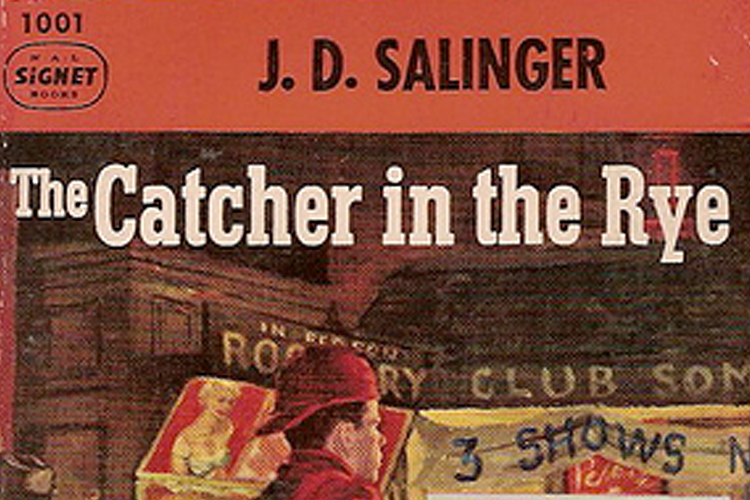
Since its first publication in 1951, “The Catcher in the Rye” has become one of the most iconic American novels — and not only because of J.D. Salinger’s words. The original art, by Salinger’s friend E. Michael Mitchell, depicts an angry red merry-go-round horse against a black-and-white cityscape — and it remains one of the most recognizable book covers of the 20th century: violent, visually arresting and beautiful.
Salinger was highly opinionated about the jacket design of his book. Being notoriously uncomfortable with fame, he asked to have his image taken off the dust jacket, and he objected to James Avati’s art for the paperback (he didn’t want any art on it at all). When Salinger switched to Bantam Press, the book was published with just a red cover, title and author name. “The Catcher in the Rye” has since appeared in many editions, in many countries, and we’ve assembled some of the most memorable jackets here (along with one recent homage on the cover of Frank Portman’s novel, “King Dork”).
What was J.D. Salinger working on?
The reclusive author died two years ago. We've learned lots about his life since, but one big question remains
J.D. Salinger (Credit: AP) When it came to his work, J.D. Salinger was the ultimate control freak. He strove for absolute perfection in his writing and sought complete power over its presentation. He ordered his photo be removed from the dust jacket of “The Catcher in the Rye,” fought with numerous publishers over his book’s content and presentation, and his disdain for editing was legendary. When a copy editor at the New Yorker dared to remove a single comma from one of his stories, Salinger snapped. “There was hell to pay,” recalled William Maxwell, and the comma was quickly reinstated. Recently uncovered letters demonstrate how the author repeatedly refused any film adaptation of his classic novel. He felt no actor could properly fill the role of Holden Caulfield, although he quipped to Ernest Hemingway that he might be persuaded to play the part himself.
Continue Reading CloseKenneth Slawenski is the author of "J.D. Salinger: A Life" (Random House), which is now in paperback. More Kenneth Slawenski.
Asking price for single Salinger sentence: $50,000
The famously private writer's short, polite note to his maid is available (for a considerable fee) on eBay
FILE - In this Jan. 28, 2010 file photo, copies of J.D. Salinger's classic novel "The Catcher in the Rye" as well as his volume of short stories called "Nine Stories" are seen at the Orange Public Library in Orange Village, Ohio. Salinger, died Wednesday, Jan. 27, 2010, in Cornish, N.H., at the age of 91. At left is a 1951 photo of the author. (AP Photo/Amy Sancetta, File)(Credit: Amy Sancetta) Reuters reports today that a polite but laconic one-sentence letter from J.D. Salinger to his maid is currently listed on eBay with a $50,000 price tag. As the New York Times’ Dave Itzkoff wryly notes, that’s “about $2,083.33 a word” — no small sum for a glorified kitchen-counter memo (albeit one left behind by an iconic literary hermit).
Continue Reading CloseEmma Mustich is a Salon contributor. Follow her on Twitter: @emustich. More Emma Mustich.
The “Catcher in the Rye” film that should never be
After J.D. Salinger's death, a movie version is more likely than ever. Here's why that's a huge mistake
“If there’s one thing I hate, it’s the movies,” says Holden Caulfield. “Don’t even mention them to me.”
The young hero of J.D. Salinger’s 1951 novel “The Catcher in the Rye” is often described as one of the great unreliable narrators in American fiction — a character whose self-image is at odds with how he’s seen by the rest of the world as well as his older, wiser creator. But when a Daily Telegraph story suggested that the late, reclusive writer’s signature work might finally land on the big screen — after decades of Salinger telling an endless parade of Hollywood phonies to take their movie pitches and shove them — Holden’s gripe struck me as a rare instance of a quote worth taking at face value.
Continue Reading CloseSalinger: “Recluse” with an ugly history of women
How we've all found a convenient way of avoiding the truth about his troubled past
In all of the many heartfelt (and deserved) eulogies about author J.D. Salinger, who died last week at 91, one word appears over and over. It is, of course, “recluse.” The headline on the Los Angeles Times blog post about his death read, “J.D. Salinger, reclusive author of ‘The Catcher in the Rye,’ dies at 91.” New York magazine called him “the world’s most celebrated literary recluse,” and the New York Times said that the author had “lived in seclusion for more than 50 years.”
Continue Reading CloseMikki Halpin is a freelance writer. She has written for many publications, including Glamour, New York, and the New Yorker. More Mikki Halpin.
Bin Laden blames U.S. for Salinger’s death
Suddenly, the al-Qaida leader has an opinion about everything!
CAIRO — Al-Qaida recluse Osama bin Laden today called for a worldwide boycott of American bookstores, saying the United States was responsible for the death of J.D. Salinger, New Hampshire recluse and author of “The Catcher in the Rye.”
Ask yourself — did you ever see them in the same room together?
“If you really want to hear about it,” bin Laden says in an audiotape released today, “you’ll want to hear all the David Copperfield crap about my lousy childhood and how I was abandoned by my father Muhammed Awad bin Laden because I was the only son of his tenth wife, but I don’t feel like going into it.”
Continue Reading ClosePage 1 of 4 in J.D. Salinger