
Food technology
The machine that will replace kitchens … and cooks
How some ambitious inventors are using printers to push the boundaries of meal preparation
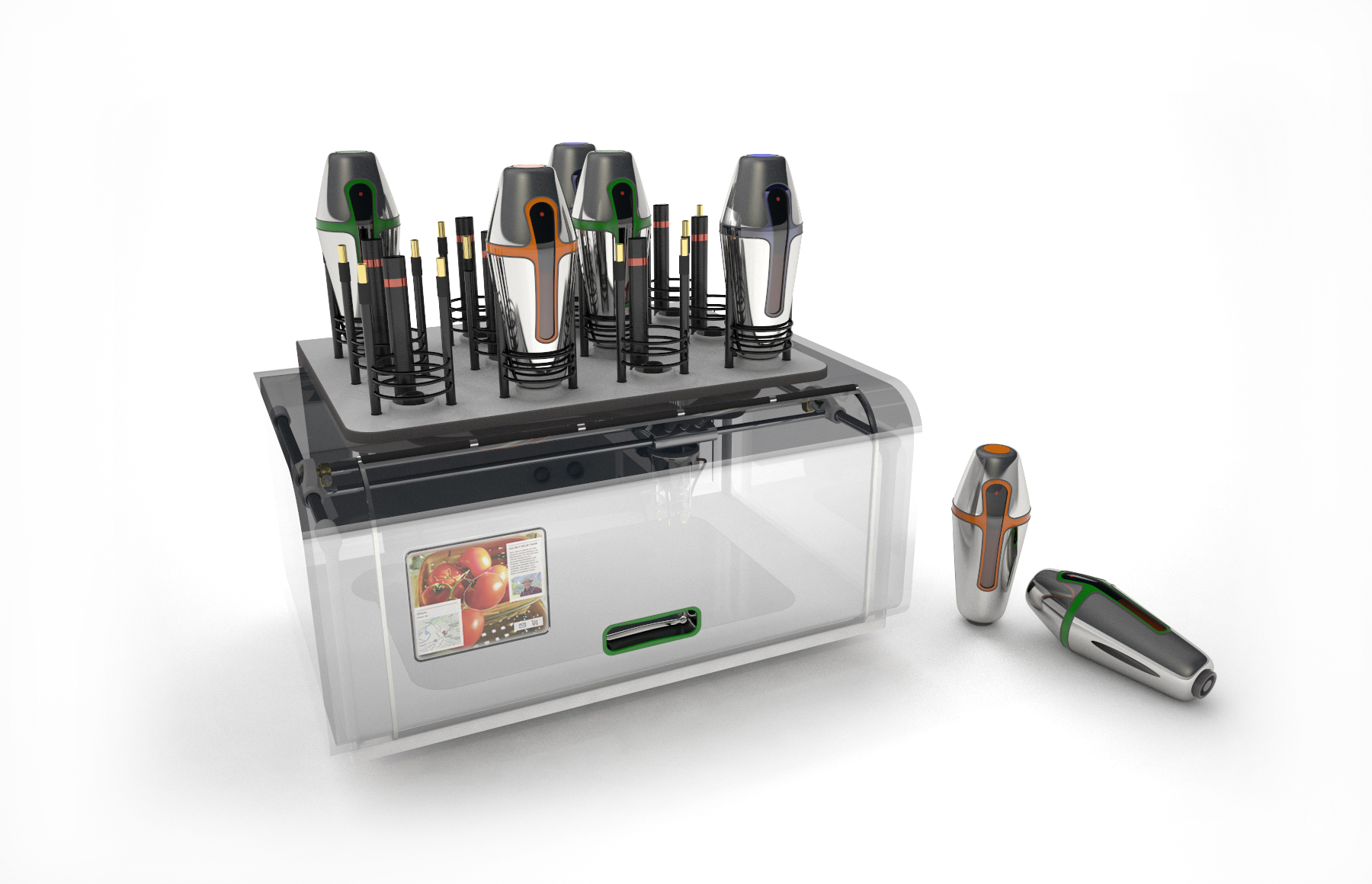
A rendering of the Cornucopia food printer. A few weeks ago, a mysterious food-making machine called the Cornucopia started making waves around the Web. A project by MIT graduate students Marcelo Coelho and Amit Zoran, it seemed like the fulfillment of our wildest Jetsons-inspired fantasies: A machine that makes food — nearly out of thin air, with no cooks needed — at the press of a button.
We’re not talking about a machine that can slice, dice and cook on its own. We’re talking about a machine that can actually make food materialize — in whatever size, shape and flavor you want — without your even going to the grocery store. As posted on its MIT Web site, the Cornucopia is a three-dimensional printer for food that looks like a small portable grill, with an attachment of multicolored metal canisters and, according to the project’s Web page, tubes and fixtures that can pipe, extrude, heat and cool ingredients to create dishes from scratch. As the blog Engadget claimed: “It may be the next major revolution in food preparation.” A Web site called Coolest Gadgets called it “the food of the future.”
Too bad the machine doesn’t actually exist. What many bloggers missed is the fact that the Cornucopia is still only a “concept design” — an idea with a digital rendering, and not much more. Amit Zoran writes via e-mail that, although the pair have worked on some “applied tests and controllers,” the machine “isn’t much more than sci-fi.” But, as the Internet hype shows, it’s a fantasy that holds broad appeal — and, given some recent advances in technology, may be more feasible than you’d think.
In recent years, 3-D printers and scanners — machines that create digital models of objects, and then build them on the spot in three dimensions using a special kind of printer — have become smaller, more user-friendly, and more widely used. They can now been used to create television and car parts, replicas for museums, 3-D sculptures — and, in some cases, food.
In 2007, a group called Evil Mad Scientist Laboratories created something called the CandyFab, a 3-D printer that creates elaborate shapes out of sugar. The CandyFab is a DIY project — it’s open-source, uses recycled material, and costs less than $ 500 to produce — and works by fusing together layers of sugar. The machine prints one two-dimensional design, then prints another design on top of it, fuses them — and continues until a three-dimensional shape emerges. Among the project’s accomplishments: Printing a gigantic sugar screw, and creating beautiful mobius-strip-like sculptures.
And in the past few months, Dave Arnold, the director of technology at the French Culinary Institute, has been experimenting with a 3-D printer called Fab@Home. The machine, which is on loan from Cornell University, creates three-dimensional objects by discharging materials from two 10mL syringes (meaning the ingredients used have to be in homogeneous paste form, and the final product can’t be any bigger than a pound of butter).
The Fab@Home can create highly intricate shapes on the inside of foods, and so far he’s used the machine to create, among other things, multilayered meatballs (“essentially a filling inside a filling”), and small space shuttles made out of scallop paste. As he explains on the FCI’s blog, he’d like to be able to create “little food creatures that move under their own power,” and he told me over the phone that he wants to make a dish using “alternating layers of paste, including fibers like meat” that would be too difficult to make by hand.
But the experiment so far hasn’t lived up to Arnold’s hopes. “I want to get something here that’s valid from a culinary standpoint. We want to try to find an application where the food we’re making is actually better than any other technique we can use,” he says. Much of what he’s produced thus far is more easily made using other techniques — especially on an industrial scale. (It’s much faster to create 1,000 scallop-paste space shuttles using a mold than it is to print them out a 3-D printer.)
Clearly, a number of obstacles will still have to be overcome before a machine like the Cornucopia can become reality. Existing fabricators can’t heat, season or bake any food (much less create a steak dinner from scratch), and, from a cultural standpoint, the idea of a 3-D printer runs counter to some of the major trends in American eating — which are emphasizing fresh, locally grown, minimally processed ingredients. That said, it’s not hard to imagine 3-D printers being used in the creation of manufactured foods, like custom high-end candy or chocolate, in the near future.
But even if the Jetsons experience becomes reality, claims Arnold, it may not be a good thing for American eaters. “For me, the entire idea of reducing the eating experience to a printout seems bizarre,” he says. “If you actually think you’re going to print out all of your food, you don’t like food.”
Thomas Rogers is Salon's Arts Editor. More Thomas Rogers.
How sex, bombs and burgers shaped our world
From Skype to robotics, our basest instincts have given us our greatest innovations. An expert explains why
(Credit: Olinchuck and Anetlanda via Shutterstock/Wikipedia) Our lives today are more defined by technology than ever before. Thanks to Skype and Google, we can video chat with our family from across the planet. We have robots to clean our floors and satellite TV that allows us to watch anything we want, whenever we want it. We can reheat food at the touch of a button. But without our basest instincts — our most violent and libidinous tendencies — none of this would be possible. Indeed, if Canadian tech journalist Peter Nowak is to be believed, the key drivers of 20th-century progress were bloodlust, gluttony and our desire to get laid.
Continue Reading Close
Thomas Rogers is Salon's Arts Editor. More Thomas Rogers.
Toys that really cooked
Turns out you can create a whole dinner menu based on foods made by toys. So we did. Bon appetit!
With the sad-making news last week that the Easy-Bake Oven as we know it will be going to the Great Incinerator in the Sky, we here at Salon Food started reminiscing over our own toy food memories. There were the Easy-Bake knockoff Chuck E. Cheese pizza ovens, there were the heartbreakingly dear Snoopy Sno Cones, there were the furiously lame Queasy-Bake Cookerator Dip n’ Drool Dog Bones.
It wasn’t long, then, before Aviva Shen, editorial fellow extraordinaire, realized that you could put together a whole menu of toy-made foods: “Basically,” she said, looking at dozens of Easy-Bake bootlegs, including one that grilled hamburgers, “if a child had to survive on toy oven food alone, they could do it … though they would quickly develop diabetes.”
Bah! A small price to pay for self-reliance! And probably no more dangerous than giving hormone-charged 17-year-olds keys to thousands of pounds of rocketing steel. (Probably.) So we scoured history to find the finest play-date victuals. Please, sit back and enjoy our menu of toy-made foods.
Francis Lam is Features Editor at Gilt Taste, provides color commentary for the Cooking Channel show Food(ography), and tweets at @francis_lam. More Francis Lam.
Lawsuit to Taco Bell: Where’s the beef?
Attorney in class action lawsuit says the chain restaurant's "meat mixture" contains less than 35 percent beef
An Alabama law firm claims in a lawsuit that Taco Bell is using false advertising when it refers to using “seasoned ground beef” or “seasoned beef” in its products.
The meat mixture sold by Taco Bell restaurants contains binders and extenders and does not meet the minimum requirements set by the U.S. Department of Agriculture to be labeled as “beef,” according to the legal complaint.
The class-action lawsuit was filed Friday in federal court in the Central District of California by the Montgomery law firm Beasley, Allen, Crow, Methvin, Portis & Miles.
Continue Reading CloseThe photo making people rethink chicken nuggets
A viral image is giving people the heebie-jeebies, but what's so gross about "mechanically separated meat"?
A photo circulating the Internet, claimed to be of mechanically separated chicken. That low groan you’ve been hearing is the sound of the entire Internet getting nauseated from the photo above, which is flying high on its second or third tour of viral-land. “Folks, this is mechanically separated chicken,” the site Fooducate says by way of introduction, before explaining that it’s a product of a charming process known as “advanced meat recovery,” before advancing the widely believed notion that this is the stuff from whence my (formerly) beloved Chicken McNuggets come.
Continue Reading CloseFrancis Lam is Features Editor at Gilt Taste, provides color commentary for the Cooking Channel show Food(ography), and tweets at @francis_lam. More Francis Lam.
The dumbest kitchen gadgets ever
From a pizza-cutter fork to a ride-on beer cooler scooter, a collection for the truly lazy and endlessly gullible
Growing up, one of my best friends had an uncle who was in the infomercial business, and his home was a literal warehouse of “As Seen on TV” specials. So, to impress me with its pointlessness, a product has to be truly special. It has to seek to satisfy a need so unneeded, a laziness so lonely in its lethargy, or a hunger so base that no one has ever bothered to make something for it. It has to be for the truly, madly, deeply gullible.
And yet, inspired but a recent chance encounter with a personal collector of such things, a little bit of digging finds the food world rife with genius-level inanity, from the fork-cum-pizza-cutter to the Motorized Ice Cream Cone. Here, then, are a few of our favorites. And no, we don’t own any of them. Yet.
Francis Lam is Features Editor at Gilt Taste, provides color commentary for the Cooking Channel show Food(ography), and tweets at @francis_lam. More Francis Lam.
Page 1 of 3 in Food technology