Chile Earthquake
The Chicago boys and the Chilean earthquake
Did Milton Friedman's legacy save hundreds of thousands of lives?
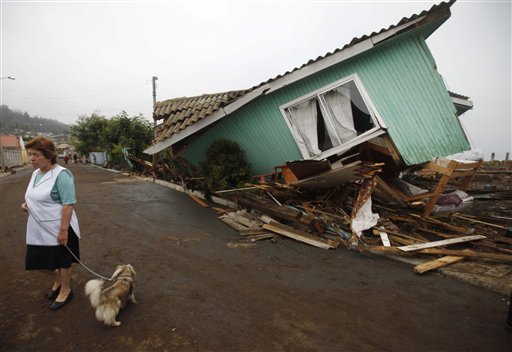
A woman stands in front of a damaged house after an earthquake in Pelluhue, some 322 kms, about 200 miles, southwest of Santiago, Sunday, Feb. 28, 2010. A 8.8-magnitude earthquake hit Chile early Saturday. (AP Photo/Roberto Candia)(Credit: AP) The ghost of Milton Friedman, writes Bret Stephens in the Wall Street Journal, “was surely hovering protectively over Chile in the early morning hours of Saturday.”
Thanks largely to him, the country has endured a tragedy that elsewhere would have been an apocalypse.
Stephens’ logic is simple. After the U.S.-backed coup in 1973, in which Gen. Pinochet seized power from the democratically elected president Salvador Allende, a group of Chilean economists mentored by Friedman, and known to history as “the Chicago boys,” instituted a series of radical free market reforms. Since that point, averaged over the decades, Chile has experienced the strongest sustained economic growth in South America. Rich countries, argues Stephens, are more likely to institute and enforce building codes. Q.E.D. Milton Friedman saved lives.
Some might find it intellectually provocative to cite Milton Friedman’s authority in an argument that depends on the foundation of successfully enforced government-mandated building code regulations. The building inspector is not exactly a libertarian hero. Others might wonder if a more important factor in Chile’s relatively tough building codes might be the devastating 9.5 earthquake the country endured in 1960. Haiti hadn’t experienced an earthquake as bad as the one this January in 240 years. Earthquake resistant building codes tend to be taken more seriously in regions that are accustomed to regular bouts of annihilation.
But the earthquake is just a side show for the opinion page of the Wall Street Journal — just another opportunity, however shameless, to push free market fundamentalism. One of the great blemishes on Milton Friedman’s legacy is his association with the Pinochet government, which has been held responsible for murdering some 2, 000 to 3,000 people during its 17-year tenure, along with arresting tens of thousands of other citizens and enforcing harsh controls on the press and other civil liberties. Friedman’s acolytes have long tried to wish away the complicity of the Chicago boys and their guiding light in one of the darkest chapters of modern Chilean history, but the stain is tough to get out. If trampling all over the democratically expressed wishes of the people and instituting an authoritarian reign of terror are what it takes to achieve economic growth, is it really worth it?
But a more pertinent question might be to ask just how much credit really is due Chicago-school economics for Chile’s current relative prosperity? Mining alone accounts for 20 percent of Chile’s GDP, and it is very much worth noting that the country’s crown jewel, the copper industry, is completely dominated by one state-owned company, Codelco. Ponder that, for a second: Latin America’s poster child for Chicago school economics features state control of the single most important economic resource. Huh.
Chile also suffers from some of worst income inequality in the world, and in fact, only began to take serious steps to address income disparities after the plebiscite that ended Pinochet’s rule. And how did the government do that? By raising taxes and social spending.
But it’s a job that’s hardly finished, as evidenced by the reports of serious social disorder currently emanating from Chile, which some observers have compared unfavorably with Haiti.
Vast extremes in income equality do not make people happy, especially in the aftermath of huge disasters. That might be the true lesson of Chile, and it’s one that the Chicago boys who make their home in the United States might do well to mull over.
Andrew Leonard is a staff writer at Salon. On Twitter, @koxinga21. More Andrew Leonard.
Strong quake jolts Chile; magnitude 6.8
The quake's center is exactly the same spot as last year's 8.8 earth shaker, but no tsunamis were spawned this time
More than 500 people died in the 8.8 earthquake on Feb. 27, 2010. No casualties have been reported in today's quake. A magnitude-6.8 earthquake struck central Chile Friday, centered in almost exactly the same spot where last year’s magnitude-8.8 quake spawned a tsunami and devastated coastal communities.
Electricity and phone service were disrupted and thousands of people fled to higher ground following Friday’s quake, but the government quickly announced that there was no risk of a tsunami, and there were no reports of damage or injuries.
President Sebastian Pinera appealed for calm and praised his government and Chileans in general for responding quickly.
Continue Reading CloseBiggest aftershock hits Chile on inauguration day
The temblor rocked buildings as dignitaries arrived for the swearing-in of a new president
The largest aftershock since Chile’s devastating earthquake rocked the South American country Thursday minutes before the inauguration of President Sebastian Pinera.
The 7.2-magnitude aftershock was stronger than the Jan. 12 quake that devastated the Haitian capital. It happened along the same fault zone as Chile’s magnitude-8.8 quake on Feb. 27, said geophysicist Don Blakeman at the U.S. Geological Survey in Golden, Colorado.
“When we get quakes in the 8 range, we would expect to see maybe a couple of aftershocks in the 7 range,” he said.
Continue Reading CloseDeadly quakes are coincidence, scientists say
Recent earthquakes are not a sign of impending apocalypse
Experts say there is nothing unusual about the latest spate of earthquakes in Haiti, Chile and now Turkey, but their devastating effects illustrate how increased construction up and down the world’s fault lines can translate into massive casualties.
And seismologists say that although one powerful quake can conceivably make others slightly more likely elsewhere, the string of quakes is probably just coincidence.
Bob Holdsworth, an expert in tectonics at Durham University, said Monday that “I can definitely tell you that the world is not coming to an end.”
Many quake survivors look to new president
After a destructive earthquake, Chileans hope their new leader is up to the tough job ahead
Chile’s earthquake and tsunami smashed this pretty little tourist town into splinters, leaving little more than immense piles of wreckage and an awful stench. Rooting through the remains Thursday, Dichato’s residents said they are pinning their hopes for renewal on the new president, a conservative billionaire who takes office next week.
Nothing short of mammoth reconstruction can return Dichato to a semblance of what it was, and survivors here — and throughout the disaster zone — said they’re hoping President-elect Sebastian Pinera is up to the job.
Continue Reading CloseAnother Milton Friedman Chile quake aftershock
Naomi Klein points out that Salvador Allende's government was responsible for the country's tough building codes
In the introduction to his book, “Pinochet’s Economists,” Juan Gabriel Valdes, a Chilean political scientistist who served as his country’s foreign minister in the post-Pinochet era, observes that Chile’s abrupt transition from radical socialism to radical Milton Friedman Chicago Schoolism has excited the enduring interest of outside parties of all political persuasions.
Continue Reading Close
Andrew Leonard is a staff writer at Salon. On Twitter, @koxinga21. More Andrew Leonard.
Page 1 of 5 in Chile Earthquake