Faddy foods
Macarons: The heir to the cupcake craze
It's small, colorful, crunchy, chewy, French, and it's about to take America by storm
What is it?
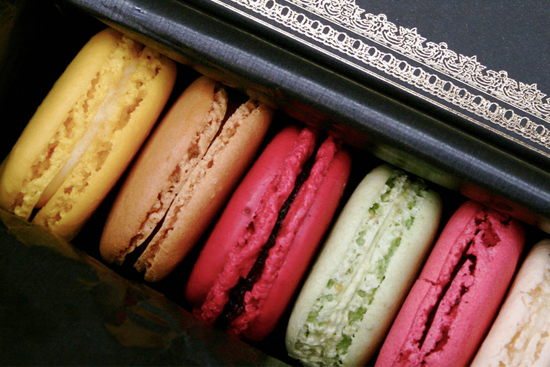
Only one “o” separates the sticky-sweet coconut balls called macaroons from macarons, but it’s not the Passover treat that has Gossip Girls and American food fanatics buzzing. Macarons are traditionally high-end French confections that look like whoopie pies on acid — incredibly saturated with color, their delicate outer shells are glossy and crunchy, with domed tops and flat bottoms (known as “the foot”). Basically crisp meringues of sweetened egg whites and almond flour, the cookies are sandwiched around a ganache, buttercream, or a fruit puree.
They come in a dozens of fruity, nutty and sweet flavors — raspberry, lemon, pistachio, chocolate and caramel are common — and even some highly unconventional ones: foie gras, white truffle, rose, violet. Macaron bakers pride themselves on fashioning distinctive colors and sometimes dustings of powders to distinguish their flavors, and their visual appeal is hard to deny. Check out these photographs to see the variety of their bright, saturated colors, which can look like an intense array of exotic fruits.
But it’s the texture of the macaron that makes it truly unique. The crunch is subtle — unlike, say, a potato chip — and the fillings’ moisture helps soften the interior of the meringue to a chewiness. When you bite into it, the shell cracks and dissolves on your tongue, you chew, the filling melts, and the flavors announce themselves.
Where did it come from?
The origins of the macaron aren’t entirely clear — they may have been invented in Renaissance Italy monks — and are believed to have been introduced to France by the pastry chefs of Catherine de Medici in the 16th century. But in any case, what is currently known as a macaron (with the crisp-chewy shell and soft filling) was invented by Pierre Defontaines in the 1930s.
For decades the only flavors of macaron were chocolate, vanilla, coffee and raspberry — that is, until Pierre Herme, a French pastry wiz kid who apprenticed under famed patissier Gaston Lenotre at the tender age of 14, became the head patissier at Fauchon, the upscale Parisian patisserie, in the late 1980s. At Fauchon, he pioneered bold and new flavors — like rose, olive oil and ketchup — and in the ’90s collaborated with Laduree — France’s best-known macaron-makers — to expand their flavor repertoire. Released seasonally, like haute couture, new flavors get their own lines. (At Laduree, spring 2009 was Lily-of-the-Valley.)
Since then, France has witnessed a macaron explosion that has, in the last several years, gone international. The desserts have increasingly popped up in culinary and non-culinary magazines (like O), been prominently featured in Sofia Coppola’s “Marie Antoinette,” became minor plot points on the CW’s “Gossip Girl,” and in high-end American restaurants, have become a popular mignardise (a post-dessert treat to enjoy with your coffee … and to take the edge off getting the check).
Who’s eating it?
The fact that macarons are extremely difficult to make well (something as subtle as the humidity in your kitchen can ruin them) and have a short window where they’re best — after the filling has softened the meringue, but before the cookie dries out — means that they have always been a painstaking, small-batch product, and expensive. (If you understand French, or, erm, Quebecois, you can watch this helpful demonstration on how to make them.)
But as the Wall Street Journal pointed out this morning, the macaron is now getting a populist makeover. More and more coffee shops and grocery stores are selling versions of the treat on both sides of the Atlantic. Laduree recently opened a stall in London’s Harrod’s department store, and since 2007, French McDonald’s have been selling them cheaply at McCafes, their in-restaurant cafes (the macarons are sent to the restaurants frozen) — a fact that has many purists disappointed that they’re not made or treated with the care that makes them special. In the U.S., Whole Foods, Trader Joe’s and even Starbucks have begun offering packaged versions of the macarons.
But, even in their diminished form, the macaron is likely headed for a popular explosion. As YumSugar’s Susannah Chen point out in the Wall Street Journal, it has the makings of the next cupcake craze: “They come in different colors and flavors, and they’re indulgent, but they won’t wreck your calorie count for the day.”
Longevity rating: 10 (out of 10)
Clearly, history is on the macarons’ side — and if confectioners can figure out how to do them right on a big scale, it’s only a matter of time before America is completely invaded by their rainbow of sweet and crunchy deliciousness.
Thomas Rogers is Salon's Arts Editor. More Thomas Rogers.
Pop Torn: 10 pieces of culture we’re feeling iffy about
From "True Blood" to Mark Zuckerberg killing a goat to a purse made out of jerky, this week is all about meat
Memorial Day weekend, you guys! I know that I will be happy to wear all my white clothing again, because nothing says “I’ve been to a summer barbeque” like visible condiment sauce all over my clothing.
And with this warm weather comes tons of pop culture news stories that are just to the right of funky. We’ve rounded up some of the stranger stuff that we missed this week, and leave it up to you to decide if maybe being raptured wasn’t such a bad idea.
1. People who think the Onion’s headlines are real: Oh, it happens. And now it’s a Tumblr. (Expect a book deal in the near future.)
Continue Reading CloseDrew Grant is a staff writer for Salon. Follow her on Twitter at @videodrew. More Drew Grant.
How do “natural” non-sugar sweeteners stack up?
With Nutrasweet and Splenda taking a hit, we look into -- and taste -- trendy alternatives like agave syrup
Now that the artificial sweetener aspartame (Nutrasweet) has attracted suspicion, you might be thinking twice about that daily Diet Coke or Splenda (sucralose) in your coffee. Not that this is surprising; even without the stroke and cancer warnings, the word “artificial” alone conjures up images of shadowy figures in lab coats concocting solutions destined for your stomach. Much more reassuring are images of freshly plowed farms tucked in the mountains, like the one on the jar of Lundberg Family Farms’ organic brown rice syrup.
Continue Reading CloseAviva Shen is an editorial fellow at Salon. More Aviva Shen.
The utter ridiculousness of hip food trends
A chef describes how suddenly hot ingredients -- like razor clams -- hurt the consumer in the end
A razor clam So here are some tweets from this week, from longtime restaurant critic Gael Greene and NBC’s thefeast.com food editor Matt Duckor:
Gael Greene We had razor clams three nights in a row last week. John Dory, Bar Basque, Dressler. Good but not a match for Esca’s.
mattduckor @GaelGreene Casa Mono’s razor clams predate the trend and are excellent.
Continue Reading CloseEddie Huang is chef and owner of BaoHaus restaurant in New York City. He writes the blog, Fresh Off the Boat. More Eddie Huang.
America: It’s time to win the future (of cooking vegetables)
Meat debauchery was so 2010 (and every year before that). Chefs are having fun with vegetables, and you can too
Tomato, Many Complementary Flavors from the restaurant Alinea I’ve heard it and read it — and said it myself — over and over: Vegetables will be the hot food trend in 2011. Of course, I say that with the wincing pain that comes with the knowledge that the words leaving your mouth sound stupid. I mean, it’s like saying air will be the new hotness in breathing. But here’s the thing: Despite our ever-increasing culinary sophistication and our interest in vegetarianism, veganism and just plain-old eating less meat for health or environment or whatever, Americans have most assuredly not won the future on the creative, enthusiastic cooking of vegetables. Yet.
Continue Reading CloseFrancis Lam is Features Editor at Gilt Taste, provides color commentary for the Cooking Channel show Food(ography), and tweets at @francis_lam. More Francis Lam.
Police arrest Kobayashi for hot dog contest outburst
A former eating champion illegally stage rushes the famous Coney Island competition's award ceremony
Hot dog!
Competitive eater Joey Chestnut has held on to his title at the annual July Fourth hot dog eating contest at New York’s Coney Island, but one of his biggest rivals tried to crash the celebration and has been taken into custody.
Chestnut chomped down on 54 hot dogs in 10 minutes on Sunday to win the annual Nathan’s International Hot Dog Eating Contest for the fourth year in a row.
Watching from the crowd was six-time champion Takeru Kobayashi (tah-KEH’-roo koh-bah-YAH’-shee), who has not signed a contract with Major League Eating to be free to compete in contests sanctioned by other groups.
But Kobayashi went on stage after the competition. Police officers grabbed him, and he tried to hold onto police barricades as they took him into custody.
Page 1 of 4 in Faddy foods
The facts: Beloved by raw food enthusiasts, agave syrup has become one of the easiest alternative sweeteners to find in grocery stores. It’s derived from the Mexican succulent plant agave, of which there are several varieties. It has to be processed to become sweet, and depending on that process, it can be comparable in composition to the dreaded high fructose corn syrup. True, agave has a low glycemic index — meaning it releases glucose into the blood stream at a slower rate than refined sugar — so it can help keep blood sugar levels stable. Eating agave as a “healthy” alternative to sugar, however, is pointless; the two have the same number of calories, no nutritional value whatsoever, and, even though it doesn’t spike blood sugar, the primary sugar in agave, fructose, has been linked to cancer and cholesterol problems when consumed in large quantities.
The facts: Brown rice syrup is what happens when cooked brown rice meets barley malt enzymes. The sweetness comes from starchy complex carbohydrates, which take a couple of hours to digest. As a result, the glucose is released gradually into the bloodstream, providing a steady supply of energy rather than the rush — and crash — of cane sugar. Plus, the syrup maintains some of the nutrients in brown rice, like protein, so it’s not a total nutritional bust like most sweeteners are.
The facts: Stevia’s not technically a sugar; it’s extracted from a sweet herb of the same name. Therefore it has no calories and doesn’t raise blood sugar. Though the FDA labeled it a “dangerous food additive” in 1991 after an “anonymous industry complaint” (read: shadowy figures in lab coats), stevia is now back on the market as a “dietary supplement.” In the rest of the world, particularly Japan, widespread use of stevia has been going on for decades.
The facts: Date sugar is so low-tech it’s kind of funny — it’s just dehydrated dates that have been ground into a powder. That means it’s completely unprocessed and retains all the nutrients in dates. It’s high in fiber and protein, and has lots of vitamins and minerals like iron and potassium. Plus, it qualifies as a raw food. It still contains sucrose, fructose and glucose, so it’s not a good alternative for diabetics or people looking to control their blood sugar.