
Tyler Perry’s good mission, lousy movies

"Why Did I Get Married Too?" renews an old debate: Is the hugely successful black filmmaker a hero -- or a hack?

Topics: Tyler Perry, Film Salon, Movies,

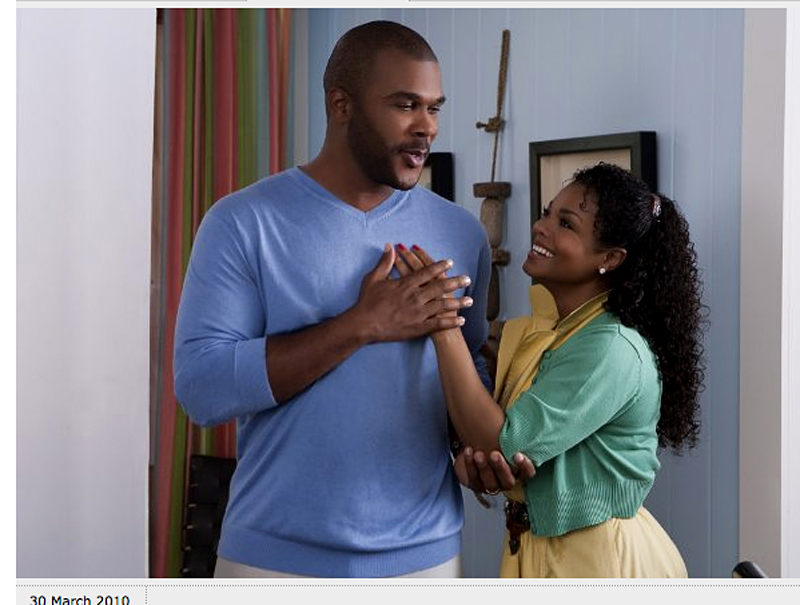
Tyler Perry's good mission, lousy moviesTyler Perry and Janet Jackson

In the black community, you don’t have to seek out Tyler Perry movies; they come to you. I watched the original “Why Did I Get Married?” over at my mother’s house one night when I visited for dinner, after she and my sister (avid cinephiles) anxiously popped in the DVD before I could even object. A few months later, on a bachelor/bachelorette wedding outing, the bride-to-be introduced the movie — about four African-American couples struggling with their relationships over one disastrous weekend — by announcing, “This is everything that should not happen on this trip.”

But as ubiquitous as Tyler Perry movies are, they are equally as contentious. And as “Why Did I Get Married Too?” (which did not screen prior to its release) opens this Friday — most likely met with big box office and lukewarm reviews — I am bracing myself for the inevitable debates to come about Tyler Perry, the man and the work.

Over on my blog, Racialicious, any discussion of Tyler Perry immediately becomes polarized, with fans and detractors fighting for comment space. Does Tyler Perry really speak to the black community, or just a small, primarily religious and middle-class portion of it? Do his movies condone domestic violence? Should we support his movies regardless of what we think of them, knowing there are so few successful black filmmakers? And don’t even get readers started on Medea — the wisecracking, pistol-packing grandma with a heart of (tarnished) gold, the role that catapulted Perry to fame. The debate gets louder with each new release, but the argument boils down to one question: Does Perry’s importance as a black filmmaker — who uses actors and actresses of color — outweigh the mediocrity of his work?

It’s a question I go back and forth on. As a feminist, I bristle in my seat at his treatment of women. Nichole at Postbourgie throws a wrench in the Perry machine, noting:


TP wants to teach women how to have successful relationships by making sure their male partners are satisfied. His morality plays, on stage and film, scold women: Be quiet, in appearance and voice. Don’t try to be more than what you are. Serious ambition is a danger to the family. Be grateful for “good enough.” Wait for the right man to notice you. Don’t bring attention to yourself. Be appropriately thankful when a man takes care of you.

Of course, part of Perry’s problem is the unfair burden placed on him as one of only two prominent African-American filmmakers, along with Spike Lee. There certainly are other black directors — Gina Prince-Bythewood, John Singleton, Kasi Lemmons and Darnell Martin, to name a few — but only Lee and Perry have the power and influence to produce major motion pictures, which puts an intense scrutiny on their choice of subject matter and project. (Tyler Perry’s decision to write and adapt Ntozake Shange’s “For Colored GirlsWho Have Considered Suicide When the Rainbow Is Enuf” wasn’t exactly met with parades. I wrote about my own misgivings at the time.) 

But while Spike Lee’s movies are searing investigations into the black American psyche, Perry has more in common with the bland Hollywood romantic comedies of Ken Kwapis (“He’s Just Not That Into You,” “License to Wed”), Garry Marshall (“Valentine’s Day,” “Raising Helen,” “Runaway Bride,” “Pretty Woman”) and Robert Luketic (“The Ugly Truth,” “Monster in Law,” “Win a Date With Tad Hamilton”). 

Tyler Perry, at heart, is an entertainer. He’s good at churning out stories about people battling with life and love. There’s nothing remarkable about the scripts that he produces; in a way, he’s only doing what thousands of other white filmmakers do — he’s eking out a living making formulaic date flicks. But consider the fact that the romantic comedies of the past year barely featured minority extras — far less minority heroes — and you get a sense of how extraordinary it is that Tyler Perry puts African-American stories front and center in his films.

In the meantime, I just bought two tickets to “Why Did I Get Married, Too?” on Fandango. But if anyone asks, I’m there supporting Jill Scott. 

Featured Slide Shows

7 motorist-friendly camping sites

close X
  • Share on Twitter
  • Share on Facebook
  • Thumbnails
  • Fullscreen
  • 1 of 9

Sponsored Post

  • White River National Forest via Lower Crystal Lake, Colorado
    For those OK with the mainstream, White River Forest welcomes more than 10 million visitors a year, making it the most-visited recreation forest in the nation. But don’t hate it for being beautiful; it’s got substance, too. The forest boasts 8 wilderness areas, 2,500 miles of trail, 1,900 miles of winding service system roads, and 12 ski resorts (should your snow shredders fit the trunk space). If ice isn’t your thing: take the tire-friendly Flat Tops Trail Scenic Byway — 82 miles connecting the towns of Meeker and Yampa, half of which is unpaved for you road rebels.
    fs.usda.gov/whiteriveryou


    Image credit: Getty

  • Chattahoochee-Oconee National Forest via Noontootla Creek, Georgia
    Boasting 10 wildernesses, 430 miles of trail and 1,367 miles of trout-filled stream, this Georgia forest is hailed as a camper’s paradise. Try driving the Ridge and Valley Scenic Byway, which saw Civil War battles fought. If the tall peaks make your engine tremble, opt for the relatively flat Oconee National Forest, which offers smaller hills and an easy trail to the ghost town of Scull Shoals. Scaredy-cats can opt for John’s Mountain Overlook, which leads to twin waterfalls for the sensitive sightseer in you.
    fs.usda.gov/conf


    Image credit: flickr/chattoconeenf

  • Nordhouse Dunes Wilderness Area via Green Road, Michigan
    The only national forest in Lower Michigan, the Huron-Mainstee spans nearly 1 million acres of public land. Outside the requisite lush habitat for fish and wildlife on display, the Nordhouse Dunes Wilderness Area is among the biggest hooks for visitors: offering beach camping with shores pounded by big, cerulean surf. Splash in some rum and you just might think you were in the Caribbean.
    fs.usda.gov/hmnf


    Image credit: umich.edu

  • Canaan Mountain via Backcountry Canaan Loop Road, West Virginia
    A favorite hailed by outdoorsman and author Johnny Molloy as some of the best high-country car camping sites anywhere in the country, you don’t have to go far to get away. Travel 20 miles west of Dolly Sods (among the busiest in the East) to find the Canaan Backcountry (for more quiet and peace). Those willing to leave the car for a bit and foot it would be remiss to neglect day-hiking the White Rim Rocks, Table Rock Overlook, or the rim at Blackwater River Gorge.
    fs.usda.gov/mnf


    Image credit: Getty

  • Mt. Rogers NRA via Hurricane Creek Road, North Carolina
    Most know it as the highest country they’ll see from North Carolina to New Hampshire. What they may not know? Car campers can get the same grand experience for less hassle. Drop the 50-pound backpacks and take the highway to the high country by stopping anywhere on the twisting (hence the name) Hurricane Road for access to a 15-mile loop that boasts the best of the grassy balds. It’s the road less travelled, and the high one, at that.
    fs.usda.gov/gwj


    Image credit: wikipedia.org

  • Long Key State Park via the Overseas Highway, Florida
    Hiking can get old; sometimes you’d rather paddle. For a weekend getaway of the coastal variety and quieter version of the Florida Keys that’s no less luxe, stick your head in the sand (and ocean, if snorkeling’s your thing) at any of Long Key’s 60 sites. Canoes and kayaks are aplenty, as are the hot showers and electric power source amenities. Think of it as the getaway from the typical getaway.
    floridastateparks.org/longkey/default.cfm


    Image credit: floridastateparks.org

  • Grand Canyon National Park via Crazy Jug Point, Arizona
    You didn’t think we’d neglect one of the world’s most famous national parks, did you? Nor would we dare lead you astray with one of the busiest parts of the park. With the Colorado River still within view of this cliff-edge site, Crazy Jug is a carside camper’s refuge from the troops of tourists. Find easy access to the Bill Hall Trail less than a mile from camp, and descend to get a peek at the volcanic Mt. Trumbull. (Fear not: It’s about as active as your typical lazy Sunday in front of the tube, if not more peaceful.)
    fs.usda.gov/kaibab


    Image credit: flickr/Irish Typepad

  • As the go-to (weekend) getaway car for fiscally conscious field trips with friends, the 2013 MINI Convertible is your campground racer of choice, allowing you and up to three of your co-pilots to take in all the beauty of nature high and low. And with a fuel efficiency that won’t leave you in the latter, you won’t have to worry about being left stranded (or awkwardly asking to go halfsies on gas expenses).


    Image credit: miniusa.com

  • Recent Slide Shows

  • Share on Twitter
  • Share on Facebook
  • Thumbnails
  • Fullscreen
  • 1 of 9

Comments

13 Comments

Comment Preview

Your name will appear as username ( settings | log out )

You may use these HTML tags and attributes: <a href=""> <b> <em> <strong> <i> <blockquote>