
There’s no denying that the GOP is looking good going into the midterms this November. But we don’t know exactly yet how good — it’ll depend a lot on the state of the economy over the coming months. And the fact is that, after two catastrophic elections, Republicans have a lot of ground to make up.
If conditions stay extremely favorable to the GOP, then it’s very possible that control of the House of Representatives could flip. The universe of House seats that could be in serious play is larger than the margin between the two parties. On the other hand, the economy could start sinking again and it still probably wouldn’t change control of the Senate. No matter how bad a year is ahead for Democrats, the structural constraints of senatorial elections make it virtually impossible for a change in party control — especially given some recent developments.
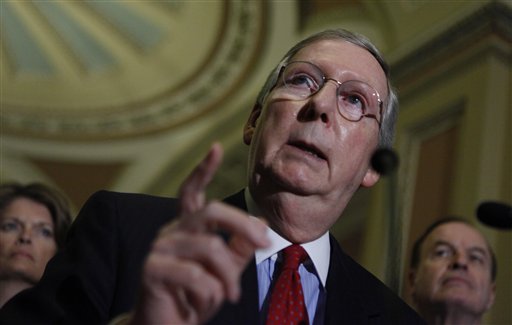
Republicans need to pick up 10 seats in the Senate to install Sen. Mitch McConnell, R-Ky., as the majority leader. Even with the assumption that they knock off every possible target, and hold all of their vulnerable seats, it still looks like they’ll need a wild card or two. And those seem to be slipping away.
In New York, George Pataki, the former three-term governor, just ruled out a challenge to appointed Democratic Sen. Kirsten Gillibrand. That’s probably the end of the GOP’s hopes of taking this seat. Gillibrand still seems to lack a deep connection with New York voters, but has uncannily good luck when it comes to her opponents. She seemed vulnerable in a Democratic primary, but only attracted former Rep. Harold Ford, R-Tenn., as a possible challenger, who quickly turned himself into a national joke, then bowed out. Given New York’s natural Democratic tilt, without a top-shelf Republican challenger like Pataki or Rudy Giuliani, Gillibrand is likely to cruise to a full term. That’s one wild-card possibility slipping away.
Wisconsin has a somewhat similar story. Democratic Sen. Russ Feingold has never had a complete lock on his seat. Wisconsin politics is known for quirky reformist liberals like Feingold, but it remains a swing state, with large, rural and conservative sections. Feingold is the kind of three-term senator who could go down if the right combination of national conditions and a strong local challenge came together. This time, former governor and Bush administration cabinet member Tommy Thompson seemed like the best, and maybe only, candidate who could rival Feingold. But Thompson is announcing his decision today, and the word is that it’s probably a no. Count another possibility out for the GOP.
Without either of those two seats, there’s no real way that Republicans can get to 51. But developments elsewhere are making it look like it may be harder than expected even to get to 48 or 49.
The Kentucky race this year has had some unusual twists. First incumbent Republican Sen. Jim Bunning had to be pushed out of the race by his party leader and fellow Kentuckian, McConnell. Then McConnell’s anointed candidate, Secretary of State Trey Grayson, seemed content to sit back and allow Dr. Rand Paul — son of Ron — to run right past him. Paul is now the improbable favorite, and yesterday won the endorsement of the outgoing Bunning to boot. This is a Republican state in a Republican year, so most likely, either GOP candidate is a favorite to win in the end. But Paul is idiosyncratic enough that he might alienate significant parts of the Republican base; really, does the GOP win elections in the South by opposing the Federal Reserve and international entanglements in the Middle East? And if Paul does stumble, Democrats have good candidates vying for their nomination: Lt. Gov. Dan Mongiardo, also a doctor, and Attorney General Jack Conway.
And in Florida, the chatter about a possible independent bid by Republican Gov. Charlie Crist seems to get a little louder every day. Like Grayson in Kentucky, Crist allowed a more ideological candidate — new right-wing darling Marco Rubio — to sneak right past him and rack up a big lead. Unlike Grayson, however, Crist appears to have no chance at recovery in the Republican primary, but is obviously the strongest general election candidate around. That’s the standard recipe for an independent candidacy. Crist has ruled out the idea so far, but it’s hard to imagine he’ll just sit and take the walloping Rubio is set to give him. Rubio, by the way, only leads likely Democratic candidate Rep. Kendrick Meek by four points in the latest general election poll; Crist beats Meek by 14. In a three-way race, Crist leads with 32 points, followed by Rubio at 30, and Meek at 24. In other words, there’s only one way that the GOP can put this race away for sure, and it’s the one thing that Republicans won’t do: nominating Crist for Senate.
Since President Obama came into office and found himself unable to get his legislation through a recalcitrant, procedure-bound Senate, liberals have complained that the chamber is dysfunctional. But now that they’re looking at losing power, there is, at least, one nice thing for Democrats about the oddness of the Senate: unlike choosing a new House, when we vote for a new Senate, the results are confined by which senators happen to be up for reelection in a particular year. So this year, it looks like the GOP just doesn’t have enough targets to take control of the body, no matter how strong the wind at the backs of Republican candidates.
