Gulf Oil Spill

Should you avoid Gulf seafood?

Stock up on those shrimp: Here's why you don't need to worry about oil toxins in your fish

  • more
    • All Share Services

Topics: , , ,

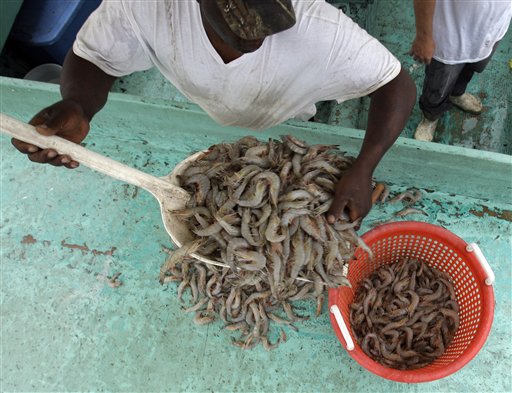
Should you avoid Gulf seafood?Hosea Wilson loads shrimp from their catch into a basket, Monday, May 3, 2010, at the Venice Marina in Venice, La. NOAA has restricted commercial and recreational fishing in oil-affected portions of the Gulf of Mexico. Their boat has been recruited to aid with the oil spill clean up efforts. (AP Photo/Eric Gay)(Credit: AP)

From certain angles, the Gulf oil spill is making it look like boom times for shrimp fishermen along the Gulf Coast. Barely hour after opening the Crescent City Farmer’s Market in New Orleans yesterday, vendors were nearly sold out. Todd Rosetti, owner of Quality Poultry and Seafood in Biloxi, MS, tells me he can’t keep enough stock in his warehouse. But when I called him, he answered my greeting of “How’s it going?” with a terse “For shit.” I met Todd a couple of years ago, when I did a series of oral histories on shrimping culture in Biloxi, and he usually talks with a measured, polite calm, but his voice betrayed his stress. He’s not sure how long he’ll be able to get shrimp to sell, and how long people are going to want it.

The damage the oil will cause to the Gulf ecology and economy is, of course, still unknown. As Mike Madden reported for Salon, many fishermen are stuck waiting for an all-clear to go fish, while the mortgage bills on their boats stack up. But even for the fishermen who survive what the black goop hath wrought (and, battered by decades of cheap imported shrimp and barely hanging on after Hurricane Katrina, there may not be many), the gravest damage to the Gulf fishing industry may be, like the oil spill itself, man-made: a market hollowed out by fear of contaminated seafood, even if it’s actually safe to eat.

Right now, there is a surge in What-if-I-Can’t-Have-It-Anymore Gulf seafood sales; spurred on by reports of impending oilpocalypse, fans of the stuff are loading up for their last hurrahs. A friend who stopped by the Crescent City market saw people filling coolers destined for their freezers; a friend of his bought 20 pounds of shrimp — 10 for herself, and 10 for her friend on jury duty. But for shrimpers, this is a good thing that’s also a bad sign, because the more the anticipation of Gulf Shrimp Armageddon grows, the more likely we are to eventually turn and believe that whatever Gulf seafood that makes it to the market is tainted.

The misunderstanding would be easy to understand. After a string of widely publicized food safety failures in recent years — from E. Coli spinach to all manner of ground beef badness — consumers are already jittery about food that comes from seemingly wholesome places, and “75% of the Gulf is still clean!” is not the kind of PR slogan that’s going to get a lot of traction. And then there’s the fact that the closing of fishing grounds is actually a bit more complex than is usually reported. Concerned about oil contamination, the National Oceanic and Atmospheric Administration (NOAA) declared an open-ended hold of at least 10 days on all fishing in an area of Federally-controlled waters between eastern Louisiana to Pensacola Bay in Florida. (Click here for a map of the closed area.) I had to say that again, slowly, three times before I caught all that, with the important caveats — like fishing still being legal and safe in the closer-to-shore State-managed waters. But boil it down to a media-friendly headline, like “Gulf Fishing Closed from Louisiana to Florida,” and you can see where people will start thinking there’s no safe fishing in the Gulf at all, and even legal, NOAA-inspected catches will be shunned in the market.

That’s what worries Frank Parker most. Frank is a seventh-generation fisherman in Biloxi, possessed of a swagger and optimism I didn’t see elsewhere among Gulf fishermen. “I’m one of the aces in this business,” he said to me, proud of his ability to make it in shrimping after Katrina, when many captains were hanging up their galoshes for good. He’s confident his ace-ness will carry him through this oil spill, too, since he knows the spots to fish that are expected to be unthreatened by oil, spots in the area that produces 77% of Louisiana’s shrimp catch anyway. But what he can’t control is whether people will buy his catch. “Oyster season, for instance, always closes around the end of April. It just coincided with the oil spill this year, so the media jumped on it, and that caused a frenzy of people thinking that they closed the oyster season because of contamination. I will worry if we do get some kind of oil, but I’m really worried if they open the shrimp season and the public still thinks the seafood is tainted.”

Dr. Jim Cowan, a professor in the Department of Oceanography and Coastal Science at Louisiana State University, is an expert in fisheries management and ecology. “There’s no potential now for contaminated seafood,” he says. “All the seafood available now was harvested before the oil spill, so I certainly wouldn’t be worried about it being contaminated.”

But he’s concerned, too about the public shunning of Gulf seafood. “When the fishing grounds are reopened — and they will be — I’d be confident in the safety of the food. It’s pretty easy to test [for oil-related toxins] in the product. Consumer safety is as big a part of NOAA as fisheries management, and they’re very, very good at monitoring contamination. Every once a while, small oyster areas will be closed because a boat came in and pumped out their ballast water. They can find that, so they have a strong system. I think consumers can be confident.”

But what Dr. Cowan is not confident of, though, is whether there will be many fishermen left to work the waters when they re-open. Many, who work on bigger boats, do need to fish in deeper waters — the kind that are currently closed — and it may not be long before their unpaid mortgages put them out of business. And, of course, the spill could move and worsen.

“The shrimp industry in the Gulf has declined primarily because of the price of imported shrimp. Between that, Katrina, and the price of fuel going up again, I don’t know whether the fishery is resilient to withstand a closure like this for very long. This could be very serious,” he says. When asked what can be done to save this industry and this way of life, he reiterated an answer I’ve been hearing from years from fishermen themselves: “Encourage people to eat Gulf oysters and shrimp.”


Continue Reading Close

Francis Lam is Features Editor at Gilt Taste, provides color commentary for the Cooking Channel show Food(ography), and tweets at @francis_lam.

Gulf spill criminals

Two years on, the Feds have filed charges against a former BP employee for destroying critical evidence

  • more
    • All Share Services

Topics:

Gulf spill criminalsIBRCC / CC BY 2.0
This originally appeared on ProPublica.

Two years after oil from a BP well began gushing into the Gulf of Mexico, the U.S. Department of Justice has filed criminal charges alleging that a former BP employee destroyed critical evidence in the early days of the unfolding disaster.

The charges are the first to be filed in what the Obama administration has called the worst environmental disaster in American history, and they are significant because they target an individual employee for his actions.

According to an affidavit and complaint filed today in a Louisiana court, Kurt Mix, a former drilling and completions engineer, deleted email and text messages he had sent to senior BP managers estimating that the amount of oil spewing into the Gulf was many times greater than the amount stated publicly. Mix was specifically instructed by attorneys contracted by BP to retain his records before he deleted them, the affidavit states.

In a statement released to reporters, U.S. Attorney General Eric Holder indicated that more charges are likely, describing the indictment as “initial charges” in an ongoing investigation, and saying that the Department of Justice “will hold accountable those who violated the law.”

More than 200 million gallons of crude oil flowed into the Gulf of Mexico after a blowout caused the explosion of the Deepwater Horizon oil rig and the death of 11 workers on April 21, 2010. The spill continued, unabated, for nearly three months. Analysts have long expected criminal charges against BP or its employees.

A spokeswoman for the agency declined to say when more charges might be expected, or to explain why the case against Mix was the first to be made public.

Mix could not be reached for comment, and we were unable to leave him a message because his voicemail was full.

BP issued a statement saying that the company was cooperating with federal investigators and that “BP had clear policies requiring preservation of evidence in this case and has undertaken substantial and ongoing efforts to preserve evidence.”

According to an FBI affidavit submitted to the court along with the indictment, Mix, who worked for BP until January 2012, was directly involved in BP’s efforts to understand how much oil was flowing out of the broken Macondo well. On April 21, 2010, Mix estimated that between 68,000 and 138,000 barrels of oil were leaking each day — far more than the 5,000 barrels that were estimated publicly at the time.

On April 22, Mix received the first of six legal notices instructing him to retain his electronic records.

Yet, according to the affidavit, in early October, Mix allegedly deleted a string of more than 200 text messages on his iPhone that he had sent to a supervisor. The deleted texts, which the Department of Justice said were recovered forensically, included sensitive — and pessimistic — internal BP information sent while the company was attempting what it called a “Top Kill” effort to stop the gushing oil on May 26, 2010.

Mix wrote that the effort — which he was directly involved in — was unlikely to succeed. “Too much flowrate — over 15,000 and too large an orifice. Pumped over 12,800 bbl of mud today plus 5 separate bridging pills. Tired. Going home and getting ready for round three tomorrow.”

At the time, BP said publicly that the measure had a 70 percent chance of success.

Mix, 50, was arrested in Katy, Texas today. If convicted, he faces a maximum penalty of 20 years in prison and a fine of up to $250,000 on each of the two counts he is charged with.

Continue Reading Close

Abrahm Lustgarten is a New York writer and photographer who reports on the environment, health and sports.

The horrific ramifications of the Gulf oil spill

Two years after the BP oil spill, deformed fish point to lasting environmental and health consequences

  • more
    • All Share Services

Topics: , , ,

The horrific ramifications of the Gulf oil spillThis 2011 photo provided by Donald Waters shows a fish harvested from the Gulf of Mexico with unusual lesions and infections. Two years after the Deepwater Horizon rig exploded and sank, touching off the worst offshore spill in U.S. history, the latest research into its effects is starting to back up those early reports from the docks: The ailing fish bear hallmarks of diseases tied to petroleum and other pollutants. (AP Photo/Courtesy Donald Waters) (Credit: AP)
This piece originally appeared on AlterNet.

Almost two full years after the BP oil spill, a panel of experts gathered at the 17th annual Tulane Environmental Law Summit, to present the continuing impacts of the BP Oil Spill. That spill began with the April 20, 2010, explosion of the Deepwater Horizon drilling unit used by BP 40 miles off the Louisiana coast. Eleven men lost their lives. The resulting spill of oil into the Gulf of Mexico stands as the largest oil spill in U.S. history and the second largest environmental disaster in this country to date besides the nearly decade-long Dust Bowl of the 1930s. Scientists at the summit presented recent photographs of shrimp with no eyes and fish with cancerous tumors born long after the gulf was declared “safe” for fishing.

AlterNetIt turns out that testing water and fish flesh under the surface oil after the spill was not very telling about long-term impacts as oil and water don’t mix and the chronic, toxic impacts were delayed until long after BP was put in charge of the “cleanup.” When BP sprayed chemical dispersants containing a slew of toxic heavy metals including arsenic, the oil didn’t magically disappear. It sank into the sediment. Disturbingly, the allowable levels set by the government for the toxins in our seafood are based on health impacts for a 176-pound adult eating less than two medium shrimp a day. The testing is for one chemical out of a crude oil mixture containing thousands of chemicals. No synergistic effects are considered. This in no way protects children, fetuses, people who weigh less than 176 pounds or anyone who eats seafood on a daily basis like the folks here on the Gulf Coast.

Dr. Andrew Whitehead, Ph.D., associate professor, Department of Biological Sciences, Louisiana State University, who is studying the BP spill and has reviewed much of the scientific studies of the Exxon Valdez spill, explained that stock declines of species may take several years to develop as reproduction is impacted in successive generations and across species. The Exxon Valdez spill is now known to be responsible for the decline of many species, including marine mammals, marine birds, and fishes such as pink salmon and herring. Though we have a take on the immediate acute impacts of the BP spill on animals caught in the oil, the chronic ultimate impacts of the BP spill are still unknown. But we do know that the killifish, the most abundant forage fish for the bigger fish in Gulf Coast marshes, are being affected. Fish from oiled marshes show signs of direct toxicity and reproductive impairment. Dr. Whitehead’s experiments involving exposures to oiled sediments, done in collaboration with colleague Dr. Fernando Galvez, show that killifish embryos are taking longer to develop or don’t hatch at all. They are being born with malformed hearts and hearts that may not function properly when they mature. And as the impacts from the spill on the fish bioaccumulate and propagate across generations, liability is harder to prove without good and strategic scientific study that sadly is harder to fund.

But some impacts are being felt now, especially for sediment dwelling seafood. Current reports from fisherman up and down the coast are startling. The oyster harvest for 2010 was the worst in more than four decades and oystermen continue to report catches down as much as 75 percent. Crab catches are in steep decline. Brown shrimp production is down two-thirds. And the white shrimp season was even worse, leading to descriptions of “worst in memory” and “nonexistent.” This from the region that before the spill provided 40 percent of the nation’s seafood.

Dr. Patricia Williams, Ph.D., Diplomate of the American Board of Toxicology, Associate Professor, Coordinator of Toxicology Research Laboratories, Pontchartrain Institute for Environmental Sciences, University of New Orleans, spoke at the summit about what she sees as a failure to properly assess the impact of the spill on seafood and on human health. She said:

In 1996, the National Oceanic and Atmospheric Administration acknowledged that direct measurement of tissue for PAH (polycyclic aromatic hydrocarbon) concentrations generally does not provide a useful indicator of exposure of fish to PAHs from petroleum spills. Regardless, an extremely expensive seafood testing program was launched using this method. Testing included only 13 PAH parent compounds out of 200 PAHs present in crude oil. PAHs act on each other resulting in greater toxicity than expected from a single PAH (synergism). The synergistic nature of the PAHs were ignored in interpretation of the results. Additionally, the Levels of Concern were calculated for a 176 pound individual. This does not address toddlers and children or the developing fetus and placental transfer. The public was not warned of these deficiencies in the seafood testing program.

Dr. Williams explained that “PAHs are endocrine disruptors that interfere with the normal blood-borne hormones (e.g., estrogen and testosterone) that are responsible for the regulation of reproductive and developmental processes. Only very low amounts of chemicals are needed to disrupt the normal endocrine balance of both humans and animals. Evidence of reproduction imbalance is seen in the second generation of white shrimp in the 2011 harvest. Shrimp were harvested with defective eye stalks, pleopods, and pereiopods. Such anatomical defects are occurring in the markedly reduced white shrimp population in the Gulf and warn of endocrine dysfunction that could result in the loss of the species.”

Furthermore, “The heavy metals known to be present in crude oil are being ignored in the testing of seafood. Metal toxicity can produce neurobehavioral abnormalities in sea life such as: alterations in avoidance or attraction responses; critical swimming speed; changes in social interactions (e.g. aggression), reproduction, feeding, and predator avoidance; food foraging with reduced feeding ability; loss or orientation in swimming and changes in schooling behavior. Heavy metal testing in BP Oil clean-up workers has documented increased arsenic levels in 24 hour urine specimens.”

Finally, Dr. Williams warned that “The future chronic health effects from consumption of contaminated seafood and biomagnification along the food chain are yet to be realized in both sea life and humans. Chronic effects may take years to present and may elude an analysis of their causal origins. ”

On the second day of the summit, a settlement between private plaintiffs and BP was announced in the press. This settlement does not resolve the government cases, either civil or criminal, against the responsible parties. But the settlement of the private case raises the question whether the government prosecutions will be resolved without a trial and without jail time for executives ultimately responsible for the deaths of 11 workers and severe and ongoing environmental and economic impacts on the region. The summit attendees were abuzz with speculation about what will happen in the federal and State of Louisiana cases.

In Louisiana, petroleum is king. This state is the third largest producer of petroleum in America, Louisiana is responsible for more than one-quarter of the nation’s natural gas production, and Louisiana is the third leading refiner of petroleum in the country. In addition, the state makes over 600 petroleum products making it the second in the nation in primary production of petrochemicals. The 20-mile stretch on the Mississippi from New Orleans to Baton Rouge known as “The Cancer Corridor” pumps out one-quarter of the chemicals made in America. Louisiana leads the United States in release of toxic chemicals into the environment. The seven-parish industrial corridor has the highest density of petrochemical industries in the nation and possibly the world.

All this money in petroleum has a huge impact on politics in Louisiana, just as it does on a national and international level. It’s probably impossible to get elected to any Louisiana office without courting petroleum dollars and making campaign promises to that industry. A visit to the petroleum friendly website for the Louisiana Department of Natural Resources reveals the following section titled “Legacy Liability Reform.”

This “Legacy Liability Reform” is less likely to ensure any protection for Louisiana’s resources or its citizens than it is to assure petroleum companies that Louisiana and its resources are theirs for the taking. The reform is code for “don’t worry about liability because immunity for really bad stuff is all part of the deal for investing in Louisiana.” Oh, by the way, the Louisiana courts have been very protective historically of petroleum interests as well.

From the 1950s on, drilling for oil and gas on federal lands and waters has produced the second largest source of revenue for the federal government besides taxes. This has led to a rather cozy relationship between the federal government and those corporations that extract petroleum here. Let us not forget that since the inception of the Minerals Management Service (now renamed the Bureau of Ocean Energy Management, Regulation and Enforcement to emphasize what it should be doing) has been involved in numerous scandals. For example, in 1990, MMS employees were linked to prostitution, and in 2008 the Department of Interior’s inspector general reported that MMS employees were engaged in both drug use and sexual activity with employees from the very energy firms they were to be regulating. This wasn’t just the foxes guarding the chicken coop, but the foxes actually in bed doing lines of coke with the chickens.

Clint Guidry, president, Louisiana Shrimp Association, spoke at the summit about the political ramifications of the spill and the unlikelihood of real justice coming from the government case. Mr. Guidry had worked for BP earlier in his career like so many Louisiana men have. He knows intimately both the oil industry and the fishing industry. When the spill happened, Louisiana shrimping was devastated. First, Guidry lobbied for jobs for all the shrimpers when the fisheries closed. Then he fought for job site safety for the workers and community residents impacted by the cleanup. Guidry’s role became that of witness to the harms on fisherman response workers when they began to suffer from being exposed to aerial application of the chemical dispersant and being downwind from burn sites of the surface oil. For instance, on May 26 seven shrimpers from the offshore response crew were admitted to West Jefferson Hospital with chemical poisoning. Two days later, after Obama’s May 27 visit to Grand Isle where he was photographed picking up tar balls, two more shrimpers were airlifted to West Jefferson Hospital for emergency medical treatment, also for chemical poisoning. Guidry met with the Occupational Health and Safety Administration, the U.S. Coast Guard, the National Institute for Occupational Health and Safety, and with other government representatives from the local to the federal including Secretaries Napolitano and Salazar and U.S. EPA Administrator Lisa Jackson.

Mr. Guidry still has the following unresolved questions:

  1. Why did we allow people who caused the oil spill to be in charge of the cleanup? Everything they did was to limit liability, not to protect the environment, the resources or the people.
  2. How could the government announce on Aug. 5, 2010, that suddenly 75 percent of the oil had disappeared? Corporations run this country and they operate under the Golden Rule: Who holds the gold makes the rule.
  3. According to statements made by Louisiana Coastal Protection and Restoration Authority Chairman Garret Graves, BP is choosing the direction of the environmental damage assessment. Shouldn’t the Oil Spill Recovery fund be administered independently so it could fund real scientists like Dr. Whitehead?
  4. Oil companies are good at covering up spills and sinking the oil with additional chemicals, but they are no good at cleaning up spills. If we are allowing these companies to drill in the Gulf, shouldn’t they be required to have the technology to prevent disasters and to clean them up? They don’t.
  5. Even after the largest loss of life and oil, no laws have been changed. Eleven men are dead but I don’t believe anybody will go to jail. The government is the keeper of the record of the criminal investigation and if they settle the case, the public will never see that information. If the record is not made public in a trial, how do we learn from this spill?
  6. I’m a third generation fisherman. We were the first environmentalists because if you don’t take care of the environment, it doesn’t take care of you. I love wildlife. The spill has devastated wildlife. What price do you put on a dead dolphin?
  7. The head of Minerals Management Service at the time of the BP disaster came from big oil. She was fired by Obama and MMS was split up but no one else was fired. Is that enough house cleaning? Can these people keep us safe when they have failed in the past?

As the federal government and affected states including Louisiana move toward trial or settlement, we should all be asking these questions.

How will the government cases be resolved? Potential penalties of more than $17 billion for environmental violations remain on the books for BP. Peter Lehner, executive director of Natural Resources Defense Counsel writes in his blog, “How the remainder of the case pans out says a lot about the future of energy in this country. Will the government allow BP, and the rest of the oil industry, to continue business as usual with nothing more than a slap on the wrist? Or will the company be put on trial and held accountable for its actions? Will the penalties be severe enough to make the oil industry clean up its act? BP reported profits of $21.7 billion in 2011, nearly 3 times the estimated cost of its settlement with private parties in the Gulf.”

And one question looms even larger than the spill, the resulting legal cases or even BP profits: How can we establish a separation between the oil industry and our government?

Continue Reading Close

Environmental groups challenge Shell drilling plan

U.S. government approved an oil exploration plan that involves five proposed deep sea wells

  • more
    • All Share Services

Topics: ,

Environmental groups challenge Shell drilling plan

Environmental groups are asking a federal appeals court to throw out a U.S. government decision to approve a Shell oil exploration plan that involves five proposed wells under more than 7,000 feet of water in the Gulf of Mexico.

The Bureau of Ocean Energy Management Regulation and Enforcement approved the plan in May. The plan also includes three previously approved wells 72 miles off Louisiana.

Defenders of Wildlife, the Center for Biological Diversity and the Natural Resources Defense Council claim in a petition filed Thursday in the 11th Circuit U.S. Court of Appeals in Atlanta that the decision violates the law and that the environment would be harmed if it stands.

New regulations for deepwater drilling were imposed following last year’s deadly rig explosion and Gulf oil spill.

BP sues partners as Gulf marks year since spill

Still widely criticized for spill, the oil giant filed a $40 billion lawsuit alleging negligence by the rig owner

  • more
    • All Share Services

Topics:

BP sues partners as Gulf marks year since spillPeople gather near crosses -- 11 for the workers who died in the Deepwater Horizon oil rig explosion and one for the Gulf of Mexico, center -- during a vigil to mark the first anniversary of the BP PLC oil spill on a beach in Grand Isle, La., Wednesday, April 20, 2011. (AP Photo/Patrick Semansky)(Credit: AP)

BP marked the first anniversary of the massive Gulf of Mexico oil spill with a $40 billion lawsuit blaming the disaster on its partners, as Gulf residents held somber vigils and relatives flew over the waters where 11 oil rig workers died.

A year after the rig explosion that triggered the worst offshore oil spill in American history, President Barack Obama vowed to hold BP and others accountable for “the painful losses that they’ve caused.”

For its part, BP filed a lawsuit alleging negligence by the rig owner and by the maker of the device that failed to stop the spill. Both of those companies filed their own claims, a reminder that lengthy court battles lie ahead.

The disaster began on the night of April 20, 2010, when the Deepwater Horizon rig burst into flames and killed the 11 men. The rest of the crew evacuated, but two days later the rig toppled into the Gulf and sank to the sea floor. Over the next 85 days, 206 million gallons of oil — 19 times more than the Exxon Valdez spilled — spewed from the well.

Parents, siblings and wives of the workers — whose bodies were never recovered — boarded a helicopter Wednesday to see the waters where their loved ones perished. The helicopter took them from New Orleans out to the well site, circled around so that people on both sides of the aircraft could see and then returned to shore, said Arleen Weise, whose son, Adam, was killed on the rig. The only indication they were at the site was an announcement from the pilot, she said.

“It was just a little emotional, seeing where they were,” Weise said by phone from Houston, where rig owner Transocean planned an evening memorial service.

Asked what went through her mind when she saw where the rig went down, Weise said, “Just rise up. I wanted them to come up, but it didn’t happen.”

In a statement, President Barack Obama paid tribute to those killed in the blast and said that despite significant progress toward mitigating the spill’s worst impacts, “the job isn’t done.”

“We continue to hold BP and other responsible parties fully accountable for the damage they’ve done and the painful losses that they’ve caused,” he said.

BP said in its lawsuit filed in federal court in New Orleans that Cameron International provided a blowout preventer with a faulty design, alleging that negligence by the manufacturer helped cause the disaster. The suit seeks damages to help BP pay for the tens of billions of dollars in liabilities it has incurred from the disaster.

BP also sued rig owner Transocean for at least $40 billion in damages, accusing it of causing last year’s deadly blowout. BP says every single safety system and device and well control procedure on the Deepwater Horizon rig failed.

Late Wednesday, BP also sued cement contractor Halliburton alleging fraud, negligence and concealing material facts in connection with its work on the rig.

In a statement, Transocean called BP’s lawsuit “desperate,” ”specious,” and “unconscionable.”

“The Deepwater Horizon was a world-class drilling rig manned by a top-flight crew that was put in jeopardy by BP, the operator of the Macondo well, thorough a series of cost-saving decisions that increased risk — in some cases, severely,” Transocean said.

Houston-based Cameron noted in a statement emailed to AP that Wednesday was the deadline under the relevant statute for all parties to file claims against each other. It said that it has filed claims of its own to protect itself.

Also Wednesday, Transocean filed court papers demanding that judgments be made against BP, Cameron and other companies in its favor.

A presidential commission has concluded that a cascade of technical and managerial failures — including a faulty cement job — caused the disaster. BP, the oil giant which owns the blown-out well, has paid billions in cleanup costs and to compensate victims. The company has estimated its total liability at $40.9 billion, but it might have to pay many billions more, especially if its officials were to be found criminally negligent in still pending investigations and trials. For now, though, the company has rebounded relatively well, with its stock now just 20 percent below its pre-spill value.

At a candle-lit ceremony in New Orleans’ Jackson Square shortly after sunrise, environmentalists and religious leaders joined to remember the perished rig workers and call on the nation to take the steps to prevent another environmental catastrophe.

“Our souls are slumbering in moral indifference,” said Rabbi Edward Cohn of the Temple Sinai in New Orleans. “People quite rightly are asking: How and when, and by whose insistence and stubborn support, will the public’s mind be refocused upon what happened in the Gulf?”

Elsewhere around the world, BP employees were observing a minute of silence.

“We are committed to meet our obligations to those affected by this tragedy and we will continue our work to strengthen safety and risk management across BP,” BP chief executive Bob Dudley said in a message on the company’s website. “But most of all today, we remember 11 fellow workers and we deeply regret the loss of their lives.”

The solemn ceremonies underscore the delicate healing that is only now taking shape. Oil still occasionally rolls up on beaches in the form of tar balls, and fishermen face an uncertain future.

Louis and Audrey Neal of Pass Christian, Miss., who make their living from crabbing, said it’s gotten so bad since the spill that they’re contemplating divorce and facing foreclosure.

“I don’t see any daylight at the end of this tunnel. I don’t see any hope at all. We thought we’d see hope after a year, but there’s nothing,” Audrey Neal said.

“We ain’t making no money. There’s no crabs,” said Louis Neal, a lifelong crabber.

His wife said the couple received about $53,000 from BP early on, but that was just enough money to cover three months of debt. They haven’t received any funds from an administrator handing out compensation from a $20 billion fund set up by BP, they said.

Still, there are some signs that normalcy is returning. Traffic jams on the narrow coastal roads of Alabama, crowded seafood restaurants in Florida and families vacationing along the Louisiana coast attest to the fact that familiar routines are returning, albeit slowly.

John Williams spent the oil spill anniversary trying to catch mackerel on the fishing pier at Gulf State Park in Gulf Shores, Ala. Hundreds lined the pier.

The state banned anglers from keeping their catch off the pier last year because of the oil, but coolers were full of big redfish and king mackerel on Wednesday.

“People will be back. It’s pretty down here, and it’s good to be out here,” said Williams, of Daphne.

Members of 10 Alabama churches gathered on a public beach in Orange Beach, Ala., during a daylong prayer vigil. As families played in the surf and BP cleanup workers scoured the beach a few miles west for tarballs, Abe Feingold sat under an awning with friends and said a prayer.

“It’s for BP not to forget us,” said Feingold, of Orange Beach. “If they keep reimbursing people, we’ll recover.”

Most scientists agree that environmental damage wasn’t as bad as some predicted, said Christopher D’Elia, dean at the School of the Coast and Environment at Louisiana State University. But biologists are still concerned about the spill’s long-term effect on marine life.

Accumulated oil is believed to lie on the bottom of the Gulf, and it still shows up as a thick, gooey black crust along miles of Louisiana’s marshy shoreline. Scientists have begun to notice that the land in many places is eroding, and plants have been damaged.

Louisiana Gov. Bobby Jindal said more than 300 miles of Louisiana coastline continues to see some BP oil. He was joined by the presidents of six coastal parishes for a commemoration on Grand Isle, a coastal barrier island that took major impact from the oil

Playing on a theme in BP’s advertising during the spill, Jindal urged the company to continue to fund coastal restoration and to speed up claims payments to those affected by the oil. “We continue to call on BP to fulfill the promises of their ads. We continue to call on BP to truly make it right.”

Earlier Wednesday, Ted Petrie, back from his first shrimping run since the spill, docked his boat at the Grand Isle marina.

He said he worries about the Gulf fishing industry’s long-term prospects. That’s why he is opting to pursue his claim against BP in court rather than settle for a quick payout from the company’s fund, as many of his fellow fishermen have done.

Still, he said he’s grateful to be back on the water doing the job he has done for 40 years. He hauled in about 2,000 pounds of shrimp in three days, enough for a modest profit.

“It feels good,” said Petrie, 50. “A fisherman has it in their blood. They just like to do it.”

Seventeen family members, one Transocean official and two pilots were aboard the chopper that flew the families to the site for the three-hour round-trip. Transocean had invited up to three members of each family to attend the flyover, but some families declined.

Janet Woodson, whose brother Aaron Burkeen was killed on the rig, also was on the helicopter ride.

“It was OK, but sad even though there was nothing there,” she told the AP.

——

Associated Press writers Melissa Nelson in Pensacola, Fla.; Jay Reeves in Gulf Shores, Ala.; Brian Skoloff in Salt Lake City, Utah; Michael Kunzelman in Grand Isle, La., and Kevin McGill in New Orleans contributed to this report. Videographer Jason Bronis contributed from Baton Rouge, La.

Continue Reading Close

Oil drilling: Lots of lobbying, no legislation

The industry spent $146.5 million on federal lobbying. Is it any wonder Congress adopted no new laws?

  • more
    • All Share Services

Topics: ,

Oil drilling: Lots of lobbying, no legislationSecurity personnel guard the entrance to the conference center where BP held its annual general meeting of its shareholders, in London, Thursday, April 14, 2011. BP's annual shareholder meeting got off to a rowdy start on Thursday as crowds of protesters watched over by police held noisy demonstrations outside the venue.(AP Photo/Lefteris Pitarakis)(Credit: AP)

On the one-year anniversary of the explosion at BP’s Macondo well, media outlets have spilled a fair amount of ink noting that not one law has been adopted by Congress on oil and gas drilling. A cursory look at the ever-forceful efforts of the oil and gas industry lobby makes this totally unsurprising.

Marcus Barum writes in the Huffington Post, that “despite introducing more than 150 bills to improve the safety and oversight of offshore drilling and holding more than 60 hearings to discuss the spill’s causes and consequences with regulators, oil company officials, grieving relatives and Gulf-area fishermen,” no bills have been adopted, and only two made it to the Senate.

“The oil industry has a veritable army at its disposal. They spend tens upon tens upon tens of millions on federal lobbying and campaign efforts,” David Levinthal of the Center for Responsive Politics told Salon.

In 2010 the oil and gas industry spent $146.5 million on federal lobbying. This is almost three times the $52 million spent on lobbying in 2004.

Although the 2009 lobbying figure ($175 million) was greater than the amount spent the year of the Deepwater Horizon explosion, Levinthal said, “Make no mistake, 2010 was still a big year for oil and gas industry lobbying.”

“If oil and gas lobbying wasn’t at the degree it is, we might see a very different situation today in terms of legislation,” Levinthal said.

Not only is lobbying expenditure vast, but the lobby size (representing every big company from BP to ExxonMobil to ConocoPhillips) is greater even than the size of Congress itself. “Seven hundred and eighty-eight lobbyists represented the various entities in the industry in 2010, and 500 of them had previously worked for the federal government in some capacity at some time,” Levinthal said.

This is a considerable wall of lobbyists for any legislation to work its way through.

Continue Reading Close

Natasha Lennard covers the Occupy movement for Salon. A British-born, Brooklyn-based journalist, she has been covering Occupy Wall Street since before the first sleeping bag was unrolled in Zuccotti Park. One of the first journalists arrested at an Occupy action, she has managed to enrage Andrew Breitbart, Rush Limbaugh and Glenn Beck. You can follow her on Twitter (@natashalennard), and email her any Occupy updates/videos/ideas to natasha.lennard@gmail.com

Page 1 of 60 in Gulf Oil Spill