
American Regional Cuisines

Culinary nostalgia gone very wrong

From Toast Water to Cheap Vinegar Pie, recipes from an old cookbook might leave you looking forward to starvation

  • more
    • All Share Services

Culinary nostalgia gone very wrongAn ancient U.S. Department of Agriculture cookbook. Yum!

A version of this story originally appeared on The Boulder Housewife.

The basic cuisine in my formative years was what one would expect from a 1980s household: Shake n’ Bake chicken, Shake n’ Bake pork chops, meat loaf. We never did have Shake n’ Bake meat loaf, which would have been very exciting and possibly more American than apple pie.

But my husband’s mother ventured farther afield, into the culinary alps of Northern California. There she lived among Sasquatch and crotchety miners in a hamlet called Sawyers Bar, and she recently gave me an antique piece of her culinary repertoire: a nearly century-old Department of Agriculture cookbook from her mother’s side of the family — part cookbook, part history book, part family Bible, the old pages keeping me company while I’m in bed with a pulled back and floating on Flexeril.

So it makes sense that the first recipe that jumped out at me was on a page titled “Preparations for the Sick.” At the top of the page, we have: “Toast Water: Place several pieces of stale toasted bread in a cup, cover with ice water, and serve to your patient.” They must’ve been pioneers in incentivized medicine: If you do not get well soon this is what we will be giving you to eat all the time. Bon appétit.

Here is another recipe, this one labeled as good for invalids. Since I am a bit of an invalid today, why not? “Frumenty: Rinse a quart of wheat [fresh from the thresher, I presume] and put in a tin vessel with a gallon of water. Set this in a larger vessel of water and boil for eight hours. It will keep in a cool corner for a week. Eat cold with sugar and cream, or reheat if you are worried about food poisoning.” OK, I added that food poisoning disclaimer myself, but look, the recipe’s name is just so close to “fermenty.”

When I first saw the title of this next preparation, from Kate F. Beanland of Clinton, Mo., I pictured a cow served with a side of her own ice cream:

Beef a la Mode: Boil a roast until half done then bake in the oven until tender. Make a paste of 1 ½ cup sour cream, ½ tsp soda, and 2 egg yelks [yes, yelks] and spread it over and around the beef, bake until browned. Lay the beef in a serving dish and cover with the following sauce: 1 ounce of butter cooked with 1 tbsp flour, add 1 cup each stock and cream and boil with minced onion then stir in two more yelks and a tbsp catsup.

Despite the fact that it asks you to “boil” a “roast,” I actually think this sounds great, but then beef stroganoff is one of my favorites. 

As I fondle this federal culinary masterpiece, random papers of the past keep falling out. The latest scrap to fall says COMMON SPEECH ERRORS across the top. On the list are: “My brother, he killed a rabbit.” “This is a boughten dress.” “I’ll learn you to do it.” MS Word seems a bit upset with these errors as well so I guess I need not keep grammar tips in my cookbook.

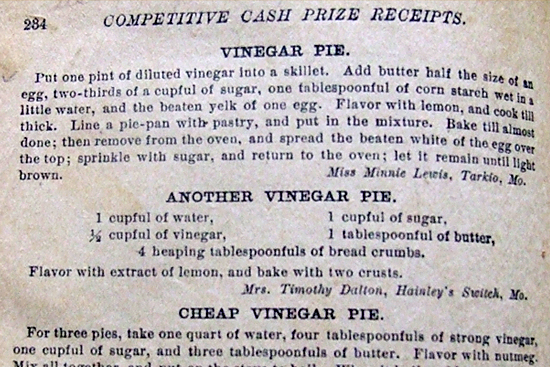
Something a cookbook should have, however, are pie recipes. In the pie category, I give you two. “Hard Times Pie: Rub ½ cup flour and ¾ cup sugar into a heaping tbsp of butter until no lumps remain. Add a cupful of water and bake with but one crust.” Mrs. Clara Everts of Griffith, Ind., assures us that it is “quite palatable.” I will have to take her word for it. Back or no back, times are not hard enough for me to make that. So how about Cheap Vinegar Pie? This one comes on the heels of Vinegar Pie and Another Vinegar Pie and just prior to plain old Cheap Pie. Makes three pies, hope you are hungry:

Take 1 quart of water and 4 tbsp of strong vinegar and mix with a cup of sugar and 3 tbsp butter. Boil. While boiling, add a cupful of flour wet in cold water and boil 2 minutes more. Let cool. Once cool, if you do not have a solid mass of glue, pour into three pans lined with paste [don't ask me] and bake in a quick oven.

I presume the oven must be quick lest it becomes aware of what it participates in.

The smell of moldering paper must be going to my head. Or is it the Flexeril? OK, one more, this one from the cover (or Page 51, as readers of the intact book may have found). Suitable for any special occasion brunch, I give you “Fried Mush: Slice cold mush ½ inch thick. Dip pieces in beaten egg and then in rolled crackers. Fry same as doughnuts. This is very nice for breakfast,” Hattie Cary of La Plata, Mo., advises.

Better yet, lie around and wait for someone to bring breakfast to you. Earlier, a crafty 12-year-old and sweet 3-year-old brought me a Pacman lap tray of second breakfast. Like a good hobbit, I ate it right down to the fun-size Butterfinger. Mmmm, that tasted good. Perfectly seasoned eggs. But now I’m wondering what Pacman is looking to do to my ancient cookbook crumbles. 

Hey, Obama, pass the spice!

After their Chinese guests requested a "quintessentially American" meal, the White House came up with this?

  • more
    • All Share Services

Hey, Obama, pass the spice!A table setting for the state dinner hosted by President Obama for Chinese President Hu Jintao.

So here we have the menu for tonight’s White House State Dinner, in honor of Chinese President Hu Jintao. And it’s kind of tragic.

State dinners are absolute banquets of symbolism, with everything from the décor to the entertainment to, of course, the food packed with cultural signifiers. And so, when Obama Foodorama reported that the Chinese delegation explicitly requested a “quintessentially American” dinner, my nerves started firing: What dishes would the White House set forth as the markers of our country? What will bear the standard of our nation, one fed by thousands of crazy blood lines, from Native Americans to the colonists to the slaves to the waves and waves of amber- and other-toned immigrants?

If you guessed steak and potatoes, congratulations. For being right, and for living in Norman Rockwell’s white-bread America. Sigh. But what about the Americanness of the rest of the menu?

1st course: D’Anjou pear salad with farmstead goat cheese, fennel, black walnuts and white balsamic

Well, black walnuts are actually native to the United States, so that’s pretty cool. And white balsamic is, by most accounts, not at all related to actual Italian balsamic vinegar, but was probably invented by marketers somewhere in New Jersey, so that counts too, I guess.

2nd course: Poached Maine lobster, orange glaze carrots and black trumpet mushrooms

Maine lobster is pretty sweet, too, since it’s also a species that’s actually native to the U.S. — it’s Latin name is Homarus Americanus, which, now that I think about it, may end up being the name of my first child — and it’s distinguished from most other lobsters by its big, meaty claws. You love lobster claws, don’t you? USA! USA!

Intermezzo: Lemon sorbet

Sorbet! That’s a French word! Damnit, it’s lemon freedom ice. Wait wait wait, sorry. French words are allowed again. My bad.

3rd course: Dry aged rib eye with buttermilk crisp onions, double-stuffed potatoes and creamed spinach

Look, I’d be happy to be sitting in front of this dish. I have nothing against it. But to represent the mosaic that is America? What, did they run out of burgers and fries? Are the servers wearing gingham too?

Dessert: Old-fashioned apple pie with vanilla ice cream

Yes. Yes, the servers are wearing gingham. And they are all moms. Also, perhaps there will be a little baseball game for the guests’ entertainment.

What kills me about this “quintessentially American” menu is how it looks compared to the first-ever Obama White House State Dinner. (Yes, the one with the infamous party crashers.)

In November of 2009, honoring Indian Prime Minister Manmohan Singh, the White House threw a joyous culinary spectacle. That dinner featured, for the first time in White House history, a guest chef: Marcus Samuelsson, an Ethiopian native, adopted and raised by Swedes, who became a naturalized American citizen and one of the most prominent chefs in the country. And the menu itself, as reported by the New York Times, included:

a mix of Indian and American favorites, including some African-American standards. Collard greens and curried prawns, chickpeas and okra, nan and cornbread were served to the 320 guests, who started off with arugula from the White House garden and finished up with pumpkin pie tart.

So: dishes that carry with them the flavors and history of diverse lineage, of foods high and low, and bent seamlessly to give a nod toward the homeland of the guest, prepared by an immigrant chef who explodes our notions of what being black in America might mean … and it’s the steak and potatoes that gets called “American”? It breaks my heart. It’s not that this menu isn’t lovely; it is, and I’m sure it’s cooked splendidly. But I just wish the version of America they’re serving on the plate would look more like the vision of America as we are today – a nation that revels in e pluribus unum.

But maybe I’m making too much of this. I mean, hey, the White House chef (who happens to be the first woman to hold that title) is Cristeta Comerford. She’s an immigrant from the Philippines.

Continue Reading Close

Francis Lam is Features Editor at Gilt Taste, provides color commentary for the Cooking Channel show Food(ography), and tweets at @francis_lam.

Francis Lam’s tales of the multicultural South

I'd love to tell you some stories of shrimpers, would-be mayors, bakers and market tenders: Folks dear to my heart

  • more
    • All Share Services

Francis Lam's tales of the multicultural SouthAndrew "FoFo" Gilich for mayor!

A few weeks ago, I had the honor of addressing the august Southern Foodways Alliance Symposium, which would be the finest food conference in the country even if it didn’t dedicate a least one entire evening to various forms of fried catfish and booze.

The subject of my talk was the global influence on the South, as shown in the diverse people of Biloxi, Miss. — shrimpers and the children of shrimpers, bakers and market tenders. It’s a subject — and these are people — dear to my heart, and I found myself unexpectedly emotional as I told their rich stories: of FoFo Gilich who grew up working in a cannery and was nearly mayor of Biloxi; of Richard Gollott, who is the man literally responsible for the establishment of a vibrant Vietnamese community in this town; of Sue Nguyen, whose “Vietnamese bakery” became, over time, simply Biloxi’s bakery; and more.

I’d like to share those stories with you here. If you’d rather not listen to me yap, below the video is one of these stories in written form, on Mr. Leroy Duvall, a retired shrimper and the president of a Cajun social club. And if you’d like to read more of the oral histories I collected in this part of the world, please visit the Southern Foodways Alliance’s website.

SFA 2010: “Cajuns, Croats, Vietnamese: On Land and Sea in Biloxi” presented by Francis Lam from UM Media Documentary Projects on Vimeo

Mr. Leroy and the French Club

This story originally appeared on Gourmet.com.

I just watched a table the size of a twin bed get piled with crawfish. Twice. So this is how they roll at the French Club. Outside, in the parking lot, half a dozen beer-fueled men watched propane-fueled pots, sending an eventual 1,500 pounds of crawfish to their hot and spicy ends.

I have to confess that I wasn’t thrilled at first about showing up at the Fleur de Lis Society. This was months ago, and I was looking for stories of Cajun fishermen, but clubs kind of weird me out, with their odd little exclusivities and mutated social hierarchies. On my way over, I imagined arcane secret-society stuff: handshakes and passwords and rituals in funny hats with the window shades down. Who knows what these people are all about? I’ve seen movies. I don’t want to end up at the bottom of the Gulf, strapped to a sack of crawfish heads.

I pulled up to their imposing meeting hall, a dead ringer for an airplane hangar, with nerves firing, and walked in to find … a couple of guys watching SportsCenter at a bar. I met Mr. Leon, Mr. Ben, Mr. Tee, friendly men in Hawaiian shirts and pleated jeans who pulled up a chair for me and chatted the way uncles do. Leroy Duvall, the club’s president, came over and shook my hand, a slight, taut man with a head of white and skin that’s been in the sun his whole life. He apologized for the ruckus as I set up the recording gear. It was a big day. Three years after Katrina took their home they’d just gotten into their new building, and the first thing he did was call in a beer order, now clanging in on hand trucks and dollies.

Seventy-five years ago, Cajun fishermen looking for work moved into Biloxi from Louisiana. In a strange town far from home, they settled into a tight-knit community in East Biloxi. They founded the French Club, as everyone called it, as a place to have dinners and dances together, and occasionally raise some money for members in bad shape.

I asked whether the Club tries to preserve French culture. Mr. Leroy nodded, talking about the dances they put on, but then said, “I don’t really speak very much French. I wish I did but I don’t, and a lot of us don’t … the younger people, you know.” There wasn’t a trace of irony in his voice when he referred to himself as one of the younger people, despite his 64 years.

Mr. Leroy worked on shrimp boats for most of his life. He misses it. “No traffic jams,” he said to me. “No 9 to 5. You just worked. But it was just the pleasure of being out there; the freedom and the good fresh air.” It’s demanding work, physical work, but I imagine of the kind that makes your body still feel young at 64 if it didn’t make you feel old at 32.

But the realities of age still stand. I asked him why the club only has 300 members now, instead of the 600 it used to have. “The older people got older,” he said. “East Biloxi started dying away. And then Katrina finished it off by taking everything out. A lot of the older people are too old to try to come back down here and start over.”

I asked if he keeps in touch with his displaced members. “That’s one reason we put the club back down here,” he said. “After Katrina took our building away there was no consideration about going anyplace else. Our people — no matter where they’re at — they know whenever they come back, the French Club is still here. A lot of our members passed away; we have a lot of older people. Every day we see them they ask when we’re going to open. They want to come back and we’re trying to get it back. For the people.”

Behind us, men loaded the new coolers with beers and Cokes and Barq’s Root Beer.

I’ve come back a few times since hoping to catch the club in action, but every time I drive by, it’s just Mr. Leroy’s old pickup in the parking lot. I poke my head in the dark hall. It’s an awfully big room for one man to be in. I say hello, he smiles warmly, counting change or taking out the trash. He tells me, every time, that I just missed everyone, that I should come by for dinner. We chat, I thank him, and leave him to his chores.

But today, I walk into the French Club and my eyes need a few minutes to adjust to the darkness from the Mississippi sun. When I can see again, the tables are crowded with people piling high the spent bodies of crawfish. The aisles are crowded with couples dancing to Cajun music played by a man with a Croatian name. I can barely make my way through the crowd, taking pictures to go with my interview, and looking for Mr. Leroy. When I finally find him, my photos all taken, he asks, “Did you get any crawfish?” I regretted saying that I had to go. “Well,” he says. “You’re welcome here anytime. You know that, don’t you?”

I smiled back at him. “Yes, I do, Mr. Leroy. Yes, I do.” 

Continue Reading Close

Francis Lam is Features Editor at Gilt Taste, provides color commentary for the Cooking Channel show Food(ography), and tweets at @francis_lam.

The most depressing hot dog stand in America

A classic Chicago dive sells the world's greatest franks, but turns into a boiled-over hate fest every weekend

  • more
    • All Share Services

The most depressing hot dog stand in America

Here is what you can expect in a good Chicago hot dog: an absurdly juicy frank (most likely from the excellently logoed Vienna Beef), a luxuriously smushy bun, and a cavalcade of condiments: yellow mustard, chopped onions, a wedge of pickle, tomato slices, hot sport peppers, a few dashes of celery salt, and an otherworldly neon green relish, so bright you can read by it. These are hot dogs in their highest form. The flavors combine and recombine in endless variation as you eat, and the textures are all there: crunch, snap, chew, squish. This is a sandwich that inflames Midwestern passions.

And so it was no surprise when my friend Emily told me about the Wiener’s Circle, a classic dog dive famous for its hot-tempered service. “It’s just people screamin’ and cussin’,” she said. “And women taking their shirts off. I grew up going there, but then I had to stop.”

Emily is a sweet soul, good-natured and kind, and so I just chalked up her resistance to prudishness. After all, Chicago is a town filled with colorful dogs, and even the gentle of tongue can have their fill of tube-steak fun. Take Chubby Wiener, which, even aside from the more-than-you-wanted-to-know name, offers a special called the Capitalist Pig: $250 for one of their superlative dogs and a bottle of Johnnie Walker Blue Label Scotch. Or the appropriately named SuperDawg, which works under the watchful eye of a 20-foot frank, broad-chested and strapping in his yellow Tarzan loincloth, impressing the females of his species with flexed muscles.

So I head over to the Wiener’s Circle, decades-old and looking like it in a long-gentrified upper-middle-class neighborhood. The dogs were fantastic, classic and perfect, with the slight tweak of an optional char on the grill (purists like them steamed). I marveled at the kitchen, where the cooks’ main activity seemed to be yelling unintelligibly at one another, despite the fact that it was the middle of the afternoon and there was hardly anyone to make hot dogs for. Still what orders that did come in — additions, substitutions and all — got filled swiftly and exactly, from memory and maybe telepathy. Where people extend their arms to take the food from the counter window, there was an empty mayonnaise container, on which there was a message: “YOU WILL TIP THE JAR, BITCHES!” You won’t see that at an Applebee’s.

I didn’t know how to feel, then, for a young woman, roughly the size of a fire hydrant, who came back to the window with a complaint about her lunch. “It’s …” she started, then, more softly, “a little burnt.” The man behind the counter, thin and bony and all hard angles, looked down at her. “Burnt? Huh?” he said with a menacing drawl, taking her hot dog in his hand.

“Next time, go with the steamed,” I prayed for her.

“Burnt?” he said again. She looked straight ahead, as if nothing was happening. “F*@# burnt! That motherf#$@*er CRISPY!” he yells, pointing her coal-black dog in the face of one of the cooks. He turns to smile at the woman with a tinge of flirtation. “We’ll get another one for you,” he says.

“See?” I told Emily after seeing that random act of, er, kindness. “It’s cool! It’s all a joke!” She shook her head. “At night is when it gets bad.”

Turns out she was right. The scene at the Wiener’s Circle is markedly different at night, late on a weekend night, that is, when people are coming in from the bar. There are no more flirty smiles with the taunts. It becomes a face-twisting orgy of aggression, where the social contract of respect between customer and server isn’t playfully broken, it’s set on fire and waved in your face.

Suddenly, you hear women get called the names of various domestic and wild animals, and you get all kinds of lessons in human anatomy from both the kitchen and the customers, hurling invective on the attack and in defense. It’s possible, for a while, to think it’s all good theater, that everyone is just letting off steam, but the tell is in people’s faces when they’re not open-mouthed and screaming. The crowd is laughing, having fun, and you hear people comment, titillated, on the quality of the show. But the staff look tired, and maybe a little bit sick to their stomachs. This is their job.

At some point, the room becomes a chorus of curses and racial epithets, and it becomes impossible not to notice that the staff, the battle-hardened staff, are all black, and the crowd nearly entirely white, male and drunk. Some of the cracks are funny, especially from the people who work there, who have had plenty of time to sharpen their tongue and their wit. But it becomes hard to laugh when you can feel how hard that clever crack is working as a shield, trying to defend against all the rage in the room.

Chants of “Chocolate milkshake” stir in the crowd. Rhythmic, pulsing, the voices calling for the chocolate shake get louder, with people banging on things, even in the kitchen. The place is in an utterly warlike state. A server, a woman, looks uninterested and annoyed, and then, exasperated, starts demanding money. When she gets enough, her shirt comes up, and the crowd cheers, victoriously, at the sight of her enormous, quivering breasts. They got their chocolate shake. I hear the tips are great. I hate this place. 

Continue Reading Close

Francis Lam is Features Editor at Gilt Taste, provides color commentary for the Cooking Channel show Food(ography), and tweets at @francis_lam.

Fried-cheese epiphany at a street fair

Amid the awful food at the San Gennaro festival, mozzarella sticks that say a lot about American cuisine

  • more
    • All Share Services

Fried-cheese epiphany at a street fair

Street food, fast, cheap and out of control, is the current darling of the food lover’s world, but the culinary glories of the San Gennaro street fair in New York’s Little Italy are faded at best. Deep-fried Oreos offer 10 seconds of pleasure and an evening of regret; once-promising sausages get burned to charcoal before being stuffed into cold rolls with peppers steamed limp. It’s not for tasty things that I jostle my way through the perpetually mobbed festival, but to get a taste of a different sort of local flavor, mainly by overhearing things like this: “My pop got into a motorcycle accident and was in the hospital for weeks. My grandpa came over and started cookin’ all this Italian food. It was the best thing that ever happened to me!”

But, last weekend, while standing next to the man with the unfortunate father, I came upon three men frying mozzarella sticks in a wok who showed me some of the best qualities of American cuisine.

Standing behind a red banner that reads “Italian food” in Chinese characters, cooks from the very-buzzy restaurant Torrisi Italian Specialties were selling what looked like classic Italian American roast-pork-and-greens sandwiches — only the pork had the sugary red glaze of Cantonese barbecue and the buns the sweetish, smushy chew of bread from Hong Kong-style bakeries. I set out to write notes about how roasted peppers balanced all that sweet fatty goodness, about how, rather than the typical broccoli rabe, the greens were the sort served alongside bowls of wontons a few blocks away in Chinatown noodle shops, but before I could dig into my bag for a pen, the sandwich magically disappeared into my belly. Poof, gone! Ai ya! Mamma mia! The mozzarella sticks, crisp but with a chew that goes on for miles, didn’t last much longer.

The quality of this food wasn’t surprising. I happened to have dinner at Torrisi a few weeks ago and the cooking is off the charts. But, more intriguing, I noticed that this was an Italian restaurant that serves no actual food from Italy: no imported prosciutto, no imported pasta, no imported cheese — none of the signifiers of “authenticity” that most “serious” Italian restaurants pride themselves on. Rather, the pasta came from a nearby pasta maker, opened 100 years ago to serve Italian immigrants. The curds for that superb house-made mozzarella come from Polly-O, the string-cheese people, whose roots are in a small Brooklyn storefront. And, most excitingly, the dried scallop garnish for its sautéed broccoli rabe came from Chinatown, one neighborhood over and half a world’s cuisine away.

It was a pairing that tasted utterly natural, the scallop’s dense ocean flavor weaving around the sweet bitterness of the greens. It was a combination that spoke of a conversation between cultures that rub up against one another in a country and a city of immigrants. For all our fashionable talk of locavorism, here, finally, was an interpretation of “eating locally” that’s not just about how far your food travels, but about community. It’s about getting to know your neighbors and their flavors and finding the ways that you can come together.

Cuisines taken by emigrants to new lands have always changed to adapt to the ingredients available to them, giving us such odd and delicious dishes as shrimp stir-fried with rum, a classic of Chinese Caribbeans made possible by the fact that the traditional rice wine was nowhere to be found in rum-producing Trinidad a hundred years ago. But with the ease of importing ingredients today, those naturally evolved cuisines may be a thing of the past; I mean, if you’re cooking to remind you of home when you feel very far away, you’re going to reach for a bottle of real rice wine if you can get your hands on it.

That seems leave us, then, with cuisines that will either be slavish devotees to an “authentic” past, or the chef-driven, inflated-ego fusion food of the ’90s. Excited by the world but ungrounded in tradition, it was cool back then to just throw Mexican molé with Japanese wasabi, smother a chicken breast in it and serve it on a Caesar salad. Easy to come across exotic flavor but hard to come across coherence; it was the stuff of fad, not evolution.

I thought about all this as I chewed on Torrisi’s custard cream puff, whose filling is a dead ringer for the eggy custard tarts that I eat in Chinese bakeries. The difference here is not just that the food tastes fantastic, but that it tastes seamless. Growing up with my parents working in Chinatown, I roamed the streets of Little Italy by day and sat down to Chinese food at night; this is the food that reflects that life, made by a couple of Italian guys frying mozzarella in a wok.

When one of the cooks showed me the thin, curved pan, I asked, “So does using the wok instead of a regular fryer add something to the dish, or is it philosophical in nature?”

“Well,” he said, “one thing is that this way we can change the oil frequently; it would get expensive to have to change out five gallons of olive oil at a time. But we really just wanted to show people what we’re doing: Chinese Italian food.” Chinese Italian food that can only happen in America.

I left their stand and jostled my way some more among the crowd. Down the street, I came across decidedly more straight-up Italian food. A stand was doing pizza in the Neapolitan style — soft and runny in the middle, puffy, just slightly crisped around the edges. The pizzaiolo working the oven spun the pies with his peel, smacking it against the oven floor in sharp motions to stoke the fire. He worked quickly, smoothly, expertly, and the pies came out beautifully, with the perfect amount of black-specked char on the bottom, just like in Naples. He turned around to set the steaming pizza on the counter, and the woman taking orders called him “Ming.” He’s Chinese.


Continue Reading Close

Francis Lam is Features Editor at Gilt Taste, provides color commentary for the Cooking Channel show Food(ography), and tweets at @francis_lam.

The end of the greatest American fishery?

Threatened by mines, Bristol Bay, Alaska, is a place of beauty and heart, dependent on salmon. Plus: A slide show

  • more
    • All Share Services

The end of the greatest American fishery?

View the slide show


If fish can be heroes, salmon have a heroic story — returning after years out in the world, they fight their way upriver back to where they were born, slipping past eagles and dodging bears to find a place for their children. But the natural order is both grislier and more beautiful than that. Those eagles and bears will stave off their hunger and snatch their fill of fish from the water. And the salmon that survive will spawn, wither and then die, their bodies nourishing the ecology with nutrients collected from the ocean.

Bristol Bay, Alaska, is home to the largest wild salmon run in the world. Every summer, up to 50 million sockeye come pounding through the bay, turning it silver. The salmon run is what brings life back to this place. It defines it. “It’s incredibly moving to see the first fish surge,” Kate Taylor, a wilderness guide, said to me. “That’s when everything starts. You see the bald eagles come out, the osprey, the wolves, the bears. Soon, you see trout up the river feeding on the salmon eggs. All this life starts to come out of this barren landscape.” And then there are the people: the fishermen gearing up for the season. The natives who have subsisted on this fish for nearly 10,000 years. The thousands of workers who come here, swelling these villages to 20 times their off-season size.

But what if the salmon don’t come? The future is unclear, as Bristol Bay also happens to be an enormous copper deposit, and Canadian and British energy corporations are planning a massive mine at the headwaters of the bay. Considering that the Pebble Mine is in a seismic zone and will require what is essentially the world’s largest earthen dam to hold back the lake of sulfuric acid it will produce, many are fearful that, whether catastrophically or just through seepage, the mine will destroy this nearly untouched wild habitat, where the air smells all the time of tundra, a perfume of herbs and flowers and moss. But for now, as I looked out to the water, waiting for a tug on my fishing line, I thought what an incredible privilege it was to be here, at the very cusp of watching a whole world come awake, and to meet some of the people who live among the salmon.

The fisherman

David McRae has fished for sockeye salmon in these waters, under this enormous sky, for 30 years. A handsome man in the Eastwood vein, his face is strong, rectangular. His hair is short and gray, his skin weathered to a toughness, and yet he smiles easily, almost beatifically, which was a relief when I hopped clumsily into his boat, nearly tripping on the nets piled on the floor. I tried to find a spot to stand, suddenly conscious of how goofy I am in my too-big borrowed rubber jacket.

His nephew Jay was also on the boat, solidly built and quiet in that way that may mean that he’s shy, or that may mean that he’s there to fish, not make friends with people with cameras and notepads. As David motored us toward their site, I could see in the distance the decaying remains of an old cannery, a reminder of how long people have been fishing here. The permit for this site has been in their family for generations. When his watch ticked to the official opening of the day, David and Jay launched into a flurry, unfurling their net into the bay.

Later we worked the gear, which means we took the skiff to one end of the net and, with our arms and backs as the motors, tug our way to the other side, picking salmon out of the webbing. The boat felt light and I pulled with excitement, but 15 minutes into it, my back announced some displeasure. I imagined what it would be like to pull a boat sagging with 1,200 pounds of fish back and forth across the gear, all day long, for the entire season.

We pulled up an occasional salmon. The easy ones fall out of the net with a gentle tip. But others come up tangled, the fish suspended in a thin, wiry web that would have M.C. Escher gnashing his teeth. Fish after fish, Jay directed me: “Give that one a good hard shake. Flip the net around. Pull that one up and over.” I had no idea what he was looking at, how he could see a path for the fish out of the gear, and he took over. Plunk, plunk — the salmon fell to the deck. At peak season, they catch a dozen fish for every couple feet of net. “Throw in a 30-knot wind at night in the rain with headlamps and the boat rolling,” David laughed. “Like trying to figure out puzzles in a washing machine.” While playing a 12-hour game of tug of war, my back reminded me.

He mentioned proudly that despite its small size, his boat consistently comes in over the catch average — even against the big boats drifting out on the horizon, their bows a dozen feet off the water, mechanical winch nets hauling fish up through the air like they were climbing Jacob’s Ladder.

“How’d you get into this?” I asked him, and he talked about family and heritage — fishing with grandparents; an aunt and uncle who took him onto their boat when he was in high school. He spoke in years by the dozens, but then said something that surprised me: “I’ve never really identified with being a fisherman.”

“What do you mean?” I asked.

“It’s something I really enjoy, but you can go to school, be creative, do art, do architecture, or fly airplanes: all these other things I love to do. But my roots here are very tangible. I’ve seen the same family names on those set net sites for decades. It’s a community.”

He’d retired from fishing entirely to fly planes, but he decided to come back when Jay asked him to. “Jay’s mom and I used to work that site, just the two of us. He started helping us out when he was 14. I don’t want to make it too flowery and romanticized, but there’s a feeling of wanting to pass on the ways,” David said.

The home pack

“Welcome to our crazy little fish plant,” Izetta Chambers said when we arrived at Naknek Family Fisheries. It’s a new-looking facility of gleaming stainless steel … in what is not much larger than a shack. She giggled when she picked up a broom to bang a light on and then introduced us to her grandmother, Violet.

A bright-eyed woman with a round face and rounder curls, maybe 5 feet tall if you give her a shoebox to stand on, Violet is the kind of person you want to hug immediately. Her hands were covered in blood and wielding 12 inches of sharpened steel. I didn’t want to hug her that badly.

She was cutting fish for smoking, part of the family’s “home pack” — the catch you keep for yourselves.

Bristol Bay has an unemployment rate at times nearly double statewide figures. It’s a real problem — one Pebble Mine proponents point to constantly — but the numbers may be misleading, because they count off-season fishermen among the unemployed, and because out here, there is a real subsistence economy, which is a planner’s dead-dull way of saying that most people here hunt and fish for a lot of their food. For many native families, nearly 80 percent of their calories can come from the land, starting with the salmon they catch and preserve for the rest of the year.

“Do you sell your smoked salmon?” I asked Violet.

“No,” she said with great seriousness. “We take care of ourselves first.”

“Do you trade it for anything?” Subsistence fishing permits don’t allow you to sell your catch, but do allow for barter.

“Yeah, cash!” she laughed.

Violet laid her fillets on a board her husband made for her, with slits in it to guide her knife, cutting it into even strips like she learned to do 70 years ago. I asked for her brine recipe. “Oh, the brine,” she said. “I put a potato in the brine to see if it’s right — it floats when there’s enough salt.” I nodded excitedly, getting ready to write down a recipe. “But I didn’t have a potato today, so I’m just guessin’,” she laughed. I put my notebook away.

We chatted lightly as she kept cutting. When I mentioned the Pebble Mine, though, her head jerked up. “Ah!” she exclaimed, putting down the salmon in her hands. “We cannot have Pebble come. We cannot have Pebble come,” she said. She looked down at her brine. “Sometimes I try to imagine what life would be without fish,” she continued, saying that last word as the locals do, with a long, soft tailing off: fisssssshh. “And I can’t imagine it.”

Once Violet hung the strips of salmon like red icicles on rods to go into the smokehouse, Izetta led us to the smokehouse out back.

In her 30s, Izetta started fishing at 9. She moved away, to Arizona, where she went to college and eventually law school before coming back home to open this little plant, where she cleans, cuts and markets fish caught by the fishermen in her family.

“You have to really love it,” she said. “It wrecks your clothes, you get fish blood all over you.”

“So do you love it?” I asked.

“Sometimes, I have to get torn out of that plant. I work in education, where you’re trying to change attitudes and beliefs, but it’s so ethereal. But in the plant, I can count what I’m doing, how many meals I’m going to provide.”

We got to the smokehouse, which really is a shed. She lit a fire and started chuckling. “My daddy came up from North Dakota, wanted to find a native lady, have her put up a bunch of salmon and treat her like a ‘squaw.’ My mom was like, ‘You’ll have to go farther away for that!’” And Izetta began putting up the salmon.

The processor

Leader Creek Fisheries is hundreds of times the size of Izetta’s little fish plant, but it might be just as crazy. For years, its strategy has been to actively decrease the number of fish it handles and sells. Izetta told me about treating the fish as other than a commodity — not in a touchy-feely spiritual sense, but in the “canned goods commodity food” sense. Better handling, higher quality is what distinguishes her product, and Norm Van Vactor, Leader Creek’s manager and three decades removed from when he was on the cutting floor himself, was showing how that idea plays out at scale.

As we toured, Norm explained how each step in his process preserved the quality of the fish. Standing at a conveyor where the salmon are pumped out of the boats was like a “Daily Show” “Moment of Zen,” watching fish fall through the air into a pool frothy with other fish. “The water keeps them from getting bruised; they’re not all banging into one another,” Norm said.

We walked through the line, past all the heading, the gutting, the trimming, and, well, in an objective sense, it wasn’t pretty. But for an operation of this scale, it was strikingly clean, orderly, panic-free and efficient.

“Too little time, too much volume is all you used to hear people say when they talked about Bristol Bay salmon,” he said to me. But Leader Creek is happy to buy fewer fish for more money — offering fishermen nearly a quarter more per pound, for fish that’s harvested slowly and treated with more care.

The remaking of this commodity into a high-quality product is, to Norm, a form of activism. Higher quality can command higher prices and a higher profile … and more of an economic argument to protect this place.

“I only live here during the season,” he said, calling himself a “Gussick,” a native term for an outsider. “But in many ways, this is really my home. Up here, everybody is so interconnected, and all my best friends live in these villages. I could become destitute tomorrow and know that I would never go hungry. Someone would offer a roof over my head. It’s just the way these folks are.”

He grew up the child of travelers, and he first came to Alaska in college to make money during summer. As he spoke, I thought of how growing up constantly on the move might compel you to fall in love with a place where people live where their ancestors did.

Norm is a fierce anti-Pebble Mine activist, but not when he first heard about it eight years ago. “Back then, the seafood industry wasn’t doing well. If there was a better place for my employees to be, I wanted to help them get there. I come from South Dakota gold miners; I’m not anti-mining.” He invited the Pebble Partnership to come by. It was early then, before lines were drawn, and the discussion was candid: A marine biologist the miners hired said he doubted the mine could keep its toxins out of the water. “I couldn’t sleep after hearing that,” he said, so the next day he flew his plane over the Pebble site, looking down at the mesh of land and water, and said, “That’s the heart of Bristol Bay. It’s where it all comes together.”

“Still, who was I, a Gussick, to come and tell people, ‘You gotta keep this industry outta here’?” he said. “But I heard villagers say, ‘What we have is more important. This is short-term pay for some, and we have a way of life that’s been here for 10,000 years.’” And so he’s been fighting the mine since. He told me about a package he happened to receive the day before, trinkets from an airport gift shop. They were from an elderly native woman, with a note: “I want you to have souvenirs of Alaska always, because of what you’ve done for my community.”

We walked out of the plant through the roe room, where workers separated sacs of fish eggs according to size. There was bright orange oil and slime coating their hands, but the eggs sat, bright and bubbly, like jewels. “Isn’t that beautiful?” Norm asked.

We piled into our van and shut the door, but Norm trotted out and stuck his head in. “Hey, I’m sorry, I should’ve said this at the beginning,” he started. “But … thank you. Thanks so much for coming this far away to see what we’re all about up here.” He paused. “Thank you for coming to see this place.” He closed the door and turned to go back to the fish. He was crying.

View the slide show 


View the slide show

Continue Reading Close

Francis Lam is Features Editor at Gilt Taste, provides color commentary for the Cooking Channel show Food(ography), and tweets at @francis_lam.

Page 1 of 4 in American Regional Cuisines