
Restaurant Culture

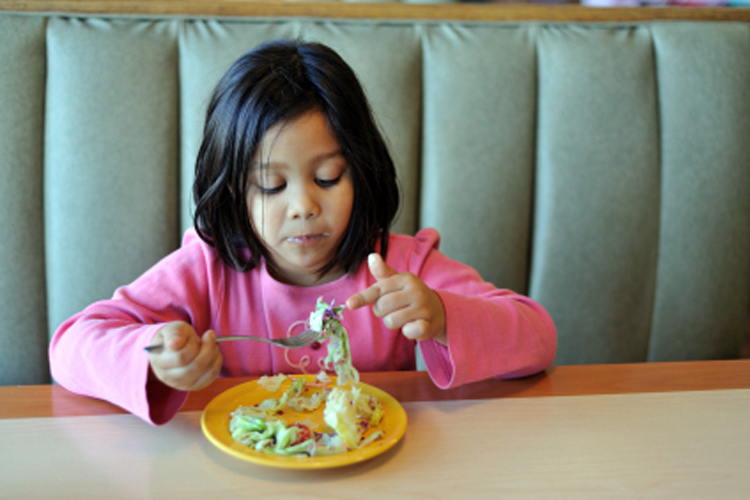
Is it possible to dine out politely with kids?

Going to restaurants with children can be like target practice for dirty looks, but you can dodge and deflect

  • more
    • All Share Services

Topics: , ,

Is it possible to dine out politely with kids?

Is there any hatred more vile and seething than that reserved for parents and young children by people not in the mood? In cities, particularly, it becomes turf war: small spaces and bulky bourgie baby-care accoutrements really don’t mix. I love kids (Hi, Peanut!), but there is a dark chamber of even my heart that opens up when I’m in a hurry and the entire sidewalk is taken up by a double-wide stroller. And nowhere are the battle lines more drawn than in restaurants.

“The first warning is when you see the parents enter the restaurant with a stroller the size of a KIA. From there they will ensure that no one enjoys their dinner until after they’re gone. I sincerely think it’s intentional,” a commenter on Serious Eats replied to a poll on whether children should be allowed in high-end restaurants. Granted, this commenter calls him/herself “Leper,” so there may be something else going on psychologically there, but that level of animosity, resentment and contempt is not out of range for what I hear uttered about parents with kids at tables.

And then I heard recently of a stylish cafe in a particularly baby-happy part of town that instituted a no-stroller policy. Not a particularly welcoming gesture, but hearing young parents in the neighborhood talk about it, it wasn’t just an annoyance, it was a declaration of class, race and gender war all rolled into one, almost as evil as anything to do with Dick Cheney. (Welcome to Brooklyn: now featuring nearly as many babies as writers named Jonathan!)

But, happily, there are peaceable ways of dealing with the dining tension of the have-babies and have-nots. Writing yesterday in Fat City, Jonathan Bender details his ground rules for taking kids to restaurants. Adapted from the rules you see around swimming pools, they’re a strong way to declare a truce with baby-haters and still get to enjoy himself at dinner with his children:

5 to 6 p.m. is open swim. The first hour should be a mulligan. It’s typically easier to feed kids earlier, and this leaves the rest of the evening to the general populace. We could even have a transitional half-hour from 6 to 6:30 p.m.

No running allowed. The table is home base and the home is where the family stays for the meal. Trips to the bathroom are fine, but otherwise we are all sitting in our seats for the duration of dinner.

Three whistles, clear the pool. If my table gets three strikes, we’re out of there. Food on the ground — we’ll call this one the automatic strike — a mild screaming fit, and talking to someone else’s table are all examples. The potential list of fouls would be agreed upon before dinner commences.

(Click on the link above for the rest.)

For more thoughts and tips, I called the ribald and always interesting Robert Sietsema, the intrepid restaurant critic of the Village Voice, who may well have dined in every restaurant from high to low in New York, and who’s been eating out professionally for nearly 20 years.

So what’s your take on kids in restaurants?

I’ve been taking my daughter out to restaurants her entire life. I believe short of actual screaming babies — and Upper West Side kids, who are more obnoxious than any other kids — most kids tend to be pretty well behaved in restaurants. You know, they really take their cues from their parents, and in my experience, there are much more obnoxious adults in restaurants than kids. Children in restaurants don’t bother me, because I care about the next generation, and a screaming baby doesn’t annoy me nearly as much as hearing an adult bitch at the waitress, or having ostentatious conversations about stock trades or their sex life.

You know, the whole discussion is always centered on the annoying brats, who are a small minority. Kids who need to act out are acting out because they’re not getting attention at home, or because the parents aren’t thinking about where they’re taking their kids appropriately. You don’t take your kid to Per Se because you’ll be eating a four-hour meal. The kid is not going to sit there all night and admire the intricacies of the bread service.

C’mon, Robert. There has to be something that annoys you about going out with kids.

OK, I do hate those new strollers. In all of these hip neighborhoods, there is tension between the unmarried who want to go out and the parents who want to show off their kids and their hardware. When we had Tracy, we had two strollers — one for long distances, and cheap one that folds up to nothing.

As a parent, there’s so much you can do to consider the feelings of other diners. If for some reason the kid starts to act out, you take the kid out for a walk. If you think you’re annoying the other diners, you just leave, and you have to be prepared to do that. And you have to choose the right place to take your kids.

How do you choose what would be an appropriate place for kids?

With some frequency, I take kids out when reviewing because I want to see how the restaurant reacts. In my experience, at Asian restaurants, especially Chinese and Japanese, the staff often willingly indulge the children. Though obviously it’s not just Asian restaurants. Loving families will choose restaurants where families and children are welcome.

There is a class of restaurants that are inappropriate for kids: ones where you can’t eat in under an hour. Even adults get antsy.

Pick a place that has food the kid likes, but encourage and let them explore. Fuck the kids meal, with its stupid chicken nuggets, if the restaurant doesn’t normally sell that food. You know, go by the old rule with your kids: “You don’t have to eat it if you don’t want, but you have to taste it.” That’s how they learn. All the time, I’m with parents pre-scanning the menu, “Oh, he won’t like this, he won’t like that.” I take them aside and say, “Oh, why don’t we experiment? The kid’s hungry. Let’s order all this food. He’s not going to know what any of this shit is! Let’s just see what happens.” Nine times out of 10, the kid will look around, make his own decisions for the first time in his life, and find stuff he likes, even if it’s just to spite his parents! 

A couple of years ago, we were at a Lebanese restaurant, and the parents were like, “Oh, he won’t like…” again. And then out came a big old plate of lamb testicles. They were really cute, they looked like little almonds, grilled, and they smelled terrific. And the kid just went to town on those balls! The parents were like, “Ewww,” but the kid will explore out of sheer native curiosity. Parents are much more responsible for bad eating behavior than the kids.

Then again, after dinner, we worried that years later the kid would be detailing the abuse in court: “They made me eat testicles.”

What are your tips on how to dine out with children? Let us know in the comments! 

Continue Reading Close

Francis Lam is Features Editor at Gilt Taste, provides color commentary for the Cooking Channel show Food(ography), and tweets at @francis_lam.

Henry Rollins hosts new show “Animal Underworld”

Nat Geo Wild has hired the Black Flag frontman to host a show about exotic creatures and the people who eat them

  • more
    • All Share Services

Topics: , , ,

Henry Rollins hosts new show Henry Rollins with a burmese python in Los Angeles, CA. (Photo Credit: © NGT)(Credit: Ngt)

Henry Rollins is coming to National Geographic Wild, and he’s going to shake things up! In a new show called “Animal Underworld” the spoken-word artist will travel to different locales and see how people use (and potentially abuse) exotic creatures.

 Just for a quick reference, this is Henry Rollins’ second time on Nat Geo Wild: He previously hosted “Snake Underworld,” where he sat around and watched a guy shoot up black mamba poison. Why? Because that is how Rollins rolls, yo. And because it makes for some great television.

I’m guessing “Animal Underworld” is going to be a lot like this clip, except with grosser stunts (“Watch me drink this lemur piss!”) and more public advocacy for not doing horrible things to animals (“Please don’t capture endangered lemurs to drink their piss, good sir”). According to National Geographic’s senior V.P.:

“It’s really an investigation into our relationship with animals,” he says. “It’s covering the full range from the off-beat and quirky to the potentially illicit. And our approach to [the latter] is to make sure that we’re obviously not encouraging that behavior.”

And obviously, the show is not going to be some voyeuristic partaking like “Animal Hoarding,” on Animal Planet, which is apparently a real thing. How is “Animal Hoarding” different from A&E’s “Hoarders,” since half the time the people are hoarding animals on that show anyway? Well, either way, “Animal Underworld” is not going to be that at all. Although there will be a segment that has been described thusly:

Rollins visits Arizona’s Road Kill Café, where the menu features not-so-exotic fare. And he meets people who consume things you would not find on the menu even at the Road Kill, like frog smoothies and tarantulas — the former because it supposedly increases virility and the latter for medicinal purposes.

Which, you know, kind of sounds worse than animal hoarding. Maybe Rollins will scream at these people until they stop, adding a humanitarian factor to the proceeding?

Other series picked up by Nat Geo Wild include “Baby Animal Cam” and “Babies Gone Wild,” the difference in the two being that the former uses entirely original footage and the latter uses clips of baby animals found on the Internet.

Continue Reading Close

Drew Grant is a staff writer for Salon. Follow her on Twitter at @videodrew.

Is the signature dish outdated?

A Seattle chef's duck specialty is divine but that doesn't mean it is -- or should be -- on the menu

  • more
    • All Share Services

Topics: , , ,

Is the signature dish outdated?

On the subject of duck, I confess that I am a chauvinist. There is the one, true way to prepare it — roasted, Chinatown style — and there is everything else. But the young chef Jason Franey’s version at the Seattle landmark Canlis is making me reconsider my prejudices. Brown as bourbon, the skin is like a crust, bowing over the breast, hugging it jealously. It crackles somewhere between crisp and crunch, a little like puffed rice, before dissolving into honey sweetness and black pepper heat. The meat has that deep, bass-note richness you want from duck, but is thick with flavors I can’t place: complex, swirling, delirious-making.

It was early spring and it was a dish very much of the moment, the bird served with wilted ramps, spring onions, pearl onions and a sauce of cream infused with onions. A few baby spring turnips. All things with bite, mellowed by youth and cooking. As I ate, I thought, “What makes duck more delicious than onions?” And also this: “In a few weeks, when spring is gone, this dish won’t be here anymore.”

Franey’s cooking is elegant, muscular and ephemeral. He refers to “microseasons,” like the part of the onion season when the onion is most delicate. As a result, his cuisine is ever-changing; it’s a cuisine of creativity and spontaneity; it’s a cuisine of what’s new. It’s about a sensibility and a philosophy more than it is a collection of established “signature” dishes. Of course, Franey’s not alone in this — it’s the prevailing ethos of most ambitious young American chefs. Which is why it seems a little strange that the wildly talented Franey’s first executive chef job is at Canlis — 60 years and counting of marriage proposals, anniversaries, and meeting the in-laws. It’s a vibrant restaurant, not a museum, but it’s still known for the signature dishes it started out with, dishes that include a twice-baked potato.

Here’s a snapshot of what American fine dining was like back in 1964. On the cover of “Famous Foods From Famous Places: Specialty-of-the-House Recipes From America’s Leading Restaurants,” there is a bowtied waiter wearing a bright red sportcoat, drowning bananas in orange glop. The big, wilty magnolia blossom on the table is passing out from the heat of the chafing dish, looking like a sea monster dying to crawl back to the water. Bon appétit!

Inside, there is a section on Canlis, then 14 years old. Restaurant years being similar to dogs’, Canlis was already an elder statesman, and the book describes its speciality-of-the-house dishes: broiled steaks, steak tartar, prawns sautéed with vermouth, and, daringly, a Canlis Salad that, “with no apologies to Caesar, contains mixed greens tossed with croutons, minced bacon and grated cheese,” prepared by “pretty Japanese girls wearing bright colored kimonos.”

The meaning, the very point of a signature dish is that it doesn’t change. Rarely do chefs themselves set out to create one; it’s a designation conferred by the public, and yet, once you accept it, it becomes a pact with your diners: If you come here, you can have this thing. It’s both an honor and a bind. So how do you deal with that if your entire culinary philosophy is based on change?

Through most of its history, Canlis was considered a steakhouse. And while the ’90s redesign of the stunning mid-century modern building left a gorgeous, sleek, muted space, there is no missing its history: A massive, copper-plated grill station juts into the dining room like the prow of a mighty ship, where the Chef-cum-Captain, be-toqued and grand, would stand at the helm, meat sizzling before him.

“Back in the day,” Franey said, pointing to the grill, “the chef would call into the kitchen on a microphone for his plates. They might have all had the same vegetable, the same potato, the same garnish. He’d just put the steak on and send it out from the grill.” Fifteen years ago, Canlis made the shift to being a modern restaurant under chef Greg Atkinson, focused on seasonal Northwest cuisine, but the first thing Franey did was change the structure of the kitchen. Literally. He personally sawed down all the racks in the middle of the line so he could have his own station in there, cooking with his crew.

And this is what I mean by cooking: curing venison in pine ash. Slicing opakapaka into sashimi, serving it with fennel pollen. Spherifying a Tequila Sunrise. And also searing steak teriyaki, sautéeing prawns in vermouth, and plating massive Canlis Salads that dwarf almost anything else coming out of the kitchen.

The classics are delicious, to be sure, but isn’t their unyielding presence frustrating for a chef so inspired by newness?

“I’m not driven by my ego,” Franey said. “I work for this family, and those legacies are part of this family. Mr. Canlis said to me, ‘My name is on the door, but this place is bigger than me. It’s bigger than all of us.’ I’m here to cook for the guests. If you’ve been coming here for 30 years, and you’re thinking, ‘Don’t mess up my steak teriyaki!’ I need to earn your trust.”

It was a lovely answer, but, frankly just a little too diplomatic. Pressed, he eventually admitted that it would probably be easier to start a menu from scratch. But then he smiled and added, “But what’s the fun in that?” Learning to make really killer Peter Canlis Prawns was, too, a form of change.

We got back to talking about the duck. Even just remembering it made me a little wobbly. “What did you … do to that thing?” I could only manage to ask.

In his modest way, he said, “Well, we roast it at 450 degrees for 16 minutes.” Then he added, “We rub it in honey first.” I asked about brines or injected marinades or sorcery — what gives it that crazy, amazing flavor? “Oh,” he said casually, “and we dry age it for 14 to 24 days first.”

The aging, for which he works exclusively with specialty butcher Tracy Smaciarz, gives the duck a wild flavor, flavor you can’t make in a lab or a kitchen, flavor that is the handiwork alone of enzymes and bacteria and time. Coming out of the oven, it’s a powerful scent: the unparalleled aroma of browned bird skin, the sweetness of toasted honey, the floral perfume of the herbs stuffed into its cavity. But the thing, the thing that you can’t miss, is the funk. The funk the bird casts off like a lure, a smell like the edge of a prosciutto. If you get close enough to be impolite, it’s a bit like the part of the cheese counter where only eagles dare to fly. Woven into the taste of the meat, the funk is subtle, a backdrop of complex, floating, lingering flavors you can’t really place. It tastes deeper than duck you’ve had before, darker, weirder, and yet also somehow lighter. Less bloody and mineral, sweeter, a cheese-rind-tang rising through the fatty succulence. It tastes like genius.

“How did you think of that?” I asked.

“Well, I learned it from Daniel Humm,” he said, matter-of-factly, referring to the chef he worked for at Eleven Madison Park in New York. “And he learned it from his mentor, Gerard Rabaey.” And he probably learned it from his, and so on. It turns out that the tradition of hanging game birds to age is, well, very, very old. Medieval. Franey smiled. “Daniel said to me once, ‘We don’t really make anything new. We just do it well.’”

After I left the restaurant, I tweeted about my incredible meal at Canlis. The tweets came flooding back: “Did you have the duck?” “The duck!” and “Please say you had the duck!” I laughed. Looks like Franey has a signature dish on his hands.

Continue Reading Close

Francis Lam is Features Editor at Gilt Taste, provides color commentary for the Cooking Channel show Food(ography), and tweets at @francis_lam.

Save the children from Hooters?

NOW calls on the breast-obsessed chain to stop serving kids

  • more
    • All Share Services

Topics: , , ,

Save the children from Hooters?

The National Organization for Women is protesting Hooters. I know: Yawn. Next I’ll be interrupting major sporting events with breaking news that Gloria Steinem isn’t a fan of the “Girls Gone Wild” franchise. But, seriously, the argument at play here is more interesting than it at first seems. It isn’t the breast-obsessed chain’s existence that is being challenged, but rather the fact that Hooters serves children. Clearly, there is abundant evidence that Hooters is guilty of poor taste (see: restaurant name) — but should the chain be forced to card customers at the door and turn away anyone younger than 18? Several California chapters of NOW have filed official complaints alleging just that.

Hooters is described in official business filings as a provider of “vicarious sexual entertainment.” NOW points out that the chain has “used this designation as a way to avoid compliance with regulations against sexual discrimination in the workplace.” The official employment manual warns that a waitress is, as NOW paraphrases, “employed as a sexual entertainer and as part of her employment can expect to be subjected to various sexual jokes by customers and such potential contacts as buttocks slaps.” At the same time, however, Hooters is marketed as a family-friendly restaurant. It offers a kid’s menu, high chairs, booster seats and all sorts of merchandise for little tykes — like a “Life begins at Hooters” T-shirt, an “I’m a boob man” onesie and a “Your crib or mine?” bib.

We could argue over whether Hooters has a healthy impact on a kid’s developing view of women and sex, but I tend to think entertainment and dining decisions should be left up to individual parents. More important, that isn’t the issue at hand. In this case, NOW (which hasn’t always been a model of moderate thinking) has taken the exceedingly reasonable position that Hooters shouldn’t be allowed to have the best of both worlds: Either it functions exclusively as an adult venue, and continues to protect itself (somewhat) from sexual discrimination claims, or it’s held to the same standards as any ol’ family restaurant and gets to keep on serving the kiddies tater tots and creepy onesies.

Continue Reading Close
Tracy Clark-Flory

Tracy Clark-Flory is a staff writer at Salon. Follow @tracyclarkflory on Twitter.

What do we tip waiters for?

A veteran server reveals how we really don't care about the service when we tip, and how he makes more money

  • more
    • All Share Services

Topics: , , ,

What do we tip waiters for?

Nearly anyone will tell you that they tip their servers depending on how well they’ve been treated. It’s an easy transaction: be nice to me, be efficient, and I’ll give you more at the end of the meal.

Only it’s not really so simple. Have you ever found yourself tipping a server differently because they were good-looking? Or because you were embarrassed by your dad’s off-color jokes? Or even because they sassed you, but they sassed you in all the right ways?

While writing the story yesterday on the very odd (and, to my mind, very disturbing) relationship between the abusive customers and staff at a Chicago hot dog stand, I recalled an old waiter friend telling me that he liked to approach his tables with an aloofness, but also with charm, so that they would work to win his approval … and that usually meant a bigger tip.

So I called Steve Dublanica, author of the blog and book “Waiter Rant” and the forthcoming “Keep the Change: A Clueless Tipper’s Quest to Become the Guru of the Gratuity,” to talk about the relationships — and strategies — of tippers and tip-getters.

OK, well, first of all, do pleasant, efficient waiters get better tips?

When I was a waiter, I cultivated a friendly arrogance. That was my M.O. [laughs]. A good waiter adapts to every personality. There are people who like the archly reserved waiter, ones who like someone who will kid them a bit and give them a slightly hard time. Others who like the joke waiter, the entertainer.

But the thing that’s always amazed me is that the quality of service has almost no effect on tipping. When I first started out, I thought, “If I’m nice and efficient, people will tip me well!” Not true!

When I was researching for my book, I read a reader survey by Zagat where 80 percent of people said, “I tip based on the quality of service,” but self-reported behavior isn’t always true. No one’s going to say, “My girlfriend left me, I’m in a bad mood, and I’m a cheap tipper.” But a study by Professor Michael Lynn at Cornell found that the customer’s perception of service affects the tip only 2 percent of the time. He said, “Service affects tipping as much as whether the sun is shining outside or not.”

If you’ve waited tables, you know this is true. I learned this on the job years ago. You can give people amazing service and they’ll stiff you. You can give them horrible service, and they can give you a great tip. There’s no rhyme or reason to it. If only 2 percent of the tip is based on the service, what are the other 98 percent doing? If they’re not tipping on service, they’re tipping on psychological processes that are happening.

So what do people base their tipping on?

One is the social norm of tipping. For most people, they don’t want to stiff a waiter even if the service is bad because they don’t want to seem cheap, or they don’t want to feel guilty, or they don’t want to upset the waiter. Other people wanna be down with the working man. Or they want to reduce the server’s envy, like, “Here I am having a good time and you’re working.” We don’t exactly know where the word “tip” comes from, but the first recorded instance of the word meant “drink money,” so there’s a “Have a good time on me” element to it.

I knew a waiter who was a drug addict. He didn’t bathe a lot. He would come up to the table and people would say, “This guy smells!” They still tipped him. Waiters can be pleasant, they can be unpleasant, and that will have almost no effect on your tip. People will often still leave you that 15 to 20 percent.

But if your tips don’t reflect the quality of the job you do, why does any waiter bother?

First, if you’re a professional, you’ll try to do a good job for the sake of doing a good job. That’s a matter of pride.

If customers get badly treated at a place, they will still tip — maybe even tip well — but they won’t come back. So there are external controls. Some waiters say, “I don’t need to be nice. I don’t need to put on a show.” But management might watch you, they might put on the pressure for you to perform. Your service will influence people’s return patronage.

Where waiters can make better money is if they cultivate a stable of regulars, people who they know are good tippers. You remember their favorite wine, their anniversary, their favorite table. You make them feel special so they’ll feel loyal to him or her. Smart waiters know that even if there’s no rhyme or reason to how people tip, they know there are people who tip well, so they try to get them to come back and to improve the odds in their favor. If you’re supposed to be kind of diffident, kind of rude, then you’ll do it. If you’re supposed to be a joke teller, then you’ll do it.

And being a good tipper will improve your service, because we will remember you. One customer would tip me $200 to $300 at the holidays, and she never had a problem at my restaurant. She could call me on a busy Friday, and I would move heaven and earth to get her a table. You don’t care why they’re good tippers, but you want them in your section.

Something that’s interesting to me in this conversation is that we keep using the tip as a sort of proxy for how satisfied the customer is with their experience. But since studies show that’s not actually an accurate indicator, how do you then gauge how happy a customer is with you? How do you develop customers’ loyalty?

You have to feel out every table from the beginning, and figure out what they want. Some people like a little repartee, a little battle of wits. Some really like to have their chains pulled. Some are trying to win the waiter’s approval.

In those cases you play it like a girl playing “hard to get.” Because they want to say, “This waiter was difficult and I turned them around, because I’m so good at dealing with people.” That’s what the customer wants from that experience. They’re looking for the waiter’s approval, not for their service. There’s a psychological need that the customer is trying to fulfill. In my first book, I write, “You have to find a customer’s personality and mine it for all it’s worth.” If you can tell the customer wants you to be their friend, you have to play hard to get, and come around in the end so they’ll leave happy.

Why do some people like to be abused, or like an aloof waiter? Some people like that. And some people like being whipped, dragged on a chain and told they’re a bad boy. You’d need far more psychological experience than me to figure that out. When I go out to eat, I want my waiter to take my order, bring my food and be nice.

Continue Reading Close

Francis Lam is Features Editor at Gilt Taste, provides color commentary for the Cooking Channel show Food(ography), and tweets at @francis_lam.

Where a $40 cocktail is worth it for the theater alone

Rich people say the darnedest things when you're eavesdropping on them at the Bar Hemingway in the Ritz

  • more
    • All Share Services

Topics: , , ,

Where a $40 cocktail is worth it for the theater alone

The Ritz in Paris is nearly the definition of fancy. A hotel built literally like a palace, it’s where the word “ritzy” comes from, where Auguste Escoffier codified and invented generations’ worth of French haute cuisine. Deep inside the hotel, past a hallway of toys for the private-island set, is the Bar Hemingway, a shrine to the original Big Papa’s version of American manliness, where his favorite typewriter sits above the fireplace and his hunting rifle hangs above the bar. And hiding in this particular bush with a friend the other night, I spied for myself a rare and elusive species: the Crass Jetsetter (Uglius Americanus).

The room is certainly beautiful — warmly lit, gorgeous old metals and woods, plush and intimate. But the menu opens curiously. Printed goofily like an old-time newspaper, it features stories describing featured drinks, including “The Best Bloody Mary in the World,” yours for only $85. And if you’re into wealth-porn enough to flip it over, you’ll find novelty cocktails with prices clocking in at the four figures. There’s also a note: “This menu available for purchase.” I’d heard incredible things about a genius bartender here named Colin, a walking encyclopedia of cocktail history and creativity, so I was confused about the gimmickery that lay before me. But then it occurred to me: The Bar Hemingway is what would happen if the Hard Rock Café managed to knock up an heiress in a library.

And so, despite the handsomely dressed servers and the high-end hush, I was only half surprised to hear a brash voice from the bar: “I love Europe! You can get laid in Europe. And China. In China, you don’t even have to wait ’til you get to your hotel. You can get laid in the airport in China.”

I turned to see where that nugget of cosmopolitan wisdom came from. A large, 40-ish bald man with a spherical torso was wrapping his lips around potato chips and making conversation with an attractive, country-club-thin woman and her slightly bemused husband. “It’s too hard to get laid in America,” he continued. “People are too uptight. Why do I spend the weekend in Paris? Because I can. Why does a dog lick his own balls? Because he can. Why would I stay at home in Orange County, where the women want to have sex two times to have two kids and miss Ronald Reagan?”

The woman laughed an expensive, tipsy laugh and visibly enjoyed it when the man continued, “Of course, you’re a beautiful blonde. You wouldn’t know anything about it being hard to get laid.”

The woman said something about Gary Coleman, and the bald man asked the room for a moment of silence for Gary Coleman. I sipped my very pricey apple juice and started to think that I’d done the right thing by coming here.

“What do you mean ‘don’t be an asholay’?” I heard the woman ask a few minutes later. “What’s an asholay?”

The bald man wrote in a legal pad and held up a word: “Assh o le”.

“Oooh! Asholay!” the woman blurted, pleased and drunk. “Asholay! I love that. You taught me something! I’ll remember that the rest of my life!”

I began to wonder if she would even remember the rest of tonight by tomorrow morning. At some point, the bald man turned and started talking to me and my friend Brandon, asking us why we’re in France. We mentioned something about eating, and the woman exclaimed, “I love to eat! Food is my hobby!” and proceeded to name some of the more luxe restaurants in the Western world. “And you know,” she said, “Paris is great for food,” before launching into a story about getting bad fish at a restaurant called Voltaire and being kicked out when she complained about it. “I said, ‘I can smell this fish! It’s been dead for hours!’ I would know. I’ve been to …” and out came more restaurants I’ve only read about.

“Well, where would you recommend I go for dinner tomorrow?” I finally asked.

She thought for a second. “Oh, go to Voltaire!” she said, her voice lingering deliriously on the last syllable.

“Um, isn’t that where you complained about the fish?”

Her husband laughed, relieved. “I’m glad someone’s paying attention!” he said.

The woman stepped away to the restroom. Before she left, though, she said the words “the French Laundry,” and soon the entire bar was in a debate about whether that particular world-class California restaurant had slipped since its sister Per Se opened in New York.

Brandon and I got the check and lightened our bank accounts. As we got up to leave, I heard one more musing from the bald man: “Your wife’s been gone a long time. You want to know what I think? I think she’s taking a shit.”

“I can’t believe you’re single, Michael,” her husband replied.

Walking back home, past couture shirt makers and watch stores where one modest specimen would pay my rent for a year, I wondered what Ernest Hemingway would think of his Parisian legacy. And Brandon said, “Well, my drink was kind of bad. But if I paid that much for a theater ticket the show wouldn’t have been nearly as good.”

Continue Reading Close

Francis Lam is Features Editor at Gilt Taste, provides color commentary for the Cooking Channel show Food(ography), and tweets at @francis_lam.

Page 1 of 4 in Restaurant Culture