
Building a Bookworm

Your daughters’ summer vacation reading list

Looking for smart books to entertain your girls when they're home from school? Here's your guide

  • more
    • All Share Services

Your daughters' summer vacation reading list

Memorial Day is just around the corner, and school is nearly out. Even if you’ve planned a full summer of activities for your kids — camps, trips, days at the beach — there may come a moment when they look at you, bored and beseeching, wondering how to fill those long, hot days. What then?

Hand them a book. A really good book. To help you out, we’ve put together two lists of great books for kids, one tailored especially for girls, one curated with boys in mind, though of course all the books on these lists may be enjoyed by kids of either gender. This week we’ll start off with especially engaging reads for girls of all ages (the boys list will appear next Thursday):

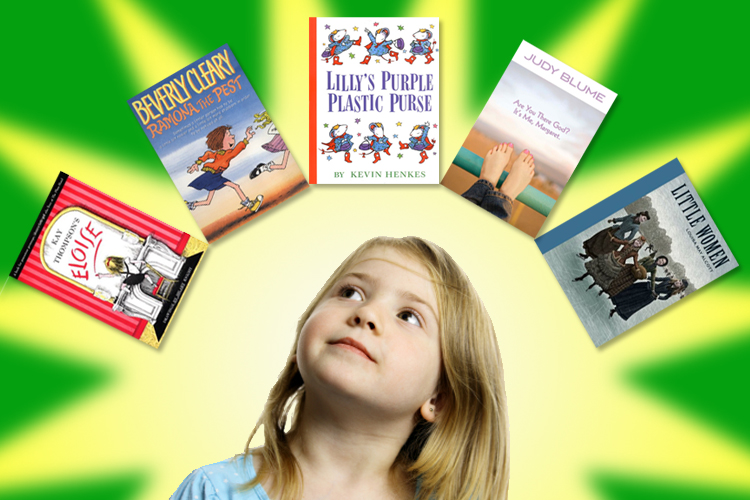
“Lilly’s Purple Plastic Purse” by Kevin Henkes (Ages 4-8)

Plenty of people have other favorites by Henkes — “Chrysanthemum,” “Owen,” “Sheila Rae, the Brave,” “Chester’s Way.” But “Lilly’s Purple Plastic Purse” stands out for its emotional nuance. Lilly, a young mouse who wears fabulous red cowboy boots, adores her teacher, Mr. Slinger. One day, Lilly brings her new purse to school, and is seriously excited to show it to the class. Asked to wait, she can’t quite manage to restrain herself, repeatedly interrupting the class to show off her new treasure. When Mr. Slinger takes the purse away until the end of the school day, Lilly, infuriated, gets revenge by drawing a mean picture of him and slipping it into his bag. Then, on the way home, she finds that Mr. Slinger has written her a sweet note, “Today was a difficult day. Tomorrow will be better.” Lilly is filled with sickening regret. But she apologizes and is forgiven and, best of all, manages to forgive herself. Mr. Slinger’s words, and Lilly’s acceptance of herself — on good days and bad — are lessons that any fabulous little girl (or grown woman) who occasionally struggles to control her impulses can take to heart.

“Eloise” by Kay Thompson, Drawings by Hilary Knight (Ages 7 and up)

There’s a reason this book about a 6-year-old girl making all manner of mischief in New York’s Plaza Hotel, originally published in 1955, is beloved by girls and women everywhere. Actually, there are myriad reasons, Knight’s breathtakingly elegant, deliciously expressive illustrations significantly among them. But mostly, it’s Eloise herself — that never-bored, perpetually inventive little girl, who orders everything from room service with a definitive “and charge it please, Thank you very much,” torments her tutor, adores her nanny, misses her absent mom (though she’d never say so), braids her pet turtle Skipperdee’s ears first thing each morning (“Otherwise he gets cross and develops a rash”), and generally spends her days, well, pretty much as she pleases. She’s a far cry from the overscheduled, helicopter-parented children of today.

“Ramona the Pest” by Beverly Cleary (Ages 7-12)

There are those who would make a strong case that Barbara Park’s more recent Junie B. Jones series is the better girl-starring series for this age group. Then there are those who remember devouring Cleary’s books by the pile when they themselves were around 7. Those people will point to the books’ enduring popularity, and the fact that the adventures (er … misadventures) of the irrepressible Romana can still deeply absorb girls — and yes, boys, too — just transitioning to chapter books, and make them laugh and laugh. If Ramona is a pest, she’s a pest many children can truly relate to.

“Little Women,” by Louisa May Alcott (Ages 9-12)

Ah, the March sisters — coltish tomboy Jo; frail, sweet Beth; beautiful, practical Meg; pampered, artistic Amy — living in genteel poverty with their mother, Marmee, in their New England home and struggling to make the best of things while their father is away, fighting in the Civil War. As wonderfully warm and endearingly romantic as you may remember them to be, the stories that make up the novel are surprisingly insightful, fresh and modern. It’s a book worth returning to, if you haven’t picked it up since childhood, and a lovely book for girls in the midst of their own.

“Are You There God? It’s Me, Margaret” by Judy Blume (Ages 9-12)

For many girls and young women, this book pretty much wraps up their preteen years: the angst over their changing bodies (or bodies that aren’t changing fast enough), the confusion over fitting in socially and staking a claim to their own beliefs, the deep desire to know right now what life will bring them at its own pace. Blume’s protagonist, 11-year-old Margaret, whose family moves to the New Jersey suburbs from New York City when she’s on the brink of sixth grade — that universally difficult year — contends with all of this, chatting with God in her bed at night though she has been raised in a non-religious home. Grown-ups who read this book years or even decades ago (it was initially released in 1970) can probably conjure images of first bras and first periods. And while they may recall how personal and real the book felt, they may have forgotten how funny it is, too.

——————

Is your favorite book sorely lacking from this list? Let’s face it, any list of five great books for girls is, by definition, woefully inadequate. Where, you might ask, looking over this handful of literary selections, is Frances Hodgson Burnett’s “The Secret Garden”? Or Roald Dahl’s “Matilda”? Or L.M. Mongtomery’s “Anne of Green Gables”? Or Astrid Lindren’s “Pippi Longstocking”? Or Madeline L’Engle’s “A Wrinkle in Time”? Or Alice, or Madeline, or Coraline? Or, frankly, a host of other long-loved favorites?

If your most treasured read hasn’t been included here, don’t shake your fist in the air and curse the gods at the injustice of it all: Blog about your own summer reading suggestions for kids on Open Salon (make sure to explain what makes them so great). Don’t forget to tag your post “Building a bookworm.” We’ll be cross-posting your submissions on Salon in the coming weeks.

Great audiobooks for your kids

From Beverly Cleary classics to ironic robots -- the perfect soundtrack to your summer family road trip

  • more
    • All Share Services

Great audiobooks for your kids

As a child, I always wanted to read in the car during long road trips. But somehow reading in the back seat of our wood-paneled Aspen station wagon usually left me dizzy and heaving on the side of a highway. Plus my mother said it was bad for my eyes (that part might have been right, judging from my contact lens prescription).

My own children are blessed with a built-in DVD player in our minivan. But a parent can only take so many animated features during a long car ride — and so much whining and poking of little brothers. And what if we have to drive Dad’s (more, err, “rustic”) vehicle?

That’s where audiobooks comes in. OK, they’re technically not reading, but it is listening to literature read aloud — verbatim — by people who can do the voices much better than Mom or Dad, and they lack the noisy sound effects and soundtracks of most kids entertainment. Plus, there’s usually a good supply of high-quality stories available at your public library.

Here are a few of my favorites:

  • “Stories of Robots,” edited by Russell Punter: This is a collection of three short stories, read with a delightful British accent. The stories, which are about robots with surprisingly human foibles, have enough slapstick humor to be entertaining to the preschool to early elementary set coupled with a surprising dose of irony to keep the parents engaged. The publisher, Usborne Children’s Books has a whole series of these CD/Book sets, featuring the typical preschool lineup of dinosaurs, mermaids, fairies and knights, but the only other one I’ve been able to get my hands on is “Stories of Pirates.” Our family has owned the robots and pirates audiobooks for about five years and we never get tired of them.
  • Beverly Cleary classics: Ramona, Beezus and Henry were some of my favorite literary characters, even though they lived a generation before my childhood. With Neil Patrick Harris voicing many of the Henry stories and Stockard Channing reading the Ramona series, the tales from Klickitat Street come alive for my boys, who ask how it’s possible that kids are riding buses alone and knocking on strangers’ doors. These are especially a nice break from the popular eye-rolling, gross-out chapter books aimed at mid-elementary boys.
  • Modern Classics: such as Carl Hiaasen’s “Hoot,” Louis Sachar’s “Holes” or Linda Sue Park’s “A Single Shard.” I have to admit, I have not read — or listened to — these books all the way through. They were part of a CD sampler we got at our local independent children’s bookstore. All I can say is that at the time we got this disk, my older son (who was only 3 at the time) would listen rapt to to this entire CD (which also included chapters from many other Newbery Award-winning children’s books, such as “Island of the Blue Dolphins”) and ask to ask to hear it again.

Maybe I’ll have to track down “Hoot” or “Holes” (which both have nature or outdoors themes) to play on the way to one of our summer camping trips.

Continue Reading Close

Best fantasy books for children

A summer reading list that will let your kid explore the magical realm (and you may even want to come along too)

  • more
    • All Share Services

Best fantasy books for children

I confess: I have no children, and yet I read children’s books. Sometimes I simply don’t have the mental energy to crack open a serious adult book (think “The Wind-up Bird Chronicle,” by Haruki Murakami, or “Truth,” by Simon Blackburn) or even a piece of light fiction (think Carl Hiaasen or James Hynes). Instead, I’ll turn to some old favorites from my childhood, along with a few newer ones that have joined the ranks in recent years. Because my tastes ran to science fiction and fantasy when I was young, these recommendations all share that flavor.

I’ve always been a fan of Roald Dahl, for both his children’s books and his adult offerings. “The BFG” is one of his most charming books for children. The BFG (for Big Friendly Giant) is a giant who kidnaps a little orphan, Sophie, and takes her off to his cave. The BFG turns out not to be a bad sort, however — in part because he doesn’t share with his monstrous giant brothers “a most squackling whoppsy appetite” for eating children — and teams up with Sophie (and the Queen of England) to do battle against those evil brothers of his: Bloodbottler, Bonecruncher, Childchewer, Fleshlumpeater, Gizzardgulper, Maidmasher, Manhugger, Meatdripper, and Butcher Boy. The BFG’s creative use of language is the best part of the book, though Blake Quentin’s illustrations make a close second.

The Forgotten Door,” by Alexander Key, introduces us to Little Jon, who falls through the old Door: “the Door that led to another place, the one that had been closed so long.” Jon is struck on the head, and when he awakens, he discovers that he’s lost his memory. But Jon is no ordinary boy. When he talks to animals, the animals actually listen (though I don’t recall Jon ever talking to a cat in the story); Jon in turn can read their thoughts. He has a few other mysterious abilities, which the family who finds him discovers as the story unfolds. It’s a classic theme: Jon needs to find his way back home. There’s also a striking current of distrust of big government that runs through the end of this 1965 book, adding an interesting contrast for the modern reader to consider.

Edith Nesbit wrote dozens of children’s stories in the late 1800s and early 1900s, among them “The Enchanted Castle” in 1907. I first read this book decades ago when I discovered it in one of the attic bedrooms of my grandparents’ house, and I found it irresistible. Four English children, three living with a French governess and the fourth the niece of the castle’s housekeeper, discover a magic ring and find out what it can do. The writing moves at a slower pace than modern children’s books, and the children sometimes don’t sound like children at all, but it’s all worthwhile. You’ll be reminded of Kenneth Grahame’s “The Wind in the Willows,” published just a year later, and you’ll understand why C.S. Lewis cites Nesbit as an influence on his “Narnia” novels. (Grahame and Lewis are worth reading as well, of course.) 

Philip Pullman’s trilogy, “His Dark Materials,” begins with “The Golden Compass” (titled “Northern Lights” in the UK). The most engaging conceit in these books is that, in the parallel-world setting of the story, people are accompanied by daemons, their souls embodied in the form of animals. Adult daemons take the form of animals that reflect their personalities: A servant might have a dog daemon, a scholar an owl or a raven daemon. Children’s daemons can change shape until the child reaches adolescence. Young Lyra and her daemon Pantalaimon happen into a mystery that could affect not only their world but our earth as well, and even the afterlife. The promise of the first two books isn’t quite met in the last, but they’re all well worth reading (the second and third books are ”The Subtle Knife” and “The Amber Spyglass“). One of my favorite bits of Pullman’s writing, which helps establish the tone for the narration, is an early description of Lyra: “She was a coarse and greedy little savage, for the most part.” Lyra does grow up eventually, though it’s a long, hard journey.

Finally, I should mention Neil Gaiman’s work: “Coraline” is one of my favorites.

Continue Reading Close

10 great “grownup” books for kids

A summer reading list of adult literature suitable for middle school readers

  • more
    • All Share Services

10 great

The idea makes sense: If you want to raise a kid with broad horizons and good writing skills, encourage said kid to read books that offer diverse perspectives, explore deeper themes, and resonate with excellent prose. This might mean sometimes encouraging your kid to read books intended for adults. And suddenly the idea sounds scary.

As a writing teacher, I ran into the same problem time and time again: I’d find the “perfect” book to assign to my students (ages 10-12): a short novel with accessible yet brilliant writing and apparently appropriate themes, only to discover a steamy sex scene halfway through my preview reading.

Many kids are ready and willing to read books intended for adults, but selecting books with both kid-friendly style and content can be time consuming. Here are the results I’ve compiled through a process of trial and error. I decided not to include authors who are generally accepted as appropriate for young readers (J. R. R. Tolkien, Sir Arthur Conant Doyle, Jules Verne).

Animal Farm” by George Orwell

Age range: Middle grades to young adult

Not Orwell’s best (see “Down and Out in Paris and London”), but moving and clearly written. Plus, talking animals offer a sneaky way to spark discussions on morality and government. When I was teaching, I assigned “Animal Farm” to fourth and fifth graders and the entire class made it to the end without complaint.

Lost Horizon” by James Hilton

Age range: Advanced middle grades to young adult

When a small craft is hijacked and goes down in the Himalayas, four travelers stumble upon paradise on earth. Written and set in the 1930s, “Lost Horizon” belongs more in the realm of adventure fiction in than the hallowed halls of serious literature. That said, it’s not without deeper meaning, and the writing is great: spare, witty, and very much a product of the era. Popular usage of the term Shangri-La stems from this novel, which was widely read at the time it was published. Some racial terms common to the era (such as Oriental) may require a context-based explanation.

The Red Pony” by John Steinbeck

Age range: Middle grades to young adult.

Kid protagonist? Check. Animals? Check. Clear writing? Check. Kid appropriate themes? Check. Steinbeck’s bittersweet novel about a pony and his boy is an easy-to-read introduction to serious literature. To be honest, my 10-year-old students didn’t love this book, but it did elicit some thoughtful responses.

The Flame Trees of Thika” by Elspeth Huxley

Age range: Middle grades to young adult

This memoir of growing up in Kenya comes alive with the steady voice of a curious and isolated only child. Huxley’s prose sings with the wild lands, the wild animals, and the wild, sometimes ruthless characters who fight for survival during the last days of British Colonial rule. Not a difficult read, but some themes may be disturbing to younger readers — Huxley writes frankly about hunting and race relations and mentions (not explicitly) an extramarital affair.

To Kill a Mockingbird” by Harper Lee

Age range: Advanced middle grades to young adult

Pretty much a given. Lee’s book is already assigned at the early high school level, but I’m including it because the story can’t be beat for its combination of serious writing, a likeable child protagonist, humor, and (predominantly) kid-accessible subject matter. Speaking of subject matter… the references to rape can, of course, be disturbing. My 11-year-old students liked this book, but I cleared it with parents first.

Gentlemen of the Road” by Michael Chabon

Age range: Young adult

A pulpy yet beautifully written adventure story about two itinerant swindlers. Swashbuckling action is delivered via gorgeously constructed sentences, making this book a good choice for the more reluctant reader. Violence (cartoonish) and references to rape and sex (not explicit) limit the age range to older kids.

Till We Have Faces: A Myth Retold” by C.S. Lewis

Age range: Advanced middle grades to young adult

A retelling of the story of Cupid and Psyche, “Till We Have Faces” is written in musical prose, and despite the mythical setting, characters emerge as startlingly real and human, and morality is depicted in shades of grey. Lewis explores trust, jealousy, the meaning of love, and the significance of beauty. Not difficult to read, but perhaps a bit dark and dense for some younger readers.

The Mysterious Stranger” by Mark Twain

Age range: Advanced middle grades to young adult

Length (short) and humor (wicked) fall in favor of this novella about the devil visiting a small town in sixteenth century Austria. Because of the sometimes convoluted sentence structure, I read this one aloud to my 10-year-old students, who loved Twain’s mischievous and evocative depictions of magic. Not necessarily appropriate for children with strong Christian beliefs.

Talking to Strange Men” by Ruth Rendell

Age range: Young adult

British school kids develop an elaborate network of spies, but their game turns dangerous when they inadvertently allow an adult to join their ranks. Rendell’s prose is crisp and brilliant, as usual. I read (and loved) this thriller when I was 12, and it certainly didn’t scar me for life. That said, it does contain some scary scenes.

Bless Me, Ultima” by Rudolfo Anaya

Age range: Advanced middle grades to young adult

An evocative coming-of-age story about growing up in New Mexico in the 1940s. The seven-year-old protagonist’s friendship with an elderly curandera (healer) leads him to question his religion and the values of his parents and neighbors. Contains references to sex (not explicit) and some profanity. Not necessarily appropriate for children with strong Christian beliefs.

Continue Reading Close

Felisa Rogers studied history and nonfiction writing at the Evergreen State College and went on to teach writing to kids for five years. She lives in Oregon’s coast range, where she works as a freelance writer and editor.

Your kids’ globally aware reading list

How do families live around the world? These books introduce a diverse planet to a young mind

  • more
    • All Share Services

Your kids' globally aware reading list

Are your kids bored? Are you tired of their obsession with Hannah Montana and Disney princesses? Here’s a list of books that will open their minds and imaginations to the rest of the world — and help them better understand their own.

How Do People Live Around the World?

1. ”Material World” by Peter Menzel and Charles C. Mann, all ages

This beautiful book of photographs and cultural anthropology is a fascinating exploration of how families live around the world. In 1994, the U.N.-sponsored International Year of the Family, photojournalist Peter Menzel conceived of this project to capture the lives of typical families in 30 nations across the globe. In each vignette, he and his collaborators photographed families posing in front of their homes and literally alongside all their world possessions. The photographers spent a week living with a “statistically average” family in each country and interviewed them about their lives, their work and their attitudes toward their possessions. The stark visual contrast between the portrait of the average family in Texas with their multiple televisions versus the family living in a dirt house in Mali is enlightening and thought-provoking. Sometimes a picture truly can say a thousand words.  The book also includes statistics on numbers of toilets and televisions, and GDP to further illuminate the disparities. 

This is not a children’s book, per se, but I would recommend it for all ages. This book is sure to engage a reader of any age, and lead to discussions about wealth and materialism. It might even make the average American child realize just how lucky he is.

2. “Mama and Papa Have a Store” by Amelia Lau Carling, ages 4-8

A storybook with beautiful, colorful illustrations, “Mama and Papa Have a Store” depicts the mundane daily life of a typical preschooler. She happens to be of Chinese descent growing up in Guatemala with her family, but her story will be familiar to any young child: going to school, eating with her family, playing and observing her parents working in her family’s general store. This is a very special cross-cultural story, involving Chinese, Guatemalan and Mayan traditions: “They call [Mama] doña Graciela. But in Chinese her name means Lady Who Lives in the Moon. [Papa] is don Rodolfo in Spanish, and in Chinese his name means Fragrant Pond.”

What Do People Eat Around the World?

3. “What the World Eats” by Faith D’Aluisio and Peter Menzel, all ages

This is another beautiful and intriguing volume by the author who wrote “Material World,” in conjunction with his wife. In a follow-up to his first book about how the average family lives around the world, this book looks at and visually describes what the average family eats. Using the same format as in “Material World,” the authors of this book depict a week’s groceries for typical families across the globe. The authors spent time with 25 families in 21 different countries to provide this comparative international portrait. Cost and calories are included, but it takes only a glance at the photos to see the shocking differences between the pizza-eating and soda-drinking American families (six gallons a week!) and the families with vegetable-based diets in many other countries. Some of the interesting statistics provided for comparison include number of McDonald’s, and the prevalence of obesity and diabetes. In addition to being a launching pad for kids to consider how much or little families live on in other countries, this book is a great pictorial representation of why obesity and diabetes are epidemic in some countries, and not in others (yet).

4. “Moonbeams, Dumplings & Dragon Boats” by Nina Simonds, Leslie Swartz and the Children’s Museum, Boston. Illustrations by Meilo So, ages 9-12

Chinese food and culture expert Nina Simonds created this book for children to understand five major Chinese festivals, highlighted through tales, recipes and activities. She offers festival lore and folk tales that will be unfamiliar to non-Chinese readers. She tempts with mouth-watering yet simple recipes for dumplings and moon cakes. Also included are instructions for engaging activities to do with kids, such as building a kite at Qing Ming or a miniature dragon boat for the Dragon Boat Festival.

5. “Too Many Tamales” by Gary Soto, ages 4-8

This is the story of Maria, a little girl who is excited to help out with her family’s Christmas tradition of making tamales. She is even more excited by the idea of trying on her mother’s diamond ring, which her mother takes off to knead the masa. Maria surreptitiously tries on the ring, and then forgets about it. Any kid who has ever done something in secret will relate to the terror Maria feels later when she can’t remember what happened to the ring, and will share her relief when it is found, and she is ultimately forgiven. Along the way, you’ll enjoy illustrations so warm and vivid with the colors of Christmas, you can almost taste the tamales.

Why Does Our Food Look Different from Everyone Else’s?

6. “The Ugly Vegetables” by Grace Lin, ages 4-8

The young girl who narrates this story is upset that her Chinese immigrant family grows vegetables instead of pretty flowers in their yard, like everyone else. She thinks the vegetables are ugly: ”The wind always smelled sweet, and butterflies and bees flew everywhere. Everyone’s garden was beautiful, except for ours.”

When the veggies are ready for harvesting and go into a soup whose aroma entices the entire neighborhood, she has a new perspective on those “ugly vegetables,” and a new appreciation for her family and culture. Written and adorned with lovely illustrations by the author, this is one of my favorite books to introduce acceptance of cultural differences. I also learned the names of some Chinese greens I previously didn’t know. A recipe for Ugly Vegetables soup is included.

Does the Tooth Fairy Fly International? 

7) “Throw Your Tooth on the Roof: Tooth Traditions From Around the World” by Selby Beeler and G. Brian Karas, ages 4-8

Do you know a 6- or 7-year-old with a gap-toothed smile? If they still believe in the Tooth Fairy, they might assume that she, or her representatives, visit children all around the world. Not so! In many cultures, it’s a rodent, not a pretty and ethereal fairy, who manages children’s lost teeth. This is a great book that describes tooth traditions from around the world. Fun for kids, and informative for the rest of us.

Continue Reading Close

Your sons’ summer vacation reading list

From amphibian tales to sinister sci-fi, your guide to keeping your boys reading throughout the holiday months

  • more
    • All Share Services

Your sons' summer vacation reading list

Last week, we hoped to spark conversation — and further suggestions — with a list of five amazing books to hand daughters this summer. We’re not leaving the boys behind. Here is our list of five great books for boys of all ages (books that will also, of course, appeal to girls, too). If your (or your kid’s) favorite book has been left off this list — John D. Fitzgerald’s “The Great Brain”? Norton Juster’s “The Phantom Tollbooth”? The Lemony Snicket books? Or, for the sports-minded child, Dan Gutman’s Baseball Card Adventure Series, or Kadir Nelson’s remarkable “We Are the Ship”? — blog about it on Open Salon: Just make sure to tag your post “Building a bookworm,” and we’ll cross-post the best ones onto Salon itself.

And now for our list:

“Frog and Toad Are Friends” by Arnold Lobel (Ages 4-8)

The thing about Lobel’s Frog and Toad — see also the equally wonderful “Days With Frog and Toad,” “Frog and Toad All Year” and “Frog and Toad Together” — is that, despite the whole amphibian thing, they’re so damn human. Toad is crabby, self-doubting and, let’s face it, somewhat prone to depression. Frog has a sunny, can-do disposition. And they may be an odd couple, of the Oscar and Felix variety, but they are also kind, supportive, considerate, loving friends. And though these stories are, of course, beloved by children of both sexes, the way these two very different fellows take care of each other — and delight in each other’s company — seems like a particularly valuable example for young boys.

“Diary of a Wimpy Kid” by Jeff Kinney (Ages 9-12)

Kinney’s “Wimpy Kid” series may not be writing at its finest, but it has struck a major chord with boys, capturing the attention of even the most reluctant readers. Described as “a novel in cartoons” — with lots of drawn illustrations, a lined-paper format and a font that looks like handwriting — it has an undeniable charm, evoking the misery that is middle school in spare, deft strokes. Its beleaguered narrator, Greg Heffley, isn’t the most sympathetic character, selling out his best friend Rowley when the occasion suits him, but he has a keen eye for demoralizing details. Like the cheese that lies rotting and repulsive on his school blacktop, spawning the terrors of “Cheese Touch.” “It’s basically like the Cooties,” Greg explains. “If you get the Cheese Touch, you’re stuck with it until you pass it on to someone else. The only way to protect yourself from the Cheese Touch is to cross your fingers.” If that doesn’t take you right back to middle school, well, you’re luckier than some of us.

“Danny the Champion of the World” by Roald Dahl (Ages 9-12)

If there is a more moving depiction of the relationship between a son and his father in all of literature than the one in this rollicking adventure tale, we’d sure like to know about it. “It is impossible to tell you how much I loved my father,” Dahl’s narrator, Danny, tells us. “When he was sitting close to me on my bunk I would reach out and slide my hand into his, and then he would fold his long fingers around my fist, holding it tight.” But Danny’s love for his dad — a filling station owner and widower who is raising his only child in a gypsy caravan — is apparent in every line, every moment of this story. Danny’s dad, he tells us, is an “eye-smiler,” whose eyes flash and twinkle when he is amused, but who never much moves his mouth. “I was glad my father was an eye-smiler,” Danny writes, “because it is impossible to make your eyes twinkle if you aren’t feeling twinkly yourself.” This gentle, funny, genuinely wonderful book will leave boys (and their parents) eye-smiling and deliciously amused.

“The Lightning Thief” by Rick Riordan (Ages 9-12)

Start your son on this first book in Riordan’s Percy Jackson and the Olympians series and watch him read away his summer. When we first meet Percy, he just seems like a troubled kid on the verge of getting kicked out of yet another school. In fact, he’s gone through six schools in six years: Bad things just seem to keep happening to him. It isn’t long before Percy (short for Perseus), and we, learn that those strange things he thinks he’s been hallucinating are actually real. Mythological monsters and gods — satyrs, minotaurs, centaurs — really are populating his life and he himself is a half-blood: His father, whom he never knew and had been told had been “lost at sea,” is, in fact, Poseidon. This popular series is a great read for any myth-minded kid who cut his teeth on “D’Aulaires’ Book of Greek Myths.” Come to think of it, it’s a great read for any kid. Come to think of it again, it’s just a great read.

“The Giver” by Lois Lowry (Young Adult)

This book about a futuristic world that initially seems utopian (no crime, no poverty, no illness, abundantly good manners), but, as it turns out, is less than ideal (no color, no music, no sunshine), is creepy yet altogether compelling. As it begins, 11-year-old Jonas is apprehensively anticipating his Ceremony of Twelve, when he will receive his adult Assignment from the Committee of Elders. Will he be a Nurturer or a judge, like the parents who are raising him? Will be a Caretaker of the Old, like his friend Fiona? But Jonas does not receive a conventional assignment: He is selected to become the community’s next Receiver of Memory, tasked absorbing the collective recollection of pain and pleasure, which the community has long since eschewed in pursuit of comfort, stability and Sameness. Jonas meets daily with the previous Receiver, now the Giver, and learns to appreciate a world with choice and compassion — and love.

Continue Reading Close

Page 1 of 2 in Building a Bookworm