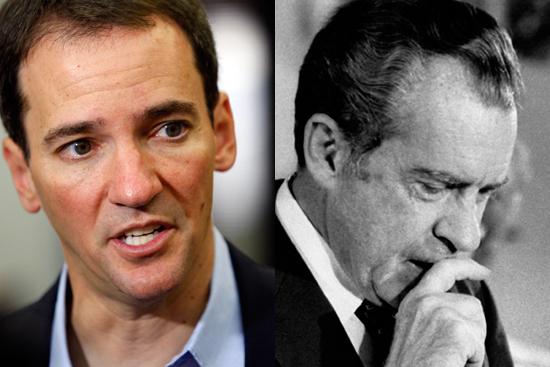

Republicans have fantasized about a Democratic "Watergate" for decades. Can they still remember the real thing?
The quest for a Democratic Watergate that has preoccupied Republicans for more than three decades may never achieve fulfillment but surely will never end. Impeaching Bill Clinton promised satisfaction only to bring deeper frustration — which must be one of the many reasons that we now hear politicians and pundits announcing the arrival of ” Obama’s Watergate” (and also why they never say ” Obama’s Whitewater” ).
So far, the alleged scandal that supposedly threatens the Obama presidency doesn’t amount to much: a verbal mention of a nonpaying advisory post to Rep. Joe Sestak in a conversation with Clinton, and an e-mail mentioning three administration jobs to Andrew Romanoff, the Democratic speaker of the Colorado state assembly, dangled in order to dissuade them from entering primaries against incumbents favored by the president.
If clumsiness were an indictable offense, then the White House officials responsible for those overtures might well be in trouble. But when people compare such ham-handed deal-making with the crimes of Watergate, it can only mean that they don’t remember what the country and the Constitution endured under Nixon — or that they cynically assume nobody else does.
Some of us do, however. And for those who don’t, or who never learned the true history of the Nixon era in high school or college, there are several gripping books, including “The Wars of Watergate” by Stanley Kutler, “Nightmare: The Underside of the Nixon Years” by the late Tony Lukas, and of course Bob Woodward and Carl Bernstein’s classic “All the President’s Men.” (The latter is also the title of a wonderful movie that outlines the conspiracy but necessarily omits most of the grim details.)
” Watergate” was the place where the president’s henchmen staged a “third-rate burglary” of the Democratic National Committee headquarters on a June night in 1972, but its historical definition is the vast gangsterism of the Nixon regime. Watergate involved no political job offers, but a series of burglaries, warrantless domestic wiretaps, illegal spying, campaign dirty tricks, and assorted acts of thuggery by a group of goons whose leaders included G. Gordon Liddy and the late E. Howard Hunt. Watergate meant a coverup of those felonies with more felonies, set up by lawyers and bureaucrats who collected cash payoffs from major corporations and then handed out hush money and secret campaign slush funds. Watergate implicated dozens of perps, from Hunt and Liddy all the way up to the president, his palace guard, and his crooked minions at the highest levels of the Justice Department, the FBI and the CIA.
Plenty of Watergate experts can be summoned to evaluate the current comparisons with the Sestak/Romanoff brouhaha — not just superb historians like Kutler and Robert Dallek or celebrated journalists like Woodward, Bernstein and Seymour Hersh, but the surviving veterans of the Nixon regime itself, from Henry Kissinger, Pat Buchanan and Roger Ailes on down to Lucianne Goldberg and Chuck Colson. If they are anywhere near as honest as the redeemed John Dean, they’d have to laugh at any suggested resemblance between the felonious wilding of the Nixon era and the tame wheeling and dealing of Rahm Emanuel.
So perhaps the time has come to amend or extend Godwin’s Law: The first to cry ” Watergate” loses the argument.
Continue Reading
Joe Conason blogs in Salon several times a week and writes a weekly column for the New York Observer. His latest book is "It Can Happen Here: Authoritarian Peril in the Age of Bush." More Joe Conason
If the administration had actually managed to get Joe Sestak and Andrew Romanoff out, the story would be dead
There is, without a doubt, a major scandal hidden in the news that the White House suggested to both Joe Sestak and Andrew Romanoff that the administration might be able to help them find jobs if they didn’t run for Senate in Pennsylvania and Colorado. But it’s not the scandal cable news anchors and blaring headlines would have you believe.
Ignore Republicans, like Rep. Darrell Issa, who want you to think there’s been some nefarious violation of the law here. After all, there’s no indication any actual promises of jobs were made — which means even former Bush administration officials are saying there doesn’t seem to be any evidence of any crime. (And Romanoff had already applied online for jobs with the administration when deputy White House chief of staff Jim Messina contacted him to discuss options.) What the disclosures about Sestak and Romanoff really show is that the White House political machine isn’t doing its job very well.
The only reason anyone’s talking about this stuff now, in fact, is because Sestak managed to knock off the Obama administration’s preferred candidate, party-switching incumbent Arlen Specter. Had Sestak lost, the fact that Bill Clinton floated the possibility of a job last summer in a failed attempt to clear the field for Specter would — maybe — merit a line in Sestak’s Wikipedia page. But as soon as he won, Republicans seized on the offer as a chance to embarrass the White House, which had campaigned on promises of transparency and ethics. (Of course, Obama never promised that “ending business as usual” would mean an end to the very basic concept of giving politicians something they want in order to sweeten a deal to make them do something they don’t want to do, but never mind that.)
When previous administrations used the same tactic, no one ever got upset. Take Karl Rove, for example. Eight years ago, Rove and then-Vice President Dick Cheney convinced Tim Pawlenty (at the time serving as Minnesota House majority leader) not to run in a GOP primary for the Senate against Norm Coleman. Why didn’t anyone accuse Rove of shady deals then? At least in part because it actually worked — Pawlenty stayed out. But it would be fairly naïve to assume Cheney and Rove made no promises at all in exchange. Rove, though, didn’t let that stop him from blustering recently that Sestak is either a liar or protecting a felon.
Unlike the early days of the George W. Bush administration, though, when President Obama’s aides give orders to Democrats around the country, they don’t necessarily seem to listen. In Pennsylvania, they couldn’t keep Sestak out (though it wasn’t entirely clear that, in June 2009, anyone in the White House thought Sestak posed a serious threat). In Arkansas, Lieutenant Gov. Bill Halter ignored the establishment’s preference to let Sen. Blanche Lincoln slide without a challenge. In Colorado, Romanoff wouldn’t even take a job he’d already applied for instead of challenging Sen. Michael Bennet. The administration also failed to lure their preferred candidates into races in Illinois, North Carolina and Florida — not to mention Delaware, where Vice President Biden’s own son decided not to run for the Senate — and had no luck trying to muscle New York Gov. David Paterson out. (The New York Times took care of that for them, it turned out.)
So the disclosures this week have Democrats grumbling (though still only under condition of anonymity) about a political operation that seems to have fallen asleep since the 2008 campaign. “What became news was that they let [the job offers] become news,” says one Democratic strategist who has worked with a campaign the White House tried — and failed — to quash. “This is not new, this is not news, there is nothing untoward or unusual. Reading about it on the front pages is the mistake that happened.” Another strategist admits there’s a “competence argument” that’s more compelling than any of the legalistic ones the GOP is pushing. (The White House didn’t immediately respond to a question about the administration’s political operation.)
Which is why the Republican protests might, in the end, be smarter than they look. It’s a tough sell to convince anyone except overeager cable bookers that there’s any real criminal controversy here. It’s far easier to turn the whole mess into yet another embarrassing problem for the administration — especially with Rod Blagojevich about to go on trial for corruption charges stemming from his own efforts to sell Obama’s old Senate seat. This isn’t about sending anyone to jail. It’s more about scoring political points. Unfortunately for the White House, their bumbling attempts last summer to go about the day-to-day business of politics made it easy for the GOP to turn things around on them now.
Continue Reading
Mike Madden is Salon's Washington correspondent. A complete listing of his articles is here. Follow him on Twitter here. More Mike Madden
When Darrell Issa compares the Sestak affair with Watergate, he is expressing a persistent Republican strain
As the point man for Republican attacks on the Obama presidency, Rep. Darrell Issa, R-Calif., is a laughable character. His billing of the deflated Sestak affair as “Obama’s Watergate,” replete with insinuations of “witness tampering,” sounds like partisan hysteria. So do the whispers and cries of “impeachment” from the wingnut gallery to whom Issa is playing.
But at a moment like this, it is worth remembering that Republican scheming to impeach Bill Clinton began long before Monica Lewinsky appeared on the public stage — and those grandiose notions seemed easy enough to laugh off at the time, too.
Theories about impeachable offenses committed by Clinton began to appear in right-wing forums as early as 1994, when such “scandals” as Whitewater, the FBI files screw-up and the White House Travel Office imbroglio were still new. To most observers those theories still sounded like a joke over the ensuing years, right up through the fall of 1997, when Bob Tyrrell, then the editor of the American Spectator, convened a dinner of conservatives at a Capitol Hill restaurant to plot the impeachment of Clinton.
The point is that no matter how heavy-handed and disreputable Issa may seem, he represents an attitude that has never changed in his party, which was not chastened by its electoral losses after the Clinton impeachment. Listening to right-wing propaganda against Obama over the past year or so, such as the “birther” meme, it is clear that there is a certain kind of Republican that still thinks any Democratic president lacks legitimacy by definition, and that those Republicans will entertain any scheme to eject a Democrat from the Oval Office.
Assuming that today’s White House explanation of the Sestak episode is accurate, such attempted horse-trading scarcely amounts to a constitutional offense contemplated by the founders as impeachable. But then neither did the Lewinsky affair — and that didn’t stop the Republicans on the House Judiciary Committee from abusing their power when they had the numbers to do so.
Obama should take the Sestak maneuver as an early warning against placing too much trust in his chief of staff, Rahm Emanuel, whose arrogance will surely cross a line someday if it has not already. Clinton’s impeachment was the culmination of years of propaganda, planning and political preparation, all awaiting an opportune moment that inevitably arrived.
Both in their campaign and in the White House, leading members of the Obama team have emphasized their cool disdain for all things Clinton. This bad week should put an end to those pretensions. The president and his aides ought to try learning from the Clinton experience instead, because for them, as Democrats in the White House, very little has changed.
Continue Reading
Joe Conason blogs in Salon several times a week and writes a weekly column for the New York Observer. His latest book is "It Can Happen Here: Authoritarian Peril in the Age of Bush." More Joe Conason
What do Peggy Noonan, Cokie Roberts, and Chris Cillizza have in common? They invent their own "mainstream opinions"
Washington Post political reporter and analyst Chris Cillizza explained, this morning, why the Sestak scandal was important:
That the story has become a major controversy, a regular fixture on cable news chat shows and a momentum-killer for Sestak following his come-from behind victory against Specter in last week’s Pennsylvania primary is evidence of how the White House mishandled the controversy, according to conversations with several high-level Democratic strategists.
Indeed, Sestak has been hurt so badly that he currently leads his opponent by three points. (Before this scandal destroyed his momemtum, Sestak trailed Toomey by five points.)
Elsewhere this morning, famous Republican opinion writer and Reagan speechwriter Peggy Noonan was fascinated by this important true fact about Barack Obama:
What continues to fascinate me is Mr. Obama’s standing with Democrats. They don’t love him. Half the party voted for Hillary Clinton, and her people have never fully reconciled themselves to him. But he is what they have.
This is a chart of reality. (Barack Obama is also still more popular among all voters than Congressional Democrats or Republicans.)
Last weekend, commentator and professional roundtable-populator Cokie Roberts instructed Connecticut Attorney General to drop out of the US Senate race following the revelation that he sometimes talked like he was in Vietnam. Roberts knows, in her heart, that 2010 is “not a year for phonies” and “people are going to hold this against him.”
The two most recent polls have Blumenthal between 19 and 25 points up.
And that is this week in mistaking your assumptions for the national mood in the process of attempting to report on perceptions that you are deeply involved in creating and shaping.
Continue Reading

Alex Pareene writes about politics for Salon. Email him at apareene@salon.com and follow him on Twitter @pareene More Alex Pareene
The White House account of the overblown Joe Sestak "bribery" scandal that D.C. journos and GOPers obsess over
The White House has released a formal statement on the Joe Sestak job “bribe” scandal that Darrell Issa invented to pass the time until he can come up with a reason to begin impeachment proceedings. Turns out, Bill Clinton is responsible.
The White House will release a memo from Rahm Emanuel to former President Clinton. Clinton was instructed to ask Rep. Sestak about his intentions.
And according to the New York Times, Clinton was gauging Sestak’s interest in “a prominent, but unpaid, advisory position.” Rahm Emanuel didn’t want Sestak to leave the House of Representatives, so a real job was never even offered.
The last sentence here is the understatement of the month:
The office of Robert F. Bauer, the White House counsel, has concluded that Mr. Emanuel’s proposal did not violate laws prohibiting government employees from promising employment as a reward for political activity because the position being offered was unpaid. The office also found other examples of presidents offering positions to political allies to achieve political aims.
There are other examples? And no one was arrested for it?
This scandal is even worse than when the White House bribed Joe Biden into getting out of the Senate to clear the way for his son. Or when they bribed Janet Napolitano into letting the crazy wingnuts take over Arizona. Or when Obama bribed Rahm Emanuel himself into giving up his House seat to be the president’s official Bribery Czar.
Anyway, this should make the whole thing go away, because what do Republicans have to gain by pursuing a trumped-up scandal? Surely no one in our responsible political press will continue to play along, right?
Continue Reading

Alex Pareene writes about politics for Salon. Email him at apareene@salon.com and follow him on Twitter @pareene More Alex Pareene