
International cuisine
Culinary diplomacy at the Axis of Evil Cafe
The Conflict Kitchen serves only food from places Americans are supposed to hate. Can taste create understanding?
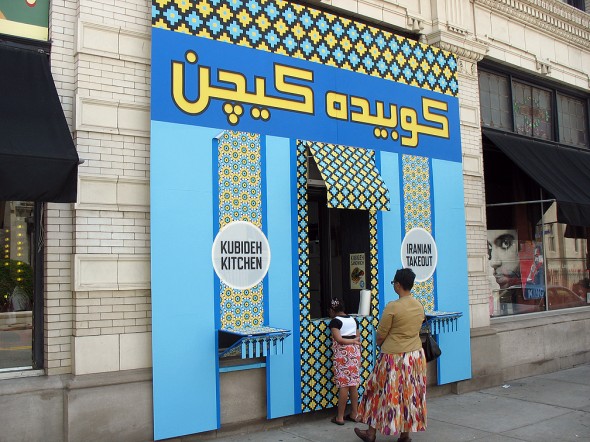
Conflict Kitchen Craving a bowl of North Korean noodles? Or maybe you’re looking for your fix of lamb kebabs, a specialty of the Afghan capital? Head over to the Conflict Kitchen, a Pittsburgh takeout restaurant whose most distinctive feature is that it only serves dishes from countries that the United States is … let’s just say not exactly best friends with.
Started by a group of artists, the Conflict Kitchen has, in its first iteration, taken the form of the Kubideh Kitchen, a blue-and-yellow stall that sells kubideh, an Iranian ground beef patty sandwiched between barbari flatbread and garnished with onion, basil and mint. “We’re using food as an entry point to help people explore cultures that aren’t talked about in the mainstream media,” says Jon Rubin, an assistant professor of art at Carnegie Mellon University. The idea isn’t to create political controversy (“We don’t support the Iranian government or anything,” says Rubin), but to help people see these countries as everyday, human places that are defined by more than just their policies and government.
Rubin and his collaborators, John Pena and Dawn Weleski, worked with the local Iranian community to create the dish. The sandwich is packaged in a blue, green and yellow paper that is lined with the opinions of Pittsburgh’s Iranian residents, covering everything from poetry to Iran’s Green Revolution. “The younger generations play Persian and Western music banned in public … Defying the regime’s propaganda is an honor for Iran’s baby boomers,” says one box titled Youth.
On June 5, the Conflict Kitchen held its first public event, a meal held simultaneously in Pittsburgh and Tehran, where diners in both cities sat around long tables that were joined via webcam: an international dinner party. They ate the same food — chicken stew with pomegranate and walnuts, a beef stew with dried limes and greens and crusty, bottom-of-the-pot rice, and talked to each other with the help of a microphone and speakers.
The conversation started safely, with talk of food — how Americans buy bread (from supermarkets) versus how Iranians buy bread (fresh from the bakery every morning) — before veering into the related topic of growing your own herbs (almost a universal practice in Iran) and eventually morphing into an edgier discussion about dating and politics and larger commonalities — two young graduates talked about the difficulty of finding a job after getting their college degrees.
“Eating the same food provided everyone with a level ground. They begun to find commonality in their experiences through the way the food smells and tastes,” Weleski says. In other words, the shared sensory experience, the intimacy of eating a meal together can take the edge off what can otherwise be a potentially antagonizing situation.
And, of course, there was the fact that food is irrevocably connected to most aspects of our lives, from religion and society to politics and identity. Conversations about food frequently grow into larger conversations about the world around us.
Just next door to the Conflict Kitchen is the Waffle Shop, another project by Rubin and Weleski that serves homemade waffles and allows diners to participate in a talk show (either as host or participant) that is broadcast over the Internet. Here, too, says Rubin, is the idea that people can be seduced via their stomachs to engage with things that they are otherwise unfamiliar with, be it going up onstage at a talk show or asking questions about a completely alien — and often vilified — foreign culture.
Recently at the Waffle Shop, a young black man and an 80-year-old Jewish woman engaged each other in a frank conversation about race. Another man came out to his father. At the Kubideh Kitchen, a Japanese Buddhist customer and a Muslim man discussed religion and food while a half-Iranian, half-American woman talked about how difficult it was for her to live with two hugely differing identities.
So what exactly is it about food that helps facilitate these conversations? “Eating comfort food like waffles or sandwiches helps people open up,” says Rubin. Maybe it’s the endorphin release that happens after a great meal, but it’s an undeniable fact that good food can soften us, turn us into defenseless, vulnerable versions of our pre-meal, hungry selves, in a way that little else can.
If the successes of the Conflict Kitchen and the Waffle Shop are anything to go by, there’s an important lesson to be learned here: that food can be used as both an amelioratory salve and as an invitation to open up. Now if only we can ply those Israeli soldiers with caramel chocolate popcorn and pizza.
Riddhi Shah is an editorial fellow at Salon. More Riddhi Shah.
How to make potsticker dumplings, Mama Yang style
Yes, it's a project. Yes, they're cheap to buy. But what's better than a party where the guests all get to cook?
I’ll be straight with you: I’m not going to try to convince you to spend hours and hours to make these potstickers. After all, they are a food that, if you live in a city with a Chinatown of any size, you can probably get for 20 cents apiece. When it comes to making dumplings at home, it’s a choice you have to come to on your own.
Because they are no joke when it comes to effort. You have to chop and squeeze and mix the filling, cooking off bits to taste for the correct seasoning until you get it right. You have to knead the dough and roll out dozens if not hundreds of skins. You have to stuff them, form them, pleat them and then, eventually, you get to cook and maybe even eat them. (This is why they are a distinguished weapon in the ever-full quivers of mothers who tend to smother with kindness.)
Continue Reading CloseFrancis Lam is Features Editor at Gilt Taste, provides color commentary for the Cooking Channel show Food(ography), and tweets at @francis_lam. More Francis Lam.
Learning to make Mom’s dumplings
OK, so they're technically not my mom's dumplings. But I wish she were here
“My mom is the best cook in the world” is one of those sentences that is inherently not to be trusted, like “there is no kitten cuter than my kitten” and “our Bobby is the most talented artist in his class.” But my friend Winnie does not play when it comes to her mother’s cooking, and especially when it comes to her pot-sticker dumplings. And to prove it, while her mom was in town last week, Winnie invited some friends over for dinner. Twenty of them.
I arrived early, to catch a dumpling-making lesson (which I’ll share with you tomorrow), but it wasn’t long before I saw what was really going on: a full-scale onslaught of weapons-grade motherly overdoing-it-ness, Asian Momma style. Winnie’s mom, Mei, had filled not one but two entire grocery carts with food, and piles of vegetables were lying all around the kitchen, as if houseplants. I saw dried noodles soaking in water, ready for cooking. I saw racks of ribs marinating. I saw a school of fish waiting to be fried. I saw a massive pot that had become the final resting place for two whole ducks. I saw a mound of ground meat roughly the size of a beach ball.
Continue Reading CloseFrancis Lam is Features Editor at Gilt Taste, provides color commentary for the Cooking Channel show Food(ography), and tweets at @francis_lam. More Francis Lam.
Is haggis really that disgusting?
It's a sheep organ-stuffed sheep stomach. It's Scotland's national dish. What's not to love?
Who’s afraid of the big bad haggis? Well, plenty of people, even if it is the national dish of Scotland. One of the earliest gross-out foods I can remember kids squealing about, it’s usually described as a boiled bag of sheep guts, but its charms are greater than even that. Every year on Jan. 25, Scots and their friends — haggis lovers and those-who-will-go-hungry — sit down to suppers honoring the poet Rabbit Buns, who, if you are not familiar with the utterly charming and sometimes-indecipherable Scottish accent, is also known as Robert Burns. At these suppers, revelers eat a proper haggis, recite lines of verse, drink drams of Scotch, and watch “Braveheart” again. (Just kidding about the last thing, people! OK, mostly kidding.)
Continue Reading CloseFrancis Lam is Features Editor at Gilt Taste, provides color commentary for the Cooking Channel show Food(ography), and tweets at @francis_lam. More Francis Lam.
Magic ginger milk pudding
Three ingredients and beautifully light with a little bit of bite. But here's the sorcery: No eggs or starch needed
Corrected: The alternate recipe instructs you to let the milk cool before adding to the ginger juice
I have this theory about the balance of global culinary power: It exists. It’s not perfect — I mean, sorry, but Turkmenistan is not as tasty a place as Thailand — but all food superpowers have something keeping them from being the One Perfect Cuisine. The Indians are weak on noodles, Mexicans are weak on bread, the French … well, who wants to give the French the satisfaction? And no one’s ever gotten sick because they ate too many Chinese desserts.
Continue Reading CloseFrancis Lam is Features Editor at Gilt Taste, provides color commentary for the Cooking Channel show Food(ography), and tweets at @francis_lam. More Francis Lam.
A nearly all-American Thanksgiving
Growing up, I fought my Chinese parents to make the holiday as American as possible, but they get the last laugh
Ungrateful whining is an American child’s birthright. But if you grow up in an immigrant family, you have a whole battery of things to whine about that other kids don’t.
For one, your parents and their friends will insist on infesting every event with dorky, embarrassing stuff from the old country. Back in my whiny years, all my cool friends from school got to have buttery mashed potatoes and flaky little Parker House rolls at their Thanksgiving tables. And I was stuck with … plain boiled rice.
Continue Reading ClosePage 1 of 10 in International cuisine