
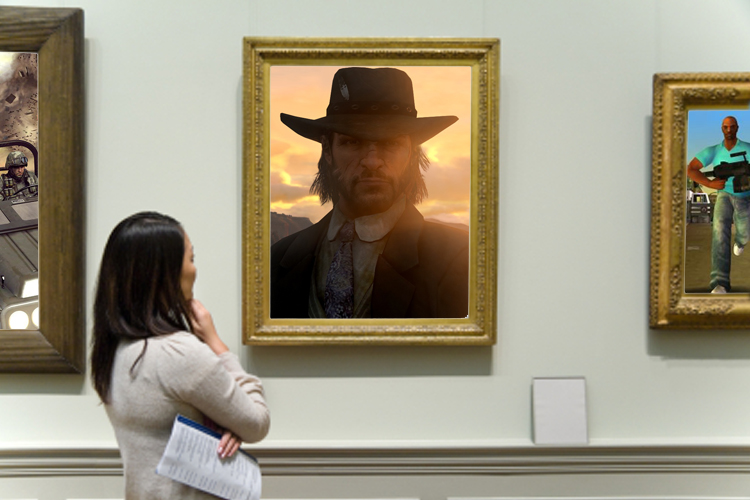

Video games have come a very long way since the 1980s, when we were all still blowing into our Super Mario Brothers cartridges and admiring the graphics in Metroid. Over the past three decades, they’ve gone from a geeky and often-ridiculed kid-centric pastime to a cultural juggernaut with a massive adult consumer base. The average gamer is now 30, and the gender ratio is approaching equilibrium (the male-female ratio is roughly 60-40). Video games are now the most consumed medium ever, with annual sales topping $20 billion.
But it’s not just the audience that’s changed. As Tom Bissell, a journalist, former Salon writer and lifelong gamer, explains in his new book, “Extra Lives: Why Video Games Matter,” the graphics, storytelling and interactivity of gaming have all made tremendous leaps forward in recent years, allowing players to intermingle with nuanced, fleshed-out digital characters in near-photo-realistic environments. Among the most notable recent examples is Rockstar’s “Red Dead Redemption,” a game the New York Times hailed as a “tour de force” for its ability to submerge players in a complex and believable world. In his book, Bissell argues that it’s finally time to take video games seriously as an art form, and give them the formal analysis they deserve. (He also describes what it’s like to play “Grand Theft Auto 4” while high on a cocaine binge.)
Salon spoke with Bissell about the video games that blew his mind, the industry’s violence problem, and what Roger Ebert doesn’t understand about gaming.
What’s changed in video games in recent years to make them worth writing a book about?
Around 2006, 2007, a handful of games started coming out that, as someone who played games but didn’t think of them as like a viable artistic medium, made me think, “Wow things have gotten extremely compelling formally.” I mostly associated video game storytelling with unforgivable clumsiness, irredeemable incompetence, and suddenly I was finding the aesthetic and formal concerns I’d always associated with fiction: storytelling, form, the medium, character. That kind of shocked me.
What were these games?
Games that changed the paradigm, at least for me, were “Portal,” “Grand Theft Auto: Vice City,” and “BioShock.” All took their storytelling seriously in different ways, and brought to the table a relatively unusual level of sophistication when it came to video-game storytelling. They simply didn’t seem unnecessarily dumb in the way a lot of video-game storytelling games feel dumb.
“Portal,” for example, is a game, more than any other game that I’ve played that took pains to disguise the tension between narrative and gameplay and actually incorporate it into the game. In the game you wake up — you’re a woman — and you’re in a laboratory and you don’t know why you’re there. You have a gun, which is actually a portal gun, not a weapon. You shoot it at the wall and a hole opens up in this wall and if you walk through that wall, you come out of the room on the other side. So it seems like a pretty simple mechanic but as the game gets more elaborate these spatial puzzles become weirder. Throughout the game, there’s a voice that tells you what to do, which, you slowly realize is your enemy. It’s really creepy. From start to finish it’s this riveting game where you get the antiseptic beauty of this strange, spare laboratory world, the physics fun of playing around with this really interesting mechanic, and the encroaching dread of this antagonist. It’s great, and it’s really an experience that only a game can give you.
The first ten minutes of “Bioshock” is maybe the best opening of any game ever. And all the storytelling is very hidden. It’s not like that. All the storytelling cues it gives you feel naturally embedded in the world itself. So you don’t ever feel that artificial moment where someone just starts declaiming to you stuff the game designers want you to know. But you know “Bioshock” is also about running around an underwater city shooting lightning out of your hands at psychopaths.
Roger Ebert has famously argued (and recently restated in a blog post) that video games should not be considered art. What do you say to that?
I really admire Roger Ebert a lot, but on this issue he’s just wrong. I think he even kind of knows he’s wrong, and he’s kind of Custer in a battle that he knows he’s outnumbered on, but he’s actually asking the wrong question. The question is not, “Are video games art?” The question is, “Can artists express themselves through the video-game medium?”
He based his argument on footage of the games in question. He made fun of the aesthetics of “Flower,” which is a really beautiful game. He’s kind of right in the sense that this isn’t going to stand up against impressionist painting, but it’s not supposed to. The whole experience of the game is floating through that world and steering yourself with the controller. So it’s this totally kinetic experience of mind, movement and atmosphere. It’d be like giving sex advice after having watched “Debbie Does Dallas,” but never having fucked anyone.
Game producer Kellee Santiago claimed that video games are now where film was in the early 1900s or even painting in its earliest iterations. Do you think that’s true?
I think video games are way beyond that. For film at the beginning of the 20th century, they didn’t even know what editing was yet. Actors didn’t know how to perform in front of the camera. There wasn’t sound. Often the art in a video game is like glorified Thomas Kinkade, but some of it is genuinely enchanting and compelling. So I don’t want to overstate the case for games, but I also don’t want to say that they’re really in this primitive stage of development.
But there is still little formal agreement about the best approach to to assembling a video game. With movies, we pretty much know. You have like a set of editing, cinematographic and performing options. I think those options are just exponentially more numbered for video games right now.
Why was “Resident Evil” such an important video game?
It was the first game that for me personally was a story more than a game. It was hideously inadequate as a story, but it did everything else so well: atmosphere, the feeling of being embedded in a fictional world, the sense of tension, and the sense that this game had just jumped the trellis.
So why do so many video games have unsatisfying storylines?
The way games are designed is you create a story and then you create an obstacle course inside that story and the player has to endure it to see more. So it’s artificial. Game designers are so intensely worried about people getting bored that they pile on busy work for players to do.
I think a really viable model is for the storytellers to create characters of such vividness and intensity that you actually find yourself wanting to portray them in a way that feels true to the fiction that they’re in. So if the game gives you the freedom to go around shooting people in the face, you actually don’t want to because you care about that character too much to see them do that. That to me is where really cool game storytelling should be headed. Because you’re never going to be able to control some jackass who just wants to piss all over what you’ve done. So my view is that rather than trying to figure out ways to outsmart that guy, why not just forget about him?
It seems like the challenge when creating a compelling game is also to allow gamers to feel like they have a lot of freedom — but still rein it in so there’s a sense of narrative.
If a game wants to treat player agency and openness seriously you have to create this illusion of choice. For instance, in games where you go around shooting everyone, there’s a friendly character and when you raise your gun, you have three choices. You can kill them and then they die, and then the mission restarts because the game literally can’t function without that character. Or you pull the trigger and the gun lowers just automatically. I think that’s a pretty elegant way to do it. Or it lets you kill that person and then that branch of the story just closes off, which is really harsh.
There’s a game called “Demon Souls” that came out last year that is designed with this level of harshness. So I put about 25 to 30 hours into it and something catastrophic happened late in the game that I couldn’t control. Characters I needed died, therefore making it almost impossible to finish the game. I was seriously considering writing letters to every member of that company and berating them for their inhuman game design practices. At the same time I kind of admire it. They’re kind of just saying, “Oh, you want to fuck around? You want to not pay attention and blithely shoot people? OK.”
The biggest cultural conversation around video games in the last few years has been around games like the “Grand Theft Auto” series that are incredibly violent and misogynistic. Are video games too violent?
Some games choose to handle it responsibly, some don’t. In a lot of popular entertainment, the violence is stylized to such a degree that you almost don’t notice it. Video games are different because it’s you pulling the trigger. “The Iliad” is pretty much about guys chopping each other’s arms off for 10,000 lines. It’s not as though literature has been immune to the sensationally compelling scenarios of violence and horror. To me the next big step in game design is going to be someone who figures out how to make an involving game that does not revolve around physical confrontation.
But people assume that these games are still being made for kids, just because they once were. One of the “Grand Theft Auto” producers, Lazlow Jones, did an interview a couple of months ago where he says, “Any parent who buys one of our games for their kids is an idiot.” And I just loved the bluntness of that. We make these games for ourselves, for people our age. We make these games for adults. These are not kids games. Period.
The demographic seems to have changed a lot, but the culture surrounding video games does seem to very heterosexual white male.
I think it’s changing slowly. And I think it needs to change a lot. The sooner the better. I’m really sick of the black character in games that say lots of black character things like “hot damn!” I think black voice over actors should just actually boycott. Any game that they come in to read for where they have to say that.
But there are games right now that let users play with issues of gender and race.
There’s a game called “Oblivion” and there are all these different races in that game. And the first time I ever played it, I picked the Argonian race, which is these lizard-like people that are hated by every other race. So when you go into a shop to buy something, Argonians get charged more. It was trippy. I was so constantly angry at how shabbily I was treated by other people. I felt a lot of Argonian pride after I had finished. Isn’t that a cool thing? A game that actually took its time to figure out the fictional implications of the races within its game world.
What game has had the greatest emotional impact on you?
I think “Grand Theft Auto 4” for the reasons I write in the book — not only because of the game but because I was strung out on coke when I was playing it. In terms of terror, there’s a game called “Dead Space.” It’s like “Alien,” except it’s in space. You’re an engineer and have engineering weapons like cutters and bolts. There’s these basically space zombies jumping out at you and it’s like all about enclosed space and terror and being outnumbered. It’s just one of the most pants-crappingly scary games I’ve ever played.
