
Food
Chocolate rum balls and church ladies
Things got a little crazy when my grandma's friend made these alcohol-laced cookies for her bridge club
The only thing more dangerous than a group of senior church ladies playing cards and drinking is a group of senior church ladies playing cards, drinking and eating rum balls. The liquor hits them twice as fast, and when you combine that with the sugar rush, the gambling and the gossip, things are bound to get a little crazy.
Sadie, my grandmother’s neighbor, was a sweet old lady with a heart of gold and a head that got a bit confused sometimes. She loved her God, her family and her friends, but she also loved her dog, her gossip and her rum balls.
Eleanor (my grandmother, whom we referred to as Nanny or Nan) and Sadie were in a circle at church together. They also frequented the same garden club, the same hairdresser and the same grocery store. A bit too much togetherness, at times, for my grandmother (Sadie was quite the talker), but she loved Sadie and knew how much it was reciprocated, so she put up with it. I remember times when we’d be sitting around the dining room table, playing Yahtzee or just visiting, and the phone would ring.
“Don’t answer it, it’s Sadie,” my grandmother would say, and nine times out of 10, we’d be treated to a delightfully long monologue by Sadie herself on the answering machine. Five times out of 10 after that, we’d peek out the window to see Sadie walking up the street toward us, often with her dog, Clem, in tow.
“Lord, don’t answer the door,” Nan would say.
“Nanny, she knows you’re home. Your car’s in the driveway, and you don’t walk anywhere. Answer the door.”
So she would, and Sadie would usually visit for a l-o-n-g time, delighting all of us and irritating my grandmother, who had far more important things to do with her time than listen to a woman 10 years her senior rambling on and on.
One day we were sitting at the table, visiting with Sadie, when she started talking about the day she was hosting bridge club. My grandmother had been there, along with several other friends. During the course of the story, Sadie and Eleanor got so tickled that they were hard to understand, at times, but the story went something like this:
“Eleanor, do you remember that time I was hosting the bridge club and…”
“Sadie, if this is the story about the rum balls, I’ll stop you right there. There are children present.”
“Oh, Elner, what’s wrong with the kids hearing this story? It’s about cards and cookies.” She always called us “the kids,” even when we were in our 20s and 30s.
“Alcohol-laced cookies.”
“The liquor cooks out, though, Elner.”
“Sadie, they’re a no-bake dessert.”
“Oh. Right.”
“Nevermind. Go on, tell it. You’ll do it whether I try to stop you or not.”
“So, do you remember…?”
“Yes, I remember.”
“And we were playing the cards, and all of a sudden Doris couldn’t tell a club from a spade, and Eloise was betting her car on a hand, and Harriet was giggling so much she couldn’t play the game?”
“Yes, I remember, Sadie, but I think you were the one doing most of the giggling.”
“No, it was Harriet. I didn’t start giggling until you told that joke. The one about the fish.”
“My fish joke?” I piped in. I had heard this joke in college and told my grandmother, who loved it.
“Yes. What do you call a fish with no eye?”
“No idea,” I played along.
“A fffffffffffsssssssssssssshhhhhhhhhhhh!” I got a little wet when she said this, and they both started howling with laughter. It still my favorite drunk joke.
“Anyway, those were some damn good rum balls, weren’t they, Elner?”
“Some of your best.”
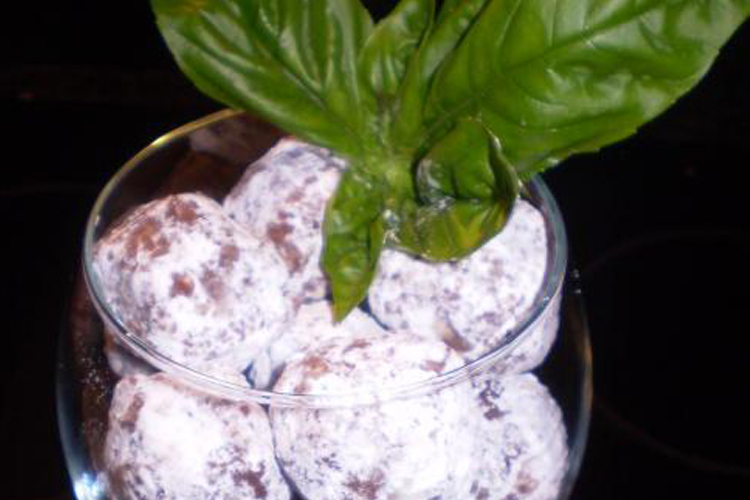
In case you don’t have a Sadie around to make you rum balls and talk your ear off, I’ve come up with a close approximation to her recipe. Make sure your kids don’t think they’re munchkins! (If you do happen to have “munchkins” in your house that you want to share these with, you can substitute orange juice for the rum.)
Ingredients
- 1 (12 ounces) box Vanilla wafer cookies, crushed
- 1 ½ cups chopped walnuts
- ¾ cup 10x powdered sugar
- ¼ cup cocoa
- ½ cup rum (dark rum, spiced rum, light rum, flavored rum … any kind you like)
- 3 tablespoons light corn syrup
- More powdered sugar or cocoa for dusting
Directions
- Crush cookies and nuts with food processor.
- Combine with powdered sugar and cocoa, then add rum and corn syrup. Stir until smooth.
- Shape dough into 1-inch balls and roll in powdered sugar or cocoa.
- Store in an airtight container for 2 or 3 days before serving to develop flavor.
- Just before serving, roll in powdered sugar or cocoa again.
- Serve with milk, coffee or your favorite rum punch (if you want a double hit). Good friends and laughter are good accompaniments, too.
The making of the term ‘pink slime’
A simple nickname that forever changed an entire industry
FILE - In this March 29, 2012 file photo, the beef product known as lean finely textured beef, or "pink slime," is displayed during a plant tour of Beef Products Inc. in South Sioux City, Neb., where the product is made. Gerald Zirnstein, the microbiologist who coined the term "pink slime," says it came to him in the spur of the moment as he was composing an email to a coworker at the U.S. Department of Agriculture a decade ago. Although it's been used as a filler for decades, the product became the center of controversy only after Zirnstein's vivid moniker for it was quoted in a 2009 New York Times article on the safety of meat processing methods. (AP Photo/Nati Harnik, File)(Credit: AP) NEW YORK (AP) — “Pink slime” was almost “pink paste” or “pink goo.”
The microbiologist who coined the term for lean finely textured beef ran through a few iterations in his head before pressing send on an email to a co-worker at the U.S. Department of Agriculture a decade ago. Then, the name hit him like heartburn after a juicy burger.
“It’s pink. It’s pasty. And it’s slimy looking. So I called it pink slime,” said Gerald Zirnstein, the former meat inspector at the USDA. “It resonates, doesn’t it?”
Continue Reading CloseDid slaves catch your seafood?
Thailand, a major source of fish imported to the US, depends on forced labor for its product
(Credit: Alena Brozova via Shutterstock) PREY VENG, Cambodia, and SAMUT SAKHON, Thailand — In the sun-baked flatlands of Cambodia, where dust stings the eyes and chokes the pores, there is a tiny clapboard house on cement stilts. It is home to three generations of runaway slaves.
The man of the house, Sokha, recently returned after nearly two years in captivity. His home is just as he left it: barren with a few dirty pillows passing for furniture. Slivers of daylight glow through cracks in the walls. The family’s most valuable possession, a sow, waddles and snorts beneath the elevated floorboards.
Horrors we hide
From slaughterhouses to sweatshops, modern society is constructed to let us ignore atrocities
Workers at a Seagate Wuxi factory in China (Credit: Robert Scoble / CC BY 2.0) Would Americans eat less meat, and would animals be treated more humanely, if slaughterhouses were made with glass walls and we all could see the monstrous killing apparatus at work? This is the query at the heart of Timothy Pachirat’s new book, “Every Twelve Seconds” — the title a reference to the typical slaughterhouse’s cattle-killing rate.
Continue Reading Close
David Sirota is a best-selling author of the new book "Back to Our Future: How the 1980s Explain the World We Live In Now." He hosts the morning show on AM760 in Colorado. E-mail him at ds@davidsirota.com, follow him on Twitter @davidsirota or visit his website at www.davidsirota.com. More David Sirota.
Lessons of a reluctant hunter
A transplant to Oregon teaches me about growing up in rural Mexico, killing iguanas and grilling chicken
Jazmin Rudin with her mother, Esperanza Jazmin is 27 years old and beautiful. She has the fierce, dark beauty of a Mexican Indian, but she’s tall, and when you see her move, you think Masai warrior or maybe ninja. And it’s true: She does have ninja skills. When I first met Jazmin, she’d just killed a pheasant. She was sitting on the deck talking with a friend when she spotted the bird at the edge of the yard, 20 feet away. She casually picked up a two-by-four and hurled it. The missile hit the pheasant in the head, a neat kill. Jazmin walked over and picked it up. “Dinner,” she said.
Continue Reading CloseFelisa Rogers studied history and nonfiction writing at the Evergreen State College and went on to teach writing to kids for five years. She lives in Oregon’s coast range, where she works as a freelance writer and editor. More Felisa Rogers.
Pink slime monster runs amok
The beef product processing industry is in a world of pain. Another scalp for social media?
The beef ingredient dubbed “pink slime.” (Credit: AP/Beef Products, Inc.) The battle over “pink slime” is getting messier. Blaming an “unfounded public outcry over the use of boneless lean beef trimmings” in the nation’s commercially sold ground beef supply, meat processor AFA Foods Inc. filed for Chapter 11 bankruptcy protection on Monday. Beef Products Inc. — the South Dakota-based meat titan that invented the pink slime manufacturing process — is also reeling, idling plants in multiple states. In response, Iowa Gov. Terry Branstad, a politician who hails from a state where there is a whole lot of boneless beef extrusion going on, called for a congressional investigation into the causes of the public uproar.
Continue Reading Close
Andrew Leonard is a staff writer at Salon. On Twitter, @koxinga21. More Andrew Leonard.
Page 1 of 238 in Food