History

The letters of Pliny the Younger: Dispatches from a dying Pompeii

The letters of Pliny the Younger provide gripping insight into Roman life -- and the last hours of a city

  • more
    • All Share Services

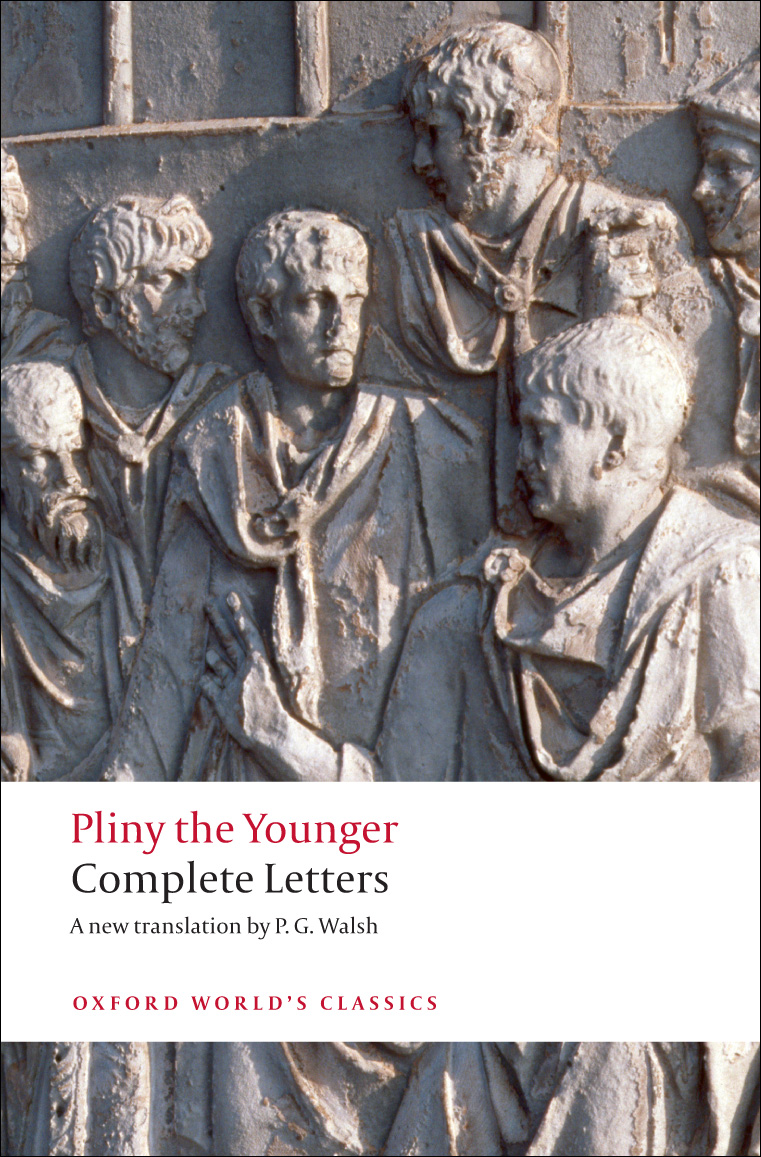
The letters of Pliny the Younger: Dispatches from a dying Pompeii"Pliny the Younger: Complete Letters," by P.G. Walsh(Credit: Cains)

A few months ago, many people who were scheduled to travel to Europe found their trips canceled at the last moment: Airborne ash from an Icelandic volcano had, astonishingly, grounded nearly all flights to England and much of the continent.

While cities weren’t buried alive beneath a drizzle of fine pumice, this strange disruption of modern life unavoidably called to mind — at least to my mind — the eruption of Mt. Vesuvius and the destruction of Pompeii, Herculaneum and Stabiae, many of whose inhabitants actually suffocated from the volcanic smoke and grit that smothered their cities. In antiquity the classic account of the eruption, and of a small part of its devastation, occurs in a pair of letters written by Pliny the Younger (61 AD – c.112 AD) to his friend the historian Tacitus. In them he relates how his uncle — in command of the Roman fleet in that part of the Bay of Naples — sailed into harm’s way, both to acquire a better idea of the scope of this natural disaster and to reassure the populace under its shadow.

Barnes & Noble ReviewAs it happens, that intrepid seaman was also called Pliny and is remembered today as an author rather than an admiral. The Elder Pliny’s “Natural History” is one of the greatest books of ancient times, a massive compendium of scientific knowledge, traveler’s tales, zoological observation and “Believe It or Not” anecdote. (This genial encyclopedia takes up 10 compact volumes in the Loeb Library, with Latin and English on facing pages, and still makes excellent bedside reading.) According to his nephew, the senior Pliny had a keen intelligence, astonishing concentration, and little need for sleep. He used to say that there was no book so bad that it was not useful at some point. He believed that any time not devoted to study was wasted.

On the day of the eruption, the younger Pliny writes, “my uncle was at Misenum, where he held command of the fleet in person. Just after midday on 24 August [79 CE] my mother pointed out to him the appearance of a cloud of unusual size and appearance. He had relaxed in the sun, had then taken a cold dip, had lunched lying down, and was at his books. He asked for his sandals, and mounted to the place from which that remarkable phenomenon could best be observed. A cloud was issuing up from some mountain which spectators from a distance could not identify; it was later established to have been Vesuvius.”

Pliny goes on to tell Tacitus about the cloud: “The pine tree, rather than any other, best describes its appearance and shape, for it rose high up into the sky on what one can describe as a very long trunk, and it then spread out into what looked like branches … Its appearance varied between white on the one hand, and grimy and spotted on the other, according as it had thrust up earth or ashes. My uncle, most learned man that he was, realized that this was important, and should be investigated at closer quarters.”

In short order, the elder Pliny “ordered a fast-sailing ship to be made ready” and, continues his nephew, “gave me the option of accompanying him if I so wished. I replied that I preferred to work at my books.” We later learn that the younger man, just 18, simply didn’t want to tear himself away from his enthralled reading of Livy’s history of Rome.

When the seas grew rough, the air dense with cloud, and stones began to fall from the sky, the older Pliny’s ships made their way to Stabiaie. There, the seemingly untroubled Roman naturalist bathed and dined at a friend’s villa, even while Vesuvius continued to pour out flames. He did his best to calm the people around him, going so far as to retire for a nap. “In fact, he relaxed in sleep that was wholly genuine, for his snoring, somewhat deep and loud because of his broad physique, was audible to those patrolling the threshold.” Before long, though, “the courtyard which gave access to his suite of rooms had become so full of ash intermingled with pumice stones that it was piled high.”

The sleeping Pliny was awakened, and a debate broke out over whether the villa’s residents should stay indoors or venture out to the coast. By now “the buildings were shaking with frequent large-scale tremors, as though dislodged from their foundations” and “seemed to shift now one way and now another, and then back again.” Pliny convinced everyone to make a dash for the sea, despite the rain of pumice and debris. “They used strips of cloth to fasten pillows on their heads as a protection against falling stones.”

By this point day had turned to night, and the little party discovered that the Mediterranean was still too “mountainous and hostile” for ships to cast off. Perhaps already starting to be overcome by the foul air, “my uncle lay down … on a discarded sail, and repeatedly drank cold water, which he had requested. Then flames and the smell of sulphur heralding the flames impelled the rest to flight and roused him. Leaning on two of his confidential slaves, he stood up and at once collapsed.” Later on, it was concluded that “his breathing was choked by the greater density of smoke, and this blocked his gullet, which was often frail and narrow, and often unsettled. When daylight was restored, two days after his eyes had closed in death, his body was found intact and unharmed. It was covered over, still in the clothes he had worn. It was more like someone sleeping than a corpse.”

In a follow-up letter to Tacitus, the younger Pliny recalls his own adventures back at Misenum. “The buildings all round were shaking,” he writes, and to his amazement the tumultuous seas were “sucked back” by an earth-tremor, leaving “many sea-creatures stranded on the dry sand.” Meanwhile, Vesuvius continued to spit forth a “black and menacing cloud, split by twisted and quivering flashes of fiery breath,” which opened out “into extended shapes of flames, like lightning flashes, but greater.”

Young Pliny and his mother soon decided to flee, despite the darkness brought on by the ash, and were nearly trampled to death by the panicked mob:

You could hear women moaning, children howling, and men shouting; they were crying out, some seeking parents, others children, and others wives, or recognizing them by the sound of their voices. Some were lamenting their own misfortune; others that of their families. A few in their fear of death were praying for death. Many were raising their hands to implore the gods, but more took the view that no gods now existed anywhere, and that this was an eternal and final darkness hanging over the world.

When true daylight finally reappeared, the exhausted survivors were “confronted with a scene of universal change, for everything was buried by deep ash, as though by snow.” At this point mother and son decided to return to Misenum and were there when “the message came about my uncle.”

Pliny the Younger’s correspondence with numerous friends — besides Tacitus, he also knew the historian Suetonius and the poet Martial — provides one of the great records of what life was like during Roman times. There are 247 surviving personal letters and 121 official memoranda to the Emperor Trajan. Only Cicero’s 914 letters (largely to his friend Atticus and written a century and a half earlier) excel Pliny’s in importance, whether as a self-portrait of the author or as a tableau of social life during the early Empire.

An experienced trial lawyer, an efficient government bureaucrat, and a trusted supporter and confidant of Trajan (who ruled from 98 to 117), Pliny often reminds me of Washingtonians I know. He’s good at his work and rightly proud of his accomplishments, and very much an Inside-the-Beltway pillar of the imperial establishment. Well-off from inheritances and land-rents, Pliny typically uses his influence to help the sons and daughters of friends, just as he regularly donates his money to worthy civic projects, such as the education of children in his hometown of Comum on the shores of what is now Lake Como.

Even though Pliny desperately yearns for literary immortality, whether as orator, poet or letter-writer, he’s clearly no genius. But he is amiable, like one of those 18th-century litterateurs such as Horace Walpole or Lord Chesterfield. This very ordinariness contributes to his appeal. We can believe what he says, whether he’s describing the structure of his villa, the beautiful springs at Clitumnus, the machinations of a shyster lawyer, or the floods on the Tiber. With at least one eye on posterity, he typically mixes little Polonius-like disquisitions about life and the proper use of one’s leisure with accounts of the latest gossip: Thus he tells of houses haunted by ghosts, reports on Vestal virgins immured alive for violating their oaths, provides instruction on how to become a better writer (through translation and imitation), confesses his sorrow over his young wife’s miscarriage, lists the traits of the ideal tutor, reflects on the opposing rhetorical styles of florid “Asiatic” expansiveness and lean “Attic” concision, and even speculates about those strange cultists known as Christians.

Sometimes Pliny seems like a charming and slightly prim eccentric: While out hunting, he takes along his tablets so that he can work on his poetry while awaiting some hapless wild boar to stray into his nets. He complains that nowadays courtrooms are filled with riff-raff and “hired claques, purchased with money.” Sport bores him: “The races were on, and I take not the slightest interest in that type of performance. There is no novelty, no variation, nothing for which a single viewing would not suffice.” Like most writers, he’s deeply sensitive to criticism, hotly defending his taste for “eloquence”: To one correspondent he complains that “you seemed to have designated some passages in my writings as inflated, when I thought them lofty, as pretentious, when I thought them bold, as overblown, when I thought them fully expressed.” He closes with an almost pathetic simper: “The impact of talent should not be confined within a very circumscribed course.”

Cultivated and well-read, Pliny — like many another Latin writer — does sometimes verge on the sententious: “There is no happiness that literature does not intensify, and nothing so sad that literature does not relieve it.” Yet he can also be quietly witty: Of one acquaintance he writes, that “his only concession to old age is discretion.” What will matter most to modern readers, though, is how much this ancient Roman resembles ourselves, how human he is. After his hated courtroom enemy Regulus dies, Pliny confesses that during trials he still finds himself looking for him, that he, in fact, misses the scoundrel. He keeps abreast of real-estate values: “Are you aware that the price of land has risen, especially around Rome? The reasons for this sudden increase have been the subject of much discussion.” When social invitations request that one attend a poetry reading if free on such and such a day, he notes that “at Rome, in fact, no one is ever ‘absolutely free’ or finds it ‘convenient’ to listen to someone reciting his work.”

There’s an immense variety in these pages, and nothing — except a couple of court cases — goes on too long. On one page Pliny might record a premonitory dream, on another a horrific murder, but he’s always aware of the latest domestic scandals, from adultery to disinheritance. One particularly charming letter marvels that a dolphin, in a lagoon near Hippo in Africa, would regularly frolic with swimmers, even allowing one boy to ride on his back. Still another reveals his own passionate love for his third wife, 30 years his junior: “My obsession with longing for you is beyond belief … The one time when I am free of this torture is when I exhaust myself in court with friends’ lawsuits.”

But repeatedly, too, there are letters of condolence and of sorrow. When his mentor and benefactor Cornelius Rufus, who has been suffering from illness, commits suicide, Pliny is devastated:

I contemplate the sort of friend, the sort of man I am now without. He completed his sixty-seventh year, a reasonable age for the sturdiest of us; I acknowledge that. He escaped from an interminable illness; I acknowledge that. He died with his dear ones surviving him, and at a time of prosperity for the state, which was dearer to him than all else; that too I acknowledge. Yet I lament his death as though he were young and in glowing health. I lament it — you can consider me a weakling in this — on my own account, for I have lost the witness, guardian and teacher of my life.

In such a paragraph, despite its emotion, there’s no disregarding the balanced sentences, the repeated phrase “I acknowledge that,” and the overall artfulness of the writing. This careful attention to style reminds us that Pliny was not only well educated in oratory, but that he was also trained by the greatest of all teachers of rhetoric, Quintilian. His prose itself might be loosely called Ciceronian, at once rhythmic and decorated with poetic tags and allusions (chiefly to Homer and Virgil). Scholars suggest that he found further models for his writing in the letters of the stoic philosopher Seneca and the verse-epistles of Ovid, such as the “Heroides” in which classical heroines bemoan their sad fates.

While an obvious source for historians, Pliny has also been, somewhat surprisingly, an inspiration to architects. His loving and leisurely descriptions of his two main homes — one on the sea at Laurentine and another in Tuscany — led architects of the Renaissance and beyond to a better understanding of Roman villas. As David Watkins has written (in “The Legacy of Rome,” edited by Richard Jenkyns): “Pliny’s Laurentine villa occupies a special place in architectural history because of the numerous paper restorations which have been inspired by his extensive and charming descriptions of it … He provided a compelling picture of the pleasure that architecture can give in its relation to sound, sight, smell, temperature, colour, water, and vegetation. At the same time, there was enough obscurity in his description to allow free rein to the imagination of countless architects down the centuries bent on reconstructing his villa.” Thomas Jefferson’s Monticello is just one of these reconstructions.

While the first nine books of Pliny’s letters follow a roughly chronological order — the author disingenuously maintains he’s just selected them casually, almost at random — Book 10 is made up of official correspondence exchanged during his tenure as governor of Bithynia (part of modern-day Turkey). Addressed to Trajan, and accompanied by the Emperor’s replies, these concise exchanges resemble office memos or short business e-mails. However, one of the few substantial letters does offer our first recorded glimpse of the Christian community by an outsider. Pliny has been investigating the religion for alleged disloyalty to Rome:

They maintained … that all that their guilt or error involved was that they were accustomed to assemble at dawn on a fixed day, to sing a hymn antiphonally to Christ as God, and to bind themselves by an oath, not for the commission of some crime, but to avoid acts of theft, brigandage, and adultery, not to break their word and not withhold money deposited with them when asked for it. When these rites were completed, it was their custom to depart, and then to assemble again to take food, which was however common and harmless.

He adds: “The infection of this superstition has extended not merely through the cities, but also through the villages and country areas, but it seems likely that it can be halted and corrected.” (Pliny was certainly wrong about that.) When Trajan writes back, he counsels restraint and tolerance, warning against any sort of witch-hunt:

Christians are not to be sought out. If brought before you and found guilty, they must be punished, but in such a way that a person who denies he is a Christian and demonstrates this by his action, that is, by worshiping our gods, may obtain pardon for repentance, even if his previous record is suspect. Documents published anonymously must play no role in any accusation, for they give the worst example, and are foreign to our age.

Since Pliny’s letters stop abruptly during his time in Bithynia, it seems likely that he died there.

While Pliny lacks the raciness of his friend Suetonius [see my earlier essay for BNR on the "Lives of the Caesars"], his is an admirably civilized sensibility. To the Renaissance he once seemed an early humanist, even as I now view him as the ancestor of today’s educated, hard-working, and much-maligned Washingtonian.

There are two readily available paperbacks of Pliny. The long-established Penguin — “The Letters of Pliny the Younger” — was translated by Betty Radice, who also edited the Latin text for the scholarly Loeb series. Her introduction is masterly and should be read. But P. G. Walsh’s Oxford World Classics edition — “Pliny the Younger: Complete Letters” — offers the advantage of extensive end-notes. These identify people and places and set the sometimes recondite material in its historical context. I have quoted Walsh here, since his seems the better book for most beginning readers of the lawyerly and industrious and kindly Gaius Plinius Caecilius Secundus.

Can cities desegregate?

Urban centers have been racially divided since Mesopotamia -- but radical, global new measures aim to change that

  • more
    • All Share Services

Can cities desegregate? (Credit: iStockphoto/AdrianHillman)
This article is an adapted excerpt from "Segregation: A Global History of Divided Cities," available May 29 from University of Chicago Press.

“Segregation,” the preacher paused to let his congregation absorb the full solemnity of his message, “is apparent everywhere.” It was December 4, 1910, in Baltimore, Maryland. Members of the largely African American crowd that had gathered in the sanctuary and overflowed onto the steps of the John Wesley Methodist Episcopal Church were grimly aware of what the Reverend Dr. Ernest Lyon was talking about, at least as far as the United States was concerned. The country’s black slaves had been emancipated less than a half century before. But now white people in Baltimore and elsewhere, even in cities outside the formerly slave-owning South, were clamoring for new ways to assert political supremacy. They had devised a new technique of racial control—segregation.

Since about 1900, whites across the United States had been outdoing each other shouting these four dread syllables from the political rooftops. In the name of segregation, they had passed laws that relegated blacks to inferior Jim Crow schools, train cars, railroad station platforms and waiting rooms, restaurants, theaters, public bathrooms, amusement parks, and even public water fountains. Employers and white workers imposed color bars that kept certain higher-prestige jobs off limits to blacks. Laws that prevented blacks from voting helped to reinforce the system. Earlier that year, on July 5, 1910, a group of angry whites in Baltimore decided it was time to take a step further and extend segregation to the city’s residential neighborhoods. As a result, Lyon reminded his congregation, “the city fathers of Baltimore are having under advisement at this time a measure which seeks to deprive free men … of their right to live and own property anywhere they can.” Two weeks after Lyon’s sermon, on December 20, 1910, Mayor J. Barry Mahool signed the city’s pathbreaking segregation ordinance into law. The ordinance divided every street in Baltimore into “white blocks” and “colored blocks” based on the race of the majority of their inhabitants at the time of the ordinance’s passage.

Segregation may have come to Baltimore, and it was definitely spreading across the United States, but it was also crisscrossing big expanses of the world beyond. It was not by any means limited to America and Africa—nor to the newly dawning twentieth century. Urban segregation designed to enhance elite groups’ power and wealth extends back to the most ancient of cities in Mesopotamia, and it was practiced in most other ancient civilizations as well. European colonial segregation dates at least as far back as the Middle Ages, when English colonists in Ireland and Italian merchants in the eastern Mediterranean reserved separate parts of overseas colonial towns for themselves.

Similar practices went into the ghettos that the Christian rulers of Venice and other Europeans cities established for Jews. The idea of separating a “black town” from a “white town” dates back to 1700, when British officials decided that color designations were crucial to governing their southern Indian colonial city of Madras (today’s Chennai). Race first entered into the conversations about urban segregation in the late 1700s in Calcutta (Kolkata), the capital of British India. British officials coined the phrase “hill station” in the early 1800s to describe dozens of segregated cities they built in the highlands of India, such as Simla—but the Dutch had built a similar place in Java a hundred years earlier. Baltimore’s 1910 segregation ordinance was not the first; experiments with legalized urban color lines arose in the mid-1800s in cities in China and around the Pacific Rim; they were designed to keep Chinese people from living in the white sections of cities like Shanghai, Hong Kong, and San Francisco.

The word “segregation” itself was first used for techniques of racial isolation in Hong Kong and Bombay (today’s Mumbai) in the 1890s. From there it inspired a nearly worldwide spread of what I call “segregation mania” across Asia, Africa, and the Atlantic world. The mania even resonated in Latin American cities like Rio de Janeiro and Buenos Aires, where distinctions between black and white were typically murkier than elsewhere. Monumental segregated colonial capitals went up in places like Rabat, in French Morocco, and New Delhi, in British India, signaling new arrogant ambitions for urban planning based on separate racial zones.

The most radical of all forms of urban segregation arose during these same years in two rapidly industrializing white settler societies. In South African cities like Durban, Cape Town, and Johannesburg, imperial officials and white settlers put in place the precedents for what would be called “apartheid” after 1948. In the United States, Baltimore’s segregation ordinance was soon followed by a subtler and ultimately more durable system of segregation, this one designed in Chicago and based above all on racial dynamics in the real estate market.The tide of urban racial segregationism reached its high-water mark worldwide during the twenty years following Dr. Lyon’s warning in Baltimore. However, members of Dr. Lyon’s congregation took his warning seriously. They helped lead a massive social movement with the goal of stopping whites’ segregationist ambitions. By the 1930s, this African American civil rights movement had created loose alliances with similar movements for national liberation in colonies across Africa and the world.

After World War II these movements succeeded in widely discrediting both racism and segregation, and they also forced whites to give up many of the practices they used to draw urban color lines. Still, the early twentieth-century mania for racial segregation left a terrible legacy for the cities of today’s world—and for the larger human communities in which they are located. Some aspects of the system of residential segregation that operates in the United States can be detected in otherwise quite different cities in the world’s other wealthiest countries, such as London and Paris, the ancestral hometowns of the world’s most influential white segregationists. The cities of Latin America and the colonial cities that Europeans and Americans ruled more recently in Asia and Africa have transformed into massive megacities sharply divided by class. There, new pressures from international financial institutions have enhanced the legacies of colonial-era segregationist urban policy. American Jim Crow fell during the 1960s and South African apartheid finally collapsed in 1994, but settler-led urban segregation continues to play a dispiriting role in some of the world’s most excruciating political conflicts, most notably in Belfast, Northern Ireland, and in Jerusalem and other cities of Israel-Palestine. In many places, the explicitly racial component of segregationism has been supplemented—or disguised— with talk of class, culture, ethnicity, and, most dangerously, religion. But much of the underlying logic and many of the techniques bear unmistakable legacies of the forces Reverend Lyon warned his congregation about in 1910.

Today, more than half of all human beings are city dwellers. We need our cities more than ever. Their comparatively rich economic, political, and cultural opportunities and their potential for a relatively small per capita environmental footprint may well make them crucial to our very survival as a species, as our many billions rapidly multiply and as we just as rapidly diminish our planet’s resources. But segregating our cities diminishes their promise—it makes them less equal, less democratic, less livable, less safe, and less able to sustain us all.

While it is amply true that supporters of white and elite privilege remain in charge of the commanding heights of the world’s urban politics, it is just as fully true that more people than ever before have come together to imagine and begin to create explicitly antisegregationist urban futures.

Many of these new visions would have been inconceivable even during the headiest days of the postwar black and brown racial revolution. To thrive in the otherwise hostile era since, today’s antisegregationist visionaries—who include grassroots activists, academics, public officials, reformers, and planners—have developed cross-oceanic intellectual networks of their own, building upon and refining those left behind by postwar revolutionaries, a process dramatically expanded in the age of the Internet. Though their hemisphere-crossing exchanges have not yet been able to slow the renewed march of segregation, people active within them have been able to acquire real slices of power within governments, the broader universe of intellectual interchange, and even in urban land markets.

The intellectual scope of their endeavor is unprecedented. Elaborating on the thought of such pioneers as W. E. B. DuBois, racial theorists have turned the concept of race on its head, arguing that racial divisions are not a natural phenomenon but a political one, subject both to mystifying rhetorical camouflage and hardened institutional inequalities that must be continually exposed and critiqued. Urban historians have dissected the dynamics of segregation, more fully uncovering some of the most highly camouflaged practices involved. At their best, social scientists who debate the spread of ghettos and slums on all continents have identified and dissected the complex and multidimensional political dramas that underlie color and class lines in cities. Planners and environmental justice activists have soundly rejected old theories that segregation wards off natural threats like disease. Instead, their work shows conclusively that urban division only increases the exposure of cities’ most vulnerable residents to environmental perils. More importantly, they point out that the kinds of segregation that depend on sprawl— and thus also upon enormous amounts of habitat destruction and automobile usage—dangerously increase cities’ environmental footprints, threatening our survival as a species. Urban activists and theorists, most notably those organized under the United Nations’ World Urban Forum, have called upon governments to recognize that all people have a fundamental “right to the city”—that is, freedom from all obstacles to urban opportunities, including freedom from residential segregation.

For these activists and thinkers, there are many ways to fight against urban divides in the interest of all people’s rights to the city. In some places, residents persuade real estate agents and local banks that integration and local public housing creates a more stable community than segregation, raising property values. Even where the actual creation of integrated communities is a long-term prospect, residents can revive their own slums and ghettos, attracting job opportunities to locate in closer proximity so that spatial disadvantages are minimized. Transport systems can make color and class lines more porous, thus giving excluded urban residents easier access to opportunities that remain distant while lowering the environmental footprint of the city. Growth boundaries around cities can slow sprawl, thus making white or elite flight more difficult and creating denser cities that also offer environmental benefits while again bringing urban opportunities closer to all. And, even in the absence of major spatial changes, the fight for more just workplaces and for government policies that redistribute wealth more fairly across racial and class lines can create more equality between all urban neighborhoods.

It is in Europe, perhaps not surprisingly, that such antisegregationist political forces have the most sway within governments. There, the strong base of support for social democracy and for centralized and relatively egalitarian urban planning has most successfully weathered attacks from New Right politicians, anti-immigrant racists, and international financial speculators. France is probably the best example, since its cities are arguably the most segregated of any wealthy society outside the United States. There, conservative leaders like Jacques Chirac and Nicholas Sarkozy, both of them well known for their hostility to immigrants, have nevertheless felt compelled to join the call for mixite sociale first enunciated by the Socialists in the 1990s.

Since 2003, their center-right administrations have pushed a massive, forty-billion Euro urban revitalization campaign to replace French cities’ ghastly postwar public housing towers with new estates and to expand the stock of public housing so that even wealthy municipalities reach the 20 percent quota envisioned by the Socialists’ anti-ghetto laws. Skeptics have rightly noted that these pharaonic new grands travaux have not yet had much effect on youth unemployment rates, which hover around 40 percent in the most “sensitive” banlieues, nor have they had much effect on Paris’s larger east-west pattern of segregation. Some suspect the housing program to be a flashy stalking horse for reductions in other social expenditures. But under questioning, Sarkozy’s housing minister piously declared that Paris’s “ghettos of the rich,” as its most conservative Western arrondissements are called, will not be exempt from their public housing quotas. He even endorsed Paris’s Socialist mayor’s recent moves to buy some of Baron Haussmann’s bourgeois apartment buildings in the swank districts near the Eiffel Tower and convert them to public housing. So far, white flight and resistance from wealthy residents and conservative mayors— including in the richest suburban municipality in the country, Sarkozy’s own Neuilly-sur-Seine—has slowed progress toward increased mixite. Still, in the dog days of late 2010, as financiers’ speculative attacks on the Euro resounded across the continent and as Islamophobic appeals redoubled, Sarkozy’s party voted robustly to refund a program of urban “territorial solidarity” that would be unimaginable, even under a “liberal” administration, in the United States.

Elsewhere in Europe, Canada, and Australasia anti-immigrant forces are just as strong as they are in France, and evidence of creeping race and class segregation can be found in many places. That said, earlier policies of building extensive but generally small-scale and dispersed public housing estates have ensured that color lines are generally less stark. It is true that public housing is an imperfect tool of urban integration: white tenants of public estates do not necessarily want to have neighbors of color any more than middle-class white homeowners, and worries about property values in the private market diminish government’s ability to build public estates where they might break up color lines. Still, even in places like post-Thatcher Britain, where governments have sold off many council estates—and even in such a historical heartland of segregation as London’s West End—it is still possible to find pockets of municipally owned affordable housing, often filled with immigrants of color, across the street from newly gentrified luxury apartments. Such patterns, which one observer labeled “microsegregation,” might actually be among the most successful attempts by any government in modern world history to use residential integration as a tool to at least begin reducing spatial disadvantages. In London and elsewhere on the continent, relatively extensive, cheap, and efficient public transport systems also help diminish some of the harms of segregation. So does London’s Greenbelt plan and other efforts to constrain sprawl, most notably in Sweden, the Netherlands, Canada, and New Zealand.

For these reasons, some European, Canadian, and Australasian cities have justly earned their reputation as the most egalitarian, integrated, and environmentally sustainable on earth. But heavy reliance on top-down government policies—no matter how successful—has some critics justifiably concerned. For all the public support that welfare states and egalitarian urban-planning policies enjoy in Europe, many governments’ actual implementation of programs too often occurs without much input from racially marginalized and low-income people themselves. The alienation many people feel from mainstream institutions— especially young people—diminishes the work of egalitarian policies. Worse, an important source of creativity and political influence lies relatively untapped.

The potential of excluded peoples’ creativity and power, paradoxically, may be easiest to see in places where governments have either given up on the fight for urban inclusiveness or where segregationist forces have most mercilessly outflanked egalitarian public agencies and policies. Such is the case in the United States, where decades of white retrenchment and free-market policies have helped to sustain many of the archsegregationist patterns set in place in the early twentieth century. These have left the country with the least egalitarian, most devastated, and most environmentally damaged excluded urban zones in the wealthy world.

Despite that history, some European antisegregationists have waxed enthusiastically about evidence of “community empowerment” they perceive in some of the least favored zones of American cities. This enthusiasm needs to be tempered, to be sure: In the United States, “empowerment” has just as often served as a cynical rhetorical cover for the weakening of even the most meager of countersegregationist public policies. Conversely, while many of the most creative initiatives in US urban politics have arisen from grassroots organizations that keep the spirit of the civil rights movement alive by mobilizing the residents of segregated ghettos, most have repeatedly demanded that American governments funnel more money into neglected urban areas.

Whatever their methods, it is undeniably true that these scrappy and courageous community-based organizations have done much of the work of desegregation that has occurred in the United States during the New Right era: they shoulder the greatest burden of enforcing fair housing laws, cajoling real estate agents and banks to help preserve the country’s few integrated neighborhoods, building affordable housing, passing inclusionary zoning ordinances, pushing for government action under the Community Reinvestment Act, advocating for expanded government support of underfunded schools, combating police brutality and the expansion of carceral ghettos, and drawing attention to urban environmental injustices linked to segregation. Some have been able to make significant inroads into inner-city land markets and finance as well, either by founding community development corporations, or by “banking” vacant urban land for socially responsible reuse, or, as in the case of Boston’s Dudley Street Initiative, by acquiring the power of eminent domain from the city government and going into business as nonprofit developers beholden to the community’s residents.

Though the scale of their operations is often limited, they have not been afraid to take comprehensive approaches to neighborhood revitalization. In Buffalo, New York, for example, People United for Sustainable Housing (PUSH Buffalo) and other allied organizations have linked affordable housing development with green rehabilitation techniques that lower residents’ heating and other costs. They strategically acquire some of the city’s multiplying vacant lots, resulting in an expansion of urban parkland, an urban farm, small-scale renewable-energy projects, and rainwater-management infrastructure. In direct action campaigns, the community’s residents have leveraged the victories of the global environmental movement and forced open the taps of “green” government and corporate funds. Using those funds, they hope to transform the business of neighborhood revival into a community-managed industry that creates local jobs and small businesses.

As this example suggests, the United States—despite its status as the historic cradle of suburban white-flight and automobile-enabled sprawl—has also recently become home to some of the most extensive discussions of the connections between desegregation, city planning, and the fight against global warming. Inner-city-based movement for environmental and transportation justice helped propel these debates, which have also involved growing numbers of antisprawl activists in the suburbs as well as professional planners attracted to the international New Urbanist and Eco Cities movements. Urban planning built around public transport and walkable spaces has enormous potential to make urban color and class lines more porous and thus create cities that are at once more just and sustainable. It is true that in housing markets where race and class exclusivity determines property values, privileged residents often strongly resist boundary-crossing mass-transit lines. Conversely, successful transit schemes can accelerate gentrification by forcing those who rely the most on the system to live furthest away from stations. In an unusually promising development, the Obama administration opened an exploratory Office of Sustainable Housing and Communities whose mission is to encourage urban transport that is connected to the development of nearby affordable housing.

The movement that perhaps has the greatest chance of erasing color lines in the United States, though, is the movement of millions of people from the Global South to American cities. Recent studies have confirmed that Latino Americans, whose numbers now far outpace those of blacks, are almost as likely to live in segregated neighborhoods and that darker-skinned Latinos are more segregated than their lighter-skinned counterparts. But many new multiracial neighborhoods have also come into being as a result of immigration, not only from Latin America, but from Asia and Africa as well. Immigrants have been an important source of reinvestment capital for many cities and inner suburbs. Their numbers have also transformed many cities—and even entire states—into majority brown and black societies, anticipating a demographic change that will encompass the entire United States later in the twenty-first century. Some bring community-organizing skills honed in opposition to repression in their countries of origin. Already these experienced organizers have helped build the most extensive grassroots protest organizations since the black civil rights movement; these have focused on reversing the militarization of the color line along the United States’ southern border. As immigrants’ numbers and their disproportionate support for egalitarian, government-led urban policies increase, they may provide the biggest political challenge to suburban strongholds of the New Right and its segregationist legacies.

Reprinted with permission from “Segregation: A Global History,” published by the University of Chicago Press. © 2012 Carl H. Nightingale. All rights reserved.

Continue Reading Close

Carl H. Nightingale is professor of urban and world history in the Department of Transnational Studies at the University of Buffalo, State University of New York. He is the author of "On the Edge: Poor Black Children and Their American Dreams."

Victory, unprecedented

How the gay movement's successes surpassed feminism and civil rights -- and became a model for a new era

  • more
    • All Share Services

Victory, unprecedented (Credit: iStockphoto/lisafx)
This article is an excerpt from "Victory: The Triumphant Gay Revolution," available June 5 from Harper.

At the height of the real estate boom in the 2000s, Robert M. “Robby” Browne, 2007 Corcoran Real Estate National Sales Person of the Year, put on his woman’s bathing suit and silver heels and walked out onto the Club Exit stage. A thousand screaming, cheering, photo-snapping real estate brokers roared their approval. The openly gay Browne, six feet tall and nearly two hundred pounds, danced a sweetly amateurish version of the Village People’s gay anthem, “YMCA,” as ten half naked male Broadway dancers backed him up.

“Is there any question of who the star is?” Browne asks proudly, watching the video today. For most real estate brokers, a third year as Corcoran’s top producer would have been stardom enough, but when Corcoran CEO Pam Liebman began planning the 2007 event, Browne thought he wouldn’t bother to attend. He’d had enough top-earner, $100-million-club years. He was turning sixty, and he was thinking about his life as a whole. Finally he said he would show up, but only if he could accept the award in drag. Browne’s beloved gay older brother, Roscoe Willett Browne, died of AIDS in 1985. He’d never forget the day when President George H. W. Bush said that dying of AIDS wasn’t as important as losing your job. “George H. W. Bush did not acknowledge the sacrifice of my brother and our love. My brother. He’s in his eighties and he still has his brothers and I don’t have any brothers,” says Browne. “And my brother was a Yalie and he was in Vietnam; Bush, how could he be more your person?” We exist, says Browne, looking at the video of his awards ceremony. “This show says we exist.”

Exist? You can’t pick up a paper without seeing evidence that gay people exist and are compelling American society to acknowledge them. The federal government protects them from homophobic violence and twenty-one states have laws against discrimination; 141 cities across the country constitute enclaves of equal treatment. A federal nondiscrimination bill gains more support in Congress with each passing year. Poll numbers show Americans overwhelmingly support protection for gays and lesbians against hate crimes and equality in health benefits, housing, and jobs. In July 2010, a federal judge struck down the federal law, the Defense of Marriage Act, that excluded gays from the federal benefits for which married people were eligible and that allowed the states to refuse to recognize the marriages if they pleased. In August, another federal judge invalidated the amendment to the California constitution, added by Proposition 8, that limited marriage to a man and a woman. September had hardly dawned when a third federal judge found the policy requiring gay soldiers to hide their sexual orientation, don’t ask/don’t tell, unconstitutional as well. The United States Congress repealed the law prohibiting out gays and lesbians from serving in the armed forces. Right after the Fourth of July in 2011, the federal courts in California ordered the United States military to stop screwing around getting ready and just cease enforcing it at once.

Gay playwright Edward Albee’s play about the unbounded nature of love objects, “The Goat, or Who Is Sylvia?,” won the Tony Award for best play in 2002; the heroic biopic about San Francisco gay activist Harvey Milk, “Milk,” won two Oscars in 2009. So many people in show business have come out as gay that some gay media are now pooh-poohing their confessions as cheap shots meant to bolster their flagging careers.

Two of the most famous heterosexual lawyers in America, David Boies and Ted Olson, brought the suit against the California marriage ban in 2009. Win or lose, Boies and Olson’s case has already achieved the crucial social goal of making same-sex marriage a legitimate claim. On the eve of the closing argument in the case in 2010, a New York Times editorial called same-sex marriage “A Basic Civil Right.” In 2011 the poll numbers in favor of same-sex marriage crossed 50 percent. Regardless of intermittent setbacks, gay people like Robby Browne have succeeded in forcing society to acknowledge that they exist—as humans with a right to life and as American citizens with a claim to equality under the United States Constitution. Most of all, they have staked their claim to be treated, without lying or hiding, as moral persons, whose lives, loves, and ambitions have value and cannot be discounted.

The year 2009 saw the fortieth anniversary of the uprising in a New York gay bar called Stonewall. In 1969, “homosexuals,” people who wanted to have sex with members of their own sex, were considered sinful by the church, their sexual practices were criminal in forty-nine states, the psychiatrists said they were crazy, and the State Department held that they were subversive. Forty-two years later, almost to the day, Andrew Cuomo, the governor of the state of New York, signed the law that enabled them to marry in New York. The Empire State Building was lit up in the rainbow colors of the symbolic gay flag.

How did this tiny minority of despised and marginalized people do it? They did it in America, what we philosophers call a “liberal (small L) state.” America’s roots go back to the beginning of modern Western political thought in the seventeenth century, when the philosopher Thomas Hobbes speculated that people create their governments; states are not handed down from God to Adam to the king. During the century and a half after Hobbes wrote, the English and their American colonists launched a variety of social movements—the English Revolution and the American Revolution among them—that pushed and pulled on the deal between people and government until they produced the basic outline of the modern western state, the liberal state. The liberal state makes three promises to its citizens. First, security: the state will protect its citizens from one another and not hurt them worse than the people it is protecting them from. Second, liberty: citizens have certain rights as human beings that even the state cannot interfere with. And finally, self-governance: for those aspects of life the state can control, citizens must decide for themselves on equal terms what they want the state to do. It’s a good deal. No wonder so many people want in.

By the late twentieth century, Americans had already undertaken two great social movements for inclusion in the liberal state, the racial civil rights movement and the feminist movement. Since people aren’t all that easy to organize, theorists have often speculated about how they did it. Their conclusions are that movements arise only when people come to see that their problems are political, not natural or personal, what theorists call “oppositional consciousness.” This “aha!” moment in the civil rights movement dates back at least to W. E. B. Du Bois in 1903, when he observed that “the problem of the Twentieth Century is the problem of the color-line.” In addition, movements need access to resources, as when the NAACP started getting hold of real money and the movement gained astute leaders, such as Martin Luther King Jr.

Students of the racial civil rights movement made the assumption that before people engage in new movements they do a rational cost-benefit analysis, weighing the benefits of political action against the cost. When people created social movements against all odds and acted against their own individual self-interest on behalf of the group, theorists had to rethink what really drives people to take action. As the racial civil rights movement gave way to other movements—the feminist, and, finally, the gay-liberation movement—sociologists produced more theories to explain the new movements; indeed, the later thinking is often called “new social-movement” theory. In the newer thinking, theorists speculated that people draw their sense of who they are from the groups or social networks they are already in. From those starting places, they conceive a positive vision of themselves and then a desire to change the way the larger society perceives them all. New social-movement theorists came to the realization that sometimes group identity is so strong that people act on behalf of the group whether it benefits them individually or not.

Classical or new, each of the movements before the gay movement was seeking citizenship in the liberal state. Women and racial minorities did not necessarily ask the dominant society to love them or approve of them. They sought to be secure against violence, to be tolerated as they exercised their human liberty, and to have equal access to political and economic life. Each movement got traction in these crucial areas. But both of them fell short of achieving all the elements of a full human life for most of the people they represented: they got little or no economic assistance or cultural validation, and, when the inevitable backlash came, they stalled or lost ground. It would take a newer new movement to make the next moves: it would take the gay revolution.

The gay revolution achieved more because it faced different challenges. The path to liberal equality almost always involves mimicking as much as possible the behaviors and beliefs of the straight white men in power. The racial civil rights and feminist movements both made substantial detours into defending difference—black separatism and difference feminism. They failed to establish that their divergent cultures were as worthy as the dominant one and all they did was to split their movements. At the end of the day, both these modern movements got most of their traction from maximizing their similarity to dominant political and social hierarchies.

By definition, people involved in the gay revolution could not replicate the majority behavior. Their very political identity was behavior that distinguished them from the majority, including, but not limited to, their sex lives. The liberal state has a basic concept of a person entitled to be a citizen. When gay activists began their efforts, the churches considered them sinful, all but one state criminalized their sex acts, the doctors thought they were crazy, and politicians saw them as traitors to the nation. Sinners were kept away from sacred rites like marriage; criminals were imprisoned; crazy people were put in asylums; and people of doubtful loyalty were fired from their government jobs. Sinful, criminal, crazy, and subversive, the gays who made the gay revolution had the vastly harder task of convincing society to recognize they were even suitable candidates for citizenship despite their difference. Although liberalism pretends to be morally neutral, homosexual sexual behavior pressed that liberal commitment to the limit. In so doing, instead of bringing their marginal group into conformity with the mainstream norms, they challenged the accepted versions of sin, crime, sanity, and loyalty and changed America for everyone.

The movement succeeded, uniquely and in large part because, at the critical moments, its leaders made a moral claim. “Gay,” as movement pioneer Franklin Kameny put it on the iconic button of the gay revolution in 1968, “Is Good.” Even though it’s different. No one told it better than activist Arthur Evans: “It was more than just being gay and having gay sex. We discovered who we were and we built authentic lives around who we were and we supported each other doing that and in the process came to very important questions about the meaning of life, ethics, the vision of the common good and we debated these issues and we lived them.”

Morally ambitious and clearly identified as different, the gay movement came from further behind than either the civil rights or the feminist movements had done. It took on the liberal state and achieved formal equality, as did the other two movements. During the AIDS epidemic, it took on not just oppression, but neglect. And then it took on the traditional institutions of heterosexual morality—marriage and the military—and is rapidly conquering those arenas as well.

Fueled by its moral ambition, the gay movement is the model of a new era. It is ironic, yet fitting, that the only counterpart to the morally driven gay revolution is its contemporary and fiercest opponent, the morally driven religious right. Indeed, it is the moral certainty of the gay revolution that explains why, unlike the racial and feminist movements, it has been able to stand up to that powerful counterforce and, slowly but surely, prevail.

The theories all suggest that a whole lot of things have to go really right for people to act collectively against legitimate political authority. Lacking the religious and historical jet fuel of racial civil rights and the demographic advantage of feminism, the gay revolution started out from much the weakest position of any of the modern movements. Brilliantly led, endlessly resourceful, and stunningly creative, it came the furthest. When we ask how a cross-dressing homosexual activist got to be the poster boy of the most successful real estate brokerage firm in New York, we are also asking how people cooperate to get anything done, much less take on their whole society and wrench it onto a different path altogether. The gay Victory is not just a story, although that would be enough. It’s an epic.

From the book “Victory: The Triumphant Gay Revolution.” Copyright © 2012 by Linda Hirshman. Reprinted courtesy of Harper, an imprint of HarperCollins Publishers.

Continue Reading Close

Linda Hirshman is the author of “Victory: The Triumphant Gay Revolution,” forthcoming in June 2012. Follow her on Twitter @LindaHirshman1

When nuclear terror reigned

Old handbooks about atomic annihilation allow a fascinating glimpse into some of our greatest fears

  • more
    • All Share Services

When nuclear terror reigned
This article originally appeared on Imprint.

ImprintEngland has a long tradition of dystopian prophecy in literature and cinema. The likes of H.G. Wells, George Orwell, J.G. Ballard, and Ridley Scott all seem to revel in presenting doomsday scenarios. Films such as 1961′s “The Day the Earth Caught Fire,” and the 1965 BBC docudrama “The War Game,” depicting a Soviet nuclear strike on England, as well as books like Raymond Briggs’ “When the Wind Blows,” a deceivingly innocent tale of untold horror, are among the works that underscore the British fascination with and fixation on nuclear devastation.

Fascination? More like well-earned trepidation. After all, during World War II, London was blitzed nightly by German bombs and rockets, its citizenry enduring what most civilized beings could barely imagine. If Hitler had developed the atomic bomb, England would have suffered the same fate as Hiroshima and Nagasaki.

England was forced to develop a sophisticated civil-defense apparatus, which included publishing cautionary guides like this handbook “Advising The Householder on Protection Against Nuclear Attack.” With the same kind of low-key narrative that a “householder” might read on how to survive a bug or rodent infestation, this “training publication for the civil defense, the police and fire services” addresses protective measures, needed equipment, what to do after an attack, and how to “manage” life “under fall-out conditions.” The text is reservedly quaint, underplaying the tragic impact of nuclear war, and the illustrations lack the slightest hint of horror. Indeed, by Jove, it is actually kind of comforting.

Similar handbooks in the United States were shrill by comparison. While they suggested that survival was possible, the magnitude of a nuclear attack was never minimized.

This handbook was republished by the V&A in 2008—for what purpose, other than nostalgia, is unclear. I reproduce it here as a curio from a time when our biggest enemy was the Soviet Union. With all the natural and man-made potential catastrophes at our doorstep, one almost longs for those days.

Continue Reading Close

Selling Zionism in the 1920s

The Palestine Poster Project reveals attempts to entice settlers into what is now Israel

  • more
    • All Share Services

Selling Zionism in the 1920s
This article originally appeared on Imprint.

ImprintDan Walsh’s incredibly rich Palestine Poster Project Archives includes much in the way of protest, but it also contains a trove of rare Zionist/Israeli posters from the 1920s through the ’50s, largely before partition. The ones excerpted here are from the Mahmoud Darwish Memorial Gallery, which includes a collection of Zionist Worker agency posters calling for increased development of Palestine.

The affairs of the workers of Eretz Israel should be in the hands of the workers of Eretz Israel, 1935.

To experience the role of posters in the birth, growing pains, and ultimate conflict, this is perhaps the best online resource. Here’s what Walsh collects: 1) international artists and agencies; 2) Zionist and Israeli artists and agencies; 3) Palestinian nationalist artists and agencies; 4) Arab and Muslim artists and agencies. And here is what he says about his collection of over 6,700 posters:

I first began collecting Palestine posters when I was a Peace Corps volunteer in Morocco in the mid-1970s. By 1980 I had acquired about 300 Palestine posters. A small grant awarded with the support of the late Dr. Edward Said allowed me to organize them into an educational slideshow to further the “third goal” of the Peace Corps: to promote a better understanding of other peoples on the part of Americans. Over the ensuing years, while running my design company, Liberation Graphics, the number of internationally published Palestine posters I acquired steadily grew. Today the archives include some 3,000 Palestine posters from myriad sources making it what many library science specialists say is the largest such archives in the world.

To fortify our home - use Hebrew cement, 1937.

Come and See the Palestine Exhibition - Vienna, 1925.

Text in logo in upper left hand corner - The Worker, 1937.

Build Industries In Palestine!, 1927

Continue Reading Close

Is American decline real?

More and more thinkers are warning that our glory days are over, but their arguments are flawed -- and old

  • more
    • All Share Services

Is American decline real?
This article was adapted from the new book, "Power and Willpower in the American Future" from Cambridge University Press.

“[T]he United States cannot afford another decline like that which has characterized the past decade and a half….[O]nly self-delusion can keep us from admitting our decline to ourselves.”

– Henry A. Kissinger, 1961

In these words, one of America’s most distinguished strategic thinkers and policy makers expresses alarm at America’s condition and the perils it faces. The warning seems timely, yet it was written more than half a century ago as an assessment of the Soviet threat, problems with allies and the developing world, and in frustration with what the author saw as dangerously inadequate policy and strategic choices. Henry Kissinger was by no means alone. He cited George Kennan’s lament about our domestic failings with race, the cities, the education and environment of our young people, and the gap between expert knowledge and popular understanding, even while criticizing Kennan’s focus on those problems to the exclusion of military and diplomatic threats.

Since World War II, the United States has been the preeminent actor in world affairs. Its status at the end of that conflict, its role in creating postwar international institutions, its leadership in the reconstruction of Europe and Japan, and its dominant status within the Western alliance during the Cold War are well known and beyond dispute. With the collapse of the Soviet Union in 1991, America emerged as the lone superpower. Yet some two decades later, its position of both absolute and relative power appears to have deteriorated. Many scholars and strategists point to economic, structural, political, and even military vulnerabilities, and contend that the United States is in serious decline. Meanwhile, the rise of important regional actors, especially Brazil, Russia, India, China and South Africa (the BRICSs), as well as others such as Indonesia, Turkey, Iran, and the increasingly prosperous and dynamic countries of East and Southeast Asia, is said to be seriously diminishing U.S. primacy in world affairs.

These depictions are pervasive on the Internet and in the press. A quick Google search for the term “American decline” yields 117 million “hits” in 0.13 seconds. A columnist for The New York Times writes that, “Wherever you choose to look . . . you’ll see a country in sad shape.” A leading German news magazine headlines, “A Superpower in Decline.” And from the realm of pop culture, the comic book action hero Superman renounces his U.S. citizenship. But are such assessments accurate?

Two propositions are widely asserted by those who see the ebbing of American predominance: first, that America itself as a society, an economy, and a political power is in decline; and second, that its international primacy is eroding as a result of the rise of other countries.

On the domestic front, the effects of a severe financial and economic crisis, an unprecedented national debt and deficit, a yawning balance of trade and payments deficits, and an aging and overloaded infrastructure lead a prominent financial journalist to foresee “the beginning of the end not just of an illusory ‘unipolar moment’ for the US, but of western supremacy in general and of Anglo-American power, in particular.” Fareed Zakaria, a widely quoted public intellectual, warns that America has become an “enfeebled” superpower and embellishes his case by observing that the world’s tallest Ferris wheel is now in Singapore and the largest casino is in Macao. For good measure he adds: “America’s success has made it sclerotic.”

Without a doubt, the United States now confronts serious problems at home and abroad. Nonetheless, recent declinist arguments carry an unmistakable echo of the past. Antecedents of these views were apparent in the 1970s, 1980s, and 1990s, and on occasion were even phrased in identical language. Indeed, declinist proclamations have appeared on and off since the late eighteenth century.

For the United States, historical as well as relatively recent comparisons provide evidence for its robustness and adaptability as a society and as a leading power. Time and again, America has faced daunting challenges and made mistakes, yet it has possessed the inventiveness and societal flexibility to adjust and respond successfully. In this regard, neither the rise of the BRICS and other regional powrs, nor competition in a globalized world economy, nor “imperial overstretch,” nor domestic weakness are by themselves bound to have the transformative effects that have been so often suggested. Despite major changes and severe challenges, these domestic and international constraints do not in themselves predetermine the end of America’s international predominance. All the same, just because America has previously overcome adversity and retained both its strength and international primacy does not guarantee that it will do so now.

Debate about America’s world role is nothing new. One notable version of it took place in the late 1980s. Paul Kennedy’s 1987 best seller, “The Rise and Fall of the Great Powers,” became one of the most widely cited books of that era. Kennedy cautioned that the United States ran the risk of “imperial overstretch,” which he defined not just in terms of military commitments, but in regard to the balance between resources and obligations. In a 1990 response, Joseph Nye was less pessimistic, arguing that the issue was not one of resources per se, but of policy and choice – that is, that to the extent the United States faced a problem, it was because it “lacks the will, not the wallet.”

The problem of “wallet” has since become more pressing. Even before the financial crisis that began in 2008, the historian Niall Ferguson cited the shift in America’s balance of payments and the change in its net international investment position – the difference between American-owned assets abroad and foreign-owned American assets – as a sign of deterioration. In doing so, he invoked comparisons with the decline and fall of the Roman Empire nearly two millennia ago. The comparison is tempting, but as with the parallels to the British experience of the past century, its relevance is tenuous at best.

Certainly the domestic situation is more difficult now than two decades ago. Yet while these problems should not be minimized, they should not be overstated either. Contrary to what many observers would assume, the United States has managed to hold its own in globalized economic competition and its strengths remain broad and deep. For the past several decades, its share of global output has been relatively constant at between one-quarter and one-fifth of world output. According to data from the International Monetary Fund (IMF), in 1980, the United States accounted for 26.0 percent of world GDP, and in 2011, 21.5 percent. These figures are based on GDP in national currency. Alternative calculations using purchasing power parities are somewhat less favorable, but still show the United States with 19.1 percent in 2011, as contrasted with 24.6 percent in 1980.

Moreover, America benefits from a growing population and one that is aging more slowly than all its possible competitors except India. And despite a dysfunctional immigration system, it continues to be a magnet for talented and ambitious immigrants. It is a world leader in science and in its system of research universities and higher education, and it has the advantage of continental scale and resources. In short, the United States remains the one country in the world that is both big and rich.

In addition, the American military remains unmatched and, despite intense stress from a decade of war in Afghanistan and Iraq, it has not suffered the disarray that afflicted it in Vietnam. This is evident in terms of indicators such as successful recruitment and performance of the volunteer force, the ongoing quality of the officer corps, and broad public support for the military as well as casualty tolerance. Moreover, in its capabilities, technology, capacity to project power, and command of the global commons, the United States has actually increased its military margin as compared with others, although with the important and challenging exception of China.

Beyond material strengths, the society itself benefits from a durable political system, rule of law, vigorous free press and information media, and a competitive and adaptable economy, as well as strong traditions of entrepreneurship and innovation, leadership and critical mass in new technology, and a history of resilience and flexibility in overcoming adversity.

The declinist proposition that America’s international primacy is collapsing as a result of the rise of other countries should also be regarded with caution. On the one hand, the United States does face a more competitive world, regional challenges, and some attrition of its relative degree of primacy. This process, or diffusion of power, is not exclusive to the post–Cold War era, but began at least four decades ago with the recovery of Europe and Japan from World War II, the rise of the Soviet Union to superpower status, and the emergence of regional powers in Asia, Latin America, the Middle East, and Africa. Still, in contrast to other great powers that have experienced decline, the United States has held a substantially more dominant position. For example, Britain at the start of the twentieth century was already falling behind Germany and the United States, although it did manage to continue for half a century as head of a vast empire and commonwealth.

Because of the enormous margin of power the United States possessed after the end of the Cold War, it should be able to withstand erosion in its relative strength for some time to come without losing its predominant status. While it is true that the weight of important regional powers has increased, many of these are allied or friendly. Those that are not (Iran, North Korea, Syria, and Venezuela) do not by themselves constitute serious balancing against the United States and its allies. Russia occupies an intermediate position, at times acting as a spoiler, but not an outright adversary. China presents a potentially more formidable challenge, notably through its growing economic might and the rapid expansion of its military capacity, but it has not yet become a true peer competitor. In any case, and despite the burden of a decade of war in the Middle East, America continues to possess significant advantages in economic breadth and depth, science, technology, competitiveness, demography, force size, power projection, military technology, and even in learning how to carry out effective counterinsurgency, and thus retains the capacity to meet key objectives.

In sum, although the United States predominates by lesser margins, it still remains a long way from being overtaken by peer competitors. However, given profound disagreements about policy, intense partisan rancor among political elites, growing social-class division, distrust of government, and deep disagreement about foreign commitments, nonmaterial factors could prove to be a greater impediment to staying power than more commonly cited indicators of economic problems and military overstretch. The United States retains the power and capacity to play a leading world role. The ultimate questions about America’s future are likely to be those of policy and will.

Power and Willpower in the American Future: Why the United States Is Not Destined to Decline, by Robert J. Lieber Copyright © 2012 Robert J. Lieber.  Reprinted with the permission of Cambridge University Press.

Continue Reading Close

Page 1 of 33 in History