
Salon Home
Topic

Sustainable food

Friday, Jul 23, 2010 4:32 PM UTC2010-07-23T16:32:00Zl, M j, Y g:i A T

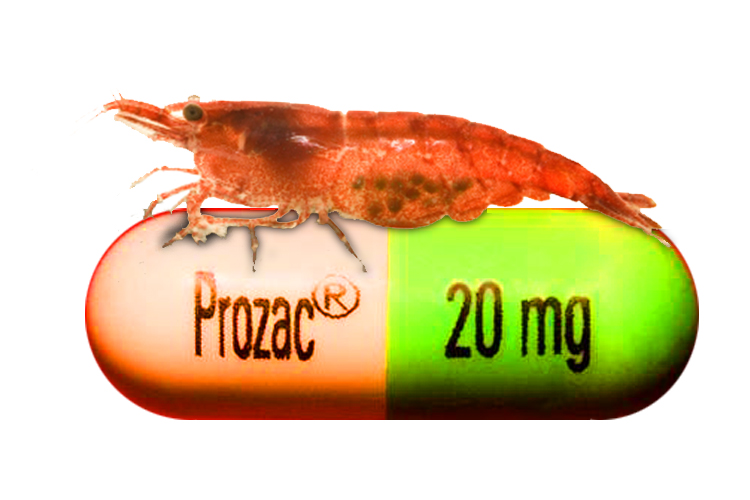
Shrimp on Prozac are killing themselves

A study shows that drug traces in our waste can affect marine life behavior, but can crustaceans have feelings?

Shrimp on Prozac are killing themselves

I have friends who are always talking about happy pigs and happy chickens — left to roam freely, eating real food instead of weird commercial food pellets, given the occasional backrub. But pity the poor shrimp! No one is raising happy shrimp … on purpose anyway. But all the Prozac we’ve been taking may be doing the work for us, and marine biologists at the University of Portsmouth in the U.K. have found that enough of the drug passes through our bodies directly into the wastewater to seriously change the behavior of shrimp who swim in it: They’re killing themselves. But do shrimp even have emotions?

Shrimp are a shy and retiring lot, living in shadows and dark crevices to hide from predators (and nurse their psychic scars?). But when they’re swimming in concentrations of Prozac (or, more specifically, the chemical fluoxetine) as those found in the water around some urban areas, they become five times as likely to swim toward light, making them easy prey. And sadly, pollutants from urban runoff are in highest concentration in river estuaries and right near the coast … which is where shrimp tend to live. Aside from the tragic irony, if shrimp populations start to collapse, it could have a serious effect on the established balance of the food chain. And most wastewater treatment plants aren’t geared toward removing residual drugs from the water. (A few years ago, scientists found fish changing sexes because of contraceptives and other chemicals in runoff.)

Continue Reading

Francis Lam is Features Editor at Gilt Taste, provides color commentary for the Cooking Channel show Food(ography), and tweets at @francis_lamMore Francis Lam

Monday, Jan 16, 2012 9:00 PM UTC2012-01-16T21:00:00Zl, M j, Y g:i A T

Escape to the red states

We were tired of Portland's yuppie brunch culture. Volunteer farming could challenge our thinking, and way of life

alex and jen revised

The night before we leave the Pacific Northwest, Jenne and I sleep over at her parents’ house in Seattle. We live a three-hour drive south, in the smaller city of Portland, but we are flying out of Seattle because it is cheaper.

After dinner, we sit with her father in their living room and make small talk over decaf coffee and cookies. He is a criminal defense attorney who specializes in civil rights law and a professor at a local university. I am an occasional poet and part-time barista, although the latter position I have recently resigned.

Continue Reading

Alex Gallo-Brown's essays have appeared in Bookslut, The Rumpus, The Brooklyn Rail, and The Collagist, among other publications. He is currently working on a manuscript of poems about grief.  More Alex Gallo-Brown

Saturday, Nov 19, 2011 3:00 PM UTC2011-11-19T15:00:00Zl, M j, Y g:i A T

Why are we still eating bluefin tuna?

This beautiful fish is in serious trouble. Fishermen, diners and chefs need to band together in order to save it

bluefin

 (Credit: holbox via Shutterstock)

This article originally appeared on Gilt Taste.

If you eat fish regularly, you’ve probably grown used to regularly being told by conservation groups — or that slightly irritating, politically correct friend — that certain fish shouldn’t be eaten: American striped bass, Atlantic swordfish, Chilean sea bass and Caspian sturgeon have all been the focus of vocal consumer and chef boycotts. Happily, some of these campaigns have been effective in helping fish populations recover. But amid all the sustainable seafood media noise, we’ve somehow managed to let the biggest and arguably most beautiful fish of all slip away.

Continue Reading

Paul Greenberg is the author of the James Beard Award-winning "Four Fish, the Future of the Last Wild Food." He is on Twitter @4fishgreenberg and on the web at fourfish.org.  More Paul Greenberg

Tuesday, Nov 1, 2011 7:55 PM UTC2011-11-01T19:55:00Zl, M j, Y g:i A T

How to save small farms

By protecting farmland from development, land trusts are making small-scale agriculture more viable

_horizontal_detail01_farm_554x285_0_0

 (Credit: Courtesy of Maine Farmland Trust)

This piece originally appeared on Gilt Taste.

You could say Penny Jordan saved the farm. A veteran of the insurance industry with a business degree, she came back to work at her Maine family farm at age 48. Since then, she’s revitalized her old farm stand business with a bus that delivers produce to senior centers. She’s opened a tiny restaurant on wheels, The Well, where a fine-dining chef turns out an ever-changing menu to be eaten at picnic tables by the parking lot—albeit one with a stunning view of Spurwink River. Jordan, a spunky, silvery blonde who favors fleece and Carhartts, has so much energy she almost bounces as she walks. Her creativity may spark new business models for other small farms, and why not? This is a woman who seems like she could do anything.

Continue Reading

  More Jane Black

Thursday, Oct 20, 2011 3:15 PM UTC2011-10-20T15:15:00Zl, M j, Y g:i A T

How to fix fish farms

A deadly salmon-farm disease has reached the wild. What can the industry do to protect itself and the environment?

A salmon jumps for food pellets at a salmon farm in Chacabuco, Chile.

A salmon jumps for food pellets at a salmon farm in Chacabuco, Chile.  (Credit: Reuters/Carlos Barria)

This article originally appeared on Gilt Taste.

My brother, in a mad dash to get dinner on the table, once made a crucial error. Instead of reaching for his stepdaughter’s plastic Barbie plate that neatly defined the space for vegetables, carbs and protein, he put down three overlapping portions of the three unlike items. When he presented this intimate arrangement to my niece, bedlam ensued. Tears poured down. Fists pounded. Dinner, The Sequel, soon followed, with food properly meted out to their respective containers. With calm finally restored, my niece let forth one of our more memorable family utterances. “Keep the food separate” she said. “That’s my motto.”

Continue Reading

Paul Greenberg is the author of the James Beard Award-winning "Four Fish, the Future of the Last Wild Food." He is on Twitter @4fishgreenberg and on the web at fourfish.org.  More Paul Greenberg

Friday, Oct 14, 2011 9:30 PM UTC2011-10-14T21:30:00Zl, M j, Y g:i A T

Welcome to the food justice movement

Navina Khanna has dedicated her life to fighting for more equitable and sustainable food systems

Navina Khanna

Navina Khanna  (Credit: Navia Khanna)

This article originally appeared on Grist.

Hunched over a table at an Oakland, Calif., coffee shop, Navina Khanna is talking about one of the most moving moments in a “Food and Freedom Ride” she organized over the summer.

On their way from Birmingham, Ala., to Detroit, her group of 12 riders had reached Columbus Junction, Iowa, near a humongous pork plant operated by Tyson, the multinational meat processor. A former Tyson employee named Julio was describing his working conditions.

Continue Reading
Andrew Leonard

Andrew Leonard is a staff writer at Salon. On Twitter, @koxinga21.  More Andrew Leonard

Page 1 of 9 in Sustainable food

Other News