

“In watching the flow of events over the past decade or so, it is hard to avoid the feeling that something very fundamental has happened in world history.” This sentiment, introducing the essay that made Francis Fukuyama a household name, commands renewed attention today, albeit from a different perspective.
Developments during the 1980s, above all the winding down of the Cold War, had convinced Fukuyama that the “end of history” was at hand. “The triumph of the West, of the Western idea,” he wrote in 1989, “is evident… in the total exhaustion of viable systematic alternatives to Western liberalism.”
Today the West no longer looks quite so triumphant. Yet events during the first decade of the present century have delivered history to another endpoint of sorts. Although Western liberalism may retain considerable appeal, the Western way of war has run its course.
For Fukuyama, history implied ideological competition, a contest pitting democratic capitalism against fascism and communism. When he wrote his famous essay, that contest was reaching an apparently definitive conclusion.
Yet from start to finish, military might had determined that competition’s course as much as ideology. Throughout much of the twentieth century, great powers had vied with one another to create new, or more effective, instruments of coercion. Military innovation assumed many forms. Most obviously, there were the weapons: dreadnoughts and aircraft carriers, rockets and missiles, poison gas, and atomic bombs — the list is a long one. In their effort to gain an edge, however, nations devoted equal attention to other factors: doctrine and organization, training systems and mobilization schemes, intelligence collection and war plans.
All of this furious activity, whether undertaken by France or Great Britain, Russia or Germany, Japan or the United States, derived from a common belief in the plausibility of victory. Expressed in simplest terms, the Western military tradition could be reduced to this proposition: war remains a viable instrument of statecraft, the accoutrements of modernity serving, if anything, to enhance its utility.
Grand Illusions
That was theory. Reality, above all the two world wars of the last century, told a decidedly different story. Armed conflict in the industrial age reached new heights of lethality and destructiveness. Once begun, wars devoured everything, inflicting staggering material, psychological, and moral damage. Pain vastly exceeded gain. In that regard, the war of 1914-1918 became emblematic: even the winners ended up losers. When fighting eventually stopped, the victors were left not to celebrate but to mourn. As a consequence, well before Fukuyama penned his essay, faith in war’s problem-solving capacity had begun to erode. As early as 1945, among several great powers — thanks to war, now great in name only — that faith disappeared altogether.
Among nations classified as liberal democracies, only two resisted this trend. One was the United States, the sole major belligerent to emerge from the Second World War stronger, richer, and more confident. The second was Israel, created as a direct consequence of the horrors unleashed by that cataclysm. By the 1950s, both countries subscribed to this common conviction: national security (and, arguably, national survival) demanded unambiguous military superiority. In the lexicon of American and Israeli politics, “peace” was a codeword. The essential prerequisite for peace was for any and all adversaries, real or potential, to accept a condition of permanent inferiority. In this regard, the two nations — not yet intimate allies — stood apart from the rest of the Western world.
So even as they professed their devotion to peace, civilian and military elites in the United States and Israel prepared obsessively for war. They saw no contradiction between rhetoric and reality.
Yet belief in the efficacy of military power almost inevitably breeds the temptation to put that power to work. “Peace through strength” easily enough becomes “peace through war.” Israel succumbed to this temptation in 1967. For Israelis, the Six Day War proved a turning point. Plucky David defeated, and then became, Goliath. Even as the United States was flailing about in Vietnam, Israel had evidently succeeded in definitively mastering war.
A quarter-century later, U.S. forces seemingly caught up. In 1991, Operation Desert Storm, George H.W. Bush’s war against Iraqi dictator Saddam Hussein, showed that American troops like Israeli soldiers knew how to win quickly, cheaply, and humanely. Generals like H. Norman Schwarzkopf persuaded themselves that their brief desert campaign against Iraq had replicated — even eclipsed — the battlefield exploits of such famous Israeli warriors as Moshe Dayan and Yitzhak Rabin. Vietnam faded into irrelevance.
For both Israel and the United States, however, appearances proved deceptive. Apart from fostering grand illusions, the splendid wars of 1967 and 1991 decided little. In both cases, victory turned out to be more apparent than real. Worse, triumphalism fostered massive future miscalculation.
On the Golan Heights, in Gaza, and throughout the West Bank, proponents of a Greater Israel — disregarding Washington’s objections — set out to assert permanent control over territory that Israel had seized. Yet “facts on the ground” created by successive waves of Jewish settlers did little to enhance Israeli security. They succeeded chiefly in shackling Israel to a rapidly growing and resentful Palestinian population that it could neither pacify nor assimilate.
In the Persian Gulf, the benefits reaped by the United States after 1991 likewise turned out to be ephemeral. Saddam Hussein survived and became in the eyes of successive American administrations an imminent threat to regional stability. This perception prompted (or provided a pretext for) a radical reorientation of strategy in Washington. No longer content to prevent an unfriendly outside power from controlling the oil-rich Persian Gulf, Washington now sought to dominate the entire Greater Middle East. Hegemony became the aim. Yet the United States proved no more successful than Israel in imposing its writ.
During the 1990s, the Pentagon embarked willy-nilly upon what became its own variant of a settlement policy. Yet U.S. bases dotting the Islamic world and U.S. forces operating in the region proved hardly more welcome than the Israeli settlements dotting the occupied territories and the soldiers of the Israeli Defense Forces (IDF) assigned to protect them. In both cases, presence provoked (or provided a pretext for) resistance. Just as Palestinians vented their anger at the Zionists in their midst, radical Islamists targeted Americans whom they regarded as neo-colonial infidels.
Stuck
No one doubted that Israelis (regionally) and Americans (globally) enjoyed unquestioned military dominance. Throughout Israel’s near abroad, its tanks, fighter-bombers, and warships operated at will. So, too, did American tanks, fighter-bombers, and warships wherever they were sent.
So what? Events made it increasingly evident that military dominance did not translate into concrete political advantage. Rather than enhancing the prospects for peace, coercion produced ever more complications. No matter how badly battered and beaten, the “terrorists” (a catch-all term applied to anyone resisting Israeli or American authority) weren’t intimidated, remained unrepentant, and kept coming back for more.
Israel ran smack into this problem during Operation Peace for Galilee, its 1982 intervention in Lebanon. U.S. forces encountered it a decade later during Operation Restore Hope, the West’s gloriously titled foray into Somalia. Lebanon possessed a puny army; Somalia had none at all. Rather than producing peace or restoring hope, however, both operations ended in frustration, embarrassment, and failure.
And those operations proved but harbingers of worse to come. By the 1980s, the IDF’s glory days were past. Rather than lightning strikes deep into the enemy rear, the narrative of Israeli military history became a cheerless recital of dirty wars — unconventional conflicts against irregular forces yielding problematic results. The First Intifada (1987-1993), the Second Intifada (2000-2005), a second Lebanon War (2006), and Operation Cast Lead, the notorious 2008-2009 incursion into Gaza, all conformed to this pattern.
Meanwhile, the differential between Palestinian and Jewish Israeli birth rates emerged as a looming threat — a “demographic bomb,” Benjamin Netanyahu called it. Here were new facts on the ground that military forces, unless employed pursuant to a policy of ethnic cleansing, could do little to redress. Even as the IDF tried repeatedly and futilely to bludgeon Hamas and Hezbollah into submission, demographic trends continued to suggest that within a generation a majority of the population within Israel and the occupied territories would be Arab.
Trailing a decade or so behind Israel, the United States military nonetheless succeeded in duplicating the IDF’s experience. Moments of glory remained, but they would prove fleeting indeed. After 9/11, Washington’s efforts to transform (or “liberate”) the Greater Middle East kicked into high gear. In Afghanistan and Iraq, George W. Bush’s Global War on Terror began impressively enough, as U.S. forces operated with a speed and élan that had once been an Israeli trademark. Thanks to “shock and awe,” Kabul fell, followed less than a year and a half later by Baghdad. As one senior Army general explained to Congress in 2004, the Pentagon had war all figured out:
We are now able to create decision superiority that is enabled by networked systems, new sensors and command and control capabilities that are producing unprecedented near real time situational awareness, increased information availability, and an ability to deliver precision munitions throughout the breadth and depth of the battlespace… Combined, these capabilities of the future networked force will leverage information dominance, speed and precision, and result in decision superiority.
The key phrase in this mass of techno-blather was the one that occurred twice: “decision superiority.” At that moment, the officer corps, like the Bush administration, was still convinced that it knew how to win.
Such claims of success, however, proved obscenely premature. Campaigns advertised as being wrapped up in weeks dragged on for years, while American troops struggled with their own intifadas. When it came to achieving decisions that actually stuck, the Pentagon (like the IDF) remained clueless.
Winless
If any overarching conclusion emerges from the Afghan and Iraq Wars (and from their Israeli equivalents), it’s this: victory is a chimera. Counting on today’s enemy to yield in the face of superior force makes about as much sense as buying lottery tickets to pay the mortgage: you better be really lucky.
Meanwhile, as the U.S. economy went into a tailspin, Americans contemplated their equivalent of Israel’s “demographic bomb” — a “fiscal bomb.” Ingrained habits of profligacy, both individual and collective, held out the prospect of long-term stagnation: no growth, no jobs, no fun. Out-of-control spending on endless wars exacerbated that threat.
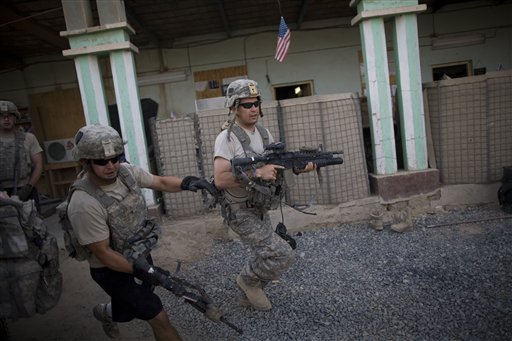
By 2007, the American officer corps itself gave up on victory, although without giving up on war. First in Iraq, then in Afghanistan, priorities shifted. High-ranking generals shelved their expectations of winning — at least as a Rabin or Schwarzkopf would have understood that term. They sought instead to not lose. In Washington as in U.S. military command posts, the avoidance of outright defeat emerged as the new gold standard of success.
As a consequence, U.S. troops today sally forth from their base camps not to defeat the enemy, but to “protect the people,” consistent with the latest doctrinal fashion. Meanwhile, tea-sipping U.S. commanders cut deals with warlords and tribal chieftains in hopes of persuading guerrillas to lay down their arms.
A new conventional wisdom has taken hold, endorsed by everyone from new Afghan War commander General David Petraeus, the most celebrated soldier of this American age, to Barack Obama, commander-in-chief and Nobel Peace Prize laureate. For the conflicts in which the United States finds itself enmeshed, “military solutions” do not exist. As Petraeus himself has emphasized, “we can’t kill our way out of” the fix we’re in. In this way, he also pronounced a eulogy on the Western conception of warfare of the last two centuries.
The Unasked Question
What then are the implications of arriving at the end of Western military history?
In his famous essay, Fukuyama cautioned against thinking that the end of ideological history heralded the arrival of global peace and harmony. Peoples and nations, he predicted, would still find plenty to squabble about.
With the end of military history, a similar expectation applies. Politically motivated violence will persist and may in specific instances even retain marginal utility. Yet the prospect of Big Wars solving Big Problems is probably gone for good. Certainly, no one in their right mind, Israeli or American, can believe that a continued resort to force will remedy whatever it is that fuels anti-Israeli or anti-American antagonism throughout much of the Islamic world. To expect persistence to produce something different or better is moonshine.
It remains to be seen whether Israel and the United States can come to terms with the end of military history. Other nations have long since done so, accommodating themselves to the changing rhythms of international politics. That they do so is evidence not of virtue, but of shrewdness. China, for example, shows little eagerness to disarm. Yet as Beijing expands its reach and influence, it emphasizes trade, investment, and development assistance. Meanwhile, the People’s Liberation Army stays home. China has stolen a page from an old American playbook, having become today the preeminent practitioner of “dollar diplomacy.”
The collapse of the Western military tradition confronts Israel with limited choices, none of them attractive. Given the history of Judaism and the history of Israel itself, a reluctance of Israeli Jews to entrust their safety and security to the good will of their neighbors or the warm regards of the international community is understandable. In a mere six decades, the Zionist project has produced a vibrant, flourishing state. Why put all that at risk? Although the demographic bomb may be ticking, no one really knows how much time remains on the clock. If Israelis are inclined to continue putting their trust in (American-supplied) Israeli arms while hoping for the best, who can blame them?
In theory, the United States, sharing none of Israel’s demographic or geographic constraints and, far more richly endowed, should enjoy far greater freedom of action. Unfortunately, Washington has a vested interest in preserving the status quo, no matter how much it costs or where it leads. For the military-industrial complex, there are contracts to win and buckets of money to be made. For those who dwell in the bowels of the national security state, there are prerogatives to protect. For elected officials, there are campaign contributors to satisfy. For appointed officials, civilian and military, there are ambitions to be pursued.
And always there is a chattering claque of militarists, calling for jihad and insisting on ever greater exertions, while remaining alert to any hint of backsliding. In Washington, members of this militarist camp, by no means coincidentally including many of the voices that most insistently defend Israeli bellicosity, tacitly collaborate in excluding or marginalizing views that they deem heretical. As a consequence, what passes for debate on matters relating to national security is a sham. Thus are we invited to believe, for example, that General Petraeus’s appointment as the umpteenth U.S. commander in Afghanistan constitutes a milestone on the way to ultimate success.
Nearly 20 years ago, a querulous Madeleine Albright demanded to know: “What’s the point of having this superb military you’re always talking about if we can’t use it?” Today, an altogether different question deserves our attention: What’s the point of constantly using our superb military if doing so doesn’t actually work?
Washington’s refusal to pose that question provides a measure of the corruption and dishonesty permeating our politics.
Andrew J. Bacevich is a professor of history and international relations at Boston University. His new book, “Washington Rules: America’s Path to Permanent War,” has just been published. Listen to the latest TomCast audio interview to hear him discuss the book by clicking here or, to download to an iPod, here.
Copyright 2010 Andrew Bacevich
