

Worldly ambition inhibits true learning. Ask me. I know. A young man in a hurry is nearly uneducable: He knows what he wants and where he’s headed; when it comes to looking back or entertaining heretical thoughts, he has neither the time nor the inclination. All that counts is that he is going somewhere. Only as ambition wanes does education become a possibility.
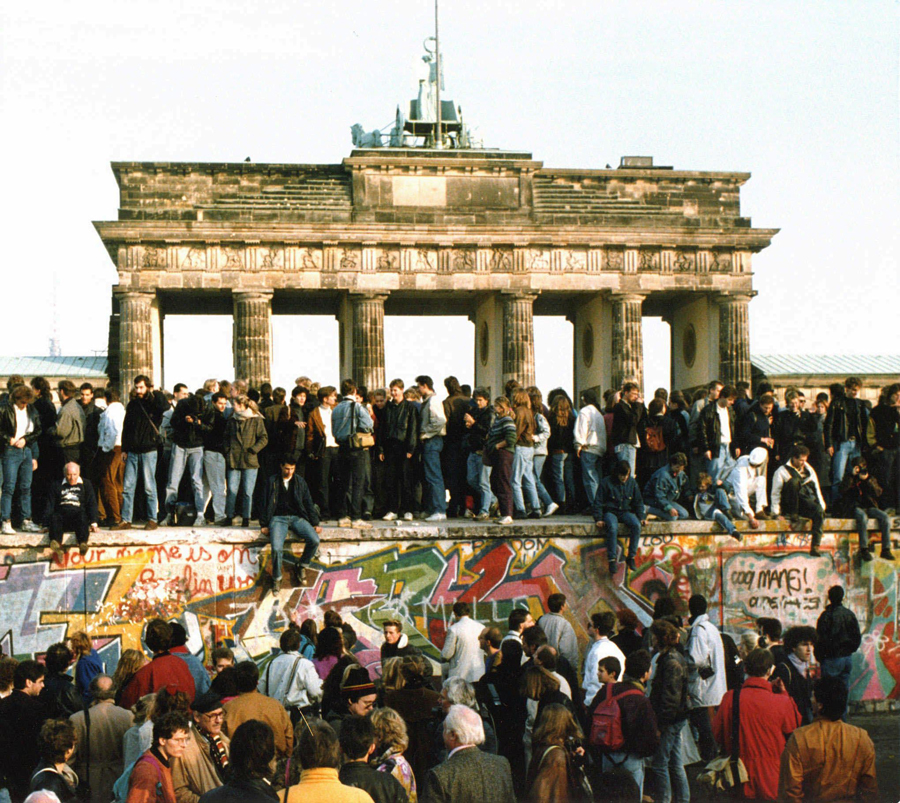
My own education did not commence until I had reached middle age. I can fix its start date with precision: for me, education began in Berlin, on a winter’s evening, at the Brandenburg Gate, not long after the Berlin Wall had fallen.
As an officer in the U.S. Army I had spent considerable time in Germany. Until that moment, however, my family and I had never had occasion to visit this most famous of German cities, still littered with artifacts of a deeply repellent history. At the end of a long day of exploration, we found ourselves in what had, until just months before, been the communist East. It was late and we were hungry, but I insisted on walking the length of the Unter den Linden, from the River Spree to the gate itself. A cold rain was falling and the pavement glistened. The buildings lining the avenue, dating from the era of Prussian kings, were dark, dirty, and pitted. Few people were about. It was hardly a night for sightseeing.
For as long as I could remember, the Brandenburg Gate had been the preeminent symbol of the age and Berlin the epicenter of contemporary history. Yet by the time I made it to the once and future German capital, history was already moving on. The Cold War had abruptly ended. A divided city and a divided nation had reunited.
For Americans who had known Berlin only from a distance, the city existed primarily as a metaphor. Pick a date — 1933, 1942, 1945, 1948, 1961, 1989 — and Berlin becomes an instructive symbol of power, depravity, tragedy, defiance, endurance, or vindication. For those inclined to view the past as a chronicle of parables, the modern history of Berlin offered an abundance of material. The greatest of those parables emerged from the events of 1933 to 1945, an epic tale of evil ascendant, belatedly confronted, then heroically overthrown. A second narrative, woven from events during the intense period immediately following World War II, saw hopes for peace dashed, yielding bitter antagonism but also great resolve. The ensuing stand-off — the “long twilight struggle,” in John Kennedy’s memorable phrase — formed the centerpiece of the third parable, its central theme stubborn courage in the face of looming peril. Finally came the exhilarating events of 1989, with freedom ultimately prevailing, not only in Berlin, but throughout Eastern Europe.
What exactly was I looking for at the Brandenburg Gate? Perhaps confirmation that those parables, which I had absorbed and accepted as true, were just that. Whatever I expected, what I actually found was a cluster of shabby-looking young men, not German, hawking badges, medallions, hats, bits of uniforms, and other artifacts of the mighty Red Army. It was all junk, cheaply made and shoddy. For a handful of deutsche marks, I bought a wristwatch emblazoned with the symbol of the Soviet armored corps. Within days, it ceased to work.
Huddling among the scarred columns, those peddlers — almost certainly off-duty Russian soldiers awaiting redeployment home — constituted a subversive presence. They were loose ends of a story that was supposed to have ended neatly when the Berlin Wall came down. As we hurried off to find warmth and a meal, this disconcerting encounter stuck with me, and I began to entertain this possibility: that the truths I had accumulated over the previous twenty years as a professional soldier — especially truths about the Cold War and U.S. foreign policy — might not be entirely true.
By temperament and upbringing, I had always taken comfort in orthodoxy. In a life spent subject to authority, deference had become a deeply ingrained habit. I found assurance in conventional wisdom. Now, I started, however hesitantly, to suspect that orthodoxy might be a sham. I began to appreciate that authentic truth is never simple and that any version of truth handed down from on high — whether by presidents, prime ministers, or archbishops — is inherently suspect. The powerful, I came to see, reveal truth only to the extent that it suits them. Even then, the truths to which they testify come wrapped in a nearly invisible filament of dissembling, deception, and duplicity. The exercise of power necessarily involves manipulation and is antithetical to candor.
I came to these obvious points embarrassingly late in life. “Nothing is so astonishing in education,” the historian Henry Adams once wrote, “as the amount of ignorance it accumulates in the form of inert facts.” Until that moment I had too often confused education with accumulating and cataloging facts. In Berlin, at the foot of the Brandenburg Gate, I began to realize that I had been a naïf. And so, at age 41, I set out, in a halting and haphazard fashion, to acquire a genuine education.
Twenty years later I’ve made only modest progress. What follows is an accounting of what I have learned thus far.
Visiting a Third-World Version of Germany
In October 1990, I’d gotten a preliminary hint that something might be amiss in my prior education. On October 3, communist East Germany — formally the German Democratic Republic (GDR) — ceased to exist and German reunification was officially secured. That very week I accompanied a group of American military officers to the city of Jena in what had been the GDR. Our purpose was self-consciously educational — to study the famous battle of Jena-Auerstädt in which Napoleon Bonaparte and his marshals had inflicted an epic defeat on Prussian forces commanded by the Duke of Brunswick. (The outcome of that 1806 battle inspired the philosopher Hegel, then residing in Jena, to declare that the “end of history” was at hand. The conclusion of the Cold War had only recently elicited a similarly exuberant judgment from the American scholar Francis Fukuyama.)
On this trip we did learn a lot about the conduct of that battle, although mainly inert facts possessing little real educational value. Inadvertently, we also gained insight into the reality of life on the far side of what Americans had habitually called the Iron Curtain, known in U.S. military vernacular as “the trace.” In this regard, the trip proved nothing less than revelatory. The educational content of this excursion would — for me — be difficult to exaggerate.
As soon as our bus crossed the old Inner German Border, we entered a time warp. For U.S. troops garrisoned throughout Bavaria and Hesse, West Germany had for decades served as a sort of theme park — a giant Epcot filled with quaint villages, stunning scenery, and superb highways, along with ample supplies of quite decent food, excellent beer, and accommodating women. Now, we found ourselves face-to-face with an altogether different Germany. Although commonly depicted as the most advanced and successful component of the Soviet Empire, East Germany more closely resembled part of the undeveloped world.
The roads — even the main highways — were narrow and visibly crumbling. Traffic posed little problem. Apart from a few sluggish Trabants and Wartburgs — East German automobiles that tended to a retro primitivism — and an occasional exhaust-spewing truck, the way was clear. The villages through which we passed were forlorn and the small farms down at the heels. For lunch we stopped at a roadside stand. The proprietor happily accepted our D-marks, offering us inedible sausages in exchange. Although the signs assured us that we remained in a land of German speakers, it was a country that had not yet recovered from World War II.
Upon arrival in Jena, we checked into the Hotel Schwarzer Bär, identified by our advance party as the best hostelry in town. It turned out to be a rundown fleabag. As the senior officer present, I was privileged to have a room in which the plumbing functioned. Others were not so lucky.
Jena itself was a midsized university city, with its main academic complex immediately opposite our hotel. A very large bust of Karl Marx, mounted on a granite pedestal and badly in need of cleaning, stood on the edge of the campus. Briquettes of soft coal used for home heating made the air all but unbreathable and coated everything with soot. In the German cities we knew, pastels predominated — houses and apartment blocks painted pale green, muted salmon, and soft yellow. Here everything was brown and gray.
That evening we set out in search of dinner. The restaurants within walking distance were few and unattractive. We chose badly, a drab establishment in which fresh vegetables were unavailable and the wurst inferior. The adequacy of the local beer provided the sole consolation.
The following morning, on the way to the battlefield, we noted a significant Soviet military presence, mostly in the form of trucks passing by — to judge by their appearance, designs that dated from the 1950s. To our surprise, we discovered that the Soviets had established a small training area adjacent to where Napoleon had vanquished the Prussians. Although we had orders to avoid contact with any Russians, the presence of their armored troops going through their paces riveted us. Here was something of far greater immediacy than Bonaparte and the Duke of Brunswick: “the other,” about which we had for so long heard so much but knew so little. Through binoculars, we watched a column of Russian armored vehicles — BMPs, in NATO parlance — traversing what appeared to be a drivers’ training course. Suddenly, one of them began spewing smoke. Soon thereafter, it burst into flames.
Here was education, although at the time I had only the vaguest sense of its significance.
An Ambitious Team Player Assailed by Doubts
These visits to Jena and Berlin offered glimpses of a reality radically at odds with my most fundamental assumptions. Uninvited and unexpected, subversive forces had begun to infiltrate my consciousness. Bit by bit, my worldview started to crumble.
That worldview had derived from this conviction: that American power manifested a commitment to global leadership, and that both together expressed and affirmed the nation’s enduring devotion to its founding ideals. That American power, policies, and purpose were bound together in a neat, internally consistent package, each element drawing strength from and reinforcing the others, was something I took as a given. That, during my adult life, a penchant for interventionism had become a signature of U.S. policy did not — to me, at least — in any way contradict America’s aspirations for peace. Instead, a willingness to expend lives and treasure in distant places testified to the seriousness of those aspirations. That, during this same period, the United States had amassed an arsenal of over 31,000 nuclear weapons, some small number of them assigned to units in which I had served, was not at odds with our belief in the inalienable right to life and liberty; rather, threats to life and liberty had compelled the United States to acquire such an arsenal and maintain it in readiness for instant use.
I was not so naïve as to believe that the American record had been without flaws. Yet I assured myself that any errors or misjudgments had been committed in good faith. Furthermore, circumstances permitted little real choice. In Southeast Asia as in Western Europe, in the Persian Gulf as in the Western Hemisphere, the United States had simply done what needed doing. Viable alternatives did not exist. To consent to any dilution of American power would be to forfeit global leadership, thereby putting at risk safety, prosperity, and freedom, not only our own but also that of our friends and allies.
The choices seemed clear enough. On one side was the status quo: the commitments, customs, and habits that defined American globalism, implemented by the national security apparatus within which I functioned as a small cog. On the other side was the prospect of appeasement, isolationism, and catastrophe. The only responsible course was the one to which every president since Harry Truman had adhered.
For me, the Cold War had played a crucial role in sustaining that worldview. Given my age, upbringing, and professional background, it could hardly have been otherwise. Although the great rivalry between the United States and the Soviet Union had contained moments of considerable anxiety — I remember my father, during the Cuban Missile Crisis, stocking our basement with water and canned goods — it served primarily to clarify, not to frighten. The Cold War provided a framework that organized and made sense of contemporary history. It offered a lineup and a scorecard. That there existed bad Germans and good Germans, their Germans and our Germans, totalitarian Germans and Germans who, like Americans, passionately loved freedom was, for example, a proposition I accepted as dogma. Seeing the Cold War as a struggle between good and evil answered many questions, consigned others to the periphery, and rendered still others irrelevant.
Back in the 1960s, during the Vietnam War, more than a few members of my generation had rejected the conception of the Cold War as a Manichean struggle. Here too, I was admittedly a slow learner. Yet having kept the faith long after others had lost theirs, the doubts that eventually assailed me were all the more disorienting.
Granted, occasional suspicions had appeared long before Jena and Berlin. My own Vietnam experience had generated its share, which I had done my best to suppress. I was, after all, a serving soldier. Except in the narrowest of terms, the military profession, in those days at least, did not look kindly on nonconformity. Climbing the ladder of career success required curbing maverick tendencies. To get ahead, you needed to be a team player. Later, when studying the history of U.S. foreign relations in graduate school, I was pelted with challenges to orthodoxy, which I vigorously deflected. When it came to education, graduate school proved a complete waste of time — a period of intense study devoted to the further accumulation of facts, while I exerted myself to ensuring that they remained inert.
Now, however, my personal circumstances were changing. Shortly after the passing of the Cold War, my military career ended. Education thereby became not only a possibility, but also a necessity.
In measured doses, mortification cleanses the soul. It’s the perfect antidote for excessive self-regard. After 23 years spent inside the U.S. Army seemingly going somewhere, I now found myself on the outside going nowhere in particular. In the self-contained and cloistered universe of regimental life, I had briefly risen to the status of minor spear carrier. The instant I took off my uniform, that status vanished. I soon came to a proper appreciation of my own insignificance, a salutary lesson that I ought to have absorbed many years earlier.
As I set out on what eventually became a crablike journey toward a new calling as a teacher and writer — a pilgrimage of sorts — ambition in the commonly accepted meaning of the term ebbed. This did not happen all at once. Yet gradually, trying to grab one of life’s shiny brass rings ceased being a major preoccupation. Wealth, power, and celebrity became not aspirations but subjects for critical analysis. History — especially the familiar narrative of the Cold War — no longer offered answers; instead, it posed perplexing riddles. Easily the most nagging was this one: How could I have so profoundly misjudged the reality of what lay on the far side of the Iron Curtain?
Had I been insufficiently attentive? Or was it possible that I had been snookered all along? Contemplating such questions, while simultaneously witnessing the unfolding of the “long 1990s” — the period bookended by two wars with Iraq when American vainglory reached impressive new heights — prompted the realization that I had grossly misinterpreted the threat posed by America’s adversaries. Yet that was the lesser half of the problem. Far worse than misperceiving “them” was the fact that I had misperceived “us.” What I thought I knew best I actually understood least. Here, the need for education appeared especially acute.
George W. Bush’s decision to launch Operation Iraqi Freedom in 2003 pushed me fully into opposition. Claims that once seemed elementary — above all, claims relating to the essentially benign purposes of American power — now appeared preposterous. The contradictions that found an ostensibly peace-loving nation committing itself to a doctrine of preventive war became too great to ignore. The folly and hubris of the policy makers who heedlessly thrust the nation into an ill-defined and open-ended “global war on terror” without the foggiest notion of what victory would look like, how it would be won, and what it might cost approached standards hitherto achieved only by slightly mad German warlords. During the era of containment, the United States had at least maintained the pretense of a principled strategy; now, the last vestiges of principle gave way to fantasy and opportunism. With that, the worldview to which I had adhered as a young adult and carried into middle age dissolved completely.
Credo and Trinity
What should stand in the place of such discarded convictions? Simply inverting the conventional wisdom, substituting a new Manichean paradigm for the old discredited version — the United States taking the place of the Soviet Union as the source of the world’s evil — would not suffice. Yet arriving at even an approximation of truth would entail subjecting conventional wisdom, both present and past, to sustained and searching scrutiny. Cautiously at first but with growing confidence, this I vowed to do.
Doing so meant shedding habits of conformity acquired over decades. All of my adult life I had been a company man, only dimly aware of the extent to which institutional loyalties induce myopia. Asserting independence required first recognizing the extent to which I had been socialized to accept certain things as unimpeachable. Here then were the preliminary steps essential to making education accessible. Over a period of years, a considerable store of debris had piled up. Now, it all had to go. Belatedly, I learned that more often than not what passes for conventional wisdom is simply wrong. Adopting fashionable attitudes to demonstrate one’s trustworthiness — the world of politics is flush with such people hoping thereby to qualify for inclusion in some inner circle — is akin to engaging in prostitution in exchange for promissory notes. It’s not only demeaning but downright foolhardy.
“Washington Rules” aims to take stock of conventional wisdom in its most influential and enduring form, namely the package of assumptions, habits, and precepts that have defined the tradition of statecraft to which the United States has adhered since the end of World War II — the era of global dominance now drawing to a close. This postwar tradition combines two components, each one so deeply embedded in the American collective consciousness as to have all but disappeared from view.
The first component specifies norms according to which the international order ought to work and charges the United States with responsibility for enforcing those norms. Call this the American credo. In the simplest terms, the credo summons the United States — and the United States alone — to lead, save, liberate, and ultimately transform the world. In a celebrated manifesto issued at the dawn of what he termed “The American Century,” Henry R. Luce made the case for this spacious conception of global leadership. Writing in Life magazine in early 1941, the influential publisher exhorted his fellow citizens to “accept wholeheartedly our duty to exert upon the world the full impact of our influence for such purposes as we see fit and by such means as we see fit.” Luce thereby captured what remains even today the credo’s essence.
Luce’s concept of an American Century, an age of unquestioned American global primacy, resonated, especially in Washington. His evocative phrase found a permanent place in the lexicon of national politics. (Recall that the neoconservatives who, in the 1990s, lobbied for more militant U.S. policies named their enterprise the Project for a New American Century.) So, too, did Luce’s expansive claim of prerogatives to be exercised by the United States. Even today, whenever public figures allude to America’s responsibility to lead, they signal their fidelity to this creed. Along with respectful allusions to God and “the troops,” adherence to Luce’s credo has become a de facto prerequisite for high office. Question its claims and your prospects of being heard in the hubbub of national politics become nil.
Note, however, that the duty Luce ascribed to Americans has two components. It is not only up to Americans, he wrote, to choose the purposes for which they would bring their influence to bear, but to choose the means as well. Here we confront the second component of the postwar tradition of American statecraft.
With regard to means, that tradition has emphasized activism over example, hard power over soft, and coercion (often styled “negotiating from a position of strength”) over suasion. Above all, the exercise of global leadership as prescribed by the credo obliges the United States to maintain military capabilities staggeringly in excess of those required for self-defense. Prior to World War II, Americans by and large viewed military power and institutions with skepticism, if not outright hostility. In the wake of World War II, that changed. An affinity for military might emerged as central to the American identity.
By the midpoint of the twentieth century, “the Pentagon” had ceased to be merely a gigantic five-sided building. Like “Wall Street” at the end of the nineteenth century, it had become Leviathan, its actions veiled in secrecy, its reach extending around the world. Yet while the concentration of power in Wall Street had once evoked deep fear and suspicion, Americans by and large saw the concentration of power in the Pentagon as benign. Most found it reassuring.
A people who had long seen standing armies as a threat to liberty now came to believe that the preservation of liberty required them to lavish resources on the armed forces. During the Cold War, Americans worried ceaselessly about falling behind the Russians, even though the Pentagon consistently maintained a position of overall primacy. Once the Soviet threat disappeared, mere primacy no longer sufficed. With barely a whisper of national debate, unambiguous and perpetual global military supremacy emerged as an essential predicate to global leadership.
Every great military power has its distinctive signature. For Napoleonic France, it was the levée en masse — the people in arms animated by the ideals of the Revolution. For Great Britain in the heyday of empire, it was command of the seas, sustained by a dominant fleet and a network of far-flung outposts from Gibraltar and the Cape of Good Hope to Singapore and Hong Kong. Germany from the 1860s to the 1940s (and Israel from 1948 to 1973) took another approach, relying on a potent blend of tactical flexibility and operational audacity to achieve battlefield superiority.
The abiding signature of American military power since World War II has been of a different order altogether. The United States has not specialized in any particular type of war. It has not adhered to a fixed tactical style. No single service or weapon has enjoyed consistent favor. At times, the armed forces have relied on citizen-soldiers to fill their ranks; at other times, long-service professionals. Yet an examination of the past 60 years of U.S. military policy and practice does reveal important elements of continuity. Call them the sacred trinity: an abiding conviction that the minimum essentials of international peace and order require the United States to maintain a global military presence, to configure its forces for global power projection, and to counter existing or anticipated threats by relying on a policy of global interventionism.
Together, credo and trinity — the one defining purpose, the other practice — constitute the essence of the way that Washington has attempted to govern and police the American Century. The relationship between the two is symbiotic. The trinity lends plausibility to the credo’s vast claims. For its part, the credo justifies the trinity’s vast requirements and exertions. Together they provide the basis for an enduring consensus that imparts a consistency to U.S. policy regardless of which political party may hold the upper hand or who may be occupying the White House. From the era of Harry Truman to the age of Barack Obama, that consensus has remained intact. It defines the rules to which Washington adheres; it determines the precepts by which Washington rules.
As used here, Washington is less a geographic expression than a set of interlocking institutions headed by people who, whether acting officially or unofficially, are able to put a thumb on the helm of state. Washington, in this sense, includes the upper echelons of the executive, legislative, and judicial branches of the federal government. It encompasses the principal components of the national security state — the departments of Defense, State, and, more recently, Homeland Security, along with various agencies comprising the intelligence and federal law enforcement communities. Its ranks extend to select think tanks and interest groups. Lawyers, lobbyists, fixers, former officials, and retired military officers who still enjoy access are members in good standing. Yet Washington also reaches beyond the Beltway to include big banks and other financial institutions, defense contractors and major corporations, television networks and elite publications like the New York Times, even quasi-academic entities like the Council on Foreign Relations and Harvard’s Kennedy School of Government. With rare exceptions, acceptance of the Washington rules forms a prerequisite for entry into this world.
My purpose in writing “Washington Rules” is fivefold: first, to trace the origins and evolution of the Washington rules — both the credo that inspires consensus and the trinity in which it finds expression; second, to subject the resulting consensus to critical inspection, showing who wins and who loses and also who foots the bill; third, to explain how the Washington rules are perpetuated, with certain views privileged while others are declared disreputable; fourth, to demonstrate that the rules themselves have lost what ever utility they may once have possessed, with their implications increasingly pernicious and their costs increasingly unaffordable; and finally, to argue for readmitting disreputable (or “radical”) views to our national security debate, in effect legitimating alternatives to the status quo. In effect, my aim is to invite readers to share in the process of education on which I embarked two decades ago in Berlin.
The Washington rules were forged at a moment when American influence and power were approaching their acme. That moment has now passed. The United States has drawn down the stores of authority and goodwill it had acquired by 1945. Words uttered in Washington command less respect than once was the case. Americans can ill afford to indulge any longer in dreams of saving the world, much less remaking it in our own image. The curtain is now falling on the American Century.
Similarly, the United States no longer possesses sufficient wherewithal to sustain a national security strategy that relies on global military presence and global power projection to underwrite a policy of global interventionism. Touted as essential to peace, adherence to that strategy has propelled the United States into a condition approximating perpetual war, as the military misadventures of the past decade have demonstrated.
To anyone with eyes to see, the shortcomings inherent in the Washington rules have become plainly evident. Although those most deeply invested in perpetuating its conventions will insist otherwise, the tradition to which Washington remains devoted has begun to unravel. Attempting to prolong its existence might serve Washington’s interests, but it will not serve the interests of the American people.
Devising an alternative to the reigning national security paradigm will pose a daunting challenge — especially if Americans look to “Washington” for fresh thinking. Yet doing so has become essential.
In one sense, the national security policies to which Washington so insistently adheres express what has long been the preferred American approach to engaging the world beyond our borders. That approach plays to America’s presumed strong suit — since World War II, and especially since the end of the Cold War, thought to be military power. In another sense, this reliance on military might creates excuses for the United States to avoid serious engagement: confidence in American arms has made it unnecessary to attend to what others might think or to consider how their aspirations might differ from our own. In this way, the Washington rules reinforce American provincialism — a national trait for which the United States continues to pay dearly.
The persistence of these rules has also provided an excuse to avoid serious self-engagement. From this perspective, confidence that the credo and the trinity will oblige others to accommodate themselves to America’s needs or desires — whether for cheap oil, cheap credit, or cheap consumer goods — has allowed Washington to postpone or ignore problems demanding attention here at home. Fixing Iraq or Afghanistan ends up taking precedence over fixing Cleveland and Detroit. Purporting to support the troops in their crusade to free the world obviates any obligation to assess the implications of how Americans themselves choose to exercise freedom.
When Americans demonstrate a willingness to engage seriously with others, combined with the courage to engage seriously with themselves, then real education just might begin.
