Social Media

MySpace gives up, links to Facebook status updates

Some see the definitive end of former social networking giant as it attempts to appropriate 500 million users

  • more
    • All Share Services

Topics: ,

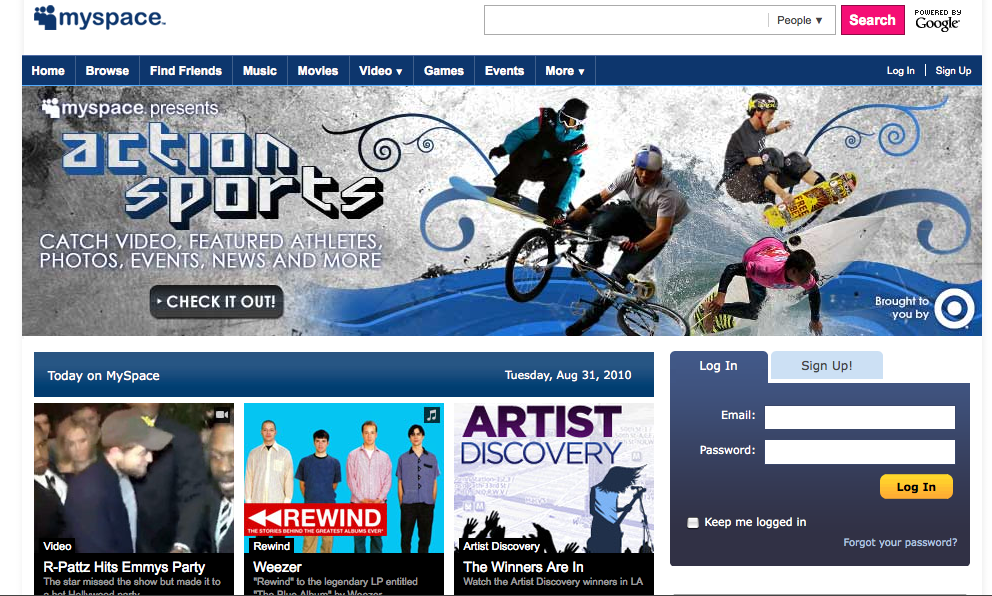
MySpace gives up, links to Facebook status updatesScreen grab of MySpace home page.

If the demise of former social media giant MySpace was predicted years ago, today’s announcement that the site is syncing with Facebook might just be the final nail in its coffin. A recent redesign was supposed to set the News Corp. network up to gain some of its lost ground, but acquiescing to Facebook’s popularity may be a sign that MySpace realizes the jig is up.

CNET has an explanation of how the syncing will work, and don’t think Twitter is being ignored — it’s got a piece of the action too. If you’re even still using MySpace, GeekSugar wants to know. In other news, News Corp. is trying to merge its online advertising arm with its social network, because everyone needs to make that cheddar. The advertising revolution might not be going so well just yet, though, because the company extended its Google ad contract for another month.

Across the Web, more senior citizens are flocking to social media, so now your mom can see what it’s like to have a parent make embarassing comments on her wall. Retailer Urban Outfitters has integrated the Facebook “like” button into its online marketing scheme, and Israeli Prime Minister Benjamin Netanyahu caught up with the 21st century by jumping into the holy trifecta of Facebook-Twitter-YouTube this week. Mazel tov!

Continue Reading Close

I, Luddite

Growing up, I thought it was cool to shun technology. Now, at 33, that attitude is ruining my life

  • more
    • All Share Services

Topics: ,

I, Luddite (Credit: iStockphoto/imbarney22)

I was having a cigarette with a 23-year-old bartender named Marty when we started talking about social media.

“I just use Facebook to meet up with friends or to know what’s happening next week,” he said. “My parents and older people abuse Facebook. They put too much out there.” Like a lot of young adults, Marty doesn’t have much use for email, though he uses it with his cousins “as a way to tell longer, more involved stories, mostly about how out of it our parents are.”

I’m considered part of Marty’s generation, despite our 10-year age difference. But the only common ground we had in that conversation was the Phillies and smoking a cigarette in the parking lot of a bar. When it comes to technology, I might as well be his granddad.

Born in 1978, I’m a millennial in name only. I’m really a Luddite. I don’t get technology, and for a long time I tried to convince myself I didn’t want to get it. My view on the latest cyber advances was lack of interest and occasionally hostility. I imagined that this rejection marked me as an iconoclast or a rugged individualist. A real man listens to Led Zeppelin and doesn’t listen to Led Zeppelin on iTunes — that sort of thing. Now, thanks to that mulishness and vanity, I feel like a clamshell of a man, outdated and struggling to communicate with the rest of my cohorts’ fancy smartphones. At the age of 33, I’ve been left behind.

Technology wasn’t a big part of my family life growing up. In the ’90s, my friends would rip on me because the only movie machine we owned was a Betamax, and because I called it a “movie machine.” There were no video games in my house. I watched the evolution from Atari to PlayStation from the living rooms and dens of friends, and while those friends were comfortable transitioning from “Mario” and “Street Fighter” to “Call of Duty” and “Grand Theft Auto,” I silently struggled to make the shapes move in “Tetris.” As a defense mechanism, I decided video games were just another waste of time, and the upgrades in graphics and complexity were a hustle to get people’s money.

In high school, I couldn’t afford a beeper like most of my friends, so I made jokes about how they were for wannabe drug dealers, even though I have probably been described by several people as a wannabe drug dealer (including my kids).

Every technological advance that followed was met with a similar attitude. From Friendster to PDAs, iPods to Facebook, I avoided dialing up or jacking in like my jean jacket and Marlboros depended on it. It was an image cultivated to look cool. But now the only image I’m left with is a deeply uncool one. I’m missing out on cultural conversations. I’m missing out on music and videos. I’m missing out on ideas that can be fired around the globe at the speed of thought. I’m missing out on social change that’s been enabled from Tahrir Square to Zuccotti Park. I’ve never even seen an Angry Bird. I’m like the club guy who wakes up one morning in his mid 30s with a cocaine nose, an overdue rent notice slipped under his door, and a clump of hair on his pillow and realizes he may have missed something bigger than a good party. Actually, I’m worse than that guy, because he probably knows how to use an iPhone.

I hoped all this stuff would go the way of my beloved Betamax Movie Machine, that the tech would crumble and disappear before I did. However, it is becoming clear to me that the exact opposite is happening. Little by little, I have been forced to enter the world I sneered at for so long. I am increasingly dependent on that world — for my employment and my future, and it is painfully clear how little control I have in that world. It makes me feel old and out of touch. Worse, it makes me feel powerless to contribute to the financial life of my family unless I can do the one thing I swore off: actually learn to use it.

But I worry that I’m too far gone. You can’t teach an old dog new apps. For my last birthday, I got an iPod. It didn’t even come with directions; everyone just knows how to use them now. (Everyone except me.) My wife patiently explained how to make it work, but no matter how many times she showed me how to construct a playlist or transfer music I couldn’t make it function in the way I wanted it to, or the way I thought it was supposed to. It was too small and its inner workings too mysterious and complicated. I simply gave up after a month. It’s been gathering dust on a shelf ever since. Even if I could figure out technology, I don’t trust myself with it. Twitter? With my poor judgment, neuroses and lack of impulse control?

The truth is that all the beepers and cellphones and video game systems and VHS (and DVD) “movie machines” weren’t the vain consumerist crap I pretended they were. They weren’t the passing fads of the bourgeois. They were the foundation of a language that almost everyone in my generation has learned to speak and one that younger members of our cohort were simply born knowing. It’s the language of adaptability, of being so willing to learn and discover a new device that you never need directions to it. All of this stuff was about communicating. With each other. With machines big and small. With people in other countries. Come to think of it, communication was never my strong suit, either.

One of the first phrases you learn in a new language is “Where’s the bathroom.” It’s a necessary question should you ever find yourself in a foreign land, and it could be argued that the intimacy of the query is automatically endearing or at least leaves an impression. I have a friend (several years older than I am) who has something on his phone that tells him where the nearest public bathroom is. Meanwhile, the fanciest thing my phone can do is text, and I only started doing that last year. So here I am, a grown man, feeling like I’m in a foreign land — with a wife, two kids, a mortgage and a job that depends on my ability to connect with people and make myself understood, and I just realized I don’t have the technocabulary to ask where the bathroom is. Maybe it’s time I learned.

Continue Reading Close

Aaron Traister is a proud graduate of the Community College of Philadelphia. He writes a monthly column for Redbook.

Franzen doesn’t get Twitter

The author calls it "the ultimate irresponsible medium." But he doesn't understand why people actually tweet

  • more
    • All Share Services

Topics: , , ,

Franzen doesn't get Twitter Jonathan Franzen (Credit: Wikipedia)
This originally appeared on HTMLGIANT.

In some ways, we’ve brought this on ourselves; it is a slippery slope. First you wonder what Angelina Jolie had for breakfast because she was so great in that one movie or whatever and then you’re buying cereal and thinking, “Does Oprah eat Raisin Bran?” Eventually, you even start to give a damn about what famous writers think about the weather or, say, social networking, and someone like Jonathan Franzen revels in his dislike of Twitter and other means of social networking from his Important Writer perch and we respond because if Franzen hates Twitter, does he hate us too? The angst is unbearable and yet it’s all sort of inevitable.

Franzen’s A Great American Writer and all but I don’t give a much of a damn about his opinions on anything (see: Edith Wharton obvi). Or I do. Is it really surprising that Franzen doesn’t care for Facebook or Twitter? His overall comportment does not suggest an affinity for the levity of social networking. I can’t really say I love Facebook, myself. It has become increasingly hard to make sense of the interface and I keep getting invited to parties and readings in Bali and Temecula and I don’t live in those places, so the experience is, at best, fragmented. At the same time, I don’t need to proselytize my dislike unless I’m on Twitter. Who cares? My opinion doesn’t matter nor does Franzen’s, though he is Very Fancy, so in the calculus of mattering, his irrelevant opinion is less irrelevant than mine. Math.

J. Franz talking smack about Twitter, though, them’s fighting words.

Jami Attenberg wrote down some of what Franzen said Monday night at Tulane:

Twitter is unspeakably irritating. Twitter stands for everything I oppose… it’s hard to cite facts or create an argument in 140 characters… it’s like if Kafka had decided to make a video semaphoring “The Metamorphosis.” Or it’s like writing a novel without the letter “P”… It’s the ultimate irresponsible medium.

Is anyone really using Twitter to craft complex rhetorical arguments? What does responsibility have to do with chattering online? It’s like Franzen is saying, “I cannot swim in my car and therefore my car is not useful.” He doesn’t understand what Twitter is for. Of course he dislikes it. He’s working from a place of profound ignorance. His stance is one of those things where you have to say, “There, there, Mr. Franzen, here is your Ovaltine.”

Attenberg smartly concluded that

he doesn’t understand that a lot of writers have to use the medium as a promotional device as well as a way to build networks. He doesn’t have to do anything! He has a publicist who probably has dreams about him every night, whether he has a book coming or not. He is free to write and just be himself, while the rest of us are struggling to be heard and recognized.

Team Franzen has the infrastructure to publicize and promote Franzen. Who knows how he wastes time, but clearly it isn’t online, so he has no need for people to “Like” his pithy Facebook updates or retweet his deepest or shallowest thoughts about, say, yogurt. He has reached a niveau where he can make ill-informed statements about something trivial and in turn we spend the next several hours, days, weeks, parodying, poking and otherwise pondering those ill-informed statements on the very networks he denounces. The circle of life.

When you’ve got it, you’ve got it.

If you attended the bookfair at AWP, you saw four rooms filled with magazines and publishers, and these attendees represented only a sixth of the magazines and small presses out there. It was a total zoo. Also, it was beastly hot. We were being punished. As I stood in the bookfair day after day, talking to writers, I was reminded of how we are all guppies in a very big pond. For those of us among the un-Franzen, there’s an intense amount of competition for any kind of attention. We are guppies together. Most writers write to be read. How the hell do you get read when there is so much to read? Sure, you have to do something interesting but you also need to do a little more. There are countless writers doing interesting things. Excellence isn’t enough. Make your peace with that already. As J. Attenberg says, the rest of are struggling to be heard and recognized but fortunately, there are great options to help us with that.

I was also on a panel at AWP about Literature and the Internet in 2012 with Blake and Kyle and Stephen Elliott and James Yeh. I had no voice so I awkwardly whispered into the microphone a couple times and it was very difficult because I had way more to say. Alas. One of the audience members asked if she needs a blog because she had heard in another panel that she needs a blog. She did not seem to actually want a blog. It was a good question. Last night a friend on Facebook asked if she needs to keep her Google+ profile she never uses. In fact, one of the questions I am asked most frequently is, “Do I need a [insert social networking platform]?” There’s a lot of anxiety out there about what we need to do as writers to reach readers.

Necessity.

What do we need?

I need to stay black and die. Everything else is relatively optional.

What do we need to do as writers?

We need to write. We need to write well and hopefully that will at least get our work into  places where we might be read. We don’t need to do anything else. However, if we want the work to be read by more than say, our parents, we should probably get connected, in thoughtful, non-annoying ways, to other writers and readers.

Social networking is a convenient way of creating these connections in a low-pressure environment. Franzen already has a million connections and a million readers so it is easy for him to sneer intellectually at social networks while using words like semaphoring. I looked up semaphore. It is an apparatus for visual signaling (as by the position of one or more movable arms or a system of visual signaling by two flags held one in each hand).

It’s interesting that Franzen wants to make social networking a conversation about responsibility because it is a little irresponsible to make such deliberately provocative statements a) about something relatively silly and b) without knowing anything substantive about the platforms.

When it comes to the social networking, do what you want. This is not as complicated as we make it. Ignore most of those well meaning articles about writers and social networking. Some of those articles are a little crazy and written by people who want you to Market Yourself and Be a Product.

Do what you like. Do what you want. Don’t stress. This should not be stressful. Social networking should not feel like a burden or obligation or something to be resented.  At the same time, get over the “self promotion is gross” thing. If you don’t like what you write enough to want to tell people about it, in moderation, don’t publish and that problem is solved.

If you want to be on Facebook, do that too but perhaps don’t ask people to like your Fan Page or whatever because if they haven’t already, they probably don’t want to anyway. If you want to be on Google+ with me and like six other people, do that, but know it’s very lonely there and lots of strangers who speak different languages will talk at you in those different languages and it can be confusing. If you want a blog, create one but update it and put more content on your blog than updates about your writing. Find something to talk about. I hear rejection works well or movies. The problem with social networking is not its triviality but rather its half-assedness. Writers feel this “market pressure” to “network” so they create social networking presences they have no idea how to use, that they have no interest in using, and then those presences languish and make the writer look like they don’t give a damn.

Do something where you are willing to show that you give a damn, however you interpret giving a damn.

Twitter is my favorite thing. If you like babbling about nonsense, and current events, and occasionally sharing links to your work, get on Twitter. I love that people willingly listen to me talk about Fage yogurt, “One Tree Hill,” Scrabble tournaments and my writing, in that order. I love listening to you talk about your cats and babies and your drunkenness and all the other things you want to talk about in 140 or fewer characters. I love when you send me things to read because most of the time, those things are great. Most importantly, let’s keep it real—no platform is more conducive to collectively watching an awards ceremony than Twitter.

Franzen approaches social networking with far too much gravitas. If he had been on Twitter during, say, the Grammys, he would better understand what it is all about. He doesn’t want to be on Twitter, though. The desire is not there and it’s not a matter of necessity for him. In that regard, Franzen is modeling the right attitude toward social networking—do what you like.

Continue Reading Close

Roxane Gay lives and writes in the Midwest.

Don’t ignore Facebook’s silly-sounding policies

A leaked manual reveals the shadowy and powerful role social media sites play in shaping public discourse

  • more
    • All Share Services

Topics: , ,

Don't ignore Facebook's silly-sounding policies (Credit: Salon)
A longer version of this piece appears on Culture Digitally.

Last week, Gawker received a curious document. Turned over by an aggrieved worker from the online freelance employment site oDesk, the document iterated, over the course of several pages and in unsettling detail, exactly what kinds of content should be deleted from the social networking site that had outsourced its content moderation to oDesk’s team. The social networking site, as it turned out, was Facebook.

The antiseptically titled “Abuse Standards 6.1: Operation Manual for Live Content Moderators” (along with an updated version 6.2 subsequently shared with Gawker, presumably by Facebook) is still available on Gawker. It represents the implementation of the Facebook’s Community Standards, which present the social media site’s priorities around acceptable content, but stay miles away from actually spelling them out. In the Community Standards, Facebook reminds users that “We have a strict ‘no nudity or pornography’ policy. Any content that is inappropriately sexual will be removed. Before posting questionable content, be mindful of the consequences for you and your environment.” But, an oDesk freelancer looking at hundreds of pieces of content every hour needs more specific instructions on what exactly is “inappropriately sexual” — such as removing “Any OBVIOUS sexual activity, even if naked parts are hidden from view by hands, clothes or other objects. Cartoons / art included. Foreplay allowed (Kissing, groping, etc.). even for same sex (man-man / woman-woman” (sic).

It’s tempting, and a little easy, to focus on the more bizarre edicts that Facebook offers here (“blatant depictions of camel toes” as well as “images of drunk or unconscious people, or sleeping people with things drawn on their faces” must be removed; pictures of marijuana are OK, as long as it’s not being offered for sale). But the absurdity here is really an artifact of having to draw this many lines in this much sand. Any time we play the game of determining what is and is not appropriate for public view, in advance and across an enormous and wide-ranging amount of content, the specifics are always going to sound sillier than the general guidelines. (It was not so long ago that “American Pie’s” filmmakers got their NC-17 rating knocked down to an R after cutting the scene in which the protagonist has sex with a pie from four thrusts to two.)

But the more important story concerns what this document reveals about the kind of content being posted to Facebook, the position in which Facebook and other content platforms find themselves, and the system they’ve put into place for enforcing the content moderation they now promise.

Facebook or no, it’s hard not to be struck by the depravity of some of the stuff that content moderators are reviewing. It’s a bit disingenuous of me to start with the camel toes, when what most of this document deals with is infinitely more reprehensible: child pornography, rape, bestiality, graphic obscenities, animal torture, racial and ethnic hatred, self-mutilation, suicide. There is something deeply unsettling about this document in the way it must, with all the delicacy of a badly written training manual, explain and sometimes show the kinds of things that fall into these categories.

This outpouring of obscenity is by no means caused by Facebook, and it is certainly reasonable for Facebook to take a position on the types of content it believes many of its users will find reprehensible. But that does not let Facebook off the hook for the kind of position it takes: not just where it draws the lines, but the fact that it draws lines at all, the kind of custodial role it takes on for itself, and the manner in which it goes about performing that role. We may not find it difficult to abhor child pornography or ethnic hatred, but we should not let that abhorrence obscure the fact that sites like Facebook are taking on this custodial role — and that while goofy frat pranks and cartoon poop may seem irrelevant, this is still public discourse. Facebook is now in the position of determining, or helping to determine, what is acceptable as public speech — on a site in which 800 million people across the globe talk to each other every day, about all manner of subjects.

This is not a new concern. The most prominent controversy has been about the removal of images of women breast-feeding, which has been a perennial thorn in Facebook’s side; but similar dust-ups have occurred around artistic nudity on Facebookpolitical caricature on Apple’s iPhonegay-themed books on Amazon, and fundamentalist Islamic videos on YouTube. The leaked document, while listing all the things that should be removed, is marked with the residue of these past controversies. It clarifies the breast-feeding rule somewhat, by prohibiting “Breastfeeding photos showing other nudity, or nipple clearly exposed.” Any commentary that denies the existence of the Holocaust must be escalated for further review, not surprising after years of criticism. Concerns for cyber-bullying, which have been taken up so vehemently over the last two years, appear repeatedly in the manual. And under the heading “international compliance” are a number of decidedly specific prohibitions, most involving Turkey’s objection to their Kurdish separatist movement, including prohibitions on maps of Kurdistan, images of the Turkish flag being burned, and any support for PKK (The Kurdistan Workers’ Party) or their imprisoned founder Abdullah Ocalan.

Facebook and its removal policies, and other major content platforms and their policies, are the new terrain for long-standing debates about the content and character of public discourse. That images of women breast-feeding have proven a controversial policy for Facebook should not be surprising, since the issue of women breast-feeding in public remains a contested cultural sore spot. That our dilemmas about terrorism and Islamic fundamentalism, so heightened over the last decade, should erupt here too is also not surprising. The dilemmas these sites face can be seen as a barometer of our society’s pressing concerns about public discourse more broadly: how much is too much; where are the lines drawn and who has the right to draw them; how do we balance freedom of speech with the values of the community, with the safety of individuals, with the aspirations of art and the wants of commerce.

But a barometer simply measures where there is pressure. When Facebook steps into these controversial issues, decides to authorize itself as custodian of content that some of its users find egregious, establishes both general guidelines and precise instructions for removing that content, and then does so, it is not merely responding to cultural pressures, it is intervening in them, reinforcing the very distinctions it applies. Whether breast-feeding is made more visible or less, whether Holocaust deniers can use this social network to make their case or not, whether sexual fetishes can or cannot be depicted, matters for the acceptability or marginalization of these topics. If, as is the case here, there are “no exceptions for news or awareness-related content” to the rules against graphic imagery and speech, well, that’s a very different decision, with different public ramifications, than if news and public service did enjoy such an exception.

But the most intriguing revelation here may not be the rules, but how the process of moderating content is handled. Sites like Facebook have been relatively circumspect about how they manage this task: They generally do not want to draw attention to the presence of so much obscene content on their sites, or that they regularly engage in “censorship” to deal with it. So the process by which content is assessed and moderated is also opaque. This little document brings into focus a complex chain of people and activities required for Facebook to play custodian.

The moderator using this leaked manual would be looking at content already reported or “flagged” by a Facebook user. The moderator would either “confirm” the report (thereby deleting the content), “unconfirm” it (the content stays) or “escalate” it, which moves it to Facebook for further or heightened review. Facebook has dozens of its own employees playing much the same role; contracting out to oDesk freelancers, and to companies like Caleris and Telecommunications On Demand, serves as merely a first pass. Facebook also acknowledges that it looks proactively at content that has not yet been reported by users (unlike sites like YouTube that claim to wait for their users to flag before they weigh in). Within Facebook, there is not only a layer of employees looking at content much as the oDesk workers do, but also a team charged with discussing truly gray area cases, empowered both to remove content and to revise the rules themselves.

At each level, we might want to ask: What kind of content gets reported, confirmed and escalated? How are the criteria for judging determined? Who is empowered to rethink these criteria? How are general guidelines translated into specific rules, and how well do these rules fit the content being uploaded day in and day out? How do those involved, from the policy setter down to the freelance clickworker, manage the tension between the rules handed to them and their own moral compass? What kind of contextual and background knowledge is necessary to make informed decisions, and how is the context retained or lost as the reported content passes from point to point along the chain? What kind of valuable speech gets caught in this net? What never gets posted at all, that perhaps should?

Keeping our Facebook streets clean is a monumental task, involving multiple teams of people, flipping through countless photos and comments, making quick judgments, based on regularly changing proscriptions translated from vague guidelines, in the face of an ever-changing, global, highly contested, and relentless flood of public expression. And this happens at every site, though implemented in different ways. Content moderation is one of those undertakings that, from one vantage point, we might say it’s amazing that it works at all, and as well as it does. But from another vantage point, we should see that we are playing a dangerous game: the private determination of the appropriate boundaries of public speech. That’s a whole lot of cultural power, in the hands of a select few who have a lot of skin in the game, and it’s being done in an oblique way that makes it difficult for anyone else to inspect or challenge. As users, we certainly cannot allow ourselves to remain naive, believing that the search engine shows all relevant results, the social networking site welcomes all posts, the video platform merely hosts what users generate. Our information landscape is a curated one. What is important, then, is that we understand the ways in which it is curated, by whom and to what ends, and engage in a sober, public conversation about the kind of public discourse we want and need, and how we’re willing to get it.

Continue Reading Close

Tarleton Gillespie is a professor of Communication and Information Science at Cornell University. He is the author of "Wired Shut: Copyright and the Shape of Digital Culture" and is writing a new book on how private online media platforms curate public discourse. He co-curates the blog Culture Digitally.

My Facebook angst

The social network site kicks up so much anxiety and embarrassment for me. But that doesn't mean I want to quit it

  • more
    • All Share Services

Topics: , ,

My Facebook angst (Credit: Salon/iStockphoto)

A few days ago, my friend Elizabeth posted an item to Facebook. I wanted to comment but held back, though not exactly because I had plenty of work to do. Instead I sent her a text: “Sometimes do you want to say something or post something or like something on FB, but then you think of all those unanswered emails and texts and silence yourself, so people won’t see you ‘wasting’ time when you could be responding to them?”

“Sometimes?” she replied.

“It’s called Twilt, that feeling,” I answered, laughing, having coined the term on the spot.

Twilt (n): the particular brand of guilt or self-reproach that results from posting, liking or commenting on items on Facebook or Twitter while simultaneously not responding to emails, text messages, phone calls or other types of personal communication with the knowledge or anxiety that the specific message senders will notice your public offerings and question your lack of private ones. Twilt, while related, is not the same as the guilt that results from general Internet-specific procrastination such as browsing blogs or online shopping, which, though it may result in its own brand of self-disgust, generally has no public shame component.

Adam Zagajewski, in his essay “The Shabby and Sublime,” says that the poetry of recent years is “marked by a disproportion … between powerful expressions of the inner life and the ceaseless chatter of self-satisfied craftsmen.” The same could be said for Facebook updates, our contemporary confessional. I have eaten the plums in the refrigerator, and they were yummy. Facebook is bad for me because I not only embarrass myself but I keenly feel the embarrassment of others whose lack of discretion, as I perceive it, I quietly judge and am embarrassed by all the same.

When someone starts a conversation with me on Facebook, in public, I’m mortified. There’s a message function for that! I have email and a cellphone. Let me respond when I can, away from the watch of hundreds. Sometimes I disable my Wall so people can’t write things there, until someone points it out and I feel guilty that I’ve done this so I change it back. I don’t like to talk on the phone in public and when a friend speaks too loudly in a cafe I am nervous that someone will overhear our conversation. At home I don’t like the sensation of my husband overhearing me order pizza, let alone having more sensitive conversations with friends. I have never been one to kiss and tell, and I like to keep my private life private. Why I have a Facebook account at all still perplexes me. I like the idea of seeing what’s going on, but I don’t want to always be a part of it. I don’t want to not be a part of it either. I want to swoop in and swoop out. But Facebook doesn’t allow for inconsistency without amplifying it, a constant record of our obsessions and our contradictions to the point of caricature.

The conversations between couples embarrass me the most, whether they’re sentimental or self-referential. It’s not that you live with that person and somehow don’t need electronic communication — I often text my husband across the table at a bar to make a snarky comment, or sometimes I send ridiculous things to the online printer in his office just to be impish. But it’s done in private, between us. That’s the point. It’s something about the relationship having a public facade so contrived and self-aware that makes my eyes water with shame. We all have facades and personas, of course, that are not Internet confined. Game faces. Once, at a reading, a poet thanked his wife so gushingly that I whispered to my friend, “That guy is totally having an affair.” I didn’t know a thing about him. But it turns out, I was right. Maybe the wife requested the shout-out, but if I were his wife I would have smiled at the crowd and taken flight. Up, up and away.

Do you remember “This American Life’s” 2001 episode about Superpowers, which poses the question: If you could have a superpower, would you choose Flight or Invisibility? My first reaction was and remains, flight. To fly! I’m petite and have spent a lifetime trying to fight invisibility, being intellectually overlooked, or feeling insignificant (this is not simply a result of my size but an entire slew of issues that would benefit from Lacanian psychoanalysis, which if I had I’d have to talk about in my status updates). I still have dreams where I’m flying, frequent dreams, and when I wake up I feel inexplicably happy. When I fly in my dreams, I don’t sputter or start or anxiously hover. I soar, I glide, and it’s fluid, like a manta ray moving through water. When I fly in my dreams I am all grace. My desire for flight would get me places faster, and in style.

But maybe my desire for flight is a sort of conditional invisibility; the idea of flight not only as the act of flying but the act of fleeing. I want to be part of the scene but to float somehow above it, to engage in the action but then be able to gracefully exit. I want to swoop on in and then glide away. But I want to be seen, for sure, and present. I just don’t want to have to stay, and I certainly don’t want anyone to comment on it.

It is also, of course, part of being a writer, to be part of a scene but also removed. Writing is about observation, but if I observe and immediately state then I’ve lost it, released it. The essay allows an expression of doubt but the Facebook update or conversation has a sort of self-satisfied glibness to it. It doesn’t invite dialogue but somehow challenges it. There is also the lack of control. It could go anywhere. Someone could say something too revealing or racist or just plain idiotic, and there it is, linked to your name. It is not a place for the anxious, Facebook.

And there is the difference of stance. An essay is an attempt at dialogue but a status update is a solicitation; the first is a meaningful hesitation or an assertive pronouncement, a languorous dip in a warm sea or a fast-paced race in a pool. But the essay swims all the same. A Facebook update is a haphazard nose dive into a near-empty watering hole. What if I break my neck? Will someone find me if my head is bleeding? If I post and no one comments, do I exist?

The comparison between the two forms needn’t be made; we know the difference, yet it might explain my relative comfort, even ease, with the personal essay and my fear of any public sort of dialogue. Do I want to be invisible or do I want to fly? Although the personal is intimate there is also the artifice of distance. When I fly in my dreams I can see myself flying while being aware of my place on the ground. Philip Lopate argues that a good essayist must see oneself from the ceiling, must turn oneself into a character. He is not advocating a “self-absorbed navel-gazing” but instead “a release from narcissism,” an ability to be able to “see yourself in the round.”

I admit I am often self-amused by my status updates (what else are they for?), but I am rarely satisfied with them. In the rare case I am amused with myself when writing anything, that to me is a sure sign that it’s going to need a very careful edit, or that it’s garbage.

What I love best about that episode of “This American Life” is the moving analysis at the end, immediately after several of the show’s guests comment on what it means to want invisibility or flight. John Hodgman reflects:

Flight and invisibility touch a nerve. Actually, they touch two different nerves, speak to very different primal desires and unconscious fears … In the end, it’s not a question of what kind of person flies and what kind of person fades. We all do both. … At the heart of this decision, the question I really don’t want to face, is this. Who do you want to be, the person you hope to be, or the person you fear you actually are?

Am I becoming someone on Facebook or am I trying to escape her? I’m happy my partner is not on Facebook because I am spared that public embarrassment, of people wishing us happy anniversary or the pressure to comment, or not comment, on his witticisms or offerings: J. just made fabulous butternut squash ravioli! From scratch! Natalie likes this. And then he would like my liking, and another friend would find it cute, and like it too, and no one would know that we spent the last hour fighting because I overloaded the dryer and almost burned down the house.

I wouldn’t mind if he joined Facebook, though, because he is the face man of our relationship and it would take some of the completely imagined but hugely felt pressure off me. (“Could you please like so-and-so’s photos of her daughter’s dance recital?”) If we had a band, he’d be the lead singer and I’d be the bassist, hiding behind my hair. (No, not the drummer! No one sees the drummer!) The bassist can look up and make eye contact with the crowd for a moment and the crowd will go wild. They don’t expect it but they hope for it all the same. The face man: He has to be on all the time. It’s his job to be on.

Do you remember the scene in “Sex in the City” where Carrie, upon receiving an email, ducks underneath her desk and shrieks, Oh my god, can he see me? A decade later it seems charming, like a text message from our grandmother. Yet the anxiety remains. Now, I suffer from what is surely a new psychological disorder: a DSM-IV classifiable paranoia that all my personal conversations are somehow being broadcast on Twitter. Is there a word for that?

Continue Reading Close

Natalie Bakopoulos's first novel, "The Green Shore," will be published by Simon & Schuster in June 2012. Her work has appeared in Tin House, Ninth Letter, Granta Online, and The O. Henry Prize Stories 2010, and she is a contributing editor for the online journal Fiction Writers Review.

The latest Twitter revolution

Long-haul truckers gather in Mississippi to learn social media skills, burnish their image -- and fight regulations

  • more
    • All Share Services

Topics: ,

The latest Twitter revolution (Credit: iStockphoto, karammiri / Salon)

Rich Wilson is telling a roomful of truckers how to sound less like, well, truckers. “Intelligence, not ignorance,” he instructs. “If you have to, Google a few words. Refrain from words like ‘ain’t,’ ‘gonna,’ ‘y’all’ or ‘you-know-what bureaucrats.’”

Wilson, himself a former truck driver, is speaking at the first-ever Trucking and Social Media Convention, and he’s trying to get those assembled to formally register comments on a federal transportation site in response to new regulations. That these phrases he tells them not to use are all direct quotes from previous comments will not dampen his determination. “Until we learn where to start, we’re just going to end up with that angry attitude,” Wilson says. “But let’s fight the bureaucrats with bureaucracy!”

So it’s not the fieriest of rallying cries. Most of the 170 drivers and advocates gathered at the Gold Strike Casino in Mississippi’s second-tallest building (31 stories) are plenty fired up already: at new federal regulations and local traffic enforcement, at big carriers, at the perception that despite their toil, truckers don’t get any respect. Post-deregulation realities and the decentralized nature of their jobs have largely left them without a seat at the table. That leaves Twitter.

Once, truck drivers flashed their lights at each other in an over-the-road Morse code, and they still narrate woes over CB radio. It’s not that they’ve all jumped on Twitter, but the vanguard of social media enthusiasts gathered at the Gold Strike in Tunica is hoping that’s where it’s headed. And they want to take it to the next level: They trade notes on the best analytics provider and Twitter clients. Murmurs a redheaded woman in a “Keep on Trucking” T-shirt, “I love Hootsuite.”

Unity in this atomized industry is rare, unless you count the kind that comes with a “Truckers Move America” belt buckle. Wilson was part of the 1979 strikes, when a convoy of truckers circled the U.S. Capitol and 75,000 truckers hit the brakes, but he doubts it had much impact or that it could happen today. “You have company drivers and you have owner-operators, you have small fleets and you have big fleets,” he says. “Now let me ask you a question, can you see those people all sitting in a room saying, ‘I’ll tell ya, we’re gonna strike’?”

Everyone laughs and whoops in disbelief. And then they get back to updating their Facebook business pages.

Business is something of profound interest to the truckers here. Kenyan-born Eddie Gichuhi, a software engineer who took up trucking after getting laid off, is here to talk about his new trucking-aimed bookkeeping software. Beside him, event emcee Toby Bogard, the author of several self-published books on trucking, trumpets how much weight he lost through his trucker-tailored diet and exercise program, “Shattering the Stereotype.” (Get a preview of the DVD, complete with a view inside his truck, on his “Truck-Writer” YouTube channel.)

To a lesser extent, they’re also interested in activism. Desiree Wood became an activist after speaking out about the trials of trucking while female on Ask the Trucker, the site founded by conference co-organizers Allen and Donna Smith. Suddenly, scores of comments and emails poured in from fellow women truckers about sexual harassment, poor training and much more. Wood’s off the road because of an injury, but still rallies her 8,000 Twitter followers (her bio reads in part, “Pretty+Smart)/Entertaining)=Lethal”). Conference honoree Hope Rivenburg, who was pregnant with twins when her trucker husband, Jason, was murdered while waiting for a load, took to Capitol Hill and social media alike to rally support for a federal safe truck parking law, which remains pending in Congress.

Sometimes, the lure is simpler. Sue Noonan  — @trukersue [sic] on Twitter — says she got into social media for one reason: “You can say anything you f—cking want to.”

- – - – - – - – - -

“I am so proud of the deaf truckers,” beams Donna Smith over dinner. “I told them, you can’t just care about deafness. You have to care about all the issues.” And the deaf truckers, who have their own table with a service dog and an amateur ASL interpreter and who solemnly nod along with the proceedings, agreed that they would.  (The hot topic on the Deaf Truckers United Facebook group has been the possibility of Department of Transportation waivers of hearing requirements for commercial driving licenses, or CDLs).

The Smiths hoped for a bigger turnout, but it’s not easy for drivers to get their dispatcher to route them through somewhere in particular, let alone to take a day off.

The convention’s renegade spirit may not help. “You do know the trucking industry is against this,” Donna says, lowering her voice conspiratorially. The powerful lobby that is the American Trucking Association is no one’s favorite here. An invitation to the Federal Motor Carrier and Safety Administration, which issues safety and hours of service regulations for truckers, drew a cautious reply but never went anywhere.

Hence the lure of blogging and tweeting, which can be a platform for niche causes as well as a booster for morale and community. The problem is not just the stereotypes of truckers as ignorant, fat or even dangerous, though along with the official classification of trucking as unskilled labor, they hurt too. Since the deregulation of the trucking industry in 1980, drivers have paid some of the price for the fast, cheap products Americans enjoy. According to Michael Belzer, author of “Sweatshop on Wheels: Winners and Losers in Trucking Regulation” and a professor at Wayne State University, truckers’ real wages fell by 30 percent in the three decades after deregulation, as union membership cratered and carriers rapidly entered and exited the industry. (Even if the traditional anti-union sentiment among the truckers were to subside, the companies all have nationwide operating rights, and many are independent contractors, making it nearly impossible to organize long-haul truckers.)

The irony is that truckers themselves helped pave the way for all this. Those occasionally violent strikes throughout the ’70s were led by Mike Parkhurst, the editor of Overdrive magazine, who testified before Congress on behalf of deregulation: “If the mood of America is for a rebirth of free enterprise, there is no nobler cause than that of the independent trucker.” It was in keeping with tradition; the first long-haul truckers were farm boys who resented the government-planned food economy, railroad monopolies and union power all at once. Still, despite the romantic image of the trucker as the “last American cowboy,” the reality of an independent trucker’s life was more like a sharecropper’s, according to Shane Hamilton’s “Trucking Country: The Road to America’s Wal-Mart Economy.” But there were few rural alternatives, and being a trucker carried the allure of being “a man in control of his time and possessing an untamed sexuality … the antithesis of the ‘organization man’ or the ‘man in the gray flannel suit.’”

The federal government is still cramping that style, imposing new safety and accountability standards and metrics on drivers — a sore point at the convention. Belzer says, “To blame the drivers is generally the rule,” but argues that instead of focusing on the individual trucker’s behavior, regulators should be looking at how the broader system incentivizes them to take risks, including violating required hours of service. Trucker pay is by the mile and the load, not the hour, but Belzer’s research suggested that truckers spend a quarter of their work time waiting, unpaid, for a terminal or warehouse operator who, in turn, has no incentive to hurry up. As Paul Taylor, an attorney who often represents truckers, puts it at the convention, “You work 100 hours a week, log 70, get paid for 40.”

At 50, Tony Hamilton can still remember the old days. “It seemed like it was a profession, like everyone was more dedicated. Now people fall back on this as a secondary job because it’s basically easy to get into,” he says, adjusting his suspenders over an American flag button-down. “You go to a school, you get your CDL, you’re put on a rig. Do you know what you’re doing? Probably not. Are you going to be around long enough to learn? You never know. Are the companies taking advantage of you? Yeah, probably.”

He says he’s making maybe 10 percent more than he did in 1985, without adjusting for inflation. In the last year, the carrier he worked for shut its doors without paying its drivers what they were owed. Hamilton’s trying not to let it get him down – he’s here representing a group that helps truckers in a jam as well as one that uses truck routes to transport animal rescues.

And the conference has encouraged him to join Twitter. “I’m a loner … so I’m trying to learn how to use it,” he says. But he already uses Facebook and call-in phone chat rooms for drivers. “Why [do you] have to talk to the one in front of you if you can talk to the one 3,000 miles from you? If you’re got the media, why not use it?”

Continue Reading Close
Irin Carmon

Irin Carmon is a staff writer for Salon. Follow her on Twitter at @irincarmon or email her at icarmon@salon.com.

Page 1 of 14 in Social Media