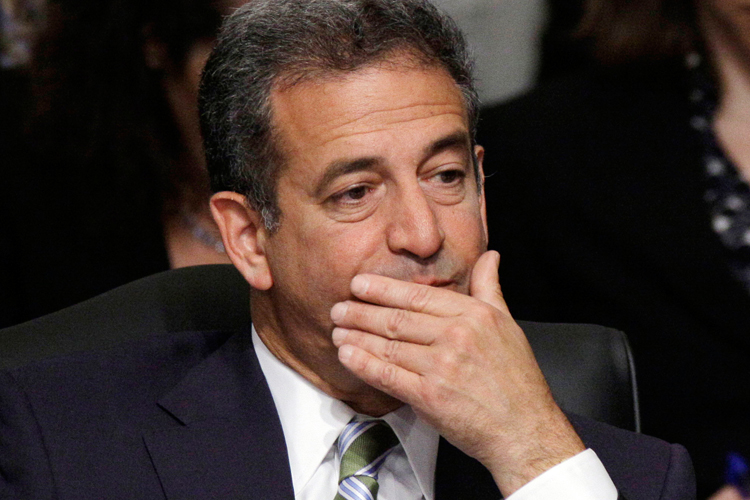

The New York Times has a lengthy story today about Russ Feingold’s unexpected reelection struggle in Wisconsin, but it’s not exactly news. Polls have shown the three-term senator under 50 percent and in a dogfight with his likely GOP foe, businessman Ron Johnson, for a while now.
Nor is it the first time Feingold has faced a difficult fall race. In his three successful Senate campaigns, his winning margins have been seven, two and 12 points and he’s never secured more than 56 percent of the vote. It’s tempting to think that this battle-tested past will help Feingold survive this year, but there’s a big — and potentially decisive — difference between his previous campaigns and this year’s: the national climate. Never before has he run with swing voters so predisposed to vote against the Democratic Party, and with such an apparent enthusiasm gap between the two parties’ bases.
Here, the story of Feingold’s 1998 reelection victory — a two-point squeaker — is instructive. On paper, Feingold probably should have lost the race: ’98 was the sixth year of Bill Clinton’s presidency, and since 1822 every president’s party had suffered losses — sometimes significant — in “six-year itch” elections. The GOP recruited an up-and-coming congressman, Mark Neumann, to challenge Feingold and the national party marked the seat as one of its top takeover opportunities. Then, as now, Feingold was attracting less than 50 percent in polling around Labor Day, and by late October, Neumann actually charged into the lead in several polls.
But something funny happened on Election Day: The Republican base did not turn out in big numbers while the Democratic base — particularly union voters — did. Plus, moderate swing voters, who would typically vote against the White House party in a six-year itch election, were unexpectedly friends to Democrats. This was partly due to a massive national turnout effort from the AFL-CIO, but the bigger reason was the GOP Congress’ drive to impeach Clinton over the Monica Lewinsky saga. The House hadn’t yet taken formal action against Clinton, but its leaders spent the campaign steadfastly moving toward impeachment — even as poll after poll warned them not to. In the November election, self-identified moderate voters opted for Democrats by a 54-43 percent margin — with 60 percent of all voters saying they were upset by the GOP Congress’ Clinton/Lewinsky posture.
This backlash, coupled with the AFL-CIO’s outreach and the failure of Neumann’s partial-birth abortion message to motivate cultural conservatives, was just enough to rescue Feingold. Nationally, Clinton became the first president since James Monroe to see his party win seats in his sixth year. 1998 stands as one of political history’s great exceptions: a midterm election in which the normal rules didn’t apply.
But they do apply this year — more so than usual. Unemployment and economic anxiety are high, and economic growth is stalling. And with Democrats controlling the White House and both houses of Congress, swing voters — who possess little collective memory or foresight — are strongly inclined to latch onto the GOP as a protest vehicle. Feingold, whose other Senate victories came in 1992 (when Bill Clinton defeated George H.W. Bush) and 2004 (a tight presidential election in which John Kerry narrowly carried Wisconsin), has never faced this kind of headwind. Just as a backlash against the GOP Congress bailed him out at the last minute in ’98, it’s not hard to see the anti-Democratic tide taking him down at the end of this race.
Sen. Russ Feingold (D-Wis) speaks at a campaign event with first lady Michelle Obama Wednesday, Oct. 13, 2010, in Milwaukee. (AP Photo/Morry Gash) (Credit: Morry Gash)
The question isn’t really if Scott Walker and his fellow Wisconsin Republicans will suffer fallout from their surprise maneuver Wednesday night. It’s how severe the fallout will be.
Walker and the state’s Republican senators, as you’ve surely heard by now, decoupled their proposal to strip public workers of their collective bargaining rights from a budget bill, allowing them to push it through the upper chamber with the entire Democratic caucus still holed up across state lines in Illinois. The GOP-controlled Assembly will presumably pass the bill today and Walker will then sign it.
Politically, this represents a wholly reckless move. Wisconsin’s state government has been paralyzed for weeks because of the collective bargaining impasse, and in that time public opinion swung sharply against Walker and his plan. All of the noise generated by the Democrats’ resistance seemed to have convinced a majority that Walker’s plan is out of the mainstream. That these same voters will now hear that Walker and the GOP resorted to an extraordinary measure to jam it through will only harden this assessment — and, potentially, make GOP legislators and the governor himself vulnerable to recall efforts.
The recall campaign will first target the handful of Republican senators who have already been in office for a year and are therefore eligible to be recalled. Petitions are already circulating in their districts. Walker himself is insulated through next January, when his first full year in office will be complete. Only then will his opponents be able to take out petitions to recall him. But that hasn’t stopped more than a few Democrats from promoting their dream recall candidate: Russ Feingold, the former three-term senator who was flushed from office in last fall’s anti-Democratic tide.
Feingold has played a visible role in the fight against Walker’s plan, and issued a statement after last night’s Senate vote that seemed to endorse the recall push. As I’ve written before, the breadth of Feingold’s popularity in his state was something national observers tended to overstate. He never broke 55 percent in any of his three winning campaigns. But when it comes to the Democratic base, his appeal is deep and abiding. And in the right climate — in other words, the current climate in Wisconsin — he’s certainly capable of winning a general election as the Democratic nominee.
He wouldn’t be the first defeated senator to stage a quick comeback as a gubernatorial candidate. Lincoln Chafee, ousted by Rhode Islanders in 2006, just won that state’s governorship as an independent last fall. Lowell Weicker, vanquished by Joe Lieberman in 1988, pulled off the same feat in Connecticut two years later. Feingold shares a quirky maverick streak with both of those men. It’s not that hard to see him following in their footsteps.
But will he get a chance next year? That’s harder to see, mainly because Wisconsin appears to have one of the more onerous recall procedures when it comes to governors: Petitioners would need to gather signatures equivalent to 25 percent of the total number of votes cast in the previous statewide election, and they’d have only 60 days to do it. By contrast, California (where Gov. Gray Davis was successfully recalled in 2003) requires signatures equivalent to only 12 percent of the votes cast in the previous election, with a 160-day window.
It also remains to be seen how long the anger will last in Wisconsin. I’m reminded of the example of Jim Florio, the New Jersey governor who set off an unprecedented tax revolt in the summer of 1990 and saw his approval rating slip to 15 percent in some surveys. It took a while, but eventually his numbers climbed back up to nearly 50 percent — high enough that he came within a fraction of a point of winning reelection in 1993 (and that it was considered an upset that he fell short). Walker’s numbers may nose-dive now, but let’s see where he’s sitting a year from now — and how big the issue still is to Wisconsin voters. The signature requirement seems very high.
Of course, even if talk of recalling Walker never amounts to much, there’ll still be 2014, when his term will expire anyway. Feingold would presumably be just as viable an option for Democrats then as he is now.
Wisconsin's Democratic candidate U.S. Senator Russ Feingold is shown before a senate debate against Republican challenger Ron Johnson held at Marquette University Law School, Friday, Oct. 22, 2010, in Milwaukee. (AP Photo/Jeffrey Phelps) (Credit: AP)
Two misconceptions probably explain why so many observers are surprised that Russ Feingold has fallen nearly 10 points behind Republican Ron Johnson in his bid for a fourth term in the U.S. Senate. The first is that Wisconsin is an unflinching progressive bastion; the other is that Feingold has been an unusually popular politician in his home state. It’s understandable how both of these views took hold.
Take Wisconsin’s ideological reputation. The Badger State is home to Madison, the Upper Midwest’s answer to Berkeley and Cambridge, and it’s produced several progressive icons, like “Fighting Bob” La Folette, who won nearly 20 percent of the popular vote on the Progressive ticket in the 1924 presidential election, and Gaylord Nelson, the father of Earth Day. Plus, it was one of the very few states to side with Michael Dukakis in the 1988 presidential race, when the Duke was swamped in a 40-state landslide — and one of only five to vote Democratic in each of the last six White House campaigns. Viewed against this backdrop, it’s inconceivable that Wisconsin would turn its back on Feingold.
But the reality of Wisconsin’s politics is more complicated. Outside of Madison, the state is also home to plenty of conservative areas — and to working- and middle-class swing voters who are willing to vote for Republicans under certain conditions. These are the voters who threw out Nelson and replaced him with Bob Kasten in 1980 — and who reelected Kasten in 1986 — and who elected Tommy Thompson to the governorship four times between 1986 and 1998. And while it’s true that Wisconsin sided with Dukakis 22 years ago, that result is best understood as a function of a depressed Upper Midwest economy that also delivered Minnesota and Iowa to the Massachusetts governor. It’s also easy to forget that George W. Bush came within about 5,000 votes of carrying the state in 2000, and about 10,000 in 2004.
In other words, Wisconsin is really a swing state that happens to have elected several liberal iconoclasts to office in its history — Feingold among them. In this sense, Feingold’s real problem is that he’s running for reelection in a horrible climate for Democrats, one in which all of the necessary conditions are in place for swing voters to side with the GOP. Had this race been taking place in 2008, when the environment was skewed in the Democrats’ favor (and when Barack Obama carried the state by 14 points), the Feingold-Johnson race would be a snore, with Feingold coasting to reelection. But in the climate of 2010, there really isn’t much that Feingold can do to overcome the burden of his party label.
Which brings us to the other misconception about this race: that Feingold, with his populism and numerous high-profile principled stands over the years, has created an unusually durable and popular brand with Wisconsin voters; that even voters who don’t agree with him ideologically have come to appreciate and value his willingness to speak his mind and vote his conscience. Some of this is related to the misconception that Wisconsin is an unusually liberal state, but it also ignores Feingold’s electoral history: In three victorious statewide campaigns, he’s never won with more than 55 percent of the vote. In fact, as I’ve written before, he probably should have lost after one term, when he stood for reelection in 1998. Had that been a more normal midterm (i.e., one in which the GOP Congress’ drive to impeach Bill Clinton seemed to cause a backlash that resulted in Democrats’ gaining seats — the first time that a president’s party had done so in his sixth year since James Monroe was in the White House), Feingold probably would have been edged out by Mark Neumann, the GOP congressman who led him in polls late into the race.
Feingold, in other words, has been a more polarizing politician than many realize — and in a state that is less liberal than many assume. The climates of the 1992, 1998 and 2004 elections helped him win (or simply weren’t bad enough to prevent him from winning), but 2010 is a totally different animal. It’s really no wonder that he’s fallen far behind — and if he somehow survives on Tuesday, it will be one of the biggest surprises of the season.
But maybe Feingold’s opponent Ron Johnson can try to use the old green-screen excuse for this clip, of him addressing the Wisconsin state legislature this last January. Johnson is there to discuss what he imagines will be the unintended consequences of the Wisconsin Child Victims Act — a bill that would extend the statute of limitations on civil suits for victims of child abuse.
(This is a base expression of the sort of libertarianism that reall appeals dumb rich folk — the prospect of some private concern getting wrongfully sued for abetting child molestation is so dire that we must not protect actual victim’s rights to seek redress for their abuse. Trial lawyers! Scary trial lawyers!!!!!)
After everyone who didn’t know already learned that Marty Peretz is a raging anti-Muslim bigot, donations to his undergraduate research endowment fund at Harvard “increased from $500,000 to $650,000.”
The bizarre, ginned-up controversy surrounding the Park51 project — a proposed Islamic community center, like the 92nd Street Y, including a space for worship, to be built at the site of an old Burlington Coat Factory (which is a store, not a factory) on Park Place in lower Manhattan, near, but not in sight of, the site of the World Trade Center — has exposed not just the blatant Islamophobia (and cheerful willingness to exploit bigotry) of many luminaries of the right, but also the cowardice of many supposed liberals. Just so we know where we stand, and using, as criteria for placement, my own inexact impressions of their public statements, I present the official War Room lists of “ground zero mosque” heroes, villains and cowards.
Heroes
It’s not a particularly hard case to make: The Constitution guarantees the right of the Cordoba Initiative to construct a house of worship on private land without any interference from the government, “Muslims” as a whole did not attack “us” on 9/11, Feisal Abdul Rauf is a well-respected, progressive imam with a history of performing outreach for the Bush administration, and even if the project was a “ground zero mosque,” celebrating its construction would demonstrate an admirable commitment to the founding ideals that we are supposedly fighting for Over There. At a time when Islamophobia appears to be on the rise, in part because xenophobia always tends to get louder during periods of economic uncertainty, liberals and progressives should be forcefully making the case for tolerance and liberty. But only a couple have bothered. Still, we should celebrate them!
Rep. Jerry Nadler, whose district actually includes ground zero, has been a loud and unflinching supporter of the project. He makes the case well, and without tossing in wishy-washy qualifications:
Mayor Michael Bloomberg’s speech in support of the Park51 project has been rightly celebrated as a courageous moral and intellectual defense of religious freedom.
Outside of New York, Sen. Russ Feingold accused mosque opponents of “gutter politics” and affirmed his support for “freedom of religion,” the simple answer that all Democratic politicians and candidates should give. Minnesota’s Al Frankenalso attacked opponents, and even cracked a joke.
I think the best response for a non-New York politician to give is probably Sherrod Brown’s.Brown said, first of all, that it’s a local, New York issue, which it is, and also said, “We’re not at war with a religion,” which is the sort of thing that needs to be said, constantly, by people with consciences, in order to rebut assholes like Gingrich.
Pennsylvania candidate Joe Sestak has been accused of “dodging” the question, but his answer seems straightforward to me: He believes it’s a New York issue and he supports the Constitution. (He has received the endorsement of Michael Bloomberg.)
Some perhaps surprising heroes include Grover Norquist, who makes the political case for supporting the project, and Ted Olson, a longtime Republican attorney whose wife died on 9/11. Olson forthrightly said, “We don’t want to turn an act of hate against us by extremists into an act of intolerance for people of religious faith.”
Cowards
The coward’s usual formulation of wishy-washy nonsupport is to proclaim that “they have a right to build it, but …” While I’d argue that even if you don’t feel like issuing a spirited defense of the specific project being debated, you can simply stop at “they have a right to build it” and retain some dignity, these politicians seem to think that they have to balance their respect for the Constitution with a healthy dose of skepticism about Muslims and acknowledged sympathy for hysterical opponents whipped up into a frenzy by lying propagandists.
Harry Reid decided to point out that while the First Amendment protects the rights of religious minorities to practice their religion, that doesn’t mean that they should practice it where it might upset someone.
Howard Dean, too, thinks that religious minorities should respect the wishes of majorities of Americans and not go around building houses of worship in places where Americans don’t want them. (Memo to Gov. Dean: One of the reasons so many Americans polled about the subject are opposed to it is because right-wing liars defined the entire debate from Day One. If you’d polled everyone in the nation back in, say, March, and asked, “Should there be an Islamic community center with a pool and an auditorium in lower Manhattan near City Hall and, yes, the WTC site?” I’m guessing it would’ve been a three-way split between support, oppose and don’t give a shit. And even if “oppose” had still won that theoretical poll, it still wouldn’t have been a good reason for the organizers to be more “sensitive” and find a new building.)
Some New York Democrats are just completely punting on the issue. Anthony Weiner refused to say anything about it for weeks, then issued a baffling letter that says nothing.Chuck Schumer, a man who stands no chance of losing reelection, and from whom a defense of religious liberties would’ve been celebrated and important, will only say he isn’t opposed to the project.
Villains
They are mostly the obvious ones: Sarah Palin, Newt Gingrich, Rudy Giuliani — all Republicans with a history of exploiting racial and ethnic tensions and resentments without regard for the consequences.
New York Democrats John Hall, Tim Bishop, Mike McMahon and Mike Arcuri all decided their best shot at reelection was joining the chorus against the project. Cowardice may have inspired them, but Arcuri’s move, in particular, seems more villainous.
The proposed $100 million Muslim center offered one such contrast. Greene echoed President Barack Obama’s recent defense of religious freedom but said, “When those families go to mourn their losses, they shouldn’t be looking at a mosque right there.”
(His opponent, Kendrick Meek, merely said he wouldn’t “step in front of a decision that’s already been made in New York City,” which is halfway between cowardly and acceptable.)
The Confused, and Confusing
I think New York politicians have a responsibility to defend the project itself, while I’ll let most non-New Yorkers off the hook for stopping at a defense of the principles involved (as long as they don’t add a Reid-ian “but …”) and an acknowledgment that it’s a “New York issue.” But what about New Jersey politicians?
Back in New York, Carolyn Maloney and her primary opponent, Reshma Saujani, both signaled their support for the project, but Saujani (a born panderer) supports it super hard, and claims Maloney only kinda supports it. I’m not convinced by Saujani’s argument, but you can read Maloney’s statement for yourself.
I might need to invent a separate “I think he actually means well but what the hell” category for Gov. David Paterson, who is, I think, trying very hard to be a peacemaker, as part of his “fuck it, I’m out of office soon anyway” tour ’10. But his claims that he will give state land to the developers (which would be constitutionally iffy) and his repeated insistence that he’s meeting with Cordoba Initiative representatives about moving the site (which they keep disputing) are just serving to support the idea that there’s some compelling reason why they should move.
Kristen Gillibrand’s support for the project seems halfhearted and overly cautious, but it’s there.
And, yes, then there’s the president. Had he stopped at his Friday night statement, a simple defense of religious liberty, I’d happily put him in the heroes category. But his Saturday non-clarification, stressing the fact that he doesn’t explicitly support the project, completely muddied the issue. Was it a walk-back? Sort of! But also not quite! His response is a Rorschach test, and interpretations of it necessarily depend on impressions of the president himself.
The heroes list is depressingly short, the cowards and villains lists populated with people I wish weren’t included, and while I understand that defending the project could be interpreted as “politicizing” the issue, I’m still depressed at how few “progressive” leaders are unable to mount simple, surprisingly necessary defenses of the fundamental rights of Americans to worship, or not, as they see fit.