
Breast cancer
Why I do not “(heart) boobies”
People are taking offense at an edgy breast cancer slogan -- but for all the wrong reasons
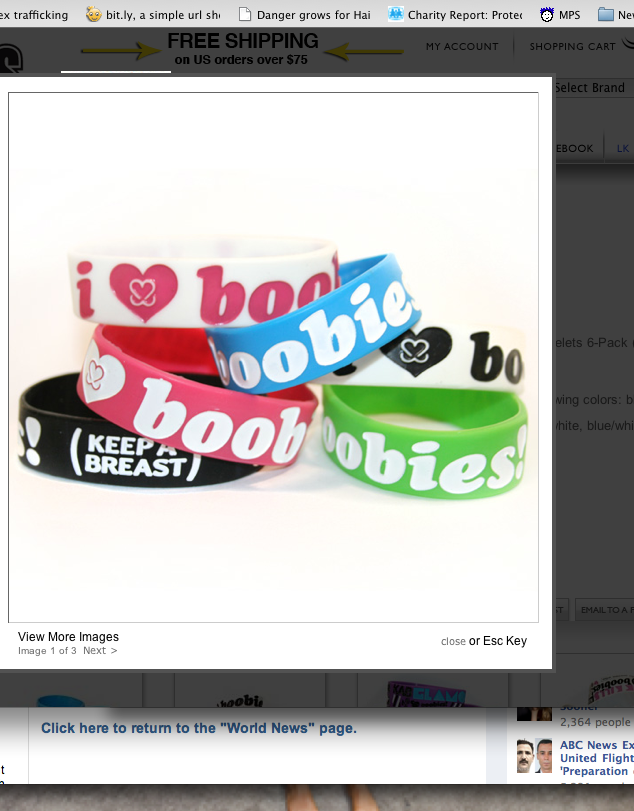
Schools across the country are banning rubber bracelets benefiting breast cancer activism — all because they read, ”I (heart) boobies.” Administrators and parents are reacting to “boobies” as though it were a corrupting four-letter word from which we must protect our nation’s youth. As though breasts themselves were obscene. As though they weren’t a normal object of teenage lust. As though the First Amendment didn’t exist.
But, you know what? I’m offended by the bracelets, too — just for a very different reason.
A growing number of activist campaigns are attempting to raise awareness (and perhaps other things) by simplifying the fight against breast cancer as a fight to save breasts. Not people, but breasts. Of course the implication is that lives will also be saved, but “boobies” are treated as the real star of this show. There was the infamous “Save the Boobs” ad, with a pair of bouncing bikini-clad breasts; the Men for Women Now campaign, which features famous(ly fratty) male celebs waxing poetic about breasts; the push for women to reveal the color of their bra in a Facebook status update; and the Booby Wall – just to name a few.
I’ve always found this approach to awareness-raising rather tasteless, but it wasn’t until my mom was diagnosed with metastasized stage IV lung cancer that they became truly enraging. Not only are women reduced to their breasts, but men are reduced to their love for breasts — as though they will only pay attention to the cause if presented with a pair of luscious, jiggling tits. Over the last few months, I’ve watched my dad give my mom shots twice a day, methodically dispense her meds, drive her to appointments, wash her hair, rub her feet, sit with her in the hospital for hours and hours and hours on end. He does it without complaint; there is simply nothing he would rather be doing, given the circumstances. It isn’t her lungs or her hair, now gone, that he loves — it’s her.
That isn’t to say that you don’t think about the diseased body parts: I stared at my mom’s bone scan until I had memorized the location of each of the glowing white spots scattered from femur to collar bone. When we got a digital copy of her CT-scan, I obsessively clicked through the cross-sectioned images of her body, examining her intestines, uterus, diaphragm, heart and lungs. She is so much more than the sum of her parts, though. When it’s an incurable case, when the prospects of survival are bleak, you aren’t thinking about how much you love “boobies,” or whatever the diseased body part may be, you’re thinking about how much you don’t want your loved one to die.
When death is truly knocking at your door — and I’m not talking about early, uncertain cases — most aren’t thinking about how much they love their breasts, they’re thinking about how much they love not being dead. They’re thinking: Chop those things off, now. Women subject themselves to the pain of chemo and elect to watch their hair fall out; they do this not to save their precious secondary sexual characteristics, but rather to live another day, because it’s worth it, breasts or no breasts.
Tracy Clark-Flory is a staff writer at Salon. Follow @tracyclarkflory on Twitter. More Tracy Clark-Flory.
The tyranny of pink
The author behind a new documentary tells Salon how breast cancer got cute and where Susan G. Komen lost its way
A still from "Pink Ribbons, Inc." Why wait for October for breast cancer awareness? There couldn’t be a more perfect moment for director Lea Pool’s new documentary “Pink Ribbons Inc.” — a searing, passionate and deeply human examination of the warping of a cause.
It’s been a shaky year for the pink. In January, the Susan G. Komen Foundation, the undisputed center of the breast cancer universe in its be-ribboned, Schiaparelli-hued incarnation, made the spectacular misstep of attempting to withdraw funding for breast cancer screenings at Planned Parenthood. Though the howls of public outrage forced the foundation to back off – and prompted the resignation of its vice president for public policy, Karen Handel — the debacle was just the latest and most grotesque move from an organization ostensibly devoted to women’s health. There was the ill-advised, high-profile partnership with Kentucky Fried Chicken, a name not exactly synonymous with good health. There was a saturation of merchandising, including a perfume of questionable toxicity. No wonder registrations for this year’s Race for the Cure are down, as Komen continues to be dogged by questions about its integrity.
Continue Reading Close
Mary Elizabeth Williams is a staff writer for Salon and the author of "Gimme Shelter: My Three Years Searching for the American Dream." Follow her on Twitter: @embeedub. More Mary Elizabeth Williams.
Komen scandal: Goodbye, Karen Handel
One week after the foundation's blunder, its scandal-plagued V.P. steps down
Karen Handel (Credit: AP/John Bazemore) It was perhaps inevitable. But it speaks volumes nonetheless. On Tuesday morning, the Susan G. Komen Foundation announced that its vice president for public policy, Karen Handel, was resigning.
It was the latest very public – and very bitter – turn in a story that has thrown the traditionally esteemed Komen foundation for one hell of a loop. Just one week ago, Planned Parenthood announced that Komen was halting its funding for the organization’s breast cancer screenings. The move, the Komen foundation insisted, was about “the charity’s newly adopted criteria barring grants to organizations that are under investigation by local, state or federal authorities” – itself a dubious smear on a respected women’s health organization. But it didn’t take long for critics to note that Handel, who was hired just last year, had run for governor of Georgia on a platform of conspicuously anti-Planned Parenthood rhetoric. In 2010, she declared “I do not support the mission of Planned Parenthood,” and that she “strongly supports” laws prohibiting “the use of taxpayer funds for abortions or abortion-related services.” A lady like that in the driver’s seat of your organization just as you’re distancing yourself from Planned Parenthood looks like a whole more than a coincidence.
Continue Reading Close
Mary Elizabeth Williams is a staff writer for Salon and the author of "Gimme Shelter: My Three Years Searching for the American Dream." Follow her on Twitter: @embeedub. More Mary Elizabeth Williams.
Susan G. Komen’s priceless gift
A radical decision woke the country up to an alarming rightward drift, and gave new life to women’s health advocacy
Members of Planned Parenthood, NARAL Pro-Choice America and more than 20 other organizations hold a "Stand Up for Women's Health" rally in Washington (Credit: Joshua Roberts / Reuters) The startling intensity that we saw this week in response to Susan G. Komen for the Cure’s decision to pull its grants from Planned Parenthood — an intensity that prompted the Komen foundation to reverse its decision today — may be the best thing that’s happened to the conversation about reproductive rights in this country for decades. It certainly should be.
Practically since Roe v. Wade was decided in 1973, reproductive rights activists have been left to play stilted defense against ideological opponents who grabbed the language of morality, life, love and family as their own, always deploying it with reference to the fetus. The rhetoric around reproductive rights, which has more recently begun to creep into arguments over contraception, has become suffocating in its emotional self-righteousness, but too muscular, too ubiquitous to effectively combat.
Continue Reading CloseRebecca Traister writes for Salon. She is the author of "Big Girls Don't Cry: The Election that Changed Everything for American Women" (Free Press). Follow @rtraister on Twitter. More Rebecca Traister.
Joan Walsh is Salon's editor at large. More Joan Walsh.
Komen victim of “bullying,” sad abortion foe says
Someone make an "It Gets Better" video for poor Kathryn Jean Lopez of the National Review
A very serious anti-bullying message from Kathryn Jean Lopez Poor Kathryn Jean Lopez, the National Review Online’s resident delicate flower, anti-feminist traditional Catholic, and enemy of all homosexualists and abortionists. She was so delighted when Susan G. Komen for the Cure announced that it would no longer be sending grant money to Planned Parenthood to fund breast cancer screenings and mammogram referrals, because it meant that her side had “won” a battle in the war against women’s health providers that perform abortions and provide contraception.
Continue Reading Close
Alex Pareene writes about politics for Salon and is the author of "The Rude Guide to Mitt." Email him at apareene@salon.com and follow him on Twitter @pareene More Alex Pareene.
How the Internet changed Komen’s mind
The torrent of reactions to the cancer group's Planned Parenthood defunding proves the power of social media VIDEO
Nancy Brinker, founding chair of Susan G. Komen for the Cure (Credit: AP/Salon) It started with a tweet. And in the end, that’s what won the war. On Tuesday, Planned Parenthood sent out a no-punches-pulling alert that “Susan G. Komen caves under anti-choice pressure, ends funding for breast cancer screenings at PP health centers.” By Friday, Komen for the Cure had said it was sorry, and reversed its decision.
Continue Reading Close
Mary Elizabeth Williams is a staff writer for Salon and the author of "Gimme Shelter: My Three Years Searching for the American Dream." Follow her on Twitter: @embeedub. More Mary Elizabeth Williams.
Page 1 of 14 in Breast cancer
