
Cocktails and Spirits

The explosive power of the tiki punch

An afternoon with retro drinks features 40-gallon bowls, grownups acting like kids, and lots and lots of fire

  • more
    • All Share Services

Topics: ,

The explosive power of the tiki punch

Whatever you do, do it with all your might. ~ PT Barnum (1880), The Art of Money Getting

PT Barnum, Robert Tilton, Huey Long — showmen all, masters of swaying their audiences. To their ranks, consider adding San Francisco barman Martin Cate.

At the recent Tiki Oasis in San Diego, Cate presented The Persuasive Power of Punch, a thumbnail history of the origins of alcoholic punch. What’s he know about punch? Plenty. As owner of the San Francisco rum bar Smuggler’s Cove, Cate presides over a drinks menu that spans centuries, going back far earlier than the mid-century tiki drinks for which he is widely known. But from Planters’ Punch to the Zombie, tiki has its share of potent multi-ingredient drinks that fall squarely in the punch tradition.

The room itself in the Crowne Plaza Hotel was divided into five main sections, all arranged in a rough circle around a tarp-covered central table. Now, tiki crowds skew slightly older, whiter, straighter and more coupled than I’m used to in drinkin’ buddies, but a more friendly crowd you couldn’t ask for. The room quickly filled with Hawaiian shirts, tropical dresses and a handful of fezzes. There were vintage cat’s eye glasses, beehive hair, coconut purses and pineapple bracelets. And the attendees were positively gleeful.

The crowd filed in, grabbed cups of welcoming punch, and started heading for spots at the surrounding tables, each of which was outfitted with a small cup covered in plastic wrap. Each section’s cups contained different liquids. As I tried to make out what they were, a volunteer pointed me to a seat. “If you sit where I tell you,” she sighed, “this would all go a lot faster.”

So I did. And Martin launched into his history of punch — its origins in India and introduction to Europe through the British East India Company. He discussed how the very name punch is said to derive from the Hindustani word panch, meaning “five” (for the five ingredients common in 17th century punches), its place in pre-industrial England and America, and how its popularity declined over the years.

But those cat’s eye glasses, those fezzes and those clusters of beehives kept turning back to the tarp in the center of the room. Fingers stealthily moved toward the cups, worrying loose edges of plastic wrap. Noses went into the cups as the audience tried to suss out their contents. Mine was clearly strong black tea. Cate, seemingly oblivious, began using a punch ladle as a pointer for his slides. It only made the audience more antsy.

He shared some tips for finding recipes and serving punches out of various vessels from bowls to coolers. “So … anyway,” he wrapped up, “that’s it. Thanks for coming. I hope you guys had a good time.” Scattered light applause began to ripple through the audience while shouts of “No, no!” arose in other parts. “What?” he asked. “Did I forget something?” After more teasing, he acknowledged there might be one more thing to do.

“I am here …” Hands begin drumming the tables.

“To present to you … ” The drumming gets faster, harder, while yelps and cheers leap forth.

“The single most powerful weapon ever crafted …” The cheers get even louder.

“Behold!” The tarp is drawn back in one dramatic reveal.

“The world’s. Most. Powerful. Volcano bowl!” The crowd goes absolutely apeshit.

There, on the table, is an enormous volcano bowl fashioned from a Home Depot koi pond. Men and women — with, one presumes, respectable day jobs — are on their feet, snapping pictures, recording video, looks of delirious joy on their faces. Is this a talk about punches or a dustbowl tent revival? The glory and the power of rum has struck these poor souls, and I’ll be damned if some of them aren’t speaking in tongues. Hawaiian, if I’m not mistaken.

Cate asks each section to come forth and contribute its ingredient from the plastic cups. In goes cup after cup of fresh lime juice. “Come up here and feed it. Feeeeed it.” The bowl’s capacity is said to be 40 gallons. The sweetness of a rich Demerara sugar goes in. “Yes, yes, give it more … Excellent.” Vanilla and cinnamon Trader Tiki syrups. After that, tea, tea and more tea. The crowd chants “Rum! Rum! Rum! Rum!” They get their wish: In goes a healthy dose of two rums. Our MC uses first a giant whisk, then an electric immersion blender to mix the ingredients. Red lights come on at the bottom of the bowl and the bubbler kicks in.

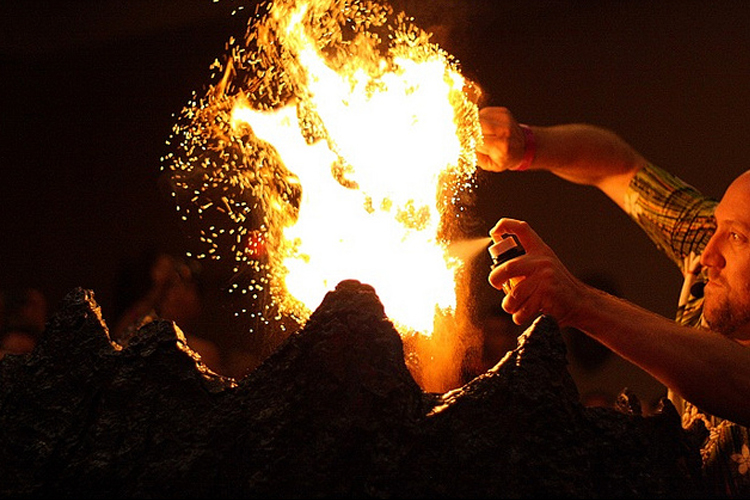
“This needs something,” Cate notes. “Maybe it’s fire.”

And with that, this modern-day Barnum blew the roof off Tiki Oasis. Well, not literally. But the fire marshal might’ve gotten a little freaked as the audience screamed its approval. A large crouton, soaked in 160-proof lemon extract is set in place above the bubbling liquid, lit, and then blown into a huge fireball.

Audience pandemonium.

Almost in a frenzy, Cate passes around long straws, tells the crowd to put two together to make even longer straws. Some clatter to the floor in a maelstrom of tiki madness. From each section, a contingent springs forth to sample with double-long long straws. My photographer — it’s his first Tiki Oasis — looks at me in amazement. “These are grown-ass adults,” he marvels “acting like they’re 21 years old.”

And that’s maybe part of the magic of Tiki Oasis and tiki crowds in general. Grown-ass adults sometimes need to act like kids. If that entails drinking and setting things on fire, then so be it. I had a blast (a contained one) and will be back next year.

Tiki Oasis 10th Anniversary Punch

Makes one serving

Ingredients

  • 1 ounce Rhum JM VSOP
  • 1 ounce Zaya rum
  • 1 ounce strong Darjeeling tea
  • 1 ounce fresh lime juice
  • .25 ounce Demerara simple syrup (optional / to taste)
  • .5 ounce Trader Tiki Cinnamon Syrup (see below)
  • .5 ounce Trader Tiki Vanilla Syrup (see below)

Directions

  1. For a single serving, mix together with ice. For a crowd, just multiply each ingredient, ice it and serve it forth.

Goes well with:

• A big block of ice. Note that punch gets less watered down if all the mixed ingredients are chilled and served on a single block of ice.

• Trader Tiki syrups are fantastic vehicles for adding exotic spices and flavorings to tropical cocktails. Check them out here.

Smuggler’s Cove, Martin Cate’s bar in San Francisco.

Tiki Oasis, the annual San Diego tiki gathering. I’m already planning to hit up Tiki Oasis next year. If you go, get tickets early: they sell out fast


Matthew Rowley is the author of Moonshine!. He lives in Southern California and runs Rowley’s Whiskey Forge.

Continue Reading Close

What you didn’t know about tequila

We plumb the colorful history of Cinco de Mayo's favorite drink, from Aztec tradition to spring break shot

  • more
    • All Share Services

Topics: , , ,

What you didn't know about tequila

The best tequila I ever drank came to me in a plastic jug. I was young, 20 maybe, with a decidedly unrefined palate. I certainly didn’t think twice about drinking from the unmarked plastic jug that our friend Danny proffered to me. Hey, it was alcohol, right? But even with my unrefined tastes, the second that tequila touched my lips I understood it was something special. It was so smooth, limes would have been an insult.

Danny was just down from the mountains of Jalisco. The jug came straight from a little distillery in the town of Tequila, Jalisco, which sits on a hill above rolling fields of agave — the domain of the ancient Cuervo and Sauza families, and home to hundreds of better distilleries. As Cinco de Mayo draws near, our thoughts drift to this tequila Valhalla and it seems an appropriate time to spill some ink on the drink beloved to sophisticates and sorority girls alike. 

Tequila and her living ancestor mezcal are made from the hearts of the agave plant. If you drive through the Tequila region, row upon row of agaves flash by, like giant half-buried pineapples or colonies of sea anemones. Despite its sharp thorns and blue-green hue, the agave is closer in kin to the lily than the cactus. One hundred and six varieties of agave, or maguey, grow in Mexico, and the Mexican devotion to the plant is rooted in ancient history. The Olmecs referred to fermented agave as “a delight for the gods and priests,” and the Aztecs worshiped Mayahuel, goddess of maguey, who was followed everywhere by a cohort of 400 drunken rabbits. Her husband Patecatl was the god of pulque, a slimy yet highly nutritious drink with the alcohol content of a domestic American beer.

Essentially, the story of how tequila came to be is the story of how Mexico came to be. An Indio idea married to Spanish ambition, influenced by the East, popular in the West. It’s a story of highs and lows that shift depending on your perspective: Aztecs fermenting ague miel scooped from the hearts of agave, Don Cenobio Sauza defending his agave plantation against bandit attack, Frida Kahlo with her perfume bottle flask, Cuervo and Sauza bought out by international corporations, Señor Frog’s on a spring break Saturday night.

The Spanish initially built primitive mud stills to make agave wine, but if you nose around into the history of Tequila, you discover that distilled agave nectar didn’t really catch on until after 1565, when the Spanish government opened a trade route between Manila and Mexico. Spain’s real goal was to transport goods from its nascent colony in the Philippines back to the crown, and to that end Spanish officials devised a laborious route: ship from Manila to Acapulco, unload, cross Mexico by pack mule and ship out again at Veracruz to sail for Spain. Easier said than done. The route meant carving a mule trail through the jagged sierra (this became the famous Camino Real), as well as building immense galleons. (Incidentally, the galleons were built in Barra de Navidad, not far from where I drank the exemplary plastic jug of tequila.) When the flagship finally set sail from Barra de Navidad, this “China galleon” was the largest seafaring vessel of its time in the world. Their mission was perilous: carry a load of Mexican silver to the Philippines, trade the silver for luxury items from China, and then embark on the horrendous (three-month) return route to Mexico. Naturally, pirates took notice; over the years, the fleet drew fire from English and Dutch privateers, including Sir Frances Drake.

When China galleons docked at Acapulco, crews of Filipino sailors unloaded porcelain, silk, ivory, spices and lacquerware. The potters of the Mexican city of Puebla would take inspiration from the blue-and-white beauty of Chinese porcelain, Mexican jewelers would work the patterns in Chinese silk into their fine gold and silver filigree, and the Filipino sailors would change the culture of Mexico forever by bringing mangos, coconuts and portable stills.

The Filipino sailors who jumped ship to settle on the coast of Mexico hobnobbed with the common folk, sharing their delicious coconut brandy and its source — nifty portable stills. News traveled fast — all the way to the mountains of Nayarit, where it seems the Huichol Indians copied Filipino technology. They weren’t the only ones. Short on coconuts, inland Mexicans got creative with ingredients at hand. Agave, that mainstay of Mexican culture, was an obvious choice. With its smoky potency and lyrical burn, distilled agave wine was a hit. Within years, mezcal production boomed in the prime agave growing region in the mountains of Jalisco, and tavernas (taverns) sprang up to sell cuernitos (horns) of mezcal to the masses. In 1600, the Marquis of Altamira built the first big distillery near the town of Tequila in New Galicia (later Jalisco).

The 18th century saw the rise of Tequila’s Cuervo clan. The family started with a small taverna, but by 1880 residents of nearby Guadalajara were downing 10,000 barrels of Cuervo tequila a year. In 1891, the portly Francophile dictator Porfirio Diaz displayed his questionable taste by awarding Cuervo a gold medal for the excellence of its tequila. (Though to Diaz’s credit, this was a long time ago. It’s possible that Jose Cuervo was actually good back then.)

During the first 200 years of our story, the line between mezcal and tequila was blurry. In the beginning, the name tequila mezcal was applied to mezcal grown in the Tequila region, but as time passed tequila became a beverage unto itself, distinguished by location (Jalisco and a few surrounding regions), production (notably, the steaming of the agave hearts) and choice of plant (blue).

Which brings me to Don Cenobio Sauza, who is notable for two accomplishments: He personally defended his agave plantation against a hoard of bandits, and he singled out the blue agave as the variety of agave most suited for tequila production. Though the Mexican government wouldn’t officially define acceptable tequila ingredients until much later on, distillers in the Tequila region followed Sauza’s lead. And as the drink became more refined, its popularity grew. By 1906 8 million gallons of tequila were produced a year in Jalisco, at least according to official figures.

In Mexico, every war has spurred tequila production. Tequila sales rose during the War of Independence from Spain (1810-1821) and undoubtedly cuernitos of tequila were tossed back on May 5, 1862, when Mexicans celebrated the country’s first major victory against Napoleon’s occupying troops. Mexicans really began identifying with tequila during and after the 1910 revolution, which saw the overthrow of Porfirio Diaz and a subsequent surge in national pride. Not only did Mexicans drink more tequila during and after the revolution, but the romantic tales of hard-partying revolutionaries that drifted across the border enhanced the drink’s romantic mystique in the United States. (Ironically, Pancho Villa, a man closely associated with tequila in the popular imagination, disapproved of drinking.)

Although Americans had got their first good dose of tequila during the Mexican-American war (in response, we thoughtfully stole half of Mexico), the beverage really achieved notoriety during Prohibition. The stream of smugglers carrying the precious cargo from Mexico to Texas was so formidable that U.S. troops patrolled the border, seizing wagons of tequila and her cousin sotol. But for every big-time operation, there were a hundred small-time equivalents. For example, in 1920, the El Paso Herald (leeringly) reported :

Maria Munoz, a young and rather pretty Mexican girl was arrested by federal officers Saturday, charged with smuggling liquor which had been concealed in her stocking. The liquor, a quart bottle of tequila, it is alleged was placed in the stocking, which was pinned to her waist and allowed to swing down into spacious bloomers.

Meanwhile, Mexicans drank their way through America’s dry years. Not everyone was happy about the state of affairs. As revolutionary governor of the state of Sonora, Elias Calles made drinking a capital offense. Gov. Calles actually went so far as to order the execution of at least one village drunk, but he was widely ignored by the citizenry. In 1919, the Evening Herald, a newspaper in dry Klamath Falls, Ore., wistfully reported that liquor in Sonora had never been cheaper or more plentiful. Even during the state-mandated destruction of 600 bottles of tequila, which took place in front of the governor’s mansion, locals brought mugs to the ceremony and scooped enough tequila out of the gutters to get “riotously drunk.”

Sometime in the mid-20th century, the margarita was invented, and the Cuervo and Sauza families laughed all the way to the bank. A number of legends exist surrounding the drink, all of them reasonably plausible. One of the more widely spread stories is that Dallas socialite Margarita Sames invented the drink for jet-setting friends at her Acapulco vacation home on Christmas of 1948. But in “The Complete Book of Spirits,” Anthony Dias Blue points out that a 1945 Jose Cuervo ad ran under the tag line: “Margarita: It’s more than just a girl’s name.” I like this tag line. It eliminates a number of contenders from the margarita melee while making an important point. Over the years, the Mexican government has become increasingly protective of the tequila name. In 1974, the Mexican government declared the word “tequila” the intellectual property of Mexico, a move that makes it illegal for other countries to produce or sell anything labeled tequila. In addition to being made in Mexico, tequila must be aged in Mexico. Regulations for categorizing tequila (as silver, reposed, or añejo) are equally stringent. These days the country even has a private sector nonprofit organization called the Consejo Regulador de Tequila, which oversees all aspects of the industry, including monitoring agave growth, protecting peasant laborers, and fostering ancient tequila traditions.

Speaking of tequila traditions, if I can’t have mine from a plastic jug, I fall back on a recipe my friend Annie and I contrived while camped on a Jalisco beach years ago. Under the eaves of our palapa hut, we hit upon the perfect pastime to validate our absolute state of degenerate sloth: We’d write a book of drink recipes. After all, we had plenty of liquor and limes on hand. There was only one glitch. The only measuring device in camp was a half-cup. All the drinks we mixed that winter contained at least 4 ounces of liquor and our margaritas were no exception. Salud!

Note: I like to mix margaritas with a reposado (slightly aged) tequila because a tinge of smoke makes the drink more interesting. I realize the traditional margarita calls for triple sec, but I prefer this stripped-down version.

Margarita Tenacatita (Serves 2)

Ingredients

  • 8 ounces tequila (for a margarita, I recommend Cazadores reposado or Herradura)
  • 3 ounces fresh lime juice (key limes are best)
  • 3 teaspoons of cane sugar
  • Rock salt on a plate
  • Ice

Directions

  1. Before you start squeezing limes, put tequila and sugar in a glass and stir vigorously.
  2. Rub a lime over the rim of your glasses. Salt rims.
  3. Add ice to glasses.
  4. Pour margarita over ice and serve.


Continue Reading Close

Felisa Rogers studied history and nonfiction writing at the Evergreen State College and went on to teach writing to kids for five years. She lives in Oregon’s coast range, where she works as a freelance writer and editor.

How to make the perfect recession martini

It may not sound like a budget drink, but in this economy, we all need a way to unwind

  • more
    • All Share Services

Topics: , , ,

How to make the perfect recession martini

The martini has no legitimate place in a series about budget living, but after a winter of huddling by a smoldering fire eating legumes and one-pot meals, I feel in the mood for something decadent. And a stiff drink. And I’ve never been above scavenging in other people’s liquor cabinets.

I’m visiting my former urban home (Seattle) for a brief vacation from the wilds of rural Oregon, so it seems appropriate to celebrate my wayward past and my hillbilly future with a drink that incorporates elements of both — fine gin with a foraged garnish.

The liquor cabinet I’ll be scavenging belongs to Chef Robin Leventhal, best known from her appearance on season six of “Top Chef.” I know from past experience that, like the rest of her artistically cluttered house, it brims with interesting items. Today is no exception.

“Smell this,” Robin commands, handing me an attractive bottle of Ebb and Flow gin. Ebb and Flow is from a new Ballard distillery, Sound Spirits. Thanks to a recent change in Washington’s liquor laws, Sound Spirits is the first distillery to open in Seattle since prohibition, and it smells like they might be on to something. The gin’s aroma has a tinge of coriander and an echo of absinthe. Robin thinks it’ll be the perfect complement to her latest prize — pickled ramps and wild fiddleheads from nearby Enumclaw.

“I’m thinking martini with ramp brine in place of vermouth,” she says. “What do you think?” I think yes.

Robin is an old hand at foraging. “Eating outdoors has always been a natural thing for me. I was a fly fisherwoman for years. I think growing up in the mountains influenced me. When I was 8 years old, I knew every wildflower that existed in Idaho and Colorado, including wild onions.” She hands me a pristine glass jar of pickled ramps.

“I’ve never had ramps before,” I say, removing the glass lid and fishing a green and white stem from the clear brine. Because ramps look like scallions, the flavor is a surprise. Chill and pleasingly crisp, the ramp bursts with garlicky sweetness.

“When I was in Vermont teaching at New England Culinary Institute, we took our students out foraging for ramps. That was the first time I ever had one,” Robin explains as she pours Ebb and Flow gin into a martini shaker. “I like them grilled. Throw them in boiling water until the leaves turn bright green. I put the white bulbs in first for 30 seconds, let the greens go in for 10, and then dunk them in ice water. Throw them on a hot grill with a little oil and salt, and they’re so delicious!” Robin says with genuine enthusiasm.

Fans of “Top Chef” may remember that Robin talks as fast as she moves — she’s got a riff for every topic. “Part of the fun of scavenging or foraging is taking people with you so it’s a group activity,” she says, straining the gin. “Then you come back together and fix a meal. It’s about community. It’s good exercise. For us city folk, it’s a real nice treat to break from our concrete world and get our shoes dirty.”

What fans of “Top Chef” may not anticipate, however, is Robin’s warmth and bounce — the show’s producers cast her as her something of a virago, but nothing of that comes across in person. She’s intense, yes. But it’s the enthusiastic intensity of a culinary aficionado who doesn’t let her expertise impede her curiosity. Also, she’s the least condescending chef I’ve ever met.

“What do you think? One teaspoon of brine or two?” she asks.

“One, for starters?” I venture, mentally preparing to sample Robin’s pickled fiddleheads, which are coiled like tiny green vipers in a glass specimen jar. After my last experience with ferns, I am prepared for bitter. Instead, Robin’s fiddleheads are sweet and salty, with a woodsy undertone. When I look closely, I notice the scrolls are entirely devoid of brown chaff, which gives credence to the reader who pointed out that my own problem with fiddleheads was probably due to my sloppy cleaning job. I eat another one.

It should come as no surprise that the ramps and fiddleheads are delectable; Robin has been on a pickling kick lately as she prepares the menu and inventory for Stopsky’s on Mercer Island, where she is head chef. The restaurant is due to open in May and is billed as Jewish with a northwest twist, which sounds perfect for Robin.

“I’ve been perfecting my pickled red cabbage and my sauerkraut,” she says, adding sternly, “which are two different things, you know.” Then in true form, she waxes enthusiastic on the subject: “I love pickling, or capturing the essence of a vegetable in its prime. Come the middle of winter and you’re craving a bite of spring, you can open up a jar of pickled ramps and fiddleheads and it brings spring right back.”

The ramps and fiddleheads in question find a nice home in silver-rimmed martini glasses full of chilled gin. We make one martini with Bombay Sapphire and one with Ebb and Flow. At first the gin overpowers in both drinks, so Robin adds an extra teaspoon of ramp brine and voila! The finished Sapphire martini is mellower and sweeter than the Ebb and Flow martini, which has an intense herbal bouquet that compliments its foraged ingredients. The Sapphire martini has its allure, but both of our blind-taste volunteers (whom we rope in from the neighboring house) prefer the Ebb and Flow version.

“So, are we done here?” Robin asks.

“Well, you said something about dried rose hips, and I did bring these licorice ferns from home,” I say, waving a moist Ziploc bag full of ferns. (I know there’s nothing about the phrase “moist Ziploc bag full of ferns” that sounds alluring to your average person, but to any longtime forager, it’s a different story.) Why am I tempting Robin into another drink-mixing session when I’ve already gleaned three recipes? It’s not just that I want another delicious free cocktail — really.


Robin’s Pickled Fiddleheads

Ingredients

Best served on salads, with fish or, as we prefer, in a martini!

  • 1/2 cup distilled vinegar
  • 1 cup water
  • 1/3 cup sugar
  • 1 tablespoon shallot, slivered
  • 2 teaspoons kosher salt
  • 1 qt. fiddlehead ferns

Directions

  1. Rinse fiddleheads and trim any brown on the stem.
  2. In a medium pot, add all the ingredients except for the fiddleheads and bring to a boil.
  3. Add fiddleheads and boil gently for two minutes.
  4. Strain from liquid and cool immediately. Save brine. Once cooled, pack fiddleheads in two pint jars, pour cooled brine into jars, and refrigerate.
  5. If you want to process in canner, pour hot brine over fiddleheads and omit step 3.

Robin’s Pickled Ramps

Ingredients

  • ¼ cup distilled vinegar
  • ¼ cup red wine vinegar
  • 1 cup water
  • 1/3 cup sugar
  • 1 teaspoon kosher salt
  • 1 qt. ramps (cleaned)

Directions

  1. Bring all ingredients to a boil except the ramps.
  2. Holding the greens above the boiling water, blanch bulbs 30 seconds.
  3. Drop entire ramps into boiling water for a 10 seconds.
  4. Remove from hot brine and cool in freezer.
  5. Pack ramp bulbs and greens into a pint jar and add cooled brine. Keeps in fridge one year, but they will never last that long!
  6. Variation: Add chilies and garlic for a great bloody Mary garnish

Wild Dirty Martini

Ingredients

  • 3 oz of gin shaken with ice
  • 1 pickled fiddlehead
  • 1 pickled ramp
  • 2 teaspoons of ramp brine

Directions

  1. In a martini shaker, shake gin with ice.
  2. Strain into chilled martini glass.
  3. Add ramp brine.
  4. Garnish with pickled ramp and fiddlehead.
Continue Reading Close

Felisa Rogers studied history and nonfiction writing at the Evergreen State College and went on to teach writing to kids for five years. She lives in Oregon’s coast range, where she works as a freelance writer and editor.

In future, cars might decide if driver is drunk

The Department of Transportation checked out a demonstration of technology that would prevent drunk driving

  • more
    • All Share Services

Topics: ,

In future, cars might decide if driver is drunk

An alcohol-detection prototype that uses automatic sensors to gauge a driver’s fitness to be on the road has been demonstrated for federal transportation officials at a Massachusetts lab.

U.S. Transportation Secretary Ray LaHood and the head of the National Highway Traffic Safety Administration were in Waltham on Friday to see the devices, designed to detect instantly if a driver is drunk and prevent a vehicle from starting.

A woman demonstrating the prototype drank two cocktails over 30 minutes, then showed how breath and touch sensors detected her blood-alcohol level.

Developers say the technology would be less intrusive than current alcohol ignition interlock systems that force drivers to blow into a breath-testing device.

Officials say the prototype is at least eight years from commercial use.

Critics question the cost and reliability.

Four Loko, drugs found with bodies of 2 teens

Two California teens were found dead along with empty cans of the infamous alcoholic energy drink last Friday

  • more
    • All Share Services

Topics: , ,

Four Loko, drugs found with bodies of 2 teensFILE - In this Nov. 10, 2010 file photo, Four Loko alcoholic energy drinks are seen in the cooler of a convenience store, in Seattle. Truckloads of Four Loko and other alcohol-laced energy drinks are being recycled into ethanol and other products after federal authorities said the beverages were dangerous and led to a "wide-awake drunk." Wholesalers from several East Coast states started sending cases of high-alcohol, caffeinated malt beverages to MXI Environmental Services in Virginia after the U.S. Food and Drug Administration announced a crackdown on the sale of such beverages in November. (AP Photo/Elaine Thompson, File)(Credit: AP)

Police in this California surf city are looking for anyone who saw two teens before they were found dead in an apartment with an empty can of an alcoholic energy drink and traces of drug and alcohol use.

“We’re trying to determine if there was anyone with them that evening, how they obtained the alcohol and what kind of drugs they might have used,” Lt. Russell Reinhart said Monday.

The bodies of Aaron Saenz, 15, of Westminster, and Chelsea Taylor, 16, of Huntington Beach, were found Friday morning along with an empty Four Loko can and physical evidence of drug and alcohol use in the apartment, which was supposed to be empty.

When it was first sold, Four Loko contained both alcohol and caffeine, but its maker announced in November that it would remove the caffeine from its formulas. It was not known if the empty can found in the apartment contained caffeine.

The sale of Four Loko has been banned by at least 13 states through their alcohol control boards, according to the National Conference of State Legislatures. Last year, the Food and Drug Administration warned four companies that make caffeine and alcohol drinks that their products are unsafe.

The managers of the large apartment complex spotted two people in the apartment and called police, who found the bodies, Reinhart said.

“There was no indication of trauma, no weapon involved. So we believe these deaths were accidental or an overdose,” Reinhart said. Autopsies were conducted on the teens Monday but the cause of their deaths remained under investigation.

Reinhart said it would take a couple of months until the toxicology tests confirm exactly how the two teens died.

He did not specify the drug evidence found because it could interfere with the investigation.

He said the boys’ families did not want to speak publicly.

“It’s obviously tragic,” he said.

Continue Reading Close

12-Second Cocktails: The Noce Royale

The Noce Royale Cocktail is an icy winter beverage topped off with champagne

  • more
    • All Share Services

Topics: ,

12-Second Cocktails: The Noce RoyaleThe Noce Royale

Watch the video

See more video

Ingredients

The Noce Royale

  • 1/4 oz Nocino della Cristina Walnut Liqueur
  • 1/2 oz Plymouth Sloe Gin
  • 1.5 oz Beefeater Gin

Directions

  1. Stir over ice, strain into a chilled cocktail glass
  2. Top with Moet Imperial Champagne.

Page 1 of 8 in Cocktails and Spirits