Literary Prizes

Why the Booker is the best literary award

Britain's book prize rewards Howard Jacobson's "The Finkler Question" and could teach its American cousins a lesson

  • more
    • All Share Services

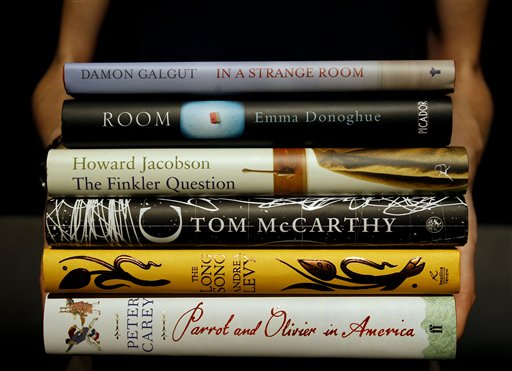
Why the Booker is the best literary awardThe six books shortlisted for the 2010 Man Booker Prize are held at a photocall on the stage of the Royal Festival Hal in London, Sunday, Oct. 10, 2010. The winner will be announced on Tuesday, Oct. 12 at a dinner at London's Guildhall. (AP Photo/Kirsty Wigglesworth)(Credit: AP)

By the time Howard Jacobson’s “The Finkler Question” won the Man Booker Prize in London last night, the bookmakers who famously place odds on the outcome had closed down betting on the favorite, Tom McCarthy’s “C,” due to a “suspicious” last-minute rush.

That’s the Booker in a nutshell, a British prize that generates tabloidish buzz in the U.K. (they even broadcast the ceremony on TV) and commands a surprising amount of sales clout on this side of the pond. “C” has divided critics and readers; McCarthy is a one-man campaign for the revival of the nouveau roman, the strain of European experimental fiction pioneered by such writers as Jean-Paul Sartre and Alain Robbe-Grillet. People either love that idea, or really, really hate it, and despite all those dicey-looking, 11th-hour bets, it seems there just weren’t enough lovers of high modernism on this year’s jury.

“The Finkler Question,” on the other hand, ruminates on the nature of British Judaism. Its author, despite having two previous novels on the Booker long list, has complained in the press that comic novels like his aren’t taken seriously enough. He’s got a point, but as someone who couldn’t make it through “The Finkler Question,” I’d suggest that this isn’t necessarily due to what Jacobson has termed “a false division between laughter and thought, between comedy and seriousness.”

Instead, while more or less everyone can agree that tragedy is sad, humor is far more dependent on individual predisposition. The corrosive satire that some readers find hilarious strikes others as repellently misanthropic. One man’s whimsy is another’s unbearable cuteness. Physical comedy leaves some people cold, while others complain that strictly verbal wit is too dry. And when a comic novel doesn’t impress you as funny, then chances are that the whole book will seem pointless.

That said, the Booker will surely give Jacobson’s reputation a boost in this country as well as in his own. Hillary Mantel was a writer’s writer with a relatively small following of American connoisseurs before “Wolf Hall,” last year’s Booker winner and her first bestseller. As a general rule, booksellers and publishers think the Booker has a greater influence on American sales than even the National Book Award, its stateside equivalent. (The NBA shortlists will be announced today and the winners declared next month.) Despite a few blips — “Vernon God Little,” anyone? I didn’t think so — the Booker is seen as a more reliable indicator of quality. One longtime Salon reader, Toby Levy, has even made a practice of reading each year’s shortlist; you can see his rankings here.

The most important factor in the Booker’s success is the diversity of its judges. This year’s panel included a dancer, a broadcaster and an author, as well as chair Sir Andrew Motion, former Poet Laureate and celebrated biographer. Although book people like to kibbitz about “typical” winners, most major awards, like the Booker, change their judges every year. (The Nobel Prize for Literature is the exception.) The line-up that picked Aravind Adiga’s “The White Tiger” for the 2008 Booker is entirely different from the one that selected Alan Hollinghurst’s “The Line of Beauty” in 2004. Nevertheless, the criteria used to select those judges has been consistent, and while even the most breathless prize-watchers seldom stop to consider such details, it’s these criteria that determine the character of each prize.

The Pulitzer Prize for fiction — the most influential of the American prizes — is, for example, awarded by the Pulitzer Board, which is mostly composed of newspaper editors and journalism professors. However, the board selects its winner from a list of three candidates chosen for it by a panel of three jurors: usually a working critic, an academic and a fellow novelist. (Full disclosure: I served as Pulitzer juror last year.) So while the final choice tends to reflect the relatively mainstream tastes of the board (which famously rejected Thomas Pynchon’s “Gravity’s Rainbow” in 1974, despite strong recommendations from all three jurors), the winner is often the most accessible alternative among three candidates selected by readers with the expertise (and esotericism) of specialists.

The National Book Awards, by contrast, are chosen by panels of five judges in each category (fiction, nonfiction, poetry and young people’s literature), who have “written and published works in that category.” In theory, fellow practitioners are the best judges of excellence in a given form, but this perfectly plausible reasoning suffers from a basic flaw: Writers are rarely disinterested in their evaluations of their closest peers.

Authors are competitive and often envious. Even at their most scrupulous, they tend to assume that prizes exist to help writers, not readers. Readers want judges to tell them which book is the best, but as far as most authors are concerned, attention, that precious resource, ought to be more equitably distributed. The National Book Awards’ reputation for erratic and even baffling choices, particularly in the fiction category (Susan Sontag’s “In America,” Lily Tuck’s “The News from Paraguay,” etc.), has its roots in the many clashing agendas that come into play when five novelists get together to name the year’s best novel.

There’s a lot to be said for including the civilian perspective, which is just what the Booker does by routinely bringing in nonwriters as judges — not as the only judges, but as an essential part of the mix. The book world is perpetually in danger of becoming too insular, of speaking only to itself. A literary culture in which the only people who read novels are other novelists is neither healthy nor, ultimately, sustainable. Any literary prize that wants to be valued by a wide variety of readers must, like the Booker, be willing to return the favor.

Referenced in this article:

The Man Booker Prize home page

Howard Jacobson on taking comic novels seriously

The Pulitzer Prize home page

National Book Awards home page

Laura Miller

Laura Miller is a senior writer for Salon. She is the author of "The Magician's Book: A Skeptic's Adventures in Narnia" and has a Web site, magiciansbook.com.

What makes a book great?

Arguments over literary prizes at home and abroad show how little we agree on what constitutes great literature

  • more
    • All Share Services

What makes a book great?

What is the purpose of literary prizes and how do we determine the excellence of a book? Those two questions have been cropping up a lot lately, from discussion of the National Book Award in the U.S. to the unfolding kerfuffle over the Booker Prize in the U.K.

Booksellers often say that the Booker has more credibility with American readers than the NBA, citing a track record that includes Yann Martel’s “Life of Pi,” Hilary Mantel’s “Wolf Hall,” Arundhati Roy’s “The God of Small Things” and A.S. Byatt’s “Possession” as titles introduced to an enthusiastic stateside readership during the prize’s 43-year history. Chosen by a panel with varied backgrounds (scholars, novelists, critics, booksellers and the occasional broadcaster), the Booker shortlist tends to be a blend of acclaimed and relatively undiscovered works that many Britons (and quite a few Americans) make a habit of reading in its entirety.

This year is a particularly contentious one, with the panel chairwoman, Dame Stella Rimington (a former director of MI5 and author of spy novels), announcing that the judges prioritized accessibility: “We want people to buy these books and read them, not buy them and admire them.” Another judge said a book had to “zip along” to make the cut. Like the typical NBA short list, the 2011 Booker shortlist includes mostly little-known titles, but this time the complaint is that the criteria used were too “populist” and that more “challenging” titles by bigger names were neglected. (On Wednesday, Julian Barnes won for his novel “The Sense of an Ending.”)

To make the dispute even more confusing, the “challenging” title most often noted as an omission from the Booker shortlist, Alan Hollinghurst’s “The Stranger’s Child,” has been shortlisted for the Galaxy Prize, which is dedicated to “books with wide popular appeal, critical acclaim and commercial success.” Furthermore, in response to what they regard as the creeping lowbrowism of the Booker, a group of malcontents, led by literary agent Andrew Kidd, is floating the idea of an alternative, to be called the Literature Prize, for novels that are “unsurpassed in their quality and ambition” without regard to popular appeal.

So it’s no wonder that all of this (and a commentary I wrote last week on the NBA shortlist) prompted author and academic Anne Trubek to write a blog post complaining that no one sufficiently explains “upon which criteria are the novels being judged … What makes a masterpiece? Are there objective grounds or is it relative? What role do race, gender, etc. etc. play in which literary works are elevated to the ranks of the great? Who gets to make those decisions? Which formal attributes are lionized over others? (difficulty = good; sentimentality = bad).”

Trubek then goes on to recall a conversation with a friend on the board of the National Book Critics Circle who was ruminating over a possible nominee for that organization’s annual fiction prize. The friend ultimately decided against the book because it lacked memorable characters, which Trubek immediately seized upon (at last!) as a definite criterion. If we all agreed that what distinguishes a great novel is great characters, she writes, we could really get down to work. (Although without Trubek, who notes, “memorable characters do not, for me, make a great novel.”)

Of course, not all novels are about character — take, for example, David Markson’s “Reader’s Block,” a book we put on Salon’s best-of-the-year list back in 1996. It has no characters — at least no conventional characters — since it’s made up of discrete anecdotes, quotations and epigrams, each one no more than a few sentences long. It went on our list because I, for one, was impressed that a work so fragmented could seize my interest so entirely that I couldn’t resist reading it while walking down the street (not a good idea in my neighborhood).

So that’s an example of my criteria, but the ability to fascinate one particular literary critic is not the basis for judging a national prize, which is a reason why these awards use panels of judges. The space between the poles of personal preference and the notion of objective merit is where the electricity of literary prizes is generated. We can all agree on how to measure the tallest building or the fastest car, but on the question of how to determine the best novel we will be arguing ’til the end of time.

Trubek is right, though, that we should more clearly state the criteria we bring to that argument. All judges say, “We just picked the best books,” when controversy arises around their choices, but shrouding their deliberations in mystery only invites more speculation. Like Trubek, I’m a fan of the the Morning News’ annual Tournament of Books precisely because its judges are asked to explain in detail why they prefer one book over another.

Talking about the standards we apply would at the very least make the discussion a lot more interesting. Whatever the merits of their shortlist, this year’s Booker judges have succeeded in getting their fellow countrymen to talk about what constitutes a “great” book. That people want to argue with those choices isn’t, in my opinion, a sign of dysfunction. Instead, it shows that we care not only about our literary culture but about the idea of sharing it with a world full of fellow readers.

Further reading:

Website for the Man Booker Prize

The article in the Guardian newspaper in which Stella Rimington describes the criteria used in judging this year’s Booker Prize

Also in the Guardian, former poet laureate and Booker chairman Andrew Motion questions the premise that “readability” and literary quality are mutually exclusive

The Galaxy National Book Awards website, announcing the shortlisting of, among others, Alan Hollinghurst

Anne Trubek asks for more clarity about the criteria for excellence in discussions of literary prizes

Last year’s Tournament of Books at the Morning News website

Continue Reading Close
Laura Miller

Laura Miller is a senior writer for Salon. She is the author of "The Magician's Book: A Skeptic's Adventures in Narnia" and has a Web site, magiciansbook.com.

How the National Book Awards made themselves irrelevant

A once-influential literary prize is now the Newbery Medal for adults: Good for you whether you like it or not

  • more
    • All Share Services

How the National Book Awards made themselves irrelevant

The short lists for the National Book Awards were announced in Portland, Ore., on Wednesday, with the annual ritual head-scratching following closely behind. As usual, it was the fiction list that provoked the most comment; it’s an assortment of low-profile and/or small-press offerings, with the exception of Tea Obrecht’s bestselling debut, “The Tiger’s Wife.”

Over the next day or two, expect to see observers pointing out the absence of two widely praised fall novels — “The Art of Fielding” by Chad Harbach and “The Marriage Plot” by Jeffrey Eugenides — and the fact that four of the five shortlisted titles are by women. (Those with longer memories will hearken back to the much-discussed all-female short list of 2004.) However, two prominent new novels by women, Ann Patchett’s “State of Wonder” and Amy Waldman’s “The Submission,” were passed over, as well.

Although the judges for the NBAs change every year, the sense that the fiction jury is locked in a frustrating impasse with the press and the public is eternal. (One notable recent exception: the selection of Colum McCann’s “Let the Great World Spin” as the winner two years ago.) The press, assuming that the amount of media coverage a novel gets is a reliable indicator of its merit, expresses bafflement. The judges, if they respond at all, defend their choices as simply the best books submitted.

Neither view is entirely persuasive. While it’s certainly true that celebrated novels are not necessarily good, it’s also true that they aren’t necessarily bad, either. Whatever policy each panel of judges embraces, over the years, the impression has arisen that already-successful titles are automatically sidelined in favor of books that the judges feel deserve an extra boost of attention. The NBA for fiction often comes across as a Hail Mary pass on behalf of “writer’s writers,” authors respected within a small community of literary devotees but largely unknown outside.

It’s understandable that the judges (all fiction writers themselves) want to correct this neglect, and that the press interprets this as a rebuke to its own judgment. However, the larger reading public has also proven recalcitrant. If you categorically rule out books that a lot of people like, you shouldn’t be surprised when a lot of people don’t like the books you end up with. This is especially common when the nominated books exhibit qualities — a poetic prose style, elliptical or fragmented storytelling — that either don’t matter much to nonprofessional readers, or even put them off.

If outsiders fail to sympathize with the judges’ perspective, the judges often have a distorted sense of the role literature plays in the lives of ordinary readers. People who can find time for only two or three new novels per year (if that) want to make sure that they’re reading something significant. Chances are they barely notice media coverage of books — certainly not enough to see some titles as “overexposed” — and instead rely on personal recommendations, bookstore browsing and Amazon rankings.

Prizes are one part of this mix, if an influential one, and the public mostly wants the major awards to help them sort out the most important books of the year, not to point them toward overlooked gems with a specialized appeal. In a culture dominated by film and television, all literary novels are so obscure as to be virtually invisible, and books that seem ubiquitous to people embedded in the publishing world are anything but to those who aren’t. (The next time you’re waiting for a bus, ask the person next to you if he or she has heard of Jeffrey Eugenides or “The Art of Fielding.” Hell, ask them if they’ve heard of Jonathan Franzen.)

For these reasons, the National Book Award in fiction, more than any other American literary prize, illustrates the ever-broadening cultural gap between the literary community and the reading public. The former believes that everyone reads as much as they do and that they still have the authority to shape readers’ tastes, while the latter increasingly suspects that it’s being served the literary equivalent of spinach. Like the Newbery Medal for children’s literature, awarded by librarians, the NBA has come to indicate a book that somebody else thinks you ought to read, whether you like it or not.

As a kid, after several such medicinal reading experiences (“… And Now Miguel” by Joseph Krumgold was a particular chore to get through), I took to avoiding books with that gold Newbery badge stamped on their covers. If it weren’t for a desperate lack of alternatives one afternoon, I’d never have resorted to E. L. Konigsburg’s “From the Mixed-Up Files of Mrs. Basil E. Frankweiler,” which became one of my favorites. Today’s adult readers, with millions of titles a mere click away, are unlikely to find themselves in such straits.

I don’t doubt there have been similarly wonderful books scattered throughout the NBA’s famously esoteric short lists over the years. (I can also attest that there’s been more than one pretentious turkey.) Whether the NBA will hold onto its fading ability to get anyone to read them is another matter.

Continue Reading Close
Laura Miller

Laura Miller is a senior writer for Salon. She is the author of "The Magician's Book: A Skeptic's Adventures in Narnia" and has a Web site, magiciansbook.com.

Poet Tomas Transtromer wins Nobel in literature

The surrealist poet has been called one of the most important Scandinavian writers since World War II

  • more
    • All Share Services

The 2011 Nobel Prize in literature was awarded Thursday to Tomas Transtromer, a Swedish poet whose surrealistic works about the mysteries of the human mind won him acclaim as one of the most important Scandinavian writers since World War II.

The Swedish Academy said it recognized the 80-year-old poet “because, through his condensed, translucent images, he gives us fresh access to reality.”

In 1990, Transtromer suffered a stroke, which left him half-paralyzed and unable to speak, but he continued to write and published a collection of poems — “The Great Enigma” — in 2004.

Transtromer has been a perennial favorite for the 10 million kronor ($1.5 million) award, and in recent years Swedish journalists have waited outside his apartment in Stockholm on the day the literature prize was announced.

Transtromer’s most famous works include the 1966 “Windows and Stones,” in which he depicts themes from his many travels and “Baltics” from 1974.

His works have been translated into more than 50 languages and influenced poets around the globe, particularly in North America.

Since the 1950′s, Transtromer has had a close friendship with American poet Robert Bly, who translated many of his works into English. In 2001, Transtromer’s Swedish publishing house Bonniers published the correspondence between the two writers in the book “Air Mail.”

Earlier this year, publishing house Bonniers released a collection of his works between 1954 and 2004 to celebrate the poet’s 80th birthday.

Born in Stockholm in 1931, Transtromer grew up alone with his teacher mother after she divorced his father — a journalist. He started writing poetry while studying at the Sodra Latin school in Stockholm and debuted with the collection “Seventeen Poems” at age 23.

He received a degree in psychology from Stockholm University and later divided his time between poetry and his work as a psychologist.

Continue Reading Close

Passing on Philip Roth

So why is every female who dislikes his novels accused of political correctness?

  • more
    • All Share Services

Passing on Philip RothPhilip Roth and Carmen Callil (inset)

Last week, Carmen Callil resigned as a judge for the Man Booker International Prize because she disagreed with the other two judges’ choice for the winner: Philip Roth. The prize, which is awarded every two years, commends a single author for a body of work making an “overall contribution to fiction on the world stage.” When she announced her departure, Callil was reported saying of Roth that she didn’t “rate him as a writer at all” and that “he goes on and on and on about the same subject in almost every single book. It’s as though he’s sitting on your face and you can’t breathe.”

It took Callil a few days to present a fuller explanation. In the meantime, it was fascinating to watch various commenters respond to the kerfuffle. “I’m discouraged by what I assume is her ideologically inspired illiteracy,” Wendy Kaminer assumed for the Atlantic Online. “Is there a terrible scar of monotonous male sexuality in these inventions that limits their power or makes Roth deserve Callil’s dismissal?” fulminated Jonathan Jones in the Guardian. “To claim that,” he went on, “is to misunderstand what a novel is.” Eileen Battersby, in the Irish Times, sniffed, “The sexism and ego of Roth can certainly offend, and obviously bothers the irate Booker judge Carmen Callil.”

Not so obviously, in fact. Nothing in Callil’s initial statements about the affair indicated that her opposition to Roth’s work had anything to do with sexism or raunch. When she published a full account of her objections in the Guardian on Saturday, she expanded on a complaint that she’d mentioned from the start: Roth is the second North American (after Alice Munro) to receive the prize in its four-year history. Given that this variation on the Booker Prize is labeled “International,” and that it provides an additional grant that the winner may use to fund further English-language translations of his or her work, Callil had hoped that it would go to a less usual suspect.

She also doesn’t like Roth’s work very much, as she made abundantly clear. For the record, while I’m more or less in Callil’s camp when it comes to Roth’s fiction (particularly the face-sitting bit), her first remarks were thoughtless and high-handed. Perhaps Callil believed she was acting in the hallowed tradition of British literary prize judges who have aired their dirty laundry in the press, but insulting an author (any author) by name in such a context is uncalled for. There are enough readers who love Roth’s work to make him a reasonable choice for an important award, even if Callil can’t personally endorse that choice.

However, the really interesting aspect of the story is the straw woman erected by pro-Roth commenters like Kaminer, Jones and Battersby (among others) before Callil explained herself at length: the dour feminist scold who’s incapable of separating art from “ideology.” Instead, it turned out that Callil finds Roth’s fiction “narrow. Not in the Austen, Bellow or Updike sense, because they use a narrow canvas to convey the widest concepts and ideas. Roth digs brilliantly into himself, but little else is there. His self-involvement and self-regard restrict him as a novelist.”

These are legitimate aesthetic reservations, even if not everyone agrees with them. Yet if you do agree with them, and you happen to be a woman, chances are excellent that — no matter what you say — Roth proponents will assume your aversion is based in politics. This is as frustrating as telling the chef you don’t care for lamb chops and getting a self-righteous lecture on his supplier’s humane farming practices.

As recently as 30 years ago, subjecting a work of art to a political litmus test — is it racist, sexist, classist, homophobic? — was considered the supreme critical method, but fortunately times have changed. Unfortunately, they have changed with a vengeance. Now, in many circles, critiques that can be labeled as “politically correct” can also be summarily dismissed as “not literary arguments but emotional or ideological ones,” to quote Kaminer.

Presumably, literary arguments can also sometimes be emotional and ideological (this one certainly is!), but the point seems to be that if you’re a female reader who hates Roth novels, you must be motivated by (irrational) passion and doctrinaire political animus, whether you realize it or not. Your taste could not possibly arise from anything but “illiteracy” and an inability to understand “what a novel is.” Patronizing? You bet. Why, it’s enough to turn a girl into a feminist.

Further reading

Judge withdraws over Philip Roth’s Booker win: The initial story in the Guardian

Wendy Kaminer’s appreciation of Philip Roth in the Atlantic Online

Jonathan Jones on why Philip Roth deserves the Man Booker International Prize

Eileen Battersby defends Philip Roth in the Irish Times

Carmen Callil on why she resigned from the Man Booker International panel

Continue Reading Close
Laura Miller

Laura Miller is a senior writer for Salon. She is the author of "The Magician's Book: A Skeptic's Adventures in Narnia" and has a Web site, magiciansbook.com.

2011 Pulitzer winners in journalism and arts

The New York Times and Los Angeles Times each snag two prizes; Jennifer Egan wins for fiction

  • more
    • All Share Services

The 2011 Pulitzer Prize winners and finalists, with comments from judges:

JOURNALISM

Public service: The Los Angeles Times for its exposure of corruption in the small California city of Bell, where officials tapped the treasury to pay themselves exorbitant salaries, resulting in arrests and reforms. Finalists: Bloomberg News for the work of Daniel Golden, John Hechinger and John Lauerman revealing how some for-profit colleges exploited low-income students, leading to a federal crackdown on a multi-billion-dollar industry; and The New York Times for the work of Alan Schwarz in illuminating the peril of concussions in football and other sports, spurring a national discussion and a re-examination of helmets and of medical and coaching practices.

Breaking news reporting: No award. Finalists: Chicago Tribune staff for coverage of the deaths of two Chicago firefighters killed while searching for squatters in an abandoned burning building; The Miami Herald and El Nuevo Herald, a joint staff entry, for coverage of the Haitian earthquake, often working under extreme conditions; and the Staff of The Tennessean, Nashville, for coverage of the most devastating flood in the area’s history.

Investigative reporting: Paige St. John of the Sarasota (Fla.) Herald-Tribune, for her examination of weaknesses in the murky property-insurance system vital to Florida homeowners, providing handy data to assess insurer reliability and stirring regulatory action. Finalists: Walt Bogdanich of The New York Times for his spotlighting of medical radiation errors that injure thousands of Americans, sparking national discussion and remedial steps; and Sam Roe and Jared S. Hopkins of the Chicago Tribune for their investigation, in print and online, of 13 deaths at a home for severely disabled children and young adults, resulting in closure of the facility.

Explanatory reporting: Mark Johnson, Kathleen Gallagher, Gary Porter, Lou Saldivar and Alison Sherwood of the Milwaukee Journal Sentinel for their lucid examination of an epic effort to use genetic technology to save a 4-year-old boy imperiled by a mysterious disease, told with words, graphics, videos and other images. Finalists: The Wall Street Journal Staff for its penetration of the shadowy world of fraud and abuse in Medicare, probing previously concealed government databases to identify millions of dollars in waste and corrupt practices; and The Washington Post staff for its exploration of how the military is using trauma surgery, brain science and other techniques both old and new to reduce fatalities among the wounded in warfare, telling the story with words, images and other tools.

Local reporting: Frank Main, Mark Konkol and John J. Kim of the Chicago Sun-Times for their immersive documentation of violence in Chicago neighborhoods, probing the lives of victims, criminals and detectives as a widespread code of silence impedes solutions. Finalists: Marshall Allen and Alex Richards of the Las Vegas Sun for their compelling reports on patients who suffered preventable injuries and other harm during hospital care, taking advantage of print and digital tools to drive home their findings; and Stanley Nelson of the Concordia (La.) Sentinel, a weekly, for his courageous and determined efforts to unravel a long forgotten Ku Klux Klan murder during the Civil Rights era.

National reporting: Jesse Eisinger and Jake Bernstein of ProPublica for their exposure of questionable practices on Wall Street that contributed to the nation’s economic meltdown, using digital tools to help explain the complex subject to lay readers. Finalists: David Evans of Bloomberg News for his revelations of how life insurance companies retained death benefits owed to families of military veterans and other Americans, leading to government investigations and remedial changes; and The Wall Street Journal Staff for its examination of the disastrous explosion on the Deepwater Horizon oil rig in the Gulf of Mexico, using detailed reports to hold government and major corporations accountable.

International reporting: Clifford J. Levy and Ellen Barry of The New York Times for dogged reporting that put a human face on the faltering justice system in Russia, remarkably influencing the discussion inside the country. Finalists: Deborah Sontag of The New York Times for her coverage of the earthquake in Haiti, steadfastly telling poignant, wide-ranging stories with a lyrical touch and an impressive eye for detail; and The Wall Street Journal staff for its examination of the causes of Europe’s debt crisis, taking readers behind closed doors to meet pivotal characters while illuminating the wider economic, political and social reverberations.

Feature writing: Amy Ellis Nutt of The Star-Ledger, Newark, N.J., for her deeply probing story of the mysterious sinking of a commercial fishing boat in the Atlantic Ocean that drowned six men. Finalists: Tony Bartelme of The Post and Courier, Charleston, S.C., for his engaging account of a South Carolina neurosurgeon’s quest to teach brain surgery in Tanzania, possibly providing a new model for health care in developing countries; and Michael M. Phillips, of The Wall Street Journal, for his portfolio of deftly written stories that provide war-weary readers with fresh perspective on the conflict in Afghanistan.

Commentary: David Leonhardt of The New York Times for his graceful penetration of America’s complicated economic questions, from the federal budget deficit to health care reform. Finalists: Phillip Morris of The Plain Dealer, Cleveland, for his blend of local storytelling and unpredictable opinions, enlarging the discussion of controversial issues that stir a big city; and Mary Schmich of the Chicago Tribune for her versatile columns exploring life and the concerns of a metropolis with whimsy and poignancy.

Criticism: Sebastian Smee of The Boston Globe for his vivid and exuberant writing about art, often bringing great works to life with love and appreciation. Finalists: Jonathan Gold of the LA Weekly for his delightful, authoritative restaurant reviews, escorting readers through a city’s diverse food culture; and Nicolai Ouroussoff of The New York Times for his well-honed architectural criticism, highlighted by ambitious essays on the burst of architectural projects in oil-rich Middle East countries.

Editorial writing: Joseph Rago of The Wall Street Journal for his well-crafted, against-the-grain editorials challenging the health care reform advocated by President Barack Obama. Finalists: Jackson Diehl of The Washington Post for his insightful editorials on foreign affairs, marked by prescient pieces critical of America’s policy toward Egypt well before a revolution erupted there; and John McCormick of the Chicago Tribune for his relentless campaign to reform an unsustainable public pension system that threatens the economic future of Illinois.

Editorial cartooning: Mike Keefe of The Denver Post for his widely ranging cartoons that employ a loose, expressive style to send strong, witty messages. Finalists: Matt Davies for cartoons in The Journal News, Westchester County, N.Y., work notably original in concept and execution, offering sharp opinion without shrillness; and Joel Pett of the Lexington Herald-Leader, for provocative cartoons that often tackle controversial Kentucky issues, marked by a simple style and a passion for humanity.

Breaking news photography: Carol Guzy, Nikki Kahn and Ricky Carioti of The Washington Post for their up-close portrait of grief and desperation after a catastrophic earthquake struck Haiti. Finalists: Daniel Berehulak and Paula Bronstein of Getty Images for their compelling portrayal of the human will to survive as historic floods engulfed regions of Pakistan; and Carolyn Cole of the Los Angeles Times for her often haunting images of a massive oil spill in the Gulf of Mexico, capturing the harsh reality of widespread devastation.

Feature photography: Barbara Davidson of the Los Angeles Times for her intimate story of innocent victims trapped in the city’s crossfire of deadly gang violence. Finalists: Todd Heisler of The New York Times for his sensitive portrayal of a large Colombian clan carrying a genetic mutation that causes Alzheimer’s disease in early middle age; and Greg Kahn of The Naples (Fla.) Daily News for his pictures that show the mixed impact of the recession in Florida — loss of jobs and homes for some but profit for others.

——

ARTS

Fiction: “A Visit from the Goon Squad,” by Jennifer Egan (Alfred A. Knopf), an inventive investigation of growing up and growing old in the digital age, displaying a big-hearted curiosity about cultural change at warp speed. Finalists: “The Privileges,” by Jonathan Dee (Random House), a contemporary, wide ranging tale about an elite Manhattan family, moral bankruptcy and the long reach of wealth; and “The Surrendered,” by Chang-Rae Lee (Riverhead Books), a haunting and often heartbreaking epic whose characters explore the deep reverberations of love, devotion and war.

Drama: “Clybourne Park,” by Bruce Norris, a powerful work whose memorable characters speak in witty and perceptive ways to America’s sometimes toxic struggle with race and class consciousness. Finalists: “Detroit,” by Lisa D’Amour, a contemporary tragicomic play that depicts a slice of desperate life in a declining inner-ring suburb where hope is in foreclosure; and “A Free Man of Color,” by John Guare, an audacious play spread across a large historical canvas, dealing with serious subjects while retaining a playful intellectual buoyancy.

History: “The Fiery Trial: Abraham Lincoln and American Slavery,” by Eric Foner (W.W. Norton & Co.), a well-orchestrated examination of Lincoln’s changing views of slavery, bringing unforeseeable twists and a fresh sense of improbability to a familiar story. Finalists: “Confederate Reckoning: Power and Politics in the Civil War South,” by Stephanie McCurry (Harvard University Press), an insightful work analyzing the experience of disenfranchised white women and black slaves who were left when Confederate soldiers headed for the battlefield; and “Eden on the Charles: The Making of Boston,” by Michael Rawson (Harvard University Press), an impressive selection of case studies that reveal how Boston helped shape the remarkable growth of American cities in the 19th century.

Biography: “Washington: A Life,” by Ron Chernow (The Penguin Press), a sweeping, authoritative portrait of an iconic leader learning to master his private feelings in order to fulfill his public duties. Finalists: “The Publisher: Henry Luce and His American Century,” by Alan Brinkley (Alfred A. Knopf), a fresh, fair-minded assessment of a complicated man who transformed the news business and showed busy Americans new ways to see the world; and “Mrs. Adams in Winter: A Journey in the Last Days of Napoleon,” by Michael O’Brien (Farrar, Straus and Giroux), a graceful account of a remarkable journey by Louisa Catherine Adams, the wife of a future president, who traveled with a young son across a Europe still reeling from warfare.

Poetry: “The Best of It: New and Selected Poems,” by Kay Ryan (Grove Press), a body of work spanning 45 years, witty, rebellious and yet tender, a treasure trove of an iconoclastic and joyful mind. Finalists: “The Common Man,” by Maurice Manning (Houghton Mifflin Harcourt), a rich, often poignant collection of poems rooted in a rural Kentucky experiencing change in its culture and landscape; and “Break the Glass,” by Jean Valentine (Copper Canyon Press), a collection of imaginative poems in which small details can accrue great power and a reader is never sure where any poem might lead.

General nonfiction: “The Emperor of All Maladies: A Biography of Cancer,” by Siddhartha Mukherjee (Scribner), an elegant inquiry, at once clinical and personal, into the long history of an insidious disease that, despite treatment breakthroughs, still bedevils medical science. Finalists: “The Shallows: What the Internet Is Doing to Our Brain,” by Nicholas Carr (W.W. Norton & Co.), a thought-provoking exploration of the Internet’s physical and cultural consequences, rendering highly technical material intelligible to the general reader; and “Empire of the Summer Moon: Quanah Parker and the Rise and Fall of the Comanches, the Most Powerful Indian Tribe in American History,” by S.C. Gwynne (Scribner), a memorable examination of the longest and most brutal of all the wars between European settlers and a single Indian tribe.

Music: Zhou Long for “Madame White Snake,” premiered Feb. 26, 2010, by the Boston Opera at the Cutler Majestic Theatre, a deeply expressive opera that draws on a Chinese folk tale to blend the musical traditions of the East and the West. Libretto by Cerise Lim Jacobs (Oxford University Press). Finalists: Fred Lerdahl for “Arches,” premiered Nov. 19, 2010, at Miller Theatre, Columbia University, a consistently original concerto that sustains an extraordinary level of sensuous invention as it evolves from one moment to the next; and Ricardo Zohn-Muldoon for “Comala,” recording released in June 2010 by Bridge Records, an ambitious cantata that translates into music an influential work of Latin American literature, giving voice to two cultures that intersect within the term “America.”

Continue Reading Close

Page 1 of 3 in Literary Prizes